
Report Feature
Non-Reconstituted Fruit Juice Market Trends and Forecast
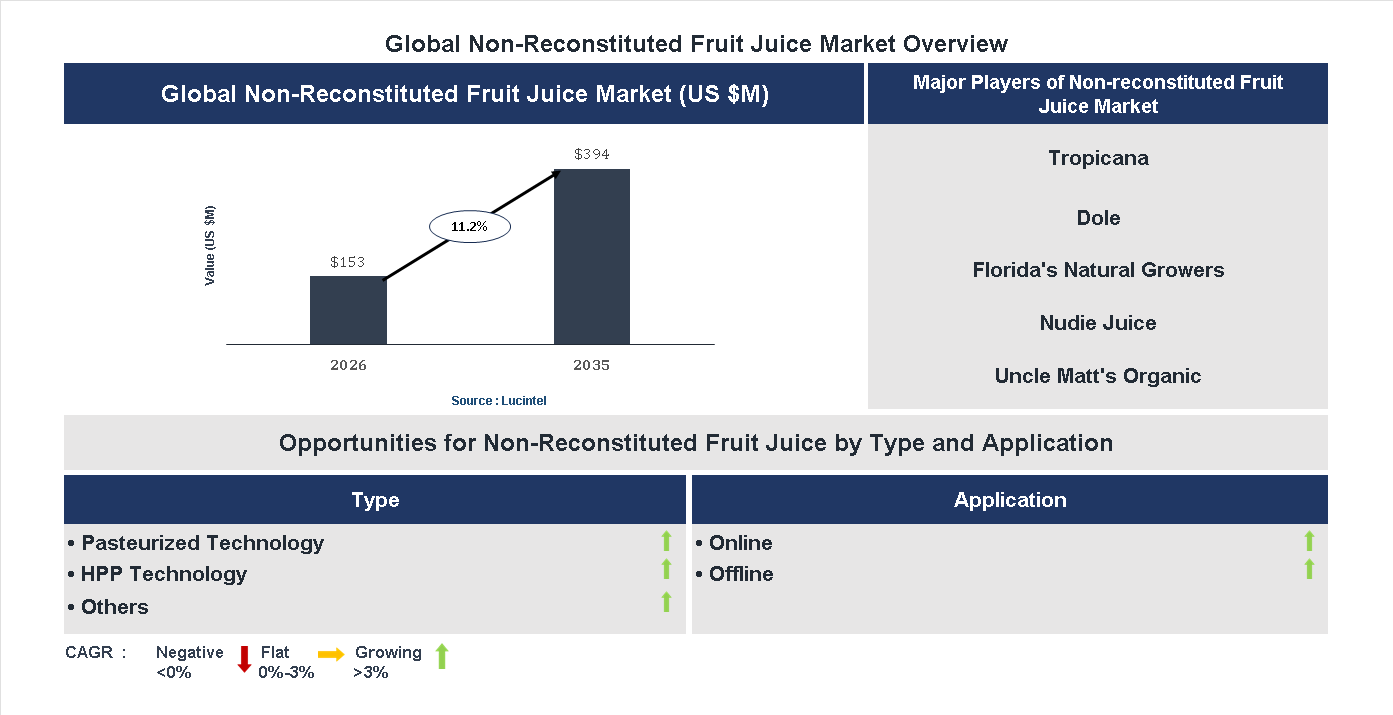
The future of the global non-reconstituted fruit juice market looks promising with opportunities in the online and offline markets. The global non-reconstituted fruit juice market is expected to reach an estimated $394 million by 2035 with a CAGR of 11.2% from 2026 to 2035. The major drivers for this market are the increasing demand for natural juice products, the rising preference for healthy beverage options, and the growing focus on clean-label fruit juices.• Lucintel forecasts that, within the type category, HPP technology is expected to witness higher growth over the forecast period.
• Within the application category, online is expected to witness higher growth.
• In terms of region, APAC is expected to witness the highest growth over the forecast period. Gain valuable insights for your business decisions with our comprehensive 150+ page report. Sample figures with some insights are shown below.
Emerging Trends in the Non-Reconstituted Fruit Juice Market
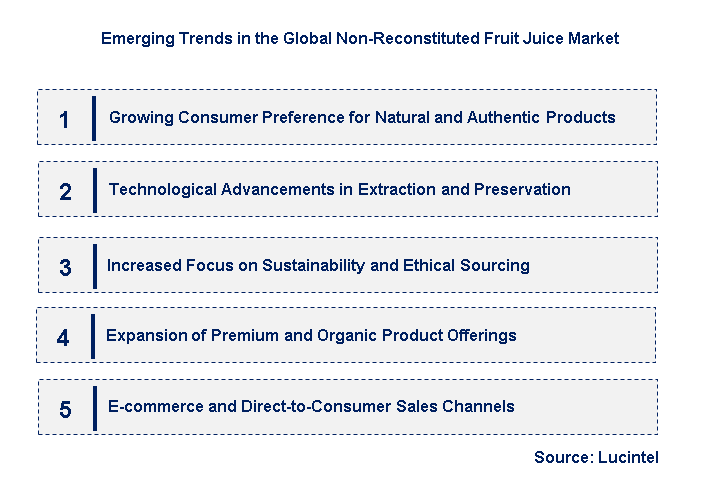
The non-reconstituted fruit juice market is experiencing a significant transformation driven by consumer preferences for natural, authentic, and minimally processed products. As health consciousness rises and technological advancements improve production methods, the industry is adapting to meet these evolving demands. Market players are focusing on innovation, sustainability, and transparency to differentiate themselves. These trends are not only shaping product offerings but also influencing marketing strategies and supply chain practices. Understanding these emerging trends is crucial for stakeholders aiming to capitalize on growth opportunities and stay competitive in this dynamic landscape.• Growing Consumer Preference for Natural and Authentic Products: Consumers are increasingly seeking non-reconstituted fruit juices that are perceived as more natural and authentic. This trend is driven by health concerns, a desire for transparency, and skepticism towards artificial additives. As a result, brands are emphasizing the use of whole, minimally processed fruits and avoiding artificial preservatives or flavorings. This shift is encouraging manufacturers to source high-quality, fresh fruits and adopt transparent labeling practices, which enhances consumer trust and loyalty.
• Technological Advancements in Extraction and Preservation: Innovations in extraction, pasteurization, and packaging technologies are enabling producers to maintain the freshness, flavor, and nutritional value of non-reconstituted juices. Techniques such as cold-pressing and high-pressure processing (HPP) help preserve natural enzymes and vitamins without the need for artificial preservatives. These advancements extend shelf life while maintaining product integrity, allowing brands to offer premium, minimally processed juices that appeal to health-conscious consumers and open new market segments.
• Increased Focus on Sustainability and Ethical Sourcing: Sustainability is becoming a key differentiator in the non-reconstituted fruit juice market. Consumers are demanding ethically sourced ingredients, environmentally friendly packaging, and sustainable production practices. Companies are adopting eco-friendly packaging solutions, reducing carbon footprints, and establishing fair-trade partnerships with fruit growers. This focus not only aligns with consumer values but also enhances brand reputation, fosters customer loyalty, and meets regulatory requirements, ultimately driving market growth through responsible business practices.
• Expansion of Premium and Organic Product Offerings: The demand for organic and premium non-reconstituted fruit juices is rising rapidly. Consumers are willing to pay a premium for products that guarantee purity, organic certification, and superior taste. This trend encourages brands to develop specialized product lines, such as cold-pressed, single-origin, or exotic fruit juices, catering to niche markets. The growth of organic certifications and premium branding strategies is helping companies differentiate themselves and capture higher profit margins in a competitive landscape.
• E-commerce and Direct-to-Consumer Sales Channels: The rise of e-commerce platforms and direct-to-consumer (DTC) models is transforming distribution strategies in the non-reconstituted fruit juice market. Online sales offer convenience, wider reach, and personalized marketing opportunities. Brands are leveraging digital channels to educate consumers about product benefits, share transparency stories, and build brand loyalty. This trend also facilitates smaller, artisanal producers to access broader markets without traditional retail constraints, fostering innovation and increasing market accessibility for high-quality, non-reconstituted juices. These emerging trends are reshaping the non-reconstituted fruit juice market by emphasizing natural authenticity, technological innovation, sustainability, premiumization, and digital engagement. Collectively, they are driving product differentiation, enhancing consumer trust, and expanding market opportunities, ultimately fostering a more transparent, sustainable, and consumer-centric industry landscape.
Recent Development in the Non-Reconstituted Fruit Juice Market
The non-reconstituted fruit juice market is experiencing rapid growth driven by consumer demand for natural, authentic, and minimally processed beverages. Innovations in sourcing, packaging, and marketing are expanding market reach globally. Increasing health consciousness and preference for premium products are also fueling this trend. Companies are investing in sustainable practices and new product lines to meet evolving consumer expectations. These developments are reshaping the industry landscape, creating new opportunities for growth and competition.• Growing Consumer Preference for Natural Products: Consumers increasingly seek authentic, minimally processed fruit juices, driving demand for non-reconstituted options. This shift is influenced by health awareness and skepticism towards artificial additives, prompting brands to emphasize purity and natural sourcing. As a result, market players are investing in transparent labeling and organic certifications to attract health-conscious buyers. This trend enhances brand loyalty and opens new premium segments, significantly expanding market size and encouraging innovation in product offerings.
• Advancements in Sourcing and Supply Chain Transparency: Improved sourcing practices and supply chain transparency are boosting consumer confidence in non-reconstituted fruit juices. Companies are establishing direct relationships with local farmers and adopting traceability technologies to ensure quality and authenticity. These efforts reduce contamination risks and enhance product credibility. As transparency becomes a key differentiator, brands gain competitive advantage, leading to increased consumer trust and market share. This development also encourages sustainable farming practices, positively impacting the environment and supply stability.
• Innovation in Packaging Technologies: New packaging solutions are enhancing product freshness, convenience, and shelf life for non-reconstituted fruit juices. Innovations such as eco-friendly bottles, lightweight materials, and smart packaging with freshness indicators are gaining popularity. These advancements improve consumer experience and reduce environmental impact, aligning with sustainability goals. Enhanced packaging also facilitates easier transportation and storage, expanding distribution channels. Consequently, companies can reach wider markets, boost sales, and strengthen brand positioning in a competitive landscape.
• Expansion into Emerging Markets: Non-reconstituted fruit juice companies are increasingly targeting emerging markets with rising disposable incomes and health awareness. Local partnerships, tailored marketing strategies, and affordable pricing are key to capturing these markets. This expansion offers significant growth opportunities due to increasing urbanization and demand for premium beverages. It also helps diversify revenue streams and reduce dependence on mature markets. As a result, companies are establishing regional manufacturing hubs and customizing products to meet local tastes, fostering long-term market penetration and growth.
• Focus on Sustainability and Ethical Practices: Sustainability initiatives, including eco-friendly sourcing, biodegradable packaging, and fair trade practices, are becoming central to industry growth. Consumers are more inclined to support brands committed to environmental and social responsibility. Companies adopting these practices enhance their brand image and meet regulatory standards, reducing risks. This focus encourages innovation in sustainable agriculture and packaging, creating a positive market perception. Overall, sustainability efforts are driving consumer loyalty, opening new market segments, and fostering industry resilience. The overall impact of these developments is a dynamic, consumer-driven market characterized by innovation, sustainability, and expanding global reach. Companies are better positioned to meet evolving preferences, resulting in increased sales, brand loyalty, and competitive advantage. These opportunities are fostering industry growth, encouraging sustainable practices, and opening new markets, ultimately shaping a resilient and forward-looking non-reconstituted fruit juice industry.
Strategic Growth Opportunities in the Non-Reconstituted Fruit Juice Market
The non-reconstituted fruit juice market is experiencing significant growth driven by consumer demand for natural, authentic, and minimally processed beverages. Increasing health consciousness, preference for premium products, and a shift towards clean-label ingredients are fueling market expansion. Innovations in packaging and flavor profiles, along with expanding distribution channels, are further enhancing market opportunities. Companies are focusing on sustainable sourcing and organic options to meet evolving consumer preferences, creating a dynamic landscape for growth across various applications and regions.• Growing Consumer Preference for Natural and Authentic Juices: Consumers are increasingly seeking non-reconstituted fruit juices due to their perceived health benefits and natural flavor profiles. This trend is driven by a desire for minimally processed, preservative-free beverages that retain the original taste and nutritional value of fruits. As awareness about artificial additives rises, demand for pure, authentic juices is expanding, encouraging producers to focus on sourcing high-quality, fresh fruits and maintaining transparency about ingredient origins.
• Expansion of Premium and Organic Juice Offerings: The market is witnessing a surge in premium and organic non-reconstituted fruit juices, driven by health-conscious consumers willing to pay more for quality and sustainability. Organic certification and eco-friendly practices are becoming key differentiators. Brands are investing in organic farming partnerships and advanced processing techniques to ensure product purity. This segment appeals to niche markets and supports brand loyalty, fostering growth in both retail and horoeka channels.
• Innovation in Packaging and Convenience Formats: Advances in packaging technology are making non-reconstituted fruit juices more convenient and appealing. Single-serve bottles, eco-friendly cartons, and resealable pouches cater to on-the-go lifestyles. Innovative packaging also helps preserve freshness and nutritional content, extending shelf life. These developments attract busy consumers and expand accessibility, especially in emerging markets. Enhanced packaging design and functionality are critical for differentiating products and increasing market penetration.
• Increasing Distribution Channels and Market Penetration: The expansion of distribution networks, including online platforms, convenience stores, and specialty outlets, is broadening access to non-reconstituted fruit juices. E-commerce sales are rising, driven by consumer preference for home delivery and digital shopping. Strategic partnerships with supermarkets and horoeka establishments are also boosting visibility. This increased accessibility supports market growth, especially in developing regions, and helps brands reach a wider consumer base with diverse preferences.
• Focus on Sustainability and Ethical Sourcing Practices: Sustainability initiatives are becoming central to market growth, with companies emphasizing eco-friendly farming, water conservation, and fair trade practices. Consumers are increasingly valuing brands that demonstrate environmental responsibility and ethical sourcing. Implementing sustainable practices enhances brand reputation and meets regulatory standards. This focus encourages innovation in sourcing, packaging, and production processes, fostering long-term growth and aligning with global sustainability goals. Overall, these growth opportunities are shaping a robust future for the non-reconstituted fruit juice market, driven by consumer preferences for authenticity, quality, convenience, and sustainability. Companies that capitalize on these trends through innovation and strategic expansion will be well-positioned to capture market share and meet evolving demands across regions and applications.
Non-Reconstituted Fruit Juice Market Driver and Challenges
The non-reconstituted fruit juice market is influenced by a variety of technological, economic, and regulatory factors that shape its growth and development. Technological advancements in extraction and preservation techniques enhance product quality and shelf life, attracting consumers seeking natural and fresh options. Economic factors such as rising disposable incomes and changing consumer preferences towards healthier lifestyles drive demand. Regulatory frameworks concerning food safety, labeling, and quality standards ensure consumer protection and influence market practices. Additionally, environmental concerns and sustainability initiatives impact sourcing and production methods. These diverse drivers and challenges collectively determine the markets trajectory, requiring stakeholders to adapt strategies to capitalize on opportunities while addressing potential hurdles. The factors responsible for driving the non-reconstituted fruit juice market include:• Technological Innovation: The development of advanced extraction, pasteurization, and packaging technologies has significantly improved the quality, flavor retention, and shelf life of non-reconstituted fruit juices. These innovations enable producers to deliver fresh, natural products that meet consumer expectations for health and authenticity. Enhanced processing methods also reduce waste and energy consumption, making production more sustainable. As technology continues to evolve, it opens new avenues for product differentiation and expansion into emerging markets. The ability to maintain fruit integrity and nutritional value is crucial for gaining competitive advantage and satisfying health-conscious consumers.
• Rising Consumer Health Awareness: Increasing awareness about the health benefits of natural and organic products is a major driver. Consumers are shifting away from processed and artificial beverages towards fresh, preservative-free options. This trend is fueled by a growing interest in wellness, fitness, and preventive healthcare. As a result, demand for non-reconstituted fruit juices, which are perceived as more natural and nutritious, is rising globally. This shift influences product development, marketing strategies, and retail distribution, encouraging brands to emphasize purity, origin, and health benefits to attract discerning customers.
• Economic Growth and Disposable Income: Economic development in emerging markets has led to higher disposable incomes, enabling consumers to spend more on premium and natural food products. As income levels rise, consumers are willing to pay a premium for high-quality, fresh, and organic fruit juices. This economic trend supports market expansion, especially in developing regions where demand for healthy beverages is increasing. Additionally, urbanization and changing lifestyles contribute to greater consumption of convenient, ready-to-drink non-reconstituted fruit juices, further boosting market growth.
• Regulatory and Food Safety Standards: Stringent regulations regarding food safety, labeling, and quality assurance influence the market landscape. Governments and international bodies enforce standards to ensure product authenticity, prevent adulteration, and protect consumer health. Compliance with these regulations can increase production costs but also enhances brand credibility and consumer trust. Companies investing in quality assurance and transparent labeling can differentiate themselves in a competitive market. Regulatory frameworks also encourage sustainable sourcing and environmentally friendly practices, aligning industry growth with social responsibility.
• Expansion of Distribution Channels: The growth of modern retail formats, e-commerce platforms, and direct-to-consumer channels has expanded access to non-reconstituted fruit juices. Retail chains, supermarkets, and online stores provide wider reach and convenience, boosting sales. Innovative distribution strategies, including subscription services and regional supply networks, facilitate market penetration in rural and underserved areas. This expansion supports brand visibility and consumer engagement, enabling producers to meet increasing demand efficiently. As distribution channels evolve, they play a vital role in shaping market dynamics and ensuring product availability across diverse consumer segments. The challenges facing the non-reconstituted fruit juice market include:
• High Production Costs: Producing non-reconstituted fruit juices involves sourcing high-quality, fresh fruits, which can be costly due to seasonal variations, supply chain complexities, and quality standards. Additionally, advanced processing technologies and stringent quality controls add to operational expenses. These high costs can limit profit margins and make it difficult for smaller producers to compete with larger, established brands. Fluctuations in raw material prices and logistical challenges further exacerbate cost pressures, impacting pricing strategies and market competitiveness.
• Supply Chain Disruptions: The reliance on fresh fruit supplies makes the market vulnerable to seasonal fluctuations, weather conditions, and geopolitical issues that can disrupt sourcing and distribution. Such disruptions lead to shortages, increased costs, and delays in product availability. Maintaining a consistent supply of high-quality raw materials is critical for brand reputation and customer satisfaction. Supply chain vulnerabilities also hinder scalability and expansion efforts, especially in emerging markets where infrastructure may be less developed.
• Regulatory Compliance and Labeling Challenges: Navigating complex regulatory environments across different regions poses significant challenges. Variations in standards related to organic certification, labeling, and safety requirements demand substantial compliance efforts and costs. Failure to meet these standards can result in legal penalties, product recalls, and damage to brand reputation. Additionally, transparency demands from consumers for clear labeling and origin information require ongoing monitoring and adaptation, increasing operational complexity and costs for producers. The non-reconstituted fruit juice market is shaped by technological advancements, health-conscious consumer trends, economic growth, regulatory standards, and distribution expansion. While these drivers foster growth and innovation, challenges such as high production costs, supply chain vulnerabilities, and regulatory complexities pose significant hurdles. The overall market outlook depends on how effectively industry players can leverage opportunities while mitigating risks. Strategic investments in technology, sustainable sourcing, and compliance will be essential for sustained growth and competitive advantage in this evolving landscape.
List of Non-Reconstituted Fruit Juice Companies
Companies in the market compete on the basis of product quality offered. Major players in this market focus on expanding their manufacturing facilities, R&D investments, infrastructural development, and leverage integration opportunities across the value chain. With these strategies non-reconstituted fruit juice companies cater increasing demand, ensure competitive effectiveness, develop innovative products & technologies, reduce production costs, and expand their customer base. Some of the non-reconstituted fruit juice companies profiled in this report include-• Tropicana
• Dole
• Floridas Natural Growers
• Nudie Juice
• Uncle Matts Organic
• Langer Juice
• Lakewood Organic
• Rauch Juice Bar
• Juice Press
• Eckes-Granini Group
Non-Reconstituted Fruit Juice Market by Segment
The study includes a forecast for the global non-reconstituted fruit juice market by type, application, and region.Non-Reconstituted Fruit Juice Market by Type [Value from 2019 to 2035]:
• Pasteurized Technology
• HPP Technology
• Others
Non-Reconstituted Fruit Juice Market by Application [Value from 2019 to 2035]:
• Online
• Offline
Non-Reconstituted Fruit Juice Market by Region [Value from 2019 to 2035]:
• North America
• Europe
• Asia Pacific
• The Rest of the World
Country Wise Outlook for the Non-Reconstituted Fruit Juice Market
The non-reconstituted fruit juice market has experienced significant shifts globally, driven by consumer preferences for natural, minimally processed products and increasing health awareness. Technological innovations, regulatory changes, and supply chain adjustments have also influenced market dynamics across major economies. These developments reflect a broader trend towards transparency, sustainability, and premiumization in beverage choices, impacting production, marketing, and distribution strategies worldwide. As consumers become more discerning, companies are investing in quality assurance, organic options, and innovative packaging to meet evolving demands. The following summarizes recent key developments in this market for the United States, China, Germany, India, and Japan.• United States: The US market has seen a surge in organic and cold-pressed non-reconstituted fruit juices, driven by health-conscious consumers. Major brands are expanding their product lines to include single-origin and minimally processed options. Regulatory agencies are tightening labeling standards to ensure transparency, boosting consumer trust. E-commerce sales have grown substantially, facilitating direct-to-consumer sales channels. Sustainability initiatives, such as eco-friendly packaging and responsible sourcing, are gaining prominence among industry players. Additionally, functional juices with added health benefits are becoming increasingly popular.
• China: The Chinese market is experiencing rapid growth in premium, non-reconstituted fruit juices, fueled by rising disposable incomes and urbanization. Domestic brands are investing in quality improvements and branding to compete with imported products. There is a growing demand for organic and natural options, with consumers seeking transparency about sourcing and processing. E-commerce platforms and social media marketing are vital for reaching younger consumers. Regulatory frameworks are evolving to enhance product safety and quality standards. Local fruit varieties are being promoted to differentiate products and cater to health-conscious buyers.
• Germany: Germanys market emphasizes organic certification and sustainability, with consumers favoring locally sourced, minimally processed juices. Innovations in packaging, such as recyclable bottles and eco-friendly cartons, are prevalent. The demand for single-origin and artisanal juices is rising, reflecting a preference for transparency and quality. Regulatory standards are strict, ensuring high safety and labeling accuracy. The market also sees growth in functional juices, including those with added vitamins and probiotics. Retailers are increasingly offering premium and niche products to cater to discerning customers.
• India: The Indian market is witnessing a shift towards non-reconstituted fruit juices as consumers seek healthier alternatives to traditional beverages. Urban middle-class populations are driving demand for premium, natural, and organic options. Local fruit varieties are gaining popularity, and brands are emphasizing purity and authenticity. E-commerce and modern retail outlets are expanding access to these products. Regulatory measures are being strengthened to improve quality standards and reduce adulteration. There is also a rising trend of small-scale, artisanal juice producers entering the market, offering unique flavors and traditional recipes.
• Japan: Japans market is characterized by a focus on health and wellness, with consumers favoring minimally processed, non-reconstituted fruit juices. Functional beverages with added health benefits, such as antioxidants and vitamins, are in high demand. Innovative packaging solutions, including lightweight and eco-friendly designs, are common. The market is also influenced by a preference for domestically sourced ingredients and transparency about processing methods. Regulatory standards are rigorous, ensuring product safety and quality. The popularity of premium and artisanal juices continues to grow, supported by a strong culture of health-conscious consumption and sustainability.

Features of the Global Non-Reconstituted Fruit Juice Market
Market Size Estimates: Non-reconstituted fruit juice market size estimation in terms of value ($M). Trend and Forecast Analysis: Market trends (2019 to 2025) and forecast (2026 to 2035) by various segments and regions. Segmentation Analysis: Non-reconstituted fruit juice market size by type, application, and region in terms of value ($M). Regional Analysis: Non-reconstituted fruit juice market breakdown by North America, Europe, Asia Pacific, and Rest of the World. Growth Opportunities: Analysis of growth opportunities in different types, applications, and regions for the non-reconstituted fruit juice market. Strategic Analysis: This includes M&A, new product development, and competitive landscape of the non-reconstituted fruit juice market. Analysis of competitive intensity of the industry based on Porter’s Five Forces model.
FAQ
Q1. What is the non-reconstituted fruit juice market size? Answer: The global non-reconstituted fruit juice market is expected to reach an estimated $394 million by 2035. Q2. What is the growth forecast for non-reconstituted fruit juice market? Answer: The global non-reconstituted fruit juice market is expected to grow with a CAGR of 11.2% from 2026 to 2035. Q3. What are the major drivers influencing the growth of the non-reconstituted fruit juice market? Answer: The major drivers for this market are the increasing demand for natural juice products, the rising preference for healthy beverage options, and the growing focus on clean-label fruit juices. Q4. What are the major segments for non-reconstituted fruit juice market? Answer: The future of the non-reconstituted fruit juice market looks promising with opportunities in the online and offline markets. Q5. Who are the key non-reconstituted fruit juice market companies? Answer: Some of the key non-reconstituted fruit juice companies are as follows:• Tropicana
• Dole
• Floridas Natural Growers
• Nudie Juice
• Uncle Matts Organic
• Langer Juice
• Lakewood Organic
• Rauch Juice Bar
• Juice Press
• Eckes-Granini Group Q6. Which non-reconstituted fruit juice market segment will be the largest in future? Answer: Lucintel forecasts that, within the type category, HPP technology is expected to witness higher growth over the forecast period. Q7. In non-reconstituted fruit juice market, which region is expected to be the largest in next 5 years? Answer: In terms of region, APAC is expected to witness the highest growth over the forecast period. Q8. Do we receive customization in this report? Answer: Yes, Lucintel provides 10% customization without any additional cost.
Table of Contents
List of Figures
List of Tables
Methodology
- In-depth interviews of the major players in this market
- Detailed secondary research from competitors’ financial statements and published data
- Extensive searches of published works, market, and database information pertaining to industry news, company press releases, and customer intentions
- A compilation of the experiences, judgments, and insights of Lucintel’s professionals, who have analyzed and tracked this market over the years.


Buy Now
Choose a license that fits your team. Instant PDF delivery.
Prices exclude taxes. Instant delivery. Custom licensing available on request.
Key Questions
- • What are some of the most promising, high-growth opportunities for the non-reconstituted fruit juice market by type (pasteurized technology, HPP technology, and others), application (online and offline), and region (North America, Europe, Asia Pacific, and the Rest of the World)?
- • Which segments will grow at a faster pace and why?
- • Which region will grow at a faster pace and why?
- • What are the key factors affecting market dynamics? What are the key challenges and business risks in this market?
- • What are the business risks and competitive threats in this market?
- • What are the emerging trends in this market and the reasons behind them?
- • What are some of the changing demands of customers in the market?
- • What are the new developments in the market? Which companies are leading these developments?
- • Who are the major players in this market? What strategic initiatives are key players pursuing for business growth?
- • What are some of the competing products in this market and how big of a threat do they pose for loss of market share by material or product substitution?
- • What M&A activity has occurred in the last 7 years and what has its impact been on the industry? For any questions related to Non-Reconstituted Fruit Juice Market, Non-Reconstituted Fruit Juice Market Size, Non-Reconstituted Fruit Juice Market Growth, Non-Reconstituted Fruit Juice Market Analysis, Non-Reconstituted Fruit Juice Market Report, Non-Reconstituted Fruit Juice Market Share, Non-Reconstituted Fruit Juice Market Trends, Non-Reconstituted Fruit Juice Market Forecast, Non-Reconstituted Fruit Juice Companies, write Lucintel analyst at email: helpdesk@lucintel.com. We will be glad to get back to you soon.


