
Market Report · July 29, 2026

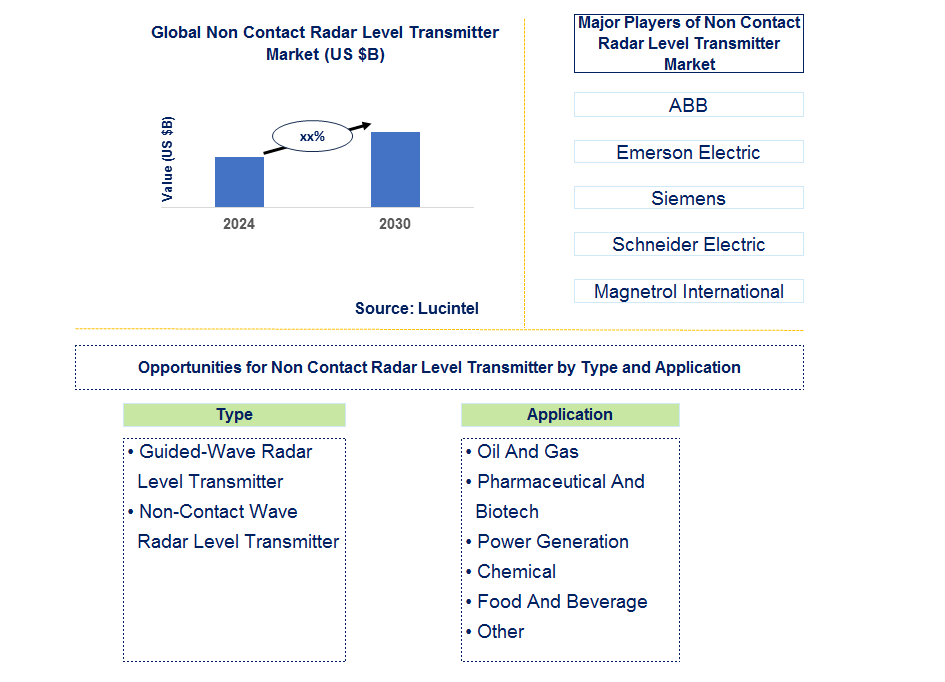
Key data points: The growth forecast = 7.2% annually for the next 6 years. Scroll below to get more insights. This market report covers trends, opportunities, and forecasts in the global non contact radar level transmitter market to 2030 by type (guided-wave radar level transmitter and non-contact wave radar level transmitter), application (oil and gas, pharmaceutical and biotech, power generation, chemical, food and beverage, and other), and region (North America, Europe, Asia Pacific, and the Rest of the World)
We'll send your sample report shortly.
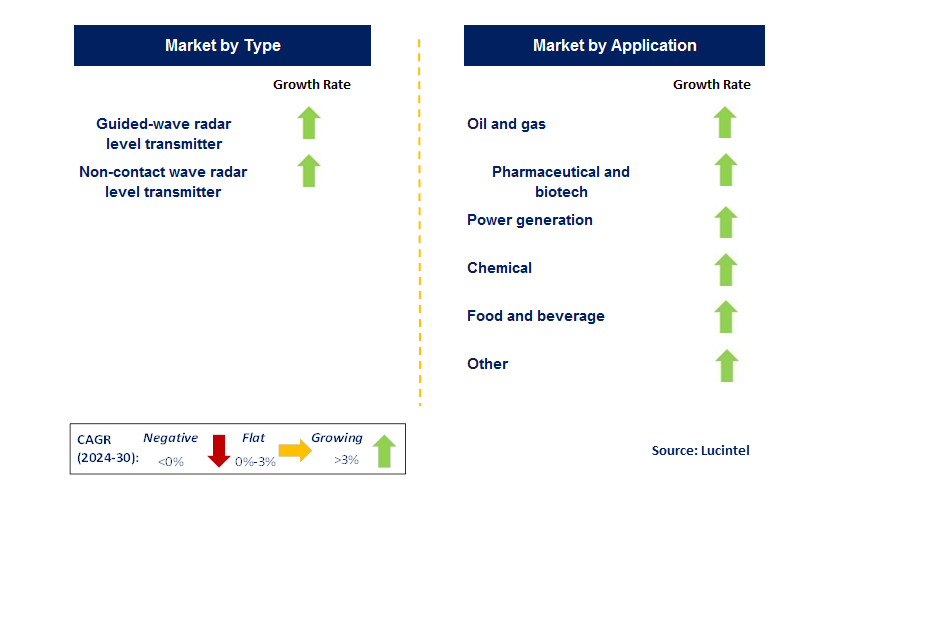
• Lucintel forecasts that within the type category, non-contact wave radar level transmitter is expected to witness a higher growth over the forecast period due to improvements in antenna design and signal processing are enhancing accuracy and reducing susceptibility to interference.
• Within the application category, oil and gas will remain the largest segment due to its reliance on reliable and accurate level measurement in tanks, pipelines, and storage facilities.
• In terms of region, APAC will remain the largest region over the forecast period due to increased investment in infrastructure development, industrial automation, and manufacturing and this fuels demand for non-contact radar level transmitters in various industries. Gain valuable insights for your business decisions with our comprehensive 150+ page report. A more than 150-page report is developed to help in your business decisions.
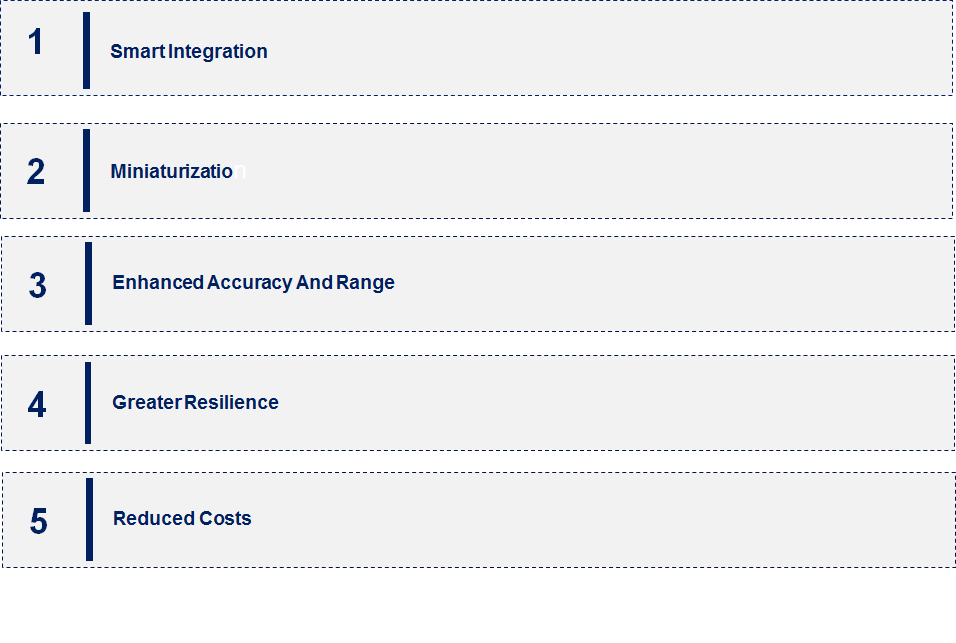
• Smart Integration: Increasingly, non-contact radar level transmitters are being linked to smart technologies and Internet of Things (IoT) platforms. Real-time data monitoring and sophisticated analytics can be conducted using this approach thereby enhancing operational efficiency through predictive maintenance.
• Miniaturization: A move towards downsizing has been occasioned by demand for smaller more compact transmitters given modern industrial settings whereby space is at premium. This helps in applications where space is limited but still maintains performance standards.
• Enhanced Accuracy And Range: Developments in radar technology have improved measurement range as well as accuracy of non-contact transmitters. For instance, these changes matter to industries that need extremely precise measurements like those dealing with chemicals or pharmaceuticals.
• Greater Resilience: Transmitters are now stronger because of the use of new materials and design improvements, particularly in harsh operating conditions. The capacity to withstand extreme temperatures, pressures or corrosive substances is increasingly becoming a major selling point.
• Reduced Costs: Technological advancements and more efficient manufacturing processes have decreased the costs. Therefore, non-contact radar level transmitters are becoming more economical for a broader range of industries and applications on this trend. These trends will lead to improved functionality, accuracy as well as lower costs in non-contact radar level transmitters thus reshaping the market. This implies that manufacturers are moving towards smarter solutions that can adapt to different industries’ needs.
• Advanced Signal Processing: Improved performance under complex conditions has been made possible through enhanced algorithms as well as digital signal processing techniques resulting from innovations in signal processing technology used for non-contact radar level transmitters.
• Integration with IoT: One of the main achievements is inclusion of Internet of Things (IoT) platforms which support real-time monitoring as well as data analytics using there by connecting the devices concerned for predictive maintenance purposes towards improving industrial efficiency.
• Increased Durability: For instance, new designs coupled with materials employed on these devices have led to their robustness hence making them suitable for extreme environments like oil fields where such equipment is exposed to tough conditions.
• Cost Efficiency : Current optimization techniques employed in production processes have led to lower prices charged on noncontacting liquid-level gauge radars, which makes them affordable to more industries than ever before.
• Statutory Compliance: FMEDA results in the improvement of the transmitter designs and their performance. It ensures safety and dependability across various industries that operate under tight regulations. These recent developments include non-contact radar level transmitters that are more accurate, connected and cost-effective. This is a move towards sophisticated solutions which serve diverse sectors with different requirements.
• Industrial Automation: The current industrial revolution is leading to growth in industrial automation through Industry 4.0 push; hence enhancing its development of noncontacting liquid-level gauge radars. They contribute by facilitating accurate measurement as well as data amalgamation for better control over manufacturing processes within automated systems.
• Energy Sector: The use of non-contacting liquid-level gauge radars has been growing steadily in energy sector like oil & gas due to their durability and accuracy. Improving precision measurements of liquids and solids under difficult conditions represent an opportunity area for further development of such products there.
• Water and Wastewater Management: Non-contact radar transmitters are particularly suitable for application in the water and wastewater management. Their ability to work in various conditions makes them dependable for checking water levels in treatment plants.
• Food and Beverage Industry: The need for hygiene and accuracy causes growth opportunities in the food and beverage industry. They are becoming popular because of their ability to accommodate different product densities as well as maintaining cleanliness.
• Pharmaceuticals: The pharmaceutical sector needs accurate level measurement and this is why they rely on non-contact radar level transmitters. These devices meet manufacturing demands through compliance, accuracy, and consistency. These strategic growth opportunities are making the non-contact radar level transmitter market expand. Through addressing specific industry’s needs and capitalizing on technological advancements, firms can tap emerging trends for increased market share.
• Technological Advancements: Developments such as signal processing technologies, smart integration materials used among others have fueled growth in noncontact transmitters that use radar technology. Subsequently, performance improvements will be realized within this segment over time.
• Increasing Demand for Automation: There has been an increase in demand for non-contact radar level transmitters due to industrial automation gains together with IoT adoption rates associated with it because they provide real-time data as well as high precision measurements which enable efficient processing systems where user experience plays a large role too during decision-making processes at any given moment when using such tools.
• Growing Industrial Applications: The expansion of industries such as energy, water management and healthcare is driving the need for reliable and robust level measurement. This has triggered an increased use of non-contact radar transmitters in the different industry sectors.
• Cost Reduction Initiatives: Improvements in manufacturing processes and materials have reduced the price of non-contact radar level transmitters. These innovations are making this technology affordable to a wider range of applications and industries.
• Regulatory Compliance: As regulations tighten around the world, more companies are being forced to use advanced measurement technologies that comply with these new laws. Non-contact radar transmitters are evolving with time to keep up with these stringent rules. Challenges in the non contact radar level transmitter market are:
• High Initial Costs: In some instances, there may be high upfront costs related to buying non-contact measuring devices hence discouraging customers because they cannot afford it especially those involved in low-cost industries that must recoup their investments over time through savings made cost-wise.
• Market Competition: A large number of players have come up in the market whereby many products are offered by them posing challenges on how to differentiate among them based on performance levels or customer support services provided; this where features like technological advancements can serve as determining factors while choosing one’s own supplier since they would want somebody who could go extra mile when supporting their needs rather than just provide basic requirements such as quality control measures taken without any proactive involvement – meaning only focusing only at what was specified rather thinking about possible future innovations needed by customer until there is no reason not doing so because competition demands it!
• Technological Complexity: Some installations require complex systems when dealing with noncontact radar transmitter technologies which results into unnecessary complexity in terms installation and maintenance hence a lot of attention should be paid here by ensuring ease-of-use coupled adequate support programs without which customers won’t find appropriate technical assistance giving rise our own challenge again – now we must either start from scratch requiring massive resources going back all way down road until things become clearer or else try something different but equally challenging like making sure that people who are actually responsible for this at every stage where they work together receive correct information right from beginning such as those obtained through internal sources within company itself so as minimize confusion arising due miscommunication among various parties involved into particular project including engineers. Major drivers and challenges that affect the non-contact radar level transmitter market demonstrate a dynamic environment characterized by technology innovation, market demand, and competitive pressure. Addressing these aspects is crucial to ensure progress and growth of the industry.
• ABB
• Emerson Electric
• Siemens
• Schneider Electric
• Magnetrol International
• Guided-Wave Radar Level Transmitter
• Non-Contact Wave Radar Level Transmitter
• Oil and Gas
• Pharmaceutical and Biotech
• Power Generation
• Chemical
• Food and Beverage
• Other
• North America
• Europe
• Asia Pacific
• The Rest of the World
• United States: In the US, there has been an increase in the adoption levels of non-contact radar level transmitters due to advancement in industrial automation as well as IoT inclusion. Enhancing connectivity features together with data analytics capability is what smart technologies aim at thus improving operational efficiency as well as predictive maintenance by the biggest players.
• China: China is increasingly focused on lowering costs and achieving better product performance. Local manufacturers are incorporating new materials into their products using novel production processes to keep them competitive priced. Government initiatives aimed at promoting industrial upgrading have led to rapid growth in applications of radar technologies especially within manufacturing and energy industries.
• Germany: The German market values precision above all else which has created a push towards this direction. Some recent developments include complex signal processing algorithms as well as compatibility with Industry 4.0 requirements among others. But it’s not just about meeting stringent European Union regulations but also the need to innovate without affecting quality or reliability.
• India: India is expanding its non-contact radar level transmitter market by focusing on localization and cost saving measures. In the past, there have been various technological advancements aimed at improving performance within harsh environments like high temperature or pressure.
• Japan: Japan continues to lead in technological advancements with a focus on miniaturization and integration with advanced control systems. Recent developments include compact and highly accurate transmitters that are used for precise industries such as electronics and pharmaceuticals.


• ABB
• Emerson Electric
• Siemens
• Schneider Electric
• Magnetrol International Q5. Which non contact radar level transmitter market segment will be the largest in future? Answer: Lucintel forecasts that non-contact wave radar level transmitter is expected to witness the higher growth over the forecast period due to improvements in antenna design and signal processing are enhancing accuracy and reducing susceptibility to interference.
• Nikon
• Sony
• Canon
• Bushnell
• Nikon Q6. In non contact radar level transmitter market, which region is expected to be the largest in next 5 years? Answer: APAC will remain the largest region over the forecast period due to increased investment in infrastructure development, industrial automation, and manufacturing and this fuels demand for non-contact radar level transmitters in various industries. Q.7 Do we receive customization in this report? Answer: Yes, Lucintel provides 10% customization without any additional cost.


Choose a license that fits your team. Instant PDF delivery.
Prices exclude taxes. Instant delivery. Custom licensing available on request.
Market Report · July 29, 2026
Market Report · July 20, 2026
Market Report · July 20, 2026
Trusted partner for strategic intelligence and business growth


Receive a complimentary market analysis tailored to your industry. Our analysts will identify key growth opportunities and competitive dynamics specific to your business.

Market size, growth rate, and key trend analysis for your specific sector.

Top competitor positioning and market share analysis.

Strategic recommendations backed by data-driven insights.
Get curated market intelligence and competitive moves straight to your inbox.
By subscribing, you agree to receive our monthly insights. Unsubscribe anytime.
Receive a complimentary market analysis tailored to your industry. Our analysts will identify key growth opportunities and competitive dynamics specific to your business.
Market size, growth rate, and key trend analysis for your specific sector.
Top competitor positioning and market share analysis.
Strategic recommendations backed by data-driven insights.
Get curated market intelligence, emerging trends, and competitive moves straight to your inbox each month.
By subscribing, you agree to receive our monthly insights. Unsubscribe anytime.
We'll send your sample report shortly.