
Market Report · July 15, 2026

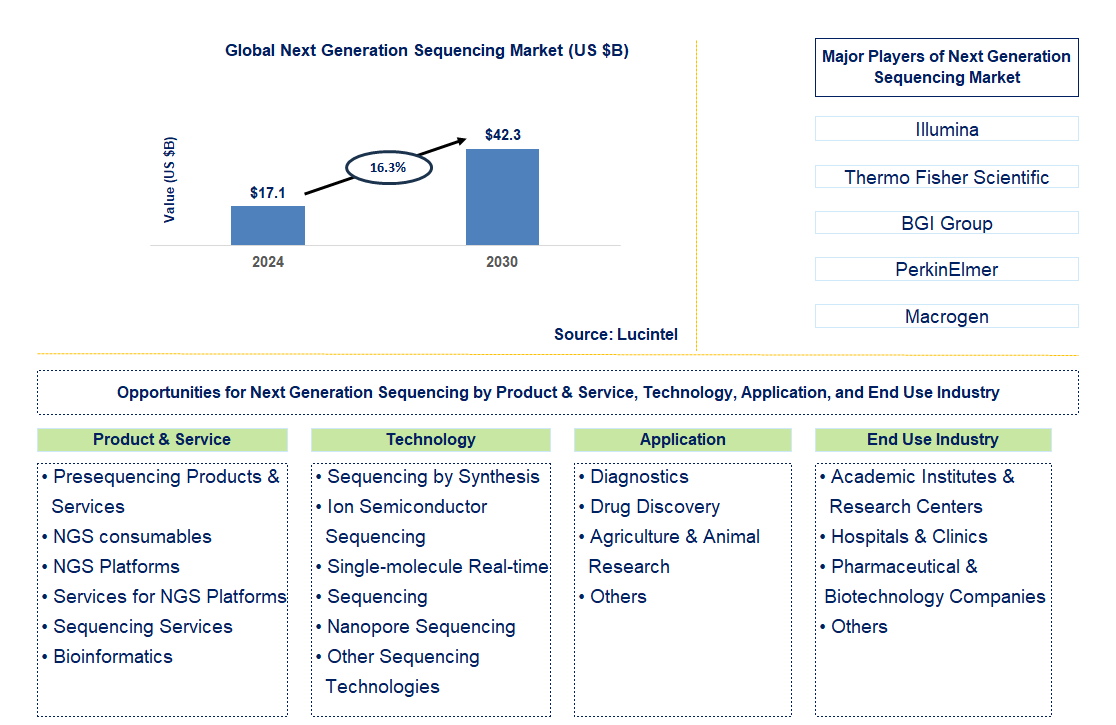
Key data points: The market size in 2030 = $42.3 billion, growth forecast = 16.3% annually for the next 6 years. Scroll below to get more insights. This market report covers trends, opportunities, and forecasts in the global next generation sequencing market to 2030 by product & service (presequencing products & services, NGS consumables, NGS platforms, services for NGS platforms, sequencing services, and bioinformatics), technology (sequencing by synthesis, ion semiconductor sequencing, single-molecule real-time sequencing, nanopore sequencing, and other sequencing technologies), application (diagnostics, drug discovery, agriculture & animal research, and others), end user (academic institutes & research centers, hospitals & clinics, pharmaceutical & biotechnology companies, and others), and region (North America, Europe, Asia Pacific, and the Rest of the World)
We'll send your sample report shortly.
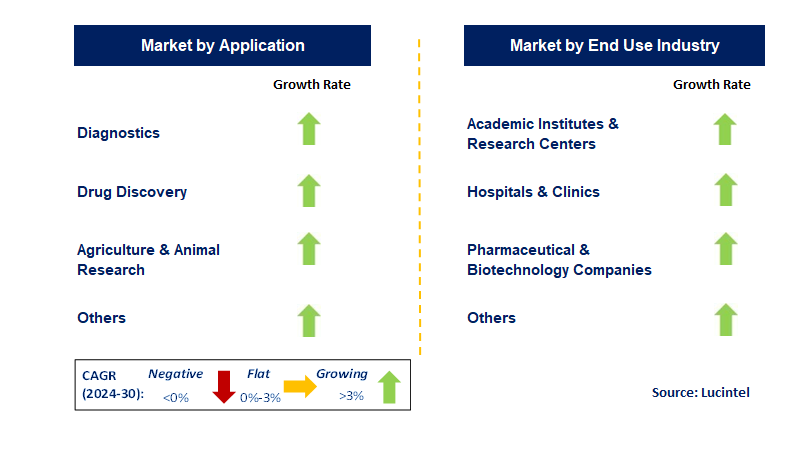
• Lucintel forecasts that, within the application category, diagnostics will remain the largest segment over the forecast period due to growing number of cancer cases across the world.
• Within the end use category, academic institutes & research centers will remain the largest segment over the forecast period because of the development of cost-effective NGS products and services for researchers and increasing collaborations between academic institutes & research centers and NGS players.
• In terms of regions, North America will remain the largest region over the forecast period due to rising investments in the research funding, and development of NGS data analysis solutions. Gain valuable insights for your business decisions with our comprehensive 150+ page report.
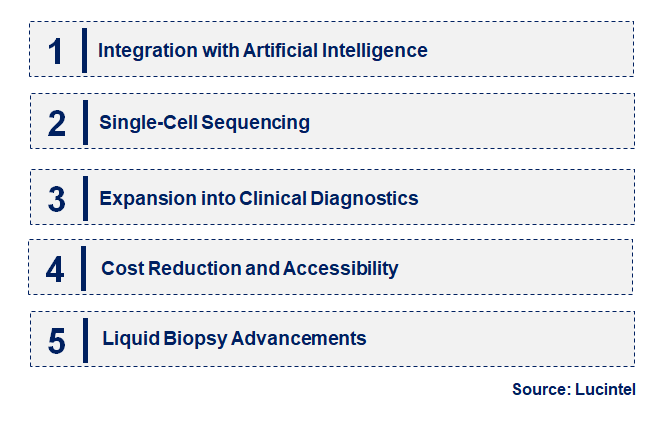
• Integration with Artificial Intelligence: The integration of AI with NGS is revolutionizing data analysis, enabling faster and more accurate interpretation of large genomic datasets. This trend is enhancing the ability to identify genetic variations, predict disease risk, and personalize treatment plans, particularly in oncology and precision medicine.
• Single-Cell Sequencing: Single-cell sequencing is emerging as a powerful tool in NGS, allowing for the analysis of individual cells' genomes and transcriptomes. This trend is providing deeper insights into cellular heterogeneity, which is crucial for understanding complex diseases like cancer and developing targeted therapies.
• Expansion into Clinical Diagnostics: NGS is increasingly being adopted in clinical diagnostics, particularly in oncology, genetic disorders, and infectious diseases. This trend is driven by advancements in sequencing accuracy, reduced costs, and the growing demand for personalized medicine, making NGS a key tool in modern healthcare.
• Cost Reduction and Accessibility: Continuous improvements in sequencing technology are driving down costs, making NGS more accessible to a broader range of researchers and clinicians. This trend is particularly significant in low-resource settings, enabling the wider adoption of NGS for public health and agricultural applications.
• Liquid Biopsy Advancements: The development of NGS-based liquid biopsy technologies is transforming non-invasive cancer diagnostics. This trend allows for the detection of circulating tumor DNA (ctDNA) in blood samples, providing a less invasive alternative to traditional biopsies and enabling real-time monitoring of cancer progression and treatment response. These emerging trends—AI integration, single-cell sequencing, clinical diagnostics expansion, cost reduction, and liquid biopsy advancements—are reshaping the NGS landscape. They are making genomic data more accessible, precise, and actionable, driving innovations across multiple fields.
• High-Throughput Sequencing: Recent developments in high-throughput sequencing have significantly increased the speed and volume of genomic data generation. This advancement allows for the sequencing of entire genomes in a fraction of the time, accelerating research and enabling large-scale genomic studies, particularly in population genomics.
• Long-Read Sequencing: Long-read sequencing technologies have seen substantial improvements, offering greater accuracy in identifying structural variants and complex genomic regions. This development is critical for studying genetic diseases, where accurate detection of large-scale genomic changes is essential for diagnosis and research.
• Targeted Sequencing Panels: The development of targeted sequencing panels has become more refined, allowing for the precise analysis of specific genomic regions associated with diseases. This advancement is particularly impactful in oncology, where targeted panels are used to identify mutations relevant to cancer treatment.
• Advancements in Bioinformatics: The integration of advanced bioinformatics tools with NGS has improved the analysis and interpretation of large genomic datasets. These developments enable more accurate identification of genetic variants, facilitating the discovery of new biomarkers and therapeutic targets in precision medicine.
• Portable Sequencing Devices: Recent innovations in portable NGS devices are making sequencing technology more accessible for fieldwork and point-of-care diagnostics. These portable devices allow for real-time genomic analysis in remote locations, expanding the use of NGS in environmental monitoring and infectious disease outbreaks. These key developments—high-throughput sequencing, long-read technologies, targeted sequencing panels, bioinformatics advancements, and portable devices—are significantly enhancing the capabilities of NGS. They are driving innovation across various fields, making genomic research more efficient and accessible.
• Oncology and Precision Medicine: The integration of NGS in oncology offers significant growth opportunities by enabling personalized treatment plans based on a patient’s genomic profile. This application is driving the adoption of NGS in clinical settings, where precise genomic data is essential for targeted therapies and improved patient outcomes.
• Population Genomics: NGS plays a crucial role in large-scale population genomics projects aimed at understanding genetic diversity and disease prevalence. Growth opportunities exist in expanding these initiatives, particularly in underrepresented populations, to develop more inclusive and effective healthcare solutions.
• Infectious Disease Surveillance: The use of NGS for pathogen surveillance and outbreak monitoring presents a significant growth area. This application is particularly relevant in the context of global health, where NGS can quickly identify and track the spread of infectious diseases, informing public health responses.
• Agricultural Genomics: NGS is increasingly used in agriculture to improve crop yields, disease resistance, and livestock breeding. Growth opportunities in this sector include the development of genomics-based solutions that address food security and sustainability challenges, particularly in response to climate change.
• Drug Development and Pharmacogenomics: NGS is becoming integral to drug development and pharmacogenomics, where genomic data is used to identify drug targets and predict patient responses to therapies. This application offers growth opportunities in the development of personalized medicines and the optimization of clinical trials. Strategic growth opportunities in oncology, population genomics, infectious disease surveillance, agricultural genomics, and drug development are driving the expansion of NGS applications. These opportunities are making NGS an essential tool across multiple sectors, enhancing its impact on global health and sustainability.
• Technological Innovation: Continuous innovation in sequencing technologies, such as faster and more accurate platforms, is driving the adoption of NGS. These advancements reduce costs and improve efficiency, making NGS more accessible and valuable across various applications, including clinical diagnostics and research.
• Rising Demand for Precision Medicine: The growing demand for personalized healthcare solutions is a significant driver of NGS adoption. Precision medicine relies on detailed genomic information to tailor treatments to individual patients, making NGS a critical tool in oncology, genetic disorders, and pharmacogenomics.
• Expansion of Genomic Research: The expansion of genomic research initiatives, particularly in population genomics and disease research, is fueling the demand for NGS. Large-scale projects aimed at understanding genetic diversity and disease mechanisms increasingly utilize NGS for comprehensive data collection.
• Cost Reduction in Sequencing: The decreasing cost of NGS is a major driver for its broader adoption. As sequencing becomes more affordable, it is increasingly used in clinical settings, research, and even consumer genomics, democratizing access to genomic data and its applications.
• Integration with Bioinformatics and AI: The integration of NGS with advanced bioinformatics and AI tools enhances data analysis and interpretation. This driver is critical for translating large genomic datasets into actionable insights, particularly in fields like precision medicine and drug development. Challenges in the next-generation sequencing market are:
• Data Interpretation Complexity: The complexity of interpreting vast amounts of genomic data generated by NGS remains a significant challenge. This requires advanced bioinformatics tools and expertise, which can be a barrier to adoption, particularly in resource-limited settings.
• Regulatory Hurdles: Navigating the regulatory landscape for NGS-based diagnostics and treatments is challenging. Varying regulations across regions can slow down the approval and adoption of NGS technologies, particularly in clinical applications where regulatory compliance is stringent.
• Ethical Concerns: Ethical concerns related to genomic data privacy and the potential for misuse of genetic information are ongoing challenges. Ensuring secure and ethical handling of genomic data is crucial for maintaining public trust and promoting the responsible use of NGS.
• Infrastructure and Resource Constraints: The need for specialized infrastructure and technical expertise to effectively utilize NGS technologies poses a challenge, particularly in developing regions. Building and maintaining the necessary infrastructure for NGS can be resource-intensive and require significant investment.
• Data Storage and Management: The sheer volume of data generated by NGS presents challenges in storage, management, and analysis. Ensuring that data is securely stored and efficiently managed is crucial for enabling its effective use in research and clinical applications. The NGS market is driven by technological innovations, a growing demand for precision medicine, and the expansion of genomic research, but it faces challenges related to data complexity, regulatory hurdles, and infrastructure constraints. Balancing these drivers and challenges will be key to the continued growth and impact of NGS.
• Illumina
• Thermo Fisher Scientific
• BGI Group
• PerkinElmer
• Macrogen
• Hamilton Company
• Lucigen
• Oxford Nanopore Technologies
• Agilent Technologies
• QIAGEN
• Presequencing Products & Services
• NGS consumables
• NGS Platforms
• Services for NGS Platforms
• Sequencing Services
• Bioinformatics
• Sequencing by Synthesis
• Ion Semiconductor Sequencing
• Single-molecule Real-time Sequencing
• Nanopore Sequencing
• Other Sequencing Technologies
• Diagnostics
• Drug Discovery
• Agriculture & Animal Research
• Others
• Academic Institutes & Research Centers
• Hospitals & Clinics
• Pharmaceutical & Biotechnology Companies
• Others
• North America
• Europe
• Asia Pacific
• The Rest of the World
• United States: In the U.S., NGS advancements are being driven by increased integration into clinical diagnostics and personalized medicine. Recent developments include faster, more cost-effective sequencing platforms and improved bioinformatics tools, facilitating the widespread adoption of NGS in cancer research, genetic testing, and rare disease diagnostics.
• China: China's recent developments in NGS focus on expanding its applications in precision medicine and agriculture. Significant investments in NGS infrastructure and research have led to advancements in large-scale population genomics projects and the development of low-cost sequencing solutions, making NGS more accessible across various sectors.
• Germany: Germany is at the forefront of integrating NGS with advanced data analytics and AI-driven bioinformatics. Recent developments include the enhancement of sequencing platforms for higher accuracy and the development of personalized treatment plans based on genomic data, particularly in oncology and rare genetic disorders.
• India: In India, recent NGS advancements are centered on improving accessibility and affordability. Initiatives to develop cost-effective sequencing technologies are underway, along with efforts to expand NGS applications in public health, such as in pathogen surveillance and population genomics, to address the country’s diverse genetic landscape.
• Japan: Japan’s NGS developments focus on high-throughput sequencing and precision medicine. The country is investing in next-generation platforms that offer faster sequencing with greater accuracy, particularly in cancer genomics. Additionally, Japan is expanding NGS applications in regenerative medicine and the study of genetic \


• Illumina
• Thermo Fisher Scientific
• BGI Group
• PerkinElmer
• Macrogen
• Hamilton Company
• Lucigen
• Oxford Nanopore Technologies
• Agilent Technologies
• QIAGEN Q6. Which next generation sequencing market segment will be the largest in future? Answer: Lucintel forecasts that, within the application category diagnostics will remain the largest segment over the forecast period due to growing number of cancer cases across the world. Q7. In next generation sequencing market, which region is expected to be the largest in next 5 years? Answer: In terms of regions, North America will remain the largest region over the forecast period due to rising investments in the research funding, and development of NGS data analysis solutions. Q.8 Do we receive customization in this report? Answer: Yes, Lucintel provides 10% customization without any additional cost.


Choose a license that fits your team. Instant PDF delivery.
Prices exclude taxes. Instant delivery. Custom licensing available on request.
Market Report · July 15, 2026
Market Report · May 18, 2026
Market Report · May 18, 2026
Trusted partner for strategic intelligence and business growth


Receive a complimentary market analysis tailored to your industry. Our analysts will identify key growth opportunities and competitive dynamics specific to your business.

Market size, growth rate, and key trend analysis for your specific sector.

Top competitor positioning and market share analysis.

Strategic recommendations backed by data-driven insights.
Get curated market intelligence and competitive moves straight to your inbox.
By subscribing, you agree to receive our monthly insights. Unsubscribe anytime.
Receive a complimentary market analysis tailored to your industry. Our analysts will identify key growth opportunities and competitive dynamics specific to your business.
Market size, growth rate, and key trend analysis for your specific sector.
Top competitor positioning and market share analysis.
Strategic recommendations backed by data-driven insights.
Get curated market intelligence, emerging trends, and competitive moves straight to your inbox each month.
By subscribing, you agree to receive our monthly insights. Unsubscribe anytime.
We'll send your sample report shortly.