
Report Feature
Next Generation Non-Volatile Memory Market Trends and Forecast
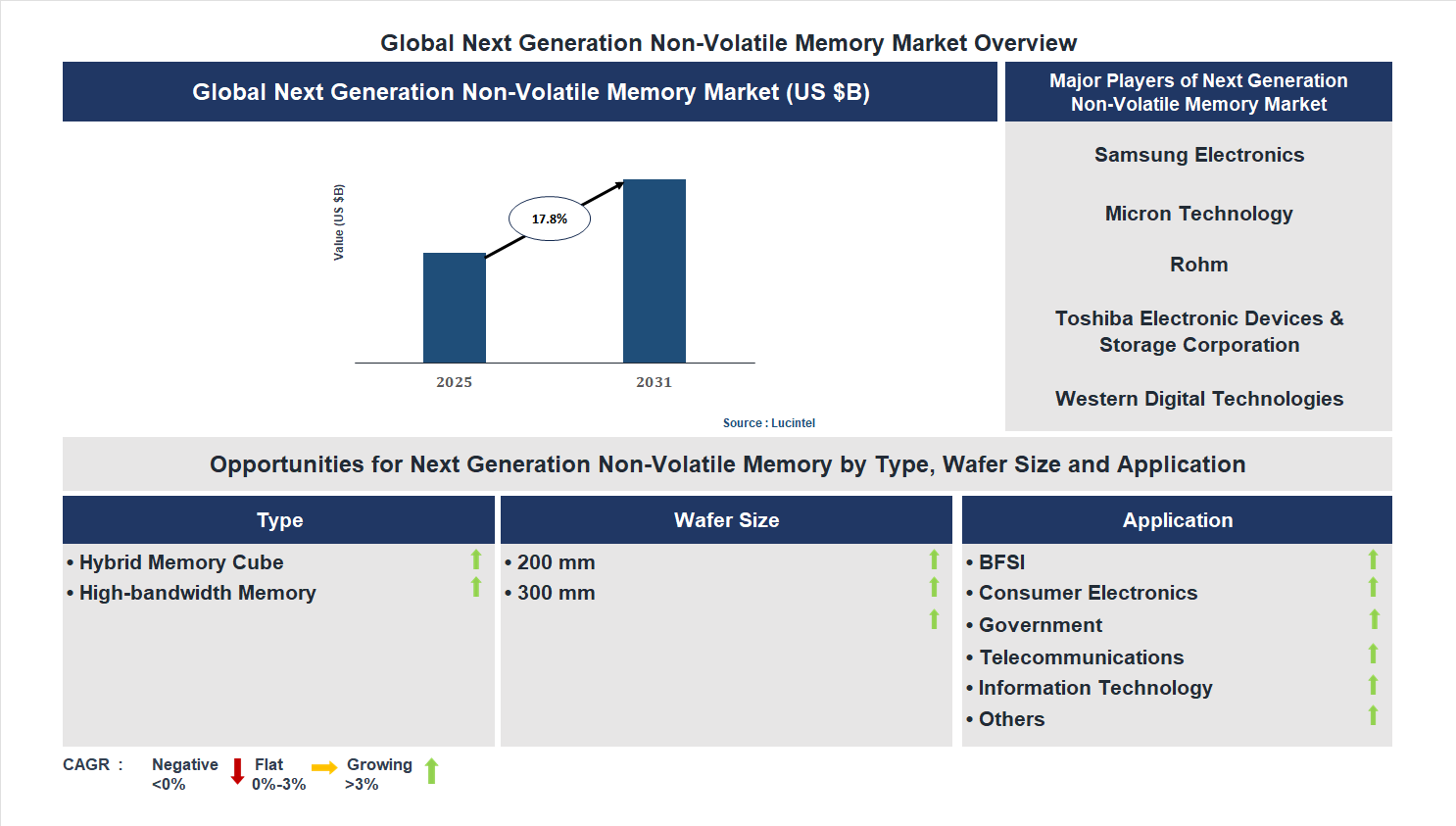
The future of the global next generation non-volatile memory market looks promising with opportunities in the BFSI, consumer electronics, government, telecommunication, and information technology markets. The global next generation non-volatile memory market is expected to grow with a CAGR of 17.8% from 2025 to 2031. The major drivers for this market are the increasing demand for faster persistent storage, the rising need for energy efficient memory, and the growing adoption of advanced computing devices.• Lucintel forecasts that, within the type category, high-bandwidth memory is expected to witness higher growth over the forecast period.
• Within the application category, BFSI is expected to witness the highest growth.
• In terms of region, APAC is expected to witness the highest growth over the forecast period. Gain valuable insights for your business decisions with our comprehensive 150+ page report. Sample figures with some insights are shown below.
Emerging Trends in the Next Generation Non-Volatile Memory Market
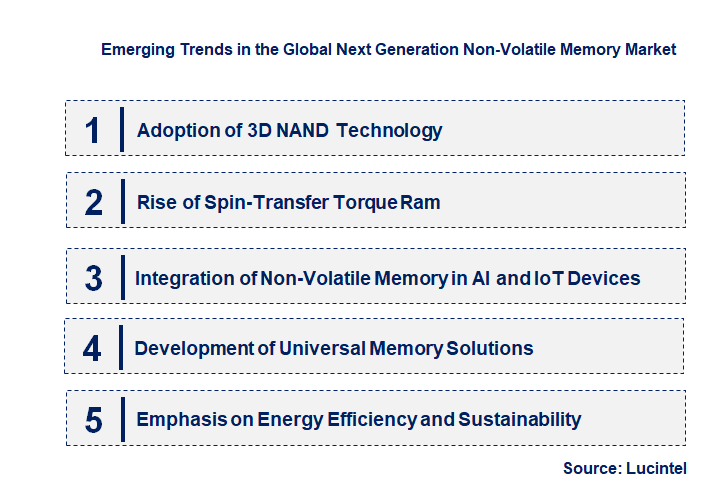
The next generation non-volatile memory market is experiencing rapid evolution driven by technological advancements and increasing demand for faster, more reliable data storage solutions. As digital transformation accelerates across industries, traditional memory technologies are being replaced or supplemented by innovative solutions that offer higher speed, durability, and energy efficiency. These developments are reshaping the competitive landscape, influencing product design, and creating new opportunities for market players. Understanding these emerging trends is crucial for stakeholders aiming to capitalize on the markets growth potential and stay ahead in this dynamic environment.• Adoption of 3D NAND Technology: This trend involves stacking memory cells vertically to increase storage density and improve performance. Companies like samsung and micron are investing heavily in 3D NAND, which offers higher capacity, better endurance, and lower costs per gigabyte. The technologys scalability makes it ideal for data centers, smartphones, and enterprise storage, significantly impacting the market by enabling more compact and efficient devices.
• Rise of Spin-Transfer Torque RAM (STT-RAM): STT-RAM is gaining traction as a promising non-volatile memory solution due to its high speed, low power consumption, and durability. Companies such as Everspin are pioneering STT-RAM development, which can serve as a universal memory, bridging the gap between DRAM and traditional NVM. Its adoption is expected to revolutionize computing architectures by providing faster, more energy-efficient memory options.
• Integration of Non-Volatile Memory in AI and IoT Devices: The proliferation of artificial intelligence and Internet of Things (IoT) devices demands high-performance, reliable memory solutions. NVM technologies like resistive RAM (ReRAM) and phase-change memory (PCM) are being integrated into these devices to enable faster data processing and persistent storage. This trend enhances device capabilities, reduces latency, and supports real-time analytics, thereby expanding the market for next-generation NVM.
• Development of Universal Memory Solutions: Companies are focusing on creating universal memory that combines the advantages of different NVM types, such as speed, endurance, and scalability. Innovations in materials and architecture aim to develop versatile memory modules suitable for a wide range of applications. This trend is expected to streamline product offerings, reduce costs, and accelerate adoption across sectors like consumer electronics, automotive, and enterprise storage.
• Emphasis on Energy Efficiency and Sustainability: As data centers and electronic devices consume increasing amounts of energy, there is a push toward more sustainable memory solutions. Companies like sandisk and kingston are investing in low-power NVM technologies that reduce energy consumption and environmental impact. This trend aligns with global sustainability goals and is likely to influence future product development, making energy-efficient memory a key differentiator in the market. These emerging trends are collectively transforming the next generation non-volatile memory market by enhancing performance, reducing costs, and enabling new applications. They are fostering innovation, driving competition, and expanding the scope of memory solutions across various industries, ultimately shaping a more efficient and sustainable digital future.
Recent Development in the Next Generation Non-Volatile Memory Market
The next generation non-volatile memory market is experiencing rapid growth driven by technological advancements and increasing demand for faster, more reliable data storage solutions. As digital transformation accelerates across industries, innovations in NVM are crucial for supporting high-performance computing, cloud storage, and IoT applications. Recent developments reflect a shift towards more efficient, durable, and scalable memory technologies, which are reshaping the competitive landscape. These advancements are not only enhancing device performance but also enabling new applications and business models, ultimately transforming the way data is stored, accessed, and managed in various sectors.• Development of 3D XPoint Technology: This innovation combines the speed of DRAM with the non-volatility of NAND, offering faster data access and higher endurance. Its impact includes enabling real-time data processing and improving the performance of enterprise storage systems, thus broadening the application scope of NVM.
• Emergence of Spintronic Memory: Spintronic memory utilizes electron spin rather than charge, providing non-volatile storage with low power consumption and high speed. This development is expected to reduce energy costs and increase device longevity, making it suitable for mobile and IoT devices.
• Advancements in Resistive RAM (ReRAM): ReRAM offers high-speed operation, low power consumption, and scalability. Its development is driving the adoption of flexible and embedded memory solutions, impacting consumer electronics and automotive sectors by enabling more compact and efficient devices.
• Integration of NVM with AI and Big Data: Incorporating NVM into AI and big data infrastructures enhances data processing speeds and reduces latency. This integration supports real-time analytics and decision-making, significantly impacting sectors like finance, healthcare, and autonomous systems.
• Development of MRAM (Magnetoresistive RAM): MRAM combines the speed of SRAM with the non-volatility of flash, offering durable and fast memory solutions. Its progress is influencing the design of next-generation computing devices, especially in data centers and high-performance computing environments. In summary, these recent developments are significantly impacting the next generation non-volatile memory market by improving performance, reducing power consumption, and enabling new applications. They are fostering innovation across industries, leading to more efficient, durable, and scalable storage solutions that meet the evolving demands of digital technology.
Strategic Growth Opportunities in the Next Generation Non-Volatile Memory Market
The next generation non-volatile memory market is experiencing rapid growth driven by technological advancements and increasing demand for faster, more reliable data storage solutions. As industries such as consumer electronics, automotive, data centers, and healthcare seek innovative memory solutions, key applications are emerging as significant growth drivers. These applications are transforming how data is stored, accessed, and managed, leading to enhanced performance, energy efficiency, and durability. Companies are investing heavily in research and development to capitalize on these opportunities, positioning the market for substantial expansion in the coming years.• Consumer Electronics: Accelerating Innovation : The demand for high-speed, durable memory in smartphones, tablets, and wearables is fueling growth. Next-gen NVM offers faster data access, lower power consumption, and increased lifespan, meeting consumer expectations for seamless performance and longer device longevity. This drives manufacturers to adopt advanced memory solutions, boosting market expansion.
• Automotive Industry: Enabling Smart Vehicles : The automotive sector is integrating NVM for advanced driver-assistance systems (ADAS), infotainment, and autonomous vehicle applications. The durability and fast read/write speeds of next-gen NVM improve vehicle safety, reliability, and real-time data processing, making it a critical component in modern automotive electronics.
• Data Centers and Cloud Computing: Enhancing Data Management : As data volumes grow exponentially, data centers require scalable, high-performance storage solutions. Next-generation NVM provides faster data access, reduced latency, and energy efficiency, enabling more efficient cloud services and big data analytics. This application is a major growth avenue for the market.
• Healthcare and Medical Devices: Improving Data Security and Speed : The healthcare sector benefits from NVM in medical imaging, patient records, and portable devices. The non-volatile nature ensures data integrity and quick access, which is vital for real-time diagnostics and secure data management, thereby expanding the market footprint in healthcare.
• Industrial Automation and IoT: Supporting Smart Manufacturing : Industrial applications leverage NVM for real-time data processing, predictive maintenance, and IoT devices. The robustness and fast performance of next-gen NVM enhance operational efficiency, safety, and connectivity in industrial environments, opening new growth opportunities. In summary, these key application-driven growth opportunities are significantly impacting the next generation non-volatile memory market by expanding its scope across diverse sectors. The integration of advanced memory solutions is enabling industries to achieve higher performance, reliability, and energy efficiency, thereby accelerating market growth and innovation.
Next Generation Non-Volatile Memory Market Driver and Challenges
The next generation non-volatile memory market is influenced by a variety of technological, economic, and regulatory factors that shape its growth trajectory. Rapid advancements in memory technology, increasing demand for faster and more reliable data storage solutions, and evolving industry standards are key drivers. Additionally, economic factors such as rising data center investments and the proliferation of IoT devices contribute significantly. Regulatory policies around data security and environmental sustainability also impact market dynamics. Navigating these complex factors requires continuous innovation and strategic adaptation from industry players to capitalize on emerging opportunities and address potential hurdles. The factors responsible for driving the next generation non-volatile memory market include:-• Technological Innovation: The continuous development of advanced memory technologies like MRAM, ReRAM, and PCM is a primary driver. These innovations offer faster data access, lower power consumption, and higher endurance compared to traditional memory solutions. As industries such as AI, IoT, and cloud computing demand more efficient storage, the market benefits from these technological breakthroughs. Companies investing heavily in R&D are pushing the boundaries, leading to new product launches and increased adoption. This innovation cycle ensures the market remains competitive and aligned with future data storage needs, fostering sustained growth.
• Growing Data Storage Needs: The exponential increase in data generated by digital platforms, IoT devices, and enterprise applications is fueling demand for advanced memory solutions. Organizations require scalable, high-speed, and durable memory to handle big data analytics, real-time processing, and cloud services. This surge in data volume necessitates more efficient storage options, prompting industries to adopt next-generation non-volatile memory solutions. As data-driven decision-making becomes critical across sectors, the market experiences heightened demand, encouraging manufacturers to develop tailored memory products that meet diverse industry requirements.
• Rising Adoption in Consumer Electronics: The proliferation of smartphones, tablets, wearables, and gaming devices is a significant driver. Consumers demand faster, more reliable, and energy-efficient devices, which require advanced memory components. Next-generation non-volatile memory offers benefits such as instant data access and improved battery life, making it attractive for consumer electronics manufacturers. As product innovation accelerates and consumer expectations rise, the integration of these memory solutions becomes more widespread, further expanding the market. This trend also encourages OEMs to incorporate cutting-edge memory technologies to differentiate their offerings in a competitive landscape.
• Industry Standards and Regulatory Support: The development of global standards and supportive regulatory frameworks encourages market growth. Governments and industry bodies are promoting policies that favor innovation, data security, and environmental sustainability. Incentives for adopting energy-efficient memory solutions and regulations around data privacy foster a conducive environment for market expansion. Compliance with these standards ensures interoperability and builds consumer trust, facilitating broader adoption. Regulatory support also attracts investments and accelerates commercialization of new memory technologies, ensuring the market remains dynamic and aligned with societal and environmental goals.
• Strategic Collaborations and Investments: Partnerships between memory technology developers, OEMs, and cloud service providers are vital for market expansion. These collaborations enable shared R&D efforts, faster commercialization, and tailored solutions for specific industry needs. Significant investments from venture capital and large corporations further fuel innovation and production capacity. Such strategic alliances help overcome technical challenges, reduce time-to-market, and expand application areas. As companies pool resources and expertise, the market benefits from a steady pipeline of innovative products, ensuring competitiveness and sustained growth in the evolving landscape. The challenges facing this next generation non-volatile memory market include:-
• High Development Costs: Developing next-generation non-volatile memory technologies involves substantial R&D investments, advanced manufacturing processes, and rigorous testing. These high costs can limit entry for smaller players and slow down innovation cycles. Additionally, the need for specialized materials and equipment increases production expenses, which may be passed on to consumers, potentially hindering adoption. The financial burden can also impact profitability and deter companies from pursuing aggressive expansion strategies, creating a barrier to rapid market growth and technological advancement.
• Technological Maturity and Compatibility Issues: Many emerging memory technologies are still in developmental stages, facing challenges related to scalability, endurance, and reliability. Compatibility with existing systems and interfaces is another concern, as integrating new memory solutions into current architectures can be complex and costly. These issues may delay widespread adoption and create uncertainty among end-users and manufacturers. Overcoming these technical hurdles requires extensive testing and standardization efforts, which can slow down market penetration and increase overall project risks.
• Market Competition and Intellectual Property Risks: The market is highly competitive, with numerous players vying for dominance through innovation and strategic alliances. Intellectual property disputes and patent infringements can pose significant risks, leading to legal battles and delays in product launches. Additionally, rapid technological advancements can render existing solutions obsolete quickly, pressuring companies to continuously innovate. This intense competition and IP landscape can increase costs, reduce profit margins, and create barriers for new entrants, ultimately impacting overall market stability and growth prospects. In summary, the next generation non-volatile memory market is driven by rapid technological innovation, increasing data storage demands, consumer electronics growth, supportive regulatory frameworks, and strategic collaborations. However, high development costs, technological maturity issues, and intense competition pose significant challenges. These factors collectively influence the market’s evolution, requiring stakeholders to balance innovation with risk management. While opportunities for growth are substantial, addressing technical and financial hurdles is essential for sustained success. Overall, the market’s future hinges on technological breakthroughs, strategic partnerships, and adaptive regulatory policies that foster innovation while mitigating risks.
List of Next Generation Non-Volatile Memory Companies
Companies in the market compete on the basis of product quality offered. Major players in this market focus on expanding their manufacturing facilities, R&D investments, infrastructural development, and leverage integration opportunities across the value chain. With these strategies next generation non-volatile memory companies cater increasing demand, ensure competitive effectiveness, develop innovative products & technologies, reduce production costs, and expand their customer base. Some of the next generation non-volatile memory companies profiled in this report include-• Samsung Electronics
• Micron Technology
• Rohm
• Toshiba Electronic Devices & Storage Corporation
• Western Digital Technologies
• Honeywell International
• Crossbar
• Fujitsu
• Japan Semiconductor Corporation
• HDD Manufacturers
Next Generation Non-Volatile Memory Market by Segment
The study includes a forecast for the global next generation non-volatile memory market by type, wafer size, application, and region.Next Generation Non-Volatile Memory Market by Type [Value from 2019 to 2031]:
• Hybrid Memory Cube
• High-bandwidth Memory
Next Generation Non-Volatile Memory Market by Wafer Size [Value from 2019 to 2031]:
• 200 mm
• 300 mm
Next Generation Non-Volatile Memory Market by Application [Value from 2019 to 2031]:
• BFSI
• Consumer Electronics
• Government
• Telecommunications
• Information Technology
• Others
Next Generation Non-Volatile Memory Market by Region [Value from 2019 to 2031]:
• North America
• Europe
• Asia Pacific
• The Rest of the World
Country Wise Outlook for the Next Generation Non-Volatile Memory Market
The next generation non-volatile memory market is experiencing rapid growth driven by technological advancements, increasing demand for faster and more durable storage solutions, and expanding applications across various industries. Countries are investing heavily in research and development to enhance memory performance, reduce costs, and improve energy efficiency. The competitive landscape is evolving with new product launches and strategic collaborations. As digital transformation accelerates globally, the adoption of innovative NVM technologies is expected to reshape data storage paradigms, impacting sectors such as consumer electronics, automotive, and data centers.• United States, companies like samsung and micron are leading innovation with the development of 3D XPoint and other advanced memory technologies, focusing on high-speed, high-density solutions. The market sees increased investments in R&D, with a focus on integrating NVM into data centers and enterprise storage systems. Regulatory support and a robust tech ecosystem foster rapid commercialization of new products.
• China is rapidly advancing in NVM technology, with firms such as huawei and tianjin bohai investing heavily in developing domestically produced memory solutions. The government’s strategic initiatives aim to reduce reliance on foreign technology, leading to breakthroughs in resistive RAM and phase-change memory. The market is characterized by aggressive funding, collaborations, and a focus on scaling production capacities.
• Germany’s market is marked by a strong emphasis on industrial applications and automotive sectors, with companies like infineon and ams developing specialized NVM solutions for embedded systems. The focus is on enhancing durability, energy efficiency, and integration with IoT devices. The country’s innovation ecosystem supports sustainable development and high-quality manufacturing standards.
• India is witnessing a surge in NVM research and startups, supported by government initiatives like Make in India. Companies such as sasken and local research institutions are exploring emerging memory technologies, aiming to develop cost-effective solutions for consumer electronics and telecom applications. The market is still emerging but shows promising growth potential driven by increasing digital adoption.
• Japan remains a key player with companies like sony and Toshiba pioneering in advanced NVM technologies, especially in flash memory and embedded solutions. The focus is on miniaturization, power efficiency, and integration with consumer electronics and automotive systems. Japan’s strong R&D infrastructure and strategic collaborations continue to propel innovation in this sector.

Features of the Global Next Generation Non-Volatile Memory Market
Market Size Estimates: Next generation non-volatile memory market size estimation in terms of value ($B). Trend and Forecast Analysis: Market trends (2019 to 2024) and forecast (2025 to 2031) by various segments and regions. Segmentation Analysis: Next generation non-volatile memory market size by type, wafer size, application, and region in terms of value ($B). Regional Analysis: Next generation non-volatile memory market breakdown by North America, Europe, Asia Pacific, and Rest of the World. Growth Opportunities: Analysis of growth opportunities in different types, wafer sizes, applications, and regions for the next generation non-volatile memory market. Strategic Analysis: This includes M&A, new product development, and competitive landscape of the next generation non-volatile memory market. Analysis of competitive intensity of the industry based on Porter’s Five Forces model.
FAQ
Q1. What is the growth forecast for next generation non-volatile memory market? Answer: The global next generation non-volatile memory market is expected to grow with a CAGR of 17.8% from 2025 to 2031. Q2. What are the major drivers influencing the growth of the next generation non-volatile memory market? Answer: The major drivers for this market are the increasing demand for faster persistent storage, the rising need for energy efficient memory, and the growing adoption of advanced computing devices. Q3. What are the major segments for next generation non-volatile memory market? Answer: The future of the next generation non-volatile memory market looks promising with opportunities in the BFSI, consumer electronics, government, telecommunication, and information technology markets. Q4. Who are the key next generation non-volatile memory market companies? Answer: Some of the key next generation non-volatile memory companies are as follows:• Samsung Electronics
• Micron Technology
• Rohm
• Toshiba Electronic Devices & Storage Corporation
• Western Digital Technologies
• Honeywell International
• Crossbar
• Fujitsu
• Japan Semiconductor Corporation
• HDD Manufacturers Q5. Which next generation non-volatile memory market segment will be the largest in future? Answer: Lucintel forecasts that, within the type category, high-bandwidth memory is expected to witness higher growth over the forecast period. Q6. In next generation non-volatile memory market, which region is expected to be the largest in next 5 years? Answer: In terms of region, APAC is expected to witness the highest growth over the forecast period. Q7. Do we receive customization in this report? Answer: Yes, Lucintel provides 10% customization without any additional cost.
Table of Contents
List of Figures
List of Tables
Methodology
- In-depth interviews of the major players in this market
- Detailed secondary research from competitors’ financial statements and published data
- Extensive searches of published works, market, and database information pertaining to industry news, company press releases, and customer intentions
- A compilation of the experiences, judgments, and insights of Lucintel’s professionals, who have analyzed and tracked this market over the years.


Buy Now
Choose a license that fits your team. Instant PDF delivery.
Prices exclude taxes. Instant delivery. Custom licensing available on request.
Key Questions
- • What are some of the most promising, high-growth opportunities for the next generation non-volatile memory market by type (hybrid memory cube and high-bandwidth memory), wafer size (200 mm and 300 mm), application (BFSI, consumer electronics, government, telecommunications, information technology, and others), and region (North America, Europe, Asia Pacific, and the Rest of the World)?
- • Which segments will grow at a faster pace and why?
- • Which region will grow at a faster pace and why?
- • What are the key factors affecting market dynamics? What are the key challenges and business risks in this market?
- • What are the business risks and competitive threats in this market?
- • What are the emerging trends in this market and the reasons behind them?
- • What are some of the changing demands of customers in the market?
- • What are the new developments in the market? Which companies are leading these developments?
- • Who are the major players in this market? What strategic initiatives are key players pursuing for business growth?
- • What are some of the competing products in this market and how big of a threat do they pose for loss of market share by material or product substitution?
- • What M&A activity has occurred in the last 5 years and what has its impact been on the industry? For any questions related to Next Generation Non-Volatile Memory Market, Next Generation Non-Volatile Memory Market Size, Next Generation Non-Volatile Memory Market Growth, Next Generation Non-Volatile Memory Market Analysis, Next Generation Non-Volatile Memory Market Report, Next Generation Non-Volatile Memory Market Share, Next Generation Non-Volatile Memory Market Trends, Next Generation Non-Volatile Memory Market Forecast, Next Generation Non-Volatile Memory Companies, write Lucintel analyst at email: helpdesk@lucintel.com. We will be glad to get back to you soon.


