
Close Lucintel Chat
Didn't Find What You're Looking for?
Call us at +1972 636 5056 or write at helpdesk@Lucintel.com
Ask an Expert Provide Custom Requirements Download Sample Report Search Available Reports
  • helpdesk@Lucintel.com
  • |
  • Call Lucintel +1 972 636 5056
  • |
  • Login
  • |
  • Register
  • |
  • Search
  • |
'
...

The Impact of COVID-19 is included in Neurorehabilitation Device Market Report. Buy it today to get an advantage.

Request the impact of COVID-19 on your product or industry


Neurorehabilitation Device Market Trends and Forecast

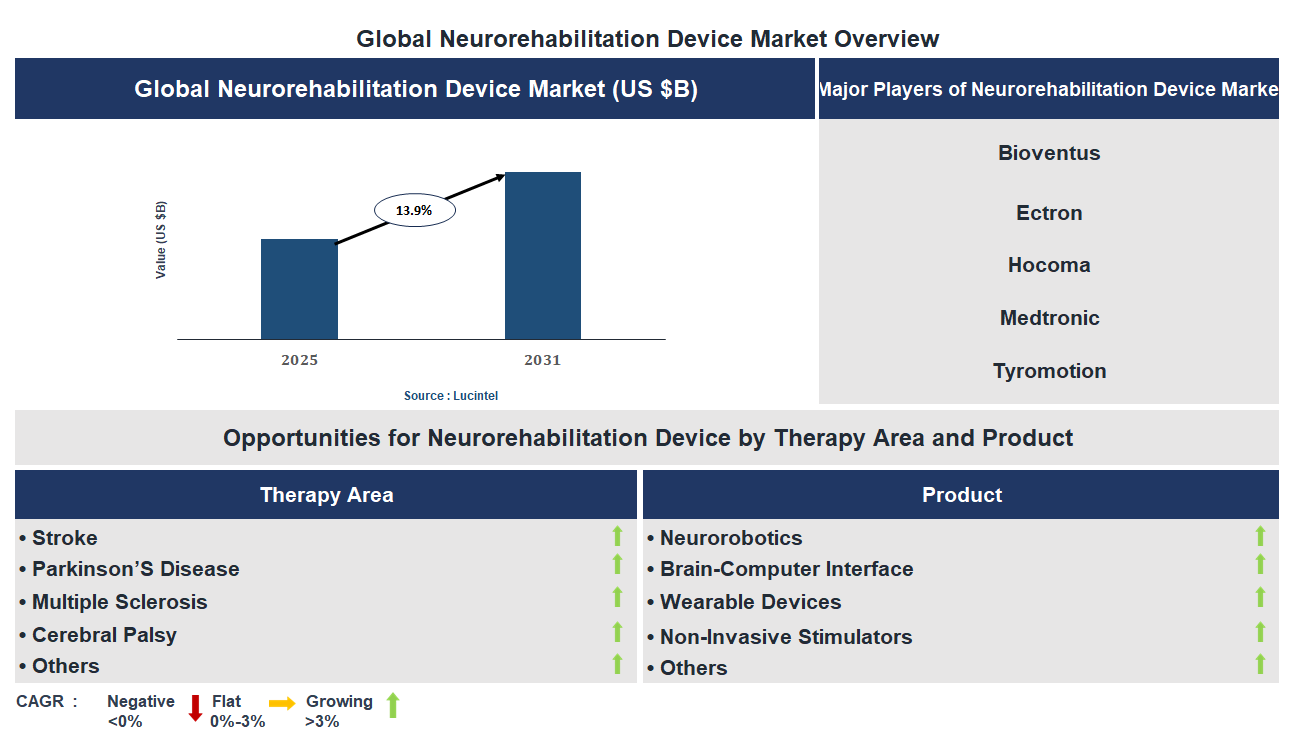
The future of the global neurorehabilitation device market looks promising with opportunities in the neurorobotic, brain-computer interface, wearable device, and non-invasive stimulator markets. The global neurorehabilitation device market is expected to grow with a CAGR of 13.9% from 2025 to 2031. The major drivers for this market are the increasing cases of neurological disorders, the rising demand for advanced rehabilitation technologies, and the growing adoption of robotic-assisted therapies.

• Lucintel forecasts that, within the therapy area category, stroke will remain the largest segment over the forecast period.
• Within the product category, neurorobotic will remain the largest segment.
• In terms of region, North America is expected to witness the highest growth over the forecast period.
Gain valuable insights for your business decisions with our comprehensive 150+ page report. Sample figures with some insights are shown below.
Neurorehabilitation Device Market Trends and Forecast

Emerging Trends in the Neurorehabilitation Device Market

The neurorehabilitation device market is experiencing rapid growth driven by technological advancements, increasing prevalence of neurological disorders, and a rising focus on personalized healthcare. As the demand for effective rehabilitation solutions grows, innovative devices are transforming patient outcomes and healthcare delivery. These developments are not only expanding market opportunities but also reshaping the way neurological conditions are managed globally. The integration of digital health, AI, and wearable technologies is creating a more connected, efficient, and patient-centric approach to neurorehabilitation. Understanding these emerging trends is crucial for stakeholders aiming to capitalize on the evolving landscape and improve patient care.

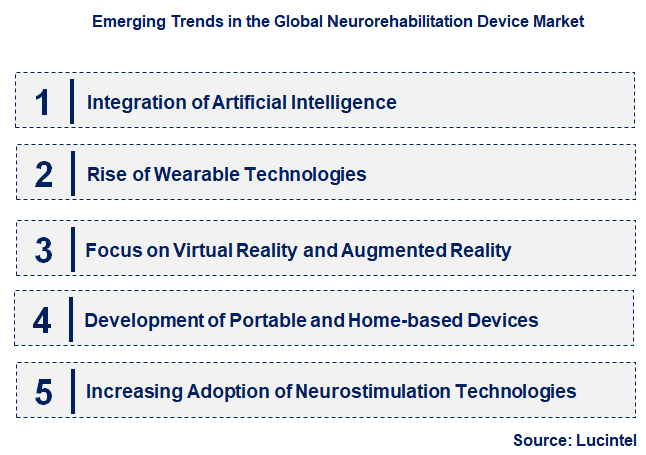
• Integration of Artificial Intelligence: AI-powered neurorehabilitation devices are enhancing personalized treatment plans by analyzing patient data in real-time. These devices adapt therapy protocols based on individual progress, improving outcomes and engagement. AI also enables remote monitoring and tele-rehabilitation, expanding access to care, especially in underserved areas. The use of AI is making neurorehabilitation more precise, efficient, and scalable, ultimately leading to better recovery rates and patient satisfaction.
• Rise of Wearable Technologies: Wearable neurorehabilitation devices, such as EEG headbands and sensor-embedded gloves, are gaining popularity for their portability and ease of use. These devices facilitate continuous monitoring of neurological functions outside clinical settings, providing valuable data for clinicians. They enable real-time feedback and gamified therapy, increasing patient motivation and adherence. The proliferation of wearable tech is democratizing access to neurorehabilitation, allowing for more personalized and flexible treatment options.
• Focus on Virtual Reality and Augmented Reality: VR and AR are revolutionizing neurorehabilitation by creating immersive environments for therapy. These technologies improve patient engagement and motivation through interactive exercises that simulate real-world scenarios. They are particularly effective in stroke and traumatic brain injury rehabilitation, helping retrain motor and cognitive functions. The integration of VR and AR is making therapy more engaging, customizable, and effective, leading to faster recovery times and better functional outcomes.
• Development of Portable and Home-based Devices: The market is witnessing a shift towards portable and home-use neurorehabilitation devices, driven by the need for cost-effective and accessible care. These devices enable patients to perform therapy sessions at home, reducing the burden on healthcare facilities and increasing therapy frequency. Remote supervision and telehealth integration ensure professional oversight, maintaining treatment quality. This trend is expanding the reach of neurorehabilitation services, especially in remote or rural areas, and promoting patient independence.
• Increasing Adoption of Neurostimulation Technologies: Neurostimulation devices, such as transcranial magnetic stimulation (TMS) and deep brain stimulation (DBS), are gaining traction for their ability to modulate neural activity and promote recovery. These technologies are used adjunctively with traditional therapies to enhance neuroplasticity and functional gains. Advances in miniaturization and precision targeting are improving safety and efficacy. The growing evidence base and regulatory approvals are accelerating adoption, making neurostimulation a key component of comprehensive neurorehabilitation strategies.

In summary, these emerging trends are transforming the neurorehabilitation device market by making therapies more personalized, accessible, and effective. The integration of AI, wearable tech, VR/AR, portable devices, and neurostimulation is fostering innovative treatment paradigms. These developments are not only expanding market opportunities but also significantly improving patient outcomes, ultimately reshaping the future of neurological disorder management worldwide.
Emerging Trends in the Neurorehabilitation Device Market

Recent Development in the Neurorehabilitation Device Market

The neurorehabilitation device market has experienced significant growth driven by technological advancements, increasing prevalence of neurological disorders, and rising healthcare investments. As the demand for effective rehabilitation solutions grows, key developments are shaping the future landscape of this industry. These innovations aim to improve patient outcomes, enhance device accessibility, and reduce treatment costs. The market is also witnessing increased collaborations between technology firms and healthcare providers, fostering the development of smarter, more personalized devices. Regulatory approvals and government initiatives further support market expansion. These developments collectively are transforming neurorehabilitation, making it more efficient, accessible, and tailored to individual patient needs.

• Integration of Artificial Intelligence: AI-powered neurorehabilitation devices are now capable of providing personalized therapy plans, real-time feedback, and adaptive learning, significantly improving patient engagement and outcomes. This advancement enhances the precision of treatments and allows for remote monitoring, reducing the need for frequent clinical visits. The impact is a more efficient, patient-centric approach that accelerates recovery times and broadens access to quality care.
• Development of Wearable Devices: Wearable neurorehabilitation devices, such as EEG headsets and exoskeletons, are gaining popularity due to their portability and ease of use. These devices enable continuous monitoring and therapy outside clinical settings, promoting early intervention and sustained rehabilitation. Their impact includes increased patient compliance, reduced healthcare costs, and improved long-term recovery prospects, especially for stroke and traumatic brain injury patients.
• Advances in Brain-Computer Interface Technology: BCI devices are now more sophisticated, allowing direct communication between the brain and external devices. This technology is revolutionizing neurorehabilitation by restoring motor functions and enabling communication for patients with severe neurological impairments. The impact is a significant improvement in quality of life and independence for patients, along with expanding therapeutic options.
• Regulatory Approvals and Reimbursement Policies: Recent approvals by regulatory bodies and the introduction of reimbursement policies have facilitated market entry and adoption of neurorehabilitation devices. These policies reduce financial barriers for patients and healthcare providers, encouraging wider use of advanced devices. The impact is accelerated market growth, increased innovation, and broader patient access to cutting-edge therapies.
• Collaborations and Strategic Partnerships: Increased collaborations between tech companies, healthcare providers, and research institutions are fostering innovation and commercialization of new devices. These partnerships enable the integration of multidisciplinary expertise, leading to more effective and user-friendly solutions. The impact includes faster product development cycles, enhanced device capabilities, and expanded market reach, ultimately benefiting patients through improved therapy options.

In summary, these key developments are collectively transforming the neurorehabilitation device market by making therapies more personalized, accessible, and effective. The integration of AI, wearable technology, advanced BCI systems, supportive regulatory frameworks, and strategic collaborations are driving market growth and improving patient outcomes. As these trends continue, the market is poised for sustained expansion, offering new hope for individuals with neurological impairments.

Strategic Growth Opportunities in the Neurorehabilitation Device Market

The neurorehabilitation device market is experiencing rapid growth driven by technological advancements, increasing prevalence of neurological disorders, and a rising focus on personalized healthcare solutions. As the demand for effective rehabilitation tools increases across various healthcare settings, key applications are emerging as significant growth drivers. These opportunities are transforming patient outcomes, expanding market reach, and fostering innovation within the industry. Stakeholders are increasingly investing in research and development to capitalize on these trends, making the market highly dynamic and competitive. Understanding these growth opportunities across different applications is essential for strategic planning and investment in this evolving landscape.

• Stroke Rehabilitation: Significant growth opportunity exists in stroke recovery devices, driven by the high incidence of stroke worldwide. These devices aid in motor recovery, speech therapy, and cognitive rehabilitation, improving patient independence. The impact includes enhanced recovery rates and reduced long-term healthcare costs, making stroke rehabilitation a key focus for market expansion.
• Traumatic Brain Injury Recovery: TBI rehabilitation devices are gaining prominence due to rising TBI cases from accidents and sports injuries. These devices facilitate neuroplasticity and functional recovery through advanced neurostimulation and robotic assistance. Their impact is seen in improved patient outcomes and increased demand for specialized rehabilitation solutions.
• Spinal Cord Injury Rehabilitation: The market for SCI devices is expanding as new technologies enable better mobility and independence for patients. Devices such as exoskeletons and neuromodulation systems are transforming SCI recovery. This growth enhances quality of life for patients and opens new revenue streams for manufacturers.
• Multiple Sclerosis Management: Neurorehabilitation devices tailored for MS patients are emerging, focusing on managing symptoms and improving mobility. These devices help in reducing fatigue and spasticity, leading to better daily functioning. The impact is a broader market segment and improved patient engagement.
• Parkinson’s Disease Therapy: The development of devices for Parkinson’s disease, including deep brain stimulation and gait training systems, is a key growth area. These devices assist in managing motor symptoms and improving quality of life. Their impact includes increased adoption of advanced therapies and expanded market opportunities.

In summary, these growth opportunities across key applications are significantly shaping the neurorehabilitation device market by enhancing patient outcomes, driving technological innovation, and expanding market reach. The evolving landscape offers substantial potential for stakeholders to capitalize on emerging needs and improve neurological healthcare solutions globally.

Neurorehabilitation Device Market Driver and Challenges

The neurorehabilitation device market is influenced by a complex interplay of technological advancements, economic factors, and regulatory frameworks. Rapid innovations in medical devices, increasing prevalence of neurological disorders, and supportive government policies are key drivers propelling market growth. Conversely, challenges such as high device costs, stringent regulatory approval processes, and limited reimbursement options pose significant hurdles. Understanding these drivers and challenges is essential for stakeholders aiming to capitalize on emerging opportunities while navigating potential risks. The evolving landscape demands continuous adaptation to technological progress and policy changes, shaping the future trajectory of the neurorehabilitation device industry.

The factors responsible for driving the neurorehabilitation device market include:
• Technological Innovation: The development of advanced neurorehabilitation devices, such as robotic exoskeletons, brain-computer interfaces, and virtual reality systems, has revolutionized patient therapy. These innovations enable more precise, personalized, and effective rehabilitation, leading to improved patient outcomes. As technology continues to evolve rapidly, manufacturers are investing heavily in R&D to introduce smarter, more user-friendly devices. This ongoing innovation not only enhances clinical efficacy but also expands the scope of neurorehabilitation, attracting healthcare providers and patients alike. The integration of AI and machine learning further enhances device capabilities, making neurorehabilitation more accessible and efficient.
• Rising Prevalence of Neurological Disorders: The increasing incidence of stroke, traumatic brain injury, multiple sclerosis, and Parkinson’s disease globally is a major driver. As populations age, the burden of neurological conditions grows, creating a higher demand for effective rehabilitation solutions. This trend compels healthcare systems to adopt advanced neurorehabilitation devices to improve recovery rates and reduce long-term disability. The rising prevalence also stimulates research and development efforts, fostering innovation in device design and functionality. Consequently, the market experiences sustained growth driven by the urgent need for effective therapeutic interventions for neurological impairments.
• Growing Awareness and Acceptance: Increased awareness among patients, caregivers, and healthcare professionals about the benefits of neurorehabilitation devices is fueling market expansion. Educational campaigns, clinical studies, and positive patient outcomes have contributed to greater acceptance of these technologies. Healthcare providers are more inclined to incorporate advanced devices into treatment protocols, recognizing their potential to enhance recovery and quality of life. Additionally, patient demand for minimally invasive and non-invasive therapies encourages adoption. This shift in perception accelerates market growth, as stakeholders seek innovative solutions that offer better efficacy and comfort.
• Supportive Regulatory Environment: Governments and regulatory bodies are implementing policies that facilitate the approval and adoption of neurorehabilitation devices. Streamlined approval processes, funding for research, and inclusion of these devices in healthcare reimbursement schemes promote market growth. Regulatory support ensures safety and efficacy standards are met while reducing time-to-market for new innovations. This environment encourages manufacturers to invest in product development, knowing that regulatory pathways are clearer and more predictable. Consequently, a favorable regulatory landscape accelerates innovation, adoption, and commercialization of neurorehabilitation devices.
• Strategic Collaborations and Partnerships: Collaborations between device manufacturers, research institutions, and healthcare providers are driving innovation and market expansion. These partnerships facilitate knowledge sharing, resource pooling, and clinical validation of new technologies. Joint ventures enable faster development cycles and help address unmet clinical needs more effectively. Moreover, collaborations often lead to the integration of neurorehabilitation devices into broader healthcare systems, enhancing their reach and utility. Such strategic alliances are crucial for navigating complex regulatory environments and ensuring successful commercialization, ultimately fueling market growth through shared expertise and innovation.

The challenges facing the neurorehabilitation device market include:
• High Device Costs: The advanced technology embedded in neurorehabilitation devices often results in high manufacturing and procurement costs. These expenses can limit accessibility, especially in developing regions with constrained healthcare budgets. High costs pose barriers for hospitals and clinics to adopt these devices widely, restricting market penetration. Additionally, patients may face financial burdens if insurance coverage or reimbursement options are limited. Cost-related challenges hinder widespread adoption and slow market growth, emphasizing the need for cost-effective innovations and supportive reimbursement policies.
• Stringent Regulatory Approval Processes: The regulatory landscape for medical devices, especially those involving neurological interventions, is complex and rigorous. Lengthy approval timelines, extensive clinical trials, and compliance requirements can delay product launches and increase development costs. Navigating these regulatory hurdles requires significant expertise and resources, which can be challenging for smaller companies. Delays in approval can result in missed market opportunities and increased financial risks. Ensuring safety and efficacy while streamlining approval processes remains a critical challenge for market participants seeking rapid commercialization.
• Limited Reimbursement and Funding: Reimbursement policies for neurorehabilitation devices vary across regions and are often limited or inconsistent. Lack of comprehensive coverage discourages healthcare providers from adopting new technologies due to financial uncertainties. This challenge hampers market growth, particularly in emerging markets where healthcare funding is constrained. Without adequate reimbursement, patients may be unable to afford these devices, reducing demand. Addressing reimbursement barriers through policy advocacy and demonstrating cost-effectiveness is essential for expanding market access and ensuring sustainable growth.

In summary, the neurorehabilitation device market is driven by technological innovation, increasing neurological disorder prevalence, awareness, regulatory support, and strategic collaborations. However, high costs, regulatory complexities, and reimbursement issues pose significant challenges. These factors collectively influence market dynamics, requiring stakeholders to focus on cost reduction, regulatory navigation, and policy engagement. The overall impact is a market poised for growth, provided these challenges are effectively managed, enabling improved patient outcomes and technological advancement in neurorehabilitation.

List of Neurorehabilitation Device Companies

Companies in the market compete on the basis of product quality offered. Major players in this market focus on expanding their manufacturing facilities, R&D investments, infrastructural development, and leverage integration opportunities across the value chain. With these strategies neurorehabilitation device companies cater increasing demand, ensure competitive effectiveness, develop innovative products & technologies, reduce production costs, and expand their customer base. Some of the neurorehabilitation device companies profiled in this report include-
• Bioventus
• Ectron
• Hocoma
• Medtronic
• Tyromotion
• Biometrics
• Bionik Laboratories
• BioXtreme
• Ekso Bionics
• Kinestica

Neurorehabilitation Device Market by Segment

The study includes a forecast for the global neurorehabilitation device market by therapy area, product, and region.

Neurorehabilitation Device Market by Therapy Area [Value from 2019 to 2031]:


• Stroke
• Parkinson’S Disease
• Multiple Sclerosis
• Cerebral Palsy
• Others

Neurorehabilitation Device Market by Product [Value from 2019 to 2031]:


• Neurorobotics
• Brain-Computer Interface
• Wearable Devices
• Non-Invasive Stimulators
• Others

Neurorehabilitation Device Market by Region [Value from 2019 to 2031]:


• North America
• Europe
• Asia Pacific
• The Rest of the World

Country Wise Outlook for the Neurorehabilitation Device Market

The neurorehabilitation device market has experienced significant growth driven by technological advancements, increasing prevalence of neurological disorders, and rising healthcare investments worldwide. Countries are adopting innovative solutions to improve patient outcomes and reduce long-term care costs. The market‘s evolution reflects a focus on personalized, non-invasive, and technologically advanced devices, with regulatory support and increased awareness playing crucial roles. As healthcare systems adapt to these innovations, each country’s unique demographic and technological landscape influences their development trajectory. The following summarizes recent developments in the United States, China, Germany, India, and Japan within this dynamic market.
• United States: The US market has seen rapid adoption of advanced neurorehabilitation devices, including brain-computer interfaces and robotic exoskeletons. Increased funding from government agencies like the NIH supports research and commercialization. Tele-rehabilitation solutions have gained popularity, especially post-pandemic, enhancing access for remote patients. Major players are collaborating with healthcare providers to develop personalized therapy options, and regulatory approvals have streamlined device deployment. The focus remains on integrating AI and machine learning to improve treatment efficacy and patient engagement.
• China: China’s neurorehabilitation device market is expanding due to rising neurological disorder cases and government initiatives promoting healthcare innovation. Local companies are developing cost-effective, portable devices tailored for large populations. The government’s support through policies and funding accelerates research and manufacturing. There is a growing emphasis on integrating traditional Chinese medicine with modern neurorehabilitation techniques. Digital health platforms and mobile applications are increasingly used to monitor patient progress remotely, making neurorehabilitation more accessible across urban and rural areas.
• Germany: Germany’s market is characterized by a strong emphasis on research and development, with collaborations between academia and industry. The adoption of robotic-assisted therapy devices and neurostimulation technologies is increasing, driven by a well-established healthcare infrastructure. Regulatory frameworks are robust, ensuring safety and efficacy. Germany is also focusing on personalized neurorehabilitation programs, utilizing advanced imaging and diagnostics. The integration of virtual reality and augmented reality tools is enhancing patient engagement and therapy outcomes, positioning Germany as a leader in innovative neurorehabilitation solutions.
• India: India’s neurorehabilitation device market is witnessing rapid growth due to increasing neurological disorder prevalence and rising healthcare awareness. Cost-effective, portable devices are in high demand to cater to a large, diverse population with limited access to specialized care. Government initiatives to improve healthcare infrastructure and telemedicine adoption are supporting market expansion. Local manufacturers are developing affordable devices, often integrating mobile technology for remote monitoring. The focus is on expanding reach in rural areas and training healthcare professionals to utilize advanced neurorehabilitation tools effectively.
• Japan: Japan’s market is driven by an aging population with a high incidence of stroke and neurodegenerative diseases. The country is investing heavily in robotic and AI-powered neurorehabilitation devices to improve recovery outcomes. Advanced technologies such as brain-machine interfaces and neurostimulation are being integrated into clinical practice. Japan’s strong healthcare system and regulatory environment facilitate rapid adoption of innovative solutions. There is also a focus on developing user-friendly devices for elderly patients, with ongoing research into enhancing device comfort and usability to support long-term therapy adherence.

Lucintel Analytics Dashboard

Features of the Global Neurorehabilitation Device Market

Market Size Estimates: Neurorehabilitation device market size estimation in terms of value ($B).
Trend and Forecast Analysis: Market trends (2019 to 2024) and forecast (2025 to 2031) by various segments and regions.
Segmentation Analysis: Neurorehabilitation device market size by therapy area, product, and region in terms of value ($B).
Regional Analysis: Neurorehabilitation device market breakdown by North America, Europe, Asia Pacific, and Rest of the World.
Growth Opportunities: Analysis of growth opportunities in different therapy areas, products, and regions for the neurorehabilitation device market.
Strategic Analysis: This includes M&A, new product development, and competitive landscape of the neurorehabilitation device market.
Analysis of competitive intensity of the industry based on Porter’s Five Forces model.

Lucintel Consulting Services

FAQ

Q1. What is the growth forecast for neurorehabilitation device market?
Answer: The global neurorehabilitation device market is expected to grow with a CAGR of 13.9% from 2025 to 2031.
Q2. What are the major drivers influencing the growth of the neurorehabilitation device market?
Answer: The major drivers for this market are the increasing cases of neurological disorders, the rising demand for advanced rehabilitation technologies, and the growing adoption of robotic-assisted therapies.
Q3. What are the major segments for neurorehabilitation device market?
Answer: The future of the neurorehabilitation device market looks promising with opportunities in the neurorobotic, brain-computer interface, wearable device, and non-invasive stimulator markets.
Q4. Who are the key neurorehabilitation device market companies?
Answer: Some of the key neurorehabilitation device companies are as follows:
• Bioventus
• Ectron
• Hocoma
• Medtronic
• Tyromotion
• Biometrics
• Bionik Laboratories
• BioXtreme
• Ekso Bionics
• Kinestica
Q5. Which neurorehabilitation device market segment will be the largest in future?
Answer: Lucintel forecasts that, within the therapy area category, stroke will remain the largest segment over the forecast period.
Q6. In neurorehabilitation device market, which region is expected to be the largest in next 5 years?
Answer: In terms of region, North America is expected to witness the highest growth over the forecast period.
Q7. Do we receive customization in this report?
Answer: Yes, Lucintel provides 10% customization without any additional cost.

This report answers following 11 key questions:

Q.1. What are some of the most promising, high-growth opportunities for the neurorehabilitation device market by therapy area (stroke, parkinson’s disease, multiple sclerosis, cerebral palsy, and others), product (neurorobotics, brain-computer interface, wearable devices, non-invasive stimulators, and others), and region (North America, Europe, Asia Pacific, and the Rest of the World)?
Q.2. Which segments will grow at a faster pace and why?
Q.3. Which region will grow at a faster pace and why?
Q.4. What are the key factors affecting market dynamics? What are the key challenges and business risks in this market?
Q.5. What are the business risks and competitive threats in this market?
Q.6. What are the emerging trends in this market and the reasons behind them?
Q.7. What are some of the changing demands of customers in the market?
Q.8. What are the new developments in the market? Which companies are leading these developments?
Q.9. Who are the major players in this market? What strategic initiatives are key players pursuing for business growth?
Q.10. What are some of the competing products in this market and how big of a threat do they pose for loss of market share by material or product substitution?
Q.11. What M&A activity has occurred in the last 5 years and what has its impact been on the industry?

For any questions related to Neurorehabilitation Device Market, Neurorehabilitation Device Market Size, Neurorehabilitation Device Market Growth, Neurorehabilitation Device Market Analysis, Neurorehabilitation Device Market Report, Neurorehabilitation Device Market Share, Neurorehabilitation Device Market Trends, Neurorehabilitation Device Market Forecast, Neurorehabilitation Device Companies, write Lucintel analyst at email: helpdesk@lucintel.com. We will be glad to get back to you soon.
                                           Table of Contents

            1. Executive Summary

            2. Market Overview

                        2.1 Background and Classifications
                        2.2 Supply Chain

            3. Market Trends & Forecast Analysis

                        3.1 Macroeconomic Trends and Forecasts
                        3.2 Industry Drivers and Challenges
                        3.3 PESTLE Analysis
                        3.4 Patent Analysis
                        3.5 Regulatory Environment
                        3.6 Global Neurorehabilitation Device Market Trends and Forecast

            4. Global Neurorehabilitation Device Market by Therapy Area

                        4.1 Overview
                        4.2 Attractiveness Analysis by Therapy Area
                        4.3 Stroke : Trends and Forecast 2025 to 2031
                        4.4 Parkinson’S Disease : Trends and Forecast 2025 to 2031
                        4.5 Multiple Sclerosis : Trends and Forecast 2025 to 2031
                        4.6 Cerebral Palsy : Trends and Forecast 2025 to 2031
                        4.7 Others : Trends and Forecast 2025 to 2031

            5. Global Neurorehabilitation Device Market by Product

                        5.1 Overview
                        5.2 Attractiveness Analysis by Product
                        5.3 Neurorobotics : Trends and Forecast 2025 to 2031
                        5.4 Brain-Computer Interface : Trends and Forecast 2025 to 2031
                        5.5 Wearable Devices : Trends and Forecast 2025 to 2031
                        5.6 Non-Invasive Stimulators : Trends and Forecast 2025 to 2031
                        5.7 Others : Trends and Forecast 2025 to 2031

            6. Regional Analysis

                        6.1 Overview
                        6.2 Global Neurorehabilitation Device Market by Region

            7. North American Neurorehabilitation Device Market

                        7.1 Overview
                        7.2 North American Neurorehabilitation Device Market by Therapy Area
                        7.3 North American Neurorehabilitation Device Market by Product
                        7.4 The United States Neurorehabilitation Device Market
                        7.5 Canadian Neurorehabilitation Device Market
                        7.6 Mexican Neurorehabilitation Device Market

            8. European Neurorehabilitation Device Market

                        8.1 Overview
                        8.2 European Neurorehabilitation Device Market by Therapy Area
                        8.3 European Neurorehabilitation Device Market by Product
                        8.4 German Neurorehabilitation Device Market
                        8.5 French Neurorehabilitation Device Market
                        8.6 Italian Neurorehabilitation Device Market
                        8.7 Spanish Neurorehabilitation Device Market
                        8.8 The United Kingdom Neurorehabilitation Device Market

            9. APAC Neurorehabilitation Device Market

                        9.1 Overview
                        9.2 APAC Neurorehabilitation Device Market by Therapy Area
                        9.3 APAC Neurorehabilitation Device Market by Product
                        9.4 Chinese Neurorehabilitation Device Market
                        9.5 Indian Neurorehabilitation Device Market
                        9.6 Japanese Neurorehabilitation Device Market
                        9.7 South Korean Neurorehabilitation Device Market
                        9.8 Indonesian Neurorehabilitation Device Market

            10. ROW Neurorehabilitation Device Market

                        10.1 Overview
                        10.2 ROW Neurorehabilitation Device Market by Therapy Area
                        10.3 ROW Neurorehabilitation Device Market by Product
                        10.4 Middle Eastern Neurorehabilitation Device Market
                        10.5 South American Neurorehabilitation Device Market
                        10.6 African Neurorehabilitation Device Market

            11. Competitor Analysis

                        11.1 Product Portfolio Analysis
                        11.2 Operational Integration
                        11.3 Porter’s Five Forces Analysis
                                    • Competitive Rivalry
                                    • Bargaining Power of Buyers
                                    • Bargaining Power of Suppliers
                                    • Threat of Substitutes
                                    • Threat of New Entrants
                        11.4 Market Share Analysis

            12. Opportunities & Strategic Analysis

                        12.1 Value Chain Analysis
                        12.2 Growth Opportunity Analysis
                                    12.2.1 Growth Opportunity by Therapy Area
                                    12.2.2 Growth Opportunity by Product
                        12.3 Emerging Trends in the Global Neurorehabilitation Device Market
                        12.4 Strategic Analysis
                                    12.4.1 New Product Development
                                    12.4.2 Certification and Licensing
                                    12.4.3 Mergers, Acquisitions, Agreements, Collaborations, and Joint Ventures

            13. Company Profiles of the Leading Players Across the Value Chain

                        13.1 Competitive Analysis Overview
                        13.2 Bioventus
                                    • Company Overview
                                    • Neurorehabilitation Device Market Business Overview
                                    • New Product Development
                                    • Merger, Acquisition, and Collaboration
                                    • Certification and Licensing
                        13.3 Ectron
                                    • Company Overview
                                    • Neurorehabilitation Device Market Business Overview
                                    • New Product Development
                                    • Merger, Acquisition, and Collaboration
                                    • Certification and Licensing
                        13.4 Hocoma
                                    • Company Overview
                                    • Neurorehabilitation Device Market Business Overview
                                    • New Product Development
                                    • Merger, Acquisition, and Collaboration
                                    • Certification and Licensing
                        13.5 Medtronic
                                    • Company Overview
                                    • Neurorehabilitation Device Market Business Overview
                                    • New Product Development
                                    • Merger, Acquisition, and Collaboration
                                    • Certification and Licensing
                        13.6 Tyromotion
                                    • Company Overview
                                    • Neurorehabilitation Device Market Business Overview
                                    • New Product Development
                                    • Merger, Acquisition, and Collaboration
                                    • Certification and Licensing
                        13.7 Biometrics
                                    • Company Overview
                                    • Neurorehabilitation Device Market Business Overview
                                    • New Product Development
                                    • Merger, Acquisition, and Collaboration
                                    • Certification and Licensing
                        13.8 Bionik Laboratories
                                    • Company Overview
                                    • Neurorehabilitation Device Market Business Overview
                                    • New Product Development
                                    • Merger, Acquisition, and Collaboration
                                    • Certification and Licensing
                        13.9 BioXtreme
                                    • Company Overview
                                    • Neurorehabilitation Device Market Business Overview
                                    • New Product Development
                                    • Merger, Acquisition, and Collaboration
                                    • Certification and Licensing
                        13.10 Ekso Bionics
                                    • Company Overview
                                    • Neurorehabilitation Device Market Business Overview
                                    • New Product Development
                                    • Merger, Acquisition, and Collaboration
                                    • Certification and Licensing
                        13.11 Kinestica
                                    • Company Overview
                                    • Neurorehabilitation Device Market Business Overview
                                    • New Product Development
                                    • Merger, Acquisition, and Collaboration
                                    • Certification and Licensing

            14. Appendix

                        14.1 List of Figures
                        14.2 List of Tables
                        14.3 Research Methodology
                        14.4 Disclaimer
                        14.5 Copyright
                        14.6 Abbreviations and Technical Units
                        14.7 About Us
                        14.8 Contact Us

                                               List of Figures


            Chapter 1

                        Figure 1.1: Trends and Forecast for the Global Neurorehabilitation Device Market

            Chapter 2

                        Figure 2.1: Usage of Neurorehabilitation Device Market
                        Figure 2.2: Classification of the Global Neurorehabilitation Device Market
                        Figure 2.3: Supply Chain of the Global Neurorehabilitation Device Market

            Chapter 3

                        Figure 3.1: Trends of the Global GDP Growth Rate
                        Figure 3.2: Trends of the Global Population Growth Rate
                        Figure 3.3: Trends of the Global Inflation Rate
                        Figure 3.4: Trends of the Global Unemployment Rate
                        Figure 3.5: Trends of the Regional GDP Growth Rate
                        Figure 3.6: Trends of the Regional Population Growth Rate
                        Figure 3.7: Trends of the Regional Inflation Rate
                        Figure 3.8: Trends of the Regional Unemployment Rate
                        Figure 3.9: Trends of Regional Per Capita Income
                        Figure 3.10: Forecast for the Global GDP Growth Rate
                        Figure 3.11: Forecast for the Global Population Growth Rate
                        Figure 3.12: Forecast for the Global Inflation Rate
                        Figure 3.13: Forecast for the Global Unemployment Rate
                        Figure 3.14: Forecast for the Regional GDP Growth Rate
                        Figure 3.15: Forecast for the Regional Population Growth Rate
                        Figure 3.16: Forecast for the Regional Inflation Rate
                        Figure 3.17: Forecast for the Regional Unemployment Rate
                        Figure 3.18: Forecast for Regional Per Capita Income
                        Figure 3.19: Driver and Challenges of the Neurorehabilitation Device Market

            Chapter 4

                        Figure 4.1: Global Neurorehabilitation Device Market by Therapy Area in 2019, 2024, and 2031
                        Figure 4.2: Trends of the Global Neurorehabilitation Device Market ($B) by Therapy Area
                        Figure 4.3: Forecast for the Global Neurorehabilitation Device Market ($B) by Therapy Area
                        Figure 4.4: Trends and Forecast for Stroke in the Global Neurorehabilitation Device Market (2019-2031)
                        Figure 4.5: Trends and Forecast for Parkinson’S Disease in the Global Neurorehabilitation Device Market (2019-2031)
                        Figure 4.6: Trends and Forecast for Multiple Sclerosis in the Global Neurorehabilitation Device Market (2019-2031)
                        Figure 4.7: Trends and Forecast for Cerebral Palsy in the Global Neurorehabilitation Device Market (2019-2031)
                        Figure 4.8: Trends and Forecast for Others in the Global Neurorehabilitation Device Market (2019-2031)

            Chapter 5

                        Figure 5.1: Global Neurorehabilitation Device Market by Product in 2019, 2024, and 2031
                        Figure 5.2: Trends of the Global Neurorehabilitation Device Market ($B) by Product
                        Figure 5.3: Forecast for the Global Neurorehabilitation Device Market ($B) by Product
                        Figure 5.4: Trends and Forecast for Neurorobotics in the Global Neurorehabilitation Device Market (2019-2031)
                        Figure 5.5: Trends and Forecast for Brain-Computer Interface in the Global Neurorehabilitation Device Market (2019-2031)
                        Figure 5.6: Trends and Forecast for Wearable Devices in the Global Neurorehabilitation Device Market (2019-2031)
                        Figure 5.7: Trends and Forecast for Non-Invasive Stimulators in the Global Neurorehabilitation Device Market (2019-2031)
                        Figure 5.8: Trends and Forecast for Others in the Global Neurorehabilitation Device Market (2019-2031)

            Chapter 6

                        Figure 6.1: Trends of the Global Neurorehabilitation Device Market ($B) by Region (2019-2024)
                        Figure 6.2: Forecast for the Global Neurorehabilitation Device Market ($B) by Region (2025-2031)

            Chapter 7

                        Figure 7.1: Trends and Forecast for the North American Neurorehabilitation Device Market (2019-2031)
                        Figure 7.2: North American Neurorehabilitation Device Market by Therapy Area in 2019, 2024, and 2031
                        Figure 7.3: Trends of the North American Neurorehabilitation Device Market ($B) by Therapy Area (2019-2024)
                        Figure 7.4: Forecast for the North American Neurorehabilitation Device Market ($B) by Therapy Area (2025-2031)
                        Figure 7.5: North American Neurorehabilitation Device Market by Product in 2019, 2024, and 2031
                        Figure 7.6: Trends of the North American Neurorehabilitation Device Market ($B) by Product (2019-2024)
                        Figure 7.7: Forecast for the North American Neurorehabilitation Device Market ($B) by Product (2025-2031)
                        Figure 7.8: Trends and Forecast for the United States Neurorehabilitation Device Market ($B) (2019-2031)
                        Figure 7.9: Trends and Forecast for the Mexican Neurorehabilitation Device Market ($B) (2019-2031)
                        Figure 7.10: Trends and Forecast for the Canadian Neurorehabilitation Device Market ($B) (2019-2031)

            Chapter 8

                        Figure 8.1: Trends and Forecast for the European Neurorehabilitation Device Market (2019-2031)
                        Figure 8.2: European Neurorehabilitation Device Market by Therapy Area in 2019, 2024, and 2031
                        Figure 8.3: Trends of the European Neurorehabilitation Device Market ($B) by Therapy Area (2019-2024)
                        Figure 8.4: Forecast for the European Neurorehabilitation Device Market ($B) by Therapy Area (2025-2031)
                        Figure 8.5: European Neurorehabilitation Device Market by Product in 2019, 2024, and 2031
                        Figure 8.6: Trends of the European Neurorehabilitation Device Market ($B) by Product (2019-2024)
                        Figure 8.7: Forecast for the European Neurorehabilitation Device Market ($B) by Product (2025-2031)
                        Figure 8.8: Trends and Forecast for the German Neurorehabilitation Device Market ($B) (2019-2031)
                        Figure 8.9: Trends and Forecast for the French Neurorehabilitation Device Market ($B) (2019-2031)
                        Figure 8.10: Trends and Forecast for the Spanish Neurorehabilitation Device Market ($B) (2019-2031)
                        Figure 8.11: Trends and Forecast for the Italian Neurorehabilitation Device Market ($B) (2019-2031)
                        Figure 8.12: Trends and Forecast for the United Kingdom Neurorehabilitation Device Market ($B) (2019-2031)

            Chapter 9

                        Figure 9.1: Trends and Forecast for the APAC Neurorehabilitation Device Market (2019-2031)
                        Figure 9.2: APAC Neurorehabilitation Device Market by Therapy Area in 2019, 2024, and 2031
                        Figure 9.3: Trends of the APAC Neurorehabilitation Device Market ($B) by Therapy Area (2019-2024)
                        Figure 9.4: Forecast for the APAC Neurorehabilitation Device Market ($B) by Therapy Area (2025-2031)
                        Figure 9.5: APAC Neurorehabilitation Device Market by Product in 2019, 2024, and 2031
                        Figure 9.6: Trends of the APAC Neurorehabilitation Device Market ($B) by Product (2019-2024)
                        Figure 9.7: Forecast for the APAC Neurorehabilitation Device Market ($B) by Product (2025-2031)
                        Figure 9.8: Trends and Forecast for the Japanese Neurorehabilitation Device Market ($B) (2019-2031)
                        Figure 9.9: Trends and Forecast for the Indian Neurorehabilitation Device Market ($B) (2019-2031)
                        Figure 9.10: Trends and Forecast for the Chinese Neurorehabilitation Device Market ($B) (2019-2031)
                        Figure 9.11: Trends and Forecast for the South Korean Neurorehabilitation Device Market ($B) (2019-2031)
                        Figure 9.12: Trends and Forecast for the Indonesian Neurorehabilitation Device Market ($B) (2019-2031)

            Chapter 10

                        Figure 10.1: Trends and Forecast for the ROW Neurorehabilitation Device Market (2019-2031)
                        Figure 10.2: ROW Neurorehabilitation Device Market by Therapy Area in 2019, 2024, and 2031
                        Figure 10.3: Trends of the ROW Neurorehabilitation Device Market ($B) by Therapy Area (2019-2024)
                        Figure 10.4: Forecast for the ROW Neurorehabilitation Device Market ($B) by Therapy Area (2025-2031)
                        Figure 10.5: ROW Neurorehabilitation Device Market by Product in 2019, 2024, and 2031
                        Figure 10.6: Trends of the ROW Neurorehabilitation Device Market ($B) by Product (2019-2024)
                        Figure 10.7: Forecast for the ROW Neurorehabilitation Device Market ($B) by Product (2025-2031)
                        Figure 10.8: Trends and Forecast for the Middle Eastern Neurorehabilitation Device Market ($B) (2019-2031)
                        Figure 10.9: Trends and Forecast for the South American Neurorehabilitation Device Market ($B) (2019-2031)
                        Figure 10.10: Trends and Forecast for the African Neurorehabilitation Device Market ($B) (2019-2031)

            Chapter 11

                        Figure 11.1: Porter’s Five Forces Analysis of the Global Neurorehabilitation Device Market
                        Figure 11.2: Market Share (%) of Top Players in the Global Neurorehabilitation Device Market (2024)

            Chapter 12

                        Figure 12.1: Growth Opportunities for the Global Neurorehabilitation Device Market by Therapy Area
                        Figure 12.2: Growth Opportunities for the Global Neurorehabilitation Device Market by Product
                        Figure 12.3: Growth Opportunities for the Global Neurorehabilitation Device Market by Region
                        Figure 12.4: Emerging Trends in the Global Neurorehabilitation Device Market

                                               List of Tables


            Chapter 1

                        Table 1.1: Growth Rate (%, 2023-2024) and CAGR (%, 2025-2031) of the Neurorehabilitation Device Market by Therapy Area and Product
                        Table 1.2: Attractiveness Analysis for the Neurorehabilitation Device Market by Region
                        Table 1.3: Global Neurorehabilitation Device Market Parameters and Attributes

            Chapter 3

                        Table 3.1: Trends of the Global Neurorehabilitation Device Market (2019-2024)
                        Table 3.2: Forecast for the Global Neurorehabilitation Device Market (2025-2031)

            Chapter 4

                        Table 4.1: Attractiveness Analysis for the Global Neurorehabilitation Device Market by Therapy Area
                        Table 4.2: Market Size and CAGR of Various Therapy Area in the Global Neurorehabilitation Device Market (2019-2024)
                        Table 4.3: Market Size and CAGR of Various Therapy Area in the Global Neurorehabilitation Device Market (2025-2031)
                        Table 4.4: Trends of Stroke in the Global Neurorehabilitation Device Market (2019-2024)
                        Table 4.5: Forecast for Stroke in the Global Neurorehabilitation Device Market (2025-2031)
                        Table 4.6: Trends of Parkinson’S Disease in the Global Neurorehabilitation Device Market (2019-2024)
                        Table 4.7: Forecast for Parkinson’S Disease in the Global Neurorehabilitation Device Market (2025-2031)
                        Table 4.8: Trends of Multiple Sclerosis in the Global Neurorehabilitation Device Market (2019-2024)
                        Table 4.9: Forecast for Multiple Sclerosis in the Global Neurorehabilitation Device Market (2025-2031)
                        Table 4.10: Trends of Cerebral Palsy in the Global Neurorehabilitation Device Market (2019-2024)
                        Table 4.11: Forecast for Cerebral Palsy in the Global Neurorehabilitation Device Market (2025-2031)
                        Table 4.12: Trends of Others in the Global Neurorehabilitation Device Market (2019-2024)
                        Table 4.13: Forecast for Others in the Global Neurorehabilitation Device Market (2025-2031)

            Chapter 5

                        Table 5.1: Attractiveness Analysis for the Global Neurorehabilitation Device Market by Product
                        Table 5.2: Market Size and CAGR of Various Product in the Global Neurorehabilitation Device Market (2019-2024)
                        Table 5.3: Market Size and CAGR of Various Product in the Global Neurorehabilitation Device Market (2025-2031)
                        Table 5.4: Trends of Neurorobotics in the Global Neurorehabilitation Device Market (2019-2024)
                        Table 5.5: Forecast for Neurorobotics in the Global Neurorehabilitation Device Market (2025-2031)
                        Table 5.6: Trends of Brain-Computer Interface in the Global Neurorehabilitation Device Market (2019-2024)
                        Table 5.7: Forecast for Brain-Computer Interface in the Global Neurorehabilitation Device Market (2025-2031)
                        Table 5.8: Trends of Wearable Devices in the Global Neurorehabilitation Device Market (2019-2024)
                        Table 5.9: Forecast for Wearable Devices in the Global Neurorehabilitation Device Market (2025-2031)
                        Table 5.10: Trends of Non-Invasive Stimulators in the Global Neurorehabilitation Device Market (2019-2024)
                        Table 5.11: Forecast for Non-Invasive Stimulators in the Global Neurorehabilitation Device Market (2025-2031)
                        Table 5.12: Trends of Others in the Global Neurorehabilitation Device Market (2019-2024)
                        Table 5.13: Forecast for Others in the Global Neurorehabilitation Device Market (2025-2031)

            Chapter 6

                        Table 6.1: Market Size and CAGR of Various Regions in the Global Neurorehabilitation Device Market (2019-2024)
                        Table 6.2: Market Size and CAGR of Various Regions in the Global Neurorehabilitation Device Market (2025-2031)

            Chapter 7

                        Table 7.1: Trends of the North American Neurorehabilitation Device Market (2019-2024)
                        Table 7.2: Forecast for the North American Neurorehabilitation Device Market (2025-2031)
                        Table 7.3: Market Size and CAGR of Various Therapy Area in the North American Neurorehabilitation Device Market (2019-2024)
                        Table 7.4: Market Size and CAGR of Various Therapy Area in the North American Neurorehabilitation Device Market (2025-2031)
                        Table 7.5: Market Size and CAGR of Various Product in the North American Neurorehabilitation Device Market (2019-2024)
                        Table 7.6: Market Size and CAGR of Various Product in the North American Neurorehabilitation Device Market (2025-2031)
                        Table 7.7: Trends and Forecast for the United States Neurorehabilitation Device Market (2019-2031)
                        Table 7.8: Trends and Forecast for the Mexican Neurorehabilitation Device Market (2019-2031)
                        Table 7.9: Trends and Forecast for the Canadian Neurorehabilitation Device Market (2019-2031)

            Chapter 8

                        Table 8.1: Trends of the European Neurorehabilitation Device Market (2019-2024)
                        Table 8.2: Forecast for the European Neurorehabilitation Device Market (2025-2031)
                        Table 8.3: Market Size and CAGR of Various Therapy Area in the European Neurorehabilitation Device Market (2019-2024)
                        Table 8.4: Market Size and CAGR of Various Therapy Area in the European Neurorehabilitation Device Market (2025-2031)
                        Table 8.5: Market Size and CAGR of Various Product in the European Neurorehabilitation Device Market (2019-2024)
                        Table 8.6: Market Size and CAGR of Various Product in the European Neurorehabilitation Device Market (2025-2031)
                        Table 8.7: Trends and Forecast for the German Neurorehabilitation Device Market (2019-2031)
                        Table 8.8: Trends and Forecast for the French Neurorehabilitation Device Market (2019-2031)
                        Table 8.9: Trends and Forecast for the Spanish Neurorehabilitation Device Market (2019-2031)
                        Table 8.10: Trends and Forecast for the Italian Neurorehabilitation Device Market (2019-2031)
                        Table 8.11: Trends and Forecast for the United Kingdom Neurorehabilitation Device Market (2019-2031)

            Chapter 9

                        Table 9.1: Trends of the APAC Neurorehabilitation Device Market (2019-2024)
                        Table 9.2: Forecast for the APAC Neurorehabilitation Device Market (2025-2031)
                        Table 9.3: Market Size and CAGR of Various Therapy Area in the APAC Neurorehabilitation Device Market (2019-2024)
                        Table 9.4: Market Size and CAGR of Various Therapy Area in the APAC Neurorehabilitation Device Market (2025-2031)
                        Table 9.5: Market Size and CAGR of Various Product in the APAC Neurorehabilitation Device Market (2019-2024)
                        Table 9.6: Market Size and CAGR of Various Product in the APAC Neurorehabilitation Device Market (2025-2031)
                        Table 9.7: Trends and Forecast for the Japanese Neurorehabilitation Device Market (2019-2031)
                        Table 9.8: Trends and Forecast for the Indian Neurorehabilitation Device Market (2019-2031)
                        Table 9.9: Trends and Forecast for the Chinese Neurorehabilitation Device Market (2019-2031)
                        Table 9.10: Trends and Forecast for the South Korean Neurorehabilitation Device Market (2019-2031)
                        Table 9.11: Trends and Forecast for the Indonesian Neurorehabilitation Device Market (2019-2031)

            Chapter 10

                        Table 10.1: Trends of the ROW Neurorehabilitation Device Market (2019-2024)
                        Table 10.2: Forecast for the ROW Neurorehabilitation Device Market (2025-2031)
                        Table 10.3: Market Size and CAGR of Various Therapy Area in the ROW Neurorehabilitation Device Market (2019-2024)
                        Table 10.4: Market Size and CAGR of Various Therapy Area in the ROW Neurorehabilitation Device Market (2025-2031)
                        Table 10.5: Market Size and CAGR of Various Product in the ROW Neurorehabilitation Device Market (2019-2024)
                        Table 10.6: Market Size and CAGR of Various Product in the ROW Neurorehabilitation Device Market (2025-2031)
                        Table 10.7: Trends and Forecast for the Middle Eastern Neurorehabilitation Device Market (2019-2031)
                        Table 10.8: Trends and Forecast for the South American Neurorehabilitation Device Market (2019-2031)
                        Table 10.9: Trends and Forecast for the African Neurorehabilitation Device Market (2019-2031)

            Chapter 11

                        Table 11.1: Product Mapping of Neurorehabilitation Device Suppliers Based on Segments
                        Table 11.2: Operational Integration of Neurorehabilitation Device Manufacturers
                        Table 11.3: Rankings of Suppliers Based on Neurorehabilitation Device Revenue

            Chapter 12

                        Table 12.1: New Product Launches by Major Neurorehabilitation Device Producers (2019-2024)
                        Table 12.2: Certification Acquired by Major Competitor in the Global Neurorehabilitation Device Market

.

Buy full report or by chapter as follows

Limited Time Offer

Price by License Type:
[-] Hide Chapter Details
[Chapter Number] [Chapter Name] [Chapter Number Of Pages] [Chapter Price]
Title/Chapter Name Pages Price
Full Report: Neurorehabilitation Device Market Report: Trends, Forecast and Competitive Analysis to 2031 Full Report $ 2,990
A 150 Page Report
Lucintel has been in the business of market research and management consulting since 2000 and has published over 1000 market intelligence reports in various markets / applications and served over 1,000 clients worldwide. This study is a culmination of four months of full-time effort performed by Lucintel's analyst team. The analysts used the following sources for the creation and completion of this valuable report:
  • In-depth interviews of the major players in this market
  • Detailed secondary research from competitors’ financial statements and published data 
  • Extensive searches of published works, market, and database information pertaining to industry news, company press releases, and customer intentions
  • A compilation of the experiences, judgments, and insights of Lucintel’s professionals, who have analyzed and tracked this market over the years.
Extensive research and interviews are conducted across the supply chain of this market to estimate market share, market size, trends, drivers, challenges, and forecasts. Below is a brief summary of the primary interviews that were conducted by job function for this report.
 
Thus, Lucintel compiles vast amounts of data from numerous sources, validates the integrity of that data, and performs a comprehensive analysis. Lucintel then organizes the data, its findings, and insights into a concise report designed to support the strategic decision-making process. The figure below is a graphical representation of Lucintel’s research process. 
 

Please sign in below to get report brochure - Neurorehabilitation Device Market Report.

At Lucintel, we respect your privacy and maintain the confidentiality of information / data provided by you
(Please enter your corporate email. * These fields are mandatory )

Follow us on