
'
...

The Impact of COVID-19 is included in Nerve Model Market Report. Buy it today to get an advantage.

Request the impact of COVID-19 on your product or industry


Nerve Model Market Trends and Forecast

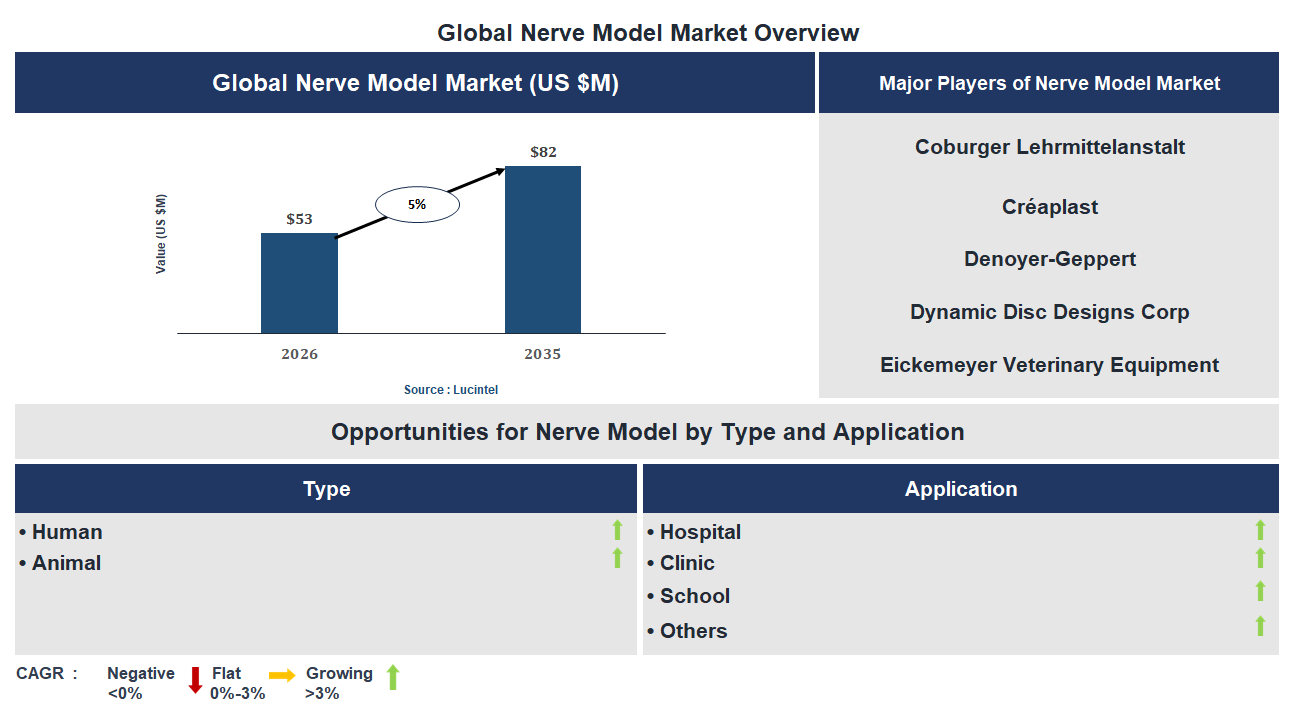
The future of the global nerve model market looks promising with opportunities in the hospital, clinic, and school markets. The global nerve model market is expected to reach an estimated $82 million by 2035 with a CAGR of 5% from 2026 to 2035. The major drivers for this market are the increasing demand for advanced nerve models, the rising adoption in medical research sectors, and the growing focus on personalized treatment solutions.

• Lucintel forecasts that, within the type category, human is expected to witness higher growth over the forecast period.
• Within the application category, hospital is expected to witness the highest growth.
• In terms of region, APAC is expected to witness the highest growth over the forecast period.
Gain valuable insights for your business decisions with our comprehensive 150+ page report. Sample figures with some insights are shown below.
Nerve Model Market Trends and Forecast

Emerging Trends in the Nerve Model Market

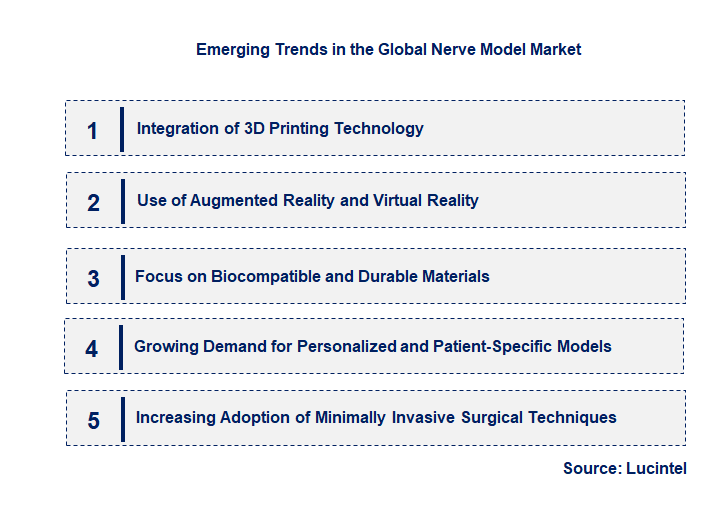
The nerve model market is experiencing rapid evolution driven by technological advancements, increasing demand for personalized healthcare, and a focus on minimally invasive procedures. As medical technology progresses, new materials and innovative designs are enhancing the accuracy and usability of nerve models. Additionally, rising awareness about neurological disorders and the need for effective training tools are fueling market growth. These developments are not only improving patient outcomes but also transforming how healthcare professionals approach diagnosis, treatment, and education. The following key trends highlight the major shifts shaping this dynamic market landscape.

• Integration of 3D Printing Technology: 3D printing is revolutionizing nerve model production by enabling highly detailed, customizable, and cost-effective models. This technology allows for rapid prototyping and personalized models tailored to specific patient anatomies, improving surgical planning and training. It reduces manufacturing time and costs while increasing accessibility for healthcare providers. As 3D printing becomes more sophisticated, nerve models are becoming more realistic, enhancing the training experience and surgical precision. This trend is expected to significantly boost market growth by offering innovative, patient-specific solutions.
• Use of Augmented Reality (AR) and Virtual Reality (VR): AR and VR are increasingly integrated into nerve model training and surgical planning. These immersive technologies provide interactive, 3D visualizations of nerve structures, allowing surgeons and students to explore complex anatomy in a simulated environment. This enhances understanding, reduces errors, and improves surgical outcomes. The adoption of AR and VR is driven by advancements in hardware and software, making these tools more accessible and affordable. As a result, the market is witnessing a shift toward more interactive, realistic training modules that improve skill acquisition and patient safety.
• Focus On Biocompatible And Durable Materials: The development of advanced materials that mimic the properties of real nerve tissue is a key trend. These biocompatible, durable materials improve the realism and longevity of nerve models, making them suitable for repeated use in training and surgical practice. Innovations include silicone, thermoplastics, and other composites that offer flexibility, elasticity, and resistance to wear. This focus on material science enhances the tactile experience and accuracy of models, leading to better surgical preparation. The trend supports the creation of more effective, reusable models that meet the evolving needs of healthcare providers.
• Growing Demand For Personalized And Patient-Specific Models: Personalized nerve models are gaining popularity due to their ability to replicate individual patient anatomy accurately. Using imaging data such as MRI or CT scans, manufacturers create customized models for preoperative planning and patient education. This trend improves surgical precision, reduces operative time, and enhances patient understanding of procedures. The demand is driven by the increasing complexity of neurological surgeries and the need for tailored treatment approaches. As technology advances, the market is expanding to include more personalized solutions, making neural models an essential tool in precision medicine.
• Increasing Adoption of Minimally Invasive Surgical Techniques: The shift toward minimally invasive procedures is influencing nerve model development. These models help surgeons plan and practice complex surgeries with limited access points, reducing patient trauma and recovery time. Enhanced visualization and simulation capabilities enable better navigation of delicate nerve structures. The trend is supported by technological innovations that allow for more accurate, compact, and portable models suitable for use in operating rooms and training centers. This evolution is making nerve models indispensable in modern surgical practices, ultimately improving outcomes and expanding their application scope.

These trends are collectively transforming the nerve model market by fostering innovation, improving training and surgical precision, and enabling personalized patient care. The integration of advanced technologies and materials is making neural models more realistic, accessible, and effective, thereby reshaping the landscape of neurological healthcare and education.
Emerging Trends in the Nerve Model Market

Recent Development in the Nerve Model Market

The nerve model market is experiencing rapid growth driven by technological advancements and increasing demand for neurological research and medical applications. Innovations in neurotechnology, the rising prevalence of neurological disorders, and expanding research funding are fueling market expansion. Additionally, the integration of AI and machine learning is enhancing model accuracy and usability. These developments are transforming diagnostic and treatment approaches, creating new opportunities for stakeholders. As the market evolves, it is poised for significant growth, impacting healthcare, research, and pharmaceutical industries worldwide.

• Growing Demand for Advanced Neuro Models: The increasing prevalence of neurological disorders such as Alzheimer’s and Parkinson’s drives demand for sophisticated nerve models. These models enable a better understanding of disease mechanisms, facilitating drug development and personalized treatments. The need for accurate, reliable, and scalable models is pushing innovation in the industry. This growth opportunity is attracting investments from biotech and pharma companies, accelerating research, and improving patient outcomes through targeted therapies.
• Technological Innovations in Neuro Modeling: Advances in bioengineering, 3D printing, and microfluidics are revolutionizing nerve model development. These technologies enable the creation of more realistic, functional, and customizable models that mimic human nerve tissues. The impact includes improved drug testing, reduced reliance on animal models, and faster research cycles. Such innovations are expanding the scope of nerve models, making them more accessible and effective for various applications, including regenerative medicine and neurotoxicity testing.
• Rising Investment and Funding in Neuro Research: Increased funding from government agencies, private investors, and research institutions is fueling market growth. This financial support accelerates the development of novel nerve models and enhances existing technologies. It also promotes collaborations across academia and industry, leading to innovative solutions. The influx of capital is enabling comprehensive research initiatives, expanding market reach, and fostering the commercialization of advanced nerve modeling products.
• Integration of Artificial Intelligence and Machine Learning: AI and machine learning are enhancing the capabilities of neural models by enabling data-driven insights and predictive analytics. These technologies improve model accuracy, optimize experimental designs, and facilitate personalized medicine approaches. The impact includes faster drug discovery, better understanding of nerve functions, and more precise disease modeling. This integration is transforming the nerve model landscape, making it more efficient and adaptable to complex neurological research needs.
• Expansion of Market Applications and Global Reach: The application scope of nerve models is broadening to include drug screening, regenerative therapies, and personalized medicine. Additionally, emerging markets in Asia and Latin America are adopting these technologies, expanding the global footprint. This diversification increases market size and competitiveness. The growth in applications and geographic reach is fostering innovation, reducing costs, and making neural models more accessible to a wider range of healthcare and research institutions.

These developments are significantly impacting the nerve model market by enhancing technological capabilities, expanding application areas, and attracting increased investment. The market is becoming more innovative, efficient, and accessible, which is driving growth and improving neurological research and treatment outcomes. As these trends continue, the market is expected to experience sustained expansion, benefiting healthcare providers, researchers, and patients worldwide.

Strategic Growth Opportunities in the Nerve Model Market

The nerve model market is experiencing significant growth driven by advancements in medical education, increasing demand for realistic simulation tools, and expanding applications in surgical planning and neurological research. As healthcare professionals seek more effective training methods and precise diagnostic tools, the market presents numerous opportunities for innovation and expansion. The integration of digital technologies and increasing awareness of neurological disorders further fuel this growth, making nerve models essential in both clinical and educational settings worldwide.

• Enhanced Medical Education and Training Opportunities: Nerve models provide realistic, hands-on training for medical students and professionals, improving understanding of complex neuroanatomy and surgical procedures. The demand for high-fidelity simulation tools is rising as institutions aim to reduce training costs and improve patient outcomes. These models facilitate safe practice environments, leading to better skill acquisition and confidence among healthcare providers, thereby expanding the market’s reach across educational institutions globally.
• Growing Adoption in Surgical Planning and Preoperative Simulation: Surgeons increasingly utilize nerve models for preoperative planning to visualize complex nerve pathways and avoid critical structures during procedures. These models enable precise mapping, reducing intraoperative risks and improving surgical outcomes. The demand for customized, patient-specific nerve models is rising, driven by technological advancements in 3D printing and imaging. This trend enhances surgical accuracy, shortens operative times, and boosts confidence in complex neurological surgeries, expanding market opportunities.
• Rising Prevalence of Neurological Disorders and Need for Diagnostic Tools: The increasing incidence of neurological conditions such as stroke, nerve injuries, and neurodegenerative diseases drives the demand for accurate diagnostic and educational tools like nerve models. These models assist clinicians in understanding disease progression and planning effective treatments. Additionally, they serve as valuable tools in patient education, improving communication and compliance. The growing burden of neurological disorders globally fuels the need for innovative nerve modeling solutions, expanding market potential.
• Technological Innovations in Digital and 3D Printing Technologies: Advances in 3D printing and digital modeling have revolutionized nerve model production, enabling highly detailed, customizable, and cost-effective models. These innovations facilitate rapid prototyping and personalized models tailored to specific clinical needs. The integration of augmented reality (AR) and virtual reality (VR) further enhances training and surgical planning. As technology becomes more accessible, the market benefits from increased adoption of sophisticated neural models, fostering growth and expanding application scope.
• Increasing Focus on Minimally Invasive Procedures and Precision Medicine: The shift toward minimally invasive neurological procedures necessitates detailed nerve models for accurate navigation and intervention. These models support precision medicine by providing patient-specific anatomical details and improving procedural success rates. The demand for such models is rising in outpatient and outpatient surgical settings, where accuracy and safety are paramount. This trend encourages innovation in nerve modeling techniques, broadening market applications, and fostering growth in the neurotechnology sector.

The overall impact of these opportunities is a robust expansion of the nerve model market, driven by technological advancements, increasing clinical applications, and a global focus on improving neurological healthcare outcomes. As these factors converge, the market is poised for sustained growth, innovation, and broader adoption across educational, clinical, and research domains worldwide.

Nerve Model Market Driver and Challenges

The nerve model market is influenced by a variety of technological, economic, and regulatory factors that shape its growth and development. Advances in neuroscience and medical technology drive innovation, while economic conditions impact investment and adoption rates. Regulatory frameworks ensure safety and efficacy but can also pose barriers to market entry. Additionally, increasing demand for neurological disorder treatments and personalized medicine fuels market expansion. However, challenges such as high R&D costs, regulatory hurdles, and ethical considerations can impede progress. Understanding these drivers and challenges is essential for stakeholders to navigate the evolving landscape and capitalize on emerging opportunities within the nerve model market.

The factors responsible for driving the nerve model market include:
• Technological Advancements: The rapid development of neuroimaging, neural interface devices, and AI-driven diagnostics significantly enhances the accuracy and efficiency of nerve modeling. These innovations enable a better understanding of neural pathways, leading to improved treatment options for neurological disorders. As technology becomes more sophisticated and affordable, adoption rates increase among healthcare providers, fueling market growth. Moreover, integration with wearable devices and telemedicine platforms expands the reach of nerve modeling solutions, making them more accessible and practical for diverse healthcare settings.
• Rising Prevalence of Neurological Disorders: The increasing incidence of conditions such as Alzheimer’s, Parkinson’s, epilepsy, and stroke creates a substantial demand for advanced diagnostic and therapeutic tools. Nerve models facilitate early diagnosis, personalized treatment planning, and monitoring of disease progression. As populations age globally, the burden of neurological diseases intensifies, prompting healthcare systems to invest in innovative nerve modeling solutions. This growing need directly correlates with market expansion, attracting investments from both public and private sectors.
• Growing Investment in R&D: Significant funding from governments, private investors, and pharmaceutical companies accelerates research in nerve modeling technologies. These investments support the development of more accurate, scalable, and cost-effective nerve models, fostering innovation. Enhanced R&D efforts lead to the discovery of novel therapeutic targets and improved simulation techniques, which can translate into better clinical outcomes. The continuous flow of capital also encourages collaborations across academia, industry, and healthcare providers, further propelling market growth.
• Regulatory Support and Policy Frameworks: Favorable regulatory environments and supportive policies facilitate the approval and commercialization of nerve modeling technologies. Regulatory agencies are increasingly recognizing the importance of advanced neural models in drug development and clinical applications, streamlining approval processes. Additionally, government initiatives aimed at promoting neuroscience research and innovation provide funding and infrastructure support. These regulatory and policy measures create a conducive environment for market players to innovate, scale, and deploy nerve modeling solutions more efficiently.
• Increasing Adoption of Personalized Medicine: The shift towards personalized treatment approaches emphasizes the need for detailed nerve models tailored to individual patients. Such models enable precise diagnosis, targeted therapies, and better management of neurological conditions. The integration of genetic, clinical, and neuroimaging data enhances the accuracy of nerve models, improving patient outcomes. As healthcare providers increasingly adopt personalized medicine, demand for sophisticated nerve modeling solutions rises, driving market growth and encouraging further technological advancements.

The challenges facing the nerve model market include:
• High R&D Costs: Developing advanced nerve models requires substantial investment in research, specialized equipment, and skilled personnel. These high costs can limit the entry of smaller players and slow down innovation, especially in regions with limited funding. Additionally, lengthy development timelines and uncertain regulatory approval processes increase financial risks, potentially discouraging investment. The need for continuous innovation to stay competitive further amplifies R&D expenses, impacting overall market growth and accessibility.
• Regulatory and Ethical Barriers: Navigating complex regulatory landscapes poses significant challenges for nerve model developers. Ensuring safety, efficacy, and ethical compliance involves rigorous testing and lengthy approval processes, which can delay market entry. Ethical concerns related to neural data privacy, consent, and potential misuse of neural models also hinder progress. These barriers require substantial resources and expertise to overcome, potentially limiting innovation and deployment, especially in jurisdictions with stringent regulations.
• Limited Clinical Validation and Adoption: Despite technological advancements, many nerve models lack extensive clinical validation, which hampers their acceptance by healthcare providers. Resistance to change, lack of awareness, and skepticism about new technologies slow adoption rates. Additionally, integrating nerve models into existing clinical workflows requires training and infrastructure upgrades, which can be costly and time-consuming. This gap between technological development and clinical application constrains market growth and limits the full potential of nerve modeling solutions.

The nerve model market is driven by technological innovation, rising neurological disorder prevalence, increased R&D investment, supportive regulatory frameworks, and a shift towards personalized medicine. However, high development costs, regulatory and ethical challenges, and slow clinical adoption pose significant hurdles. These factors collectively influence the market’s trajectory, requiring stakeholders to navigate complexities carefully. Overcoming these challenges through strategic collaborations, regulatory reforms, and clinical validation will be crucial for sustained growth and innovation in the nerve model market.

List of Nerve Model Companies

Companies in the market compete on the basis of product quality offered. Major players in this market focus on expanding their manufacturing facilities, R&D investments, infrastructural development, and leverage integration opportunities across the value chain. With these strategies nerve model companies cater increasing demand, ensure competitive effectiveness, develop innovative products & technologies, reduce production costs, and expand their customer base. Some of the nerve model companies profiled in this report include-
• Coburger Lehrmittelanstalt
• Créaplast
• Denoyer-Geppert
• Dynamic Disc Designs Corp
• Eickemeyer Veterinary Equipment
• EMS Physio Ltd
• MeiWo Science
• Nasco
• SynDaver Labs
• Trando 3D Medical Technology

Nerve Model Market by Segment

The study includes a forecast for the global nerve model market by type, application, and region.

Nerve Model Market by Type [Value from 2019 to 2035]:


• Human
• Animal

Nerve Model Market by Application [Value from 2019 to 2035]:


• Hospital
• Clinic
• School
• Others

Nerve Model Market by Region [Value from 2019 to 2035]:


• North America
• Europe
• Asia Pacific
• The Rest of the World

Country Wise Outlook for the Nerve Model Market

The nerve model market has experienced significant growth driven by advancements in medical education, research, and healthcare technology. Increasing demand for realistic simulation tools and innovative educational aids has spurred development across major economies. Countries are investing in new materials, digital integration, and enhanced realism to improve training outcomes and patient care. The markets evolution reflects broader trends in healthcare innovation, emphasizing precision, accessibility, and technological integration. As these nations continue to prioritize healthcare improvements, the nerve model market is poised for substantial expansion, with tailored solutions addressing specific regional needs and advancing global standards in medical training and research.

• United States: The US market has seen rapid adoption of high-fidelity nerve models incorporating digital and augmented reality features, enhancing training precision. Leading companies are developing customizable models for surgical simulation, driven by increased healthcare funding and research initiatives. The focus on minimally invasive procedures has further boosted demand for realistic nerve models, with hospitals and educational institutions investing heavily in advanced simulation tools.
• China: China is experiencing a surge in nerve model development, supported by government initiatives to modernize medical education and healthcare infrastructure. The market is characterized by the integration of digital technologies and cost-effective manufacturing, making models more accessible. Local companies are expanding their product portfolios to include models tailored for traditional Chinese medicine practices and regional surgical procedures.
• Germany: Germanys market emphasizes high-quality, durable nerve models used in both academic and clinical settings. The country is known for its precision engineering and innovative materials, leading to highly realistic and reusable models. Collaborations between medical device companies and research institutions are fostering the development of models that incorporate advanced features like nerve regeneration simulation.
• India: The Indian nerve model market is rapidly growing, driven by increasing investments in medical education and healthcare infrastructure. There is a strong demand for affordable, portable models suitable for training in resource-limited settings. Local manufacturers are focusing on cost-effective production while integrating basic digital features to improve training outcomes.
• Japan: Japans market is characterized by the integration of cutting-edge technology, including robotics and virtual reality, into nerve models. The focus is on creating highly detailed and interactive models for advanced surgical training and research. Japans emphasis on innovation and precision medicine is fueling the development of sophisticated nerve simulation tools to support complex medical procedures.

Lucintel Analytics Dashboard

Features of the Global Nerve Model Market

Market Size Estimates: Nerve model market size estimation in terms of value ($M).
Trend and Forecast Analysis: Market trends (2019 to 2025) and forecast (2026 to 2035) by various segments and regions.
Segmentation Analysis: Nerve model market size by type, application, and region in terms of value ($M).
Regional Analysis: Nerve model market breakdown by North America, Europe, Asia Pacific, and Rest of the World.
Growth Opportunities: Analysis of growth opportunities in different types, applications, and regions for the nerve model market.
Strategic Analysis: This includes M&A, new product development, and competitive landscape of the nerve model market.
Analysis of competitive intensity of the industry based on Porter’s Five Forces model.

Lucintel Consulting Services

FAQ

Q1. What is the market size and growth forecast for nerve model market?
Answer: The global nerve model market is expected to reach an estimated $82 million by 2035 and grow with a CAGR of 5% from 2026 to 2035.
Q2. What are the major drivers influencing the growth of the nerve model market?
Answer: The major drivers for this market are the increasing demand for advanced nerve models, the rising adoption in medical research sectors, and the growing focus on personalized treatment solutions.
Q3. What are the major segments for nerve model market?
Answer: The future of the nerve model market looks promising with opportunities in the hospital, clinic, and school markets.
Q4. Who are the key nerve model market companies?
Answer: Some of the key nerve model companies are as follows:
• Coburger Lehrmittelanstalt
• Créaplast
• Denoyer-Geppert
• Dynamic Disc Designs Corp
• Eickemeyer Veterinary Equipment
• EMS Physio Ltd
• MeiWo Science
• Nasco
• SynDaver Labs
• Trando 3D Medical Technology
Q5. Which nerve model market segment will be the largest in future?
Answer: Lucintel forecasts that, within the type category, human is expected to witness higher growth over the forecast period.
Q6. In nerve model market, which region is expected to be the largest in next 5 years?
Answer: In terms of region, APAC is expected to witness the highest growth over the forecast period.
Q7. Do we receive customization in this report?
Answer: Yes, Lucintel provides 10% customization without any additional cost.

This report answers following 11 key questions:

Q.1. What are some of the most promising, high-growth opportunities for the nerve model market by type (human and animal), application (hospital, clinic, school, and others), and region (North America, Europe, Asia Pacific, and the Rest of the World)?
Q.2. Which segments will grow at a faster pace and why?
Q.3. Which region will grow at a faster pace and why?
Q.4. What are the key factors affecting market dynamics? What are the key challenges and business risks in this market?
Q.5. What are the business risks and competitive threats in this market?
Q.6. What are the emerging trends in this market and the reasons behind them?
Q.7. What are some of the changing demands of customers in the market?
Q.8. What are the new developments in the market? Which companies are leading these developments?
Q.9. Who are the major players in this market? What strategic initiatives are key players pursuing for business growth?
Q.10. What are some of the competing products in this market and how big of a threat do they pose for loss of market share by material or product substitution?
Q.11. What M&A activity has occurred in the last 7 years and what has its impact been on the industry?

For any questions related to Nerve Model Market, Nerve Model Market Size, Nerve Model Market Growth, Nerve Model Market Analysis, Nerve Model Market Report, Nerve Model Market Share, Nerve Model Market Trends, Nerve Model Market Forecast, Nerve Model Companies, write Lucintel analyst at email: helpdesk@lucintel.com. We will be glad to get back to you soon.
                                           Table of Contents

            1. Executive Summary

            2. Market Overview

                        2.1 Background and Classifications
                        2.2 Supply Chain

            3. Market Trends & Forecast Analysis

                        3.1 Macroeconomic Trends and Forecasts
                        3.2 Industry Drivers and Challenges
                        3.3 PESTLE Analysis
                        3.4 Patent Analysis
                        3.5 Regulatory Environment
                        3.6 Global Nerve Model Market Trends and Forecast

            4. Global Nerve Model Market by Type

                        4.1 Overview
                        4.2 Attractiveness Analysis by Type
                        4.3 Human : Trends and Forecast 2019 to 2035
                        4.4 Animal : Trends and Forecast 2019 to 2035

            5. Global Nerve Model Market by Application

                        5.1 Overview
                        5.2 Attractiveness Analysis by Application
                        5.3 Hospital : Trends and Forecast 2019 to 2035
                        5.4 Clinic : Trends and Forecast 2019 to 2035
                        5.5 School : Trends and Forecast 2019 to 2035
                        5.6 Others : Trends and Forecast 2019 to 2035

            6. Regional Analysis

                        6.1 Overview
                        6.2 Global Nerve Model Market by Region

            7. North American Nerve Model Market

                        7.1 Overview
                        7.2 North American Nerve Model Market by Type
                        7.3 North American Nerve Model Market by Application
                        7.4 The United States Nerve Model Market
                        7.5 Canadian Nerve Model Market
                        7.6 Mexican Nerve Model Market

            8. European Nerve Model Market

                        8.1 Overview
                        8.2 European Nerve Model Market by Type
                        8.3 European Nerve Model Market by Application
                        8.4 German Nerve Model Market
                        8.5 French Nerve Model Market
                        8.6 Italian Nerve Model Market
                        8.7 Spanish Nerve Model Market
                        8.8 The United Kingdom Nerve Model Market

            9. APAC Nerve Model Market

                        9.1 Overview
                        9.2 APAC Nerve Model Market by Type
                        9.3 APAC Nerve Model Market by Application
                        9.4 Chinese Nerve Model Market
                        9.5 Indian Nerve Model Market
                        9.6 Japanese Nerve Model Market
                        9.7 South Korean Nerve Model Market
                        9.8 Indonesian Nerve Model Market

            10. ROW Nerve Model Market

                        10.1 Overview
                        10.2 ROW Nerve Model Market by Type
                        10.3 ROW Nerve Model Market by Application
                        10.4 Middle Eastern Nerve Model Market
                        10.5 South American Nerve Model Market
                        10.6 African Nerve Model Market

            11. Competitor Analysis

                        11.1 Product Portfolio Analysis
                        11.2 Operational Integration
                        11.3 Porter’s Five Forces Analysis
                                    • Competitive Rivalry
                                    • Bargaining Power of Buyers
                                    • Bargaining Power of Suppliers
                                    • Threat of Substitutes
                                    • Threat of New Entrants
                        11.4 Market Share Analysis

            12. Opportunities & Strategic Analysis

                        12.1 Value Chain Analysis
                        12.2 Growth Opportunity Analysis
                                    12.2.1 Growth Opportunity by Type
                                    12.2.2 Growth Opportunity by Application
                        12.3 Emerging Trends in the Global Nerve Model Market
                        12.4 Strategic Analysis
                                    12.4.1 New Product Development
                                    12.4.2 Certification and Licensing
                                    12.4.3 Mergers, Acquisitions, Agreements, Collaborations, and Joint Ventures

            13. Company Profiles of the Leading Players Across the Value Chain

                        13.1 Competitive Analysis Overview
                        13.2 Coburger Lehrmittelanstalt
                                    • Company Overview
                                    • Nerve Model Market Business Overview
                                    • New Product Development
                                    • Merger, Acquisition, and Collaboration
                                    • Certification and Licensing
                        13.3 Créaplast
                                    • Company Overview
                                    • Nerve Model Market Business Overview
                                    • New Product Development
                                    • Merger, Acquisition, and Collaboration
                                    • Certification and Licensing
                        13.4 Denoyer-Geppert
                                    • Company Overview
                                    • Nerve Model Market Business Overview
                                    • New Product Development
                                    • Merger, Acquisition, and Collaboration
                                    • Certification and Licensing
                        13.5 Dynamic Disc Designs Corp
                                    • Company Overview
                                    • Nerve Model Market Business Overview
                                    • New Product Development
                                    • Merger, Acquisition, and Collaboration
                                    • Certification and Licensing
                        13.6 Eickemeyer Veterinary Equipment
                                    • Company Overview
                                    • Nerve Model Market Business Overview
                                    • New Product Development
                                    • Merger, Acquisition, and Collaboration
                                    • Certification and Licensing
                        13.7 EMS Physio Ltd
                                    • Company Overview
                                    • Nerve Model Market Business Overview
                                    • New Product Development
                                    • Merger, Acquisition, and Collaboration
                                    • Certification and Licensing
                        13.8 MeiWo Science
                                    • Company Overview
                                    • Nerve Model Market Business Overview
                                    • New Product Development
                                    • Merger, Acquisition, and Collaboration
                                    • Certification and Licensing
                        13.9 Nasco
                                    • Company Overview
                                    • Nerve Model Market Business Overview
                                    • New Product Development
                                    • Merger, Acquisition, and Collaboration
                                    • Certification and Licensing
                        13.10 SynDaver Labs
                                    • Company Overview
                                    • Nerve Model Market Business Overview
                                    • New Product Development
                                    • Merger, Acquisition, and Collaboration
                                    • Certification and Licensing
                        13.11 Trando 3D Medical Technology
                                    • Company Overview
                                    • Nerve Model Market Business Overview
                                    • New Product Development
                                    • Merger, Acquisition, and Collaboration
                                    • Certification and Licensing

            14. Appendix

                        14.1 List of Figures
                        14.2 List of Tables
                        14.3 Research Methodology
                        14.4 Disclaimer
                        14.5 Copyright
                        14.6 Abbreviations and Technical Units
                        14.7 About Us
                        14.8 Contact Us

                                               List of Figures


            Chapter 1

                        Figure 1.1: Trends and Forecast for the Global Nerve Model Market

            Chapter 2

                        Figure 2.1: Usage of Nerve Model Market
                        Figure 2.2: Classification of the Global Nerve Model Market
                        Figure 2.3: Supply Chain of the Global Nerve Model Market

            Chapter 3

                        Figure 3.1: Trends of the Global GDP Growth Rate
                        Figure 3.2: Trends of the Global Population Growth Rate
                        Figure 3.3: Trends of the Global Inflation Rate
                        Figure 3.4: Trends of the Global Unemployment Rate
                        Figure 3.5: Trends of the Regional GDP Growth Rate
                        Figure 3.6: Trends of the Regional Population Growth Rate
                        Figure 3.7: Trends of the Regional Inflation Rate
                        Figure 3.8: Trends of the Regional Unemployment Rate
                        Figure 3.9: Trends of Regional Per Capita Income
                        Figure 3.10: Forecast for the Global GDP Growth Rate
                        Figure 3.11: Forecast for the Global Population Growth Rate
                        Figure 3.12: Forecast for the Global Inflation Rate
                        Figure 3.13: Forecast for the Global Unemployment Rate
                        Figure 3.14: Forecast for the Regional GDP Growth Rate
                        Figure 3.15: Forecast for the Regional Population Growth Rate
                        Figure 3.16: Forecast for the Regional Inflation Rate
                        Figure 3.17: Forecast for the Regional Unemployment Rate
                        Figure 3.18: Forecast for Regional Per Capita Income
                        Figure 3.19: Driver and Challenges of the Nerve Model Market

            Chapter 4

                        Figure 4.1: Global Nerve Model Market by Type in 2019, 2025, and 2035
                        Figure 4.2: Trends of the Global Nerve Model Market ($M) by Type
                        Figure 4.3: Forecast for the Global Nerve Model Market ($M) by Type
                        Figure 4.4: Trends and Forecast for Human in the Global Nerve Model Market (2019-2035)
                        Figure 4.5: Trends and Forecast for Animal in the Global Nerve Model Market (2019-2035)

            Chapter 5

                        Figure 5.1: Global Nerve Model Market by Application in 2019, 2025, and 2035
                        Figure 5.2: Trends of the Global Nerve Model Market ($M) by Application
                        Figure 5.3: Forecast for the Global Nerve Model Market ($M) by Application
                        Figure 5.4: Trends and Forecast for Hospital in the Global Nerve Model Market (2019-2035)
                        Figure 5.5: Trends and Forecast for Clinic in the Global Nerve Model Market (2019-2035)
                        Figure 5.6: Trends and Forecast for School in the Global Nerve Model Market (2019-2035)
                        Figure 5.7: Trends and Forecast for Others in the Global Nerve Model Market (2019-2035)

            Chapter 6

                        Figure 6.1: Trends of the Global Nerve Model Market ($M) by Region (2019-2025)
                        Figure 6.2: Forecast for the Global Nerve Model Market ($M) by Region (2026-2035)

            Chapter 7

                        Figure 7.1: Trends and Forecast for the North American Nerve Model Market (2019-2035)
                        Figure 7.2: North American Nerve Model Market by Type in 2019, 2025, and 2035
                        Figure 7.3: Trends of the North American Nerve Model Market ($M) by Type (2019-2025)
                        Figure 7.4: Forecast for the North American Nerve Model Market ($M) by Type (2026-2035)
                        Figure 7.5: North American Nerve Model Market by Application in 2019, 2025, and 2035
                        Figure 7.6: Trends of the North American Nerve Model Market ($M) by Application (2019-2025)
                        Figure 7.7: Forecast for the North American Nerve Model Market ($M) by Application (2026-2035)
                        Figure 7.8: Trends and Forecast for the United States Nerve Model Market ($M) (2019-2035)
                        Figure 7.9: Trends and Forecast for the Mexican Nerve Model Market ($M) (2019-2035)
                        Figure 7.10: Trends and Forecast for the Canadian Nerve Model Market ($M) (2019-2035)

            Chapter 8

                        Figure 8.1: Trends and Forecast for the European Nerve Model Market (2019-2035)
                        Figure 8.2: European Nerve Model Market by Type in 2019, 2025, and 2035
                        Figure 8.3: Trends of the European Nerve Model Market ($M) by Type (2019-2025)
                        Figure 8.4: Forecast for the European Nerve Model Market ($M) by Type (2026-2035)
                        Figure 8.5: European Nerve Model Market by Application in 2019, 2025, and 2035
                        Figure 8.6: Trends of the European Nerve Model Market ($M) by Application (2019-2025)
                        Figure 8.7: Forecast for the European Nerve Model Market ($M) by Application (2026-2035)
                        Figure 8.8: Trends and Forecast for the German Nerve Model Market ($M) (2019-2035)
                        Figure 8.9: Trends and Forecast for the French Nerve Model Market ($M) (2019-2035)
                        Figure 8.10: Trends and Forecast for the Spanish Nerve Model Market ($M) (2019-2035)
                        Figure 8.11: Trends and Forecast for the Italian Nerve Model Market ($M) (2019-2035)
                        Figure 8.12: Trends and Forecast for the United Kingdom Nerve Model Market ($M) (2019-2035)

            Chapter 9

                        Figure 9.1: Trends and Forecast for the APAC Nerve Model Market (2019-2035)
                        Figure 9.2: APAC Nerve Model Market by Type in 2019, 2025, and 2035
                        Figure 9.3: Trends of the APAC Nerve Model Market ($M) by Type (2019-2025)
                        Figure 9.4: Forecast for the APAC Nerve Model Market ($M) by Type (2026-2035)
                        Figure 9.5: APAC Nerve Model Market by Application in 2019, 2025, and 2035
                        Figure 9.6: Trends of the APAC Nerve Model Market ($M) by Application (2019-2025)
                        Figure 9.7: Forecast for the APAC Nerve Model Market ($M) by Application (2026-2035)
                        Figure 9.8: Trends and Forecast for the Japanese Nerve Model Market ($M) (2019-2035)
                        Figure 9.9: Trends and Forecast for the Indian Nerve Model Market ($M) (2019-2035)
                        Figure 9.10: Trends and Forecast for the Chinese Nerve Model Market ($M) (2019-2035)
                        Figure 9.11: Trends and Forecast for the South Korean Nerve Model Market ($M) (2019-2035)
                        Figure 9.12: Trends and Forecast for the Indonesian Nerve Model Market ($M) (2019-2035)

            Chapter 10

                        Figure 10.1: Trends and Forecast for the ROW Nerve Model Market (2019-2035)
                        Figure 10.2: ROW Nerve Model Market by Type in 2019, 2025, and 2035
                        Figure 10.3: Trends of the ROW Nerve Model Market ($M) by Type (2019-2025)
                        Figure 10.4: Forecast for the ROW Nerve Model Market ($M) by Type (2026-2035)
                        Figure 10.5: ROW Nerve Model Market by Application in 2019, 2025, and 2035
                        Figure 10.6: Trends of the ROW Nerve Model Market ($M) by Application (2019-2025)
                        Figure 10.7: Forecast for the ROW Nerve Model Market ($M) by Application (2026-2035)
                        Figure 10.8: Trends and Forecast for the Middle Eastern Nerve Model Market ($M) (2019-2035)
                        Figure 10.9: Trends and Forecast for the South American Nerve Model Market ($M) (2019-2035)
                        Figure 10.10: Trends and Forecast for the African Nerve Model Market ($M) (2019-2035)

            Chapter 11

                        Figure 11.1: Porter’s Five Forces Analysis of the Global Nerve Model Market
                        Figure 11.2: Market Share (%) of Top Players in the Global Nerve Model Market (2025)

            Chapter 12

                        Figure 12.1: Growth Opportunities for the Global Nerve Model Market by Type
                        Figure 12.2: Growth Opportunities for the Global Nerve Model Market by Application
                        Figure 12.3: Growth Opportunities for the Global Nerve Model Market by Region
                        Figure 12.4: Emerging Trends in the Global Nerve Model Market

                                               List of Tables


            Chapter 1

                        Table 1.1: Growth Rate (%, 2024-2025) and CAGR (%, 2026-2035) of the Nerve Model Market by Type and Application
                        Table 1.2: Attractiveness Analysis for the Nerve Model Market by Region
                        Table 1.3: Global Nerve Model Market Parameters and Attributes

            Chapter 3

                        Table 3.1: Trends of the Global Nerve Model Market (2019-2025)
                        Table 3.2: Forecast for the Global Nerve Model Market (2026-2035)

            Chapter 4

                        Table 4.1: Attractiveness Analysis for the Global Nerve Model Market by Type
                        Table 4.2: Market Size and CAGR of Various Type in the Global Nerve Model Market (2019-2025)
                        Table 4.3: Market Size and CAGR of Various Type in the Global Nerve Model Market (2026-2035)
                        Table 4.4: Trends of Human in the Global Nerve Model Market (2019-2025)
                        Table 4.5: Forecast for Human in the Global Nerve Model Market (2026-2035)
                        Table 4.6: Trends of Animal in the Global Nerve Model Market (2019-2025)
                        Table 4.7: Forecast for Animal in the Global Nerve Model Market (2026-2035)

            Chapter 5

                        Table 5.1: Attractiveness Analysis for the Global Nerve Model Market by Application
                        Table 5.2: Market Size and CAGR of Various Application in the Global Nerve Model Market (2019-2025)
                        Table 5.3: Market Size and CAGR of Various Application in the Global Nerve Model Market (2026-2035)
                        Table 5.4: Trends of Hospital in the Global Nerve Model Market (2019-2025)
                        Table 5.5: Forecast for Hospital in the Global Nerve Model Market (2026-2035)
                        Table 5.6: Trends of Clinic in the Global Nerve Model Market (2019-2025)
                        Table 5.7: Forecast for Clinic in the Global Nerve Model Market (2026-2035)
                        Table 5.8: Trends of School in the Global Nerve Model Market (2019-2025)
                        Table 5.9: Forecast for School in the Global Nerve Model Market (2026-2035)
                        Table 5.10: Trends of Others in the Global Nerve Model Market (2019-2025)
                        Table 5.11: Forecast for Others in the Global Nerve Model Market (2026-2035)

            Chapter 6

                        Table 6.1: Market Size and CAGR of Various Regions in the Global Nerve Model Market (2019-2025)
                        Table 6.2: Market Size and CAGR of Various Regions in the Global Nerve Model Market (2026-2035)

            Chapter 7

                        Table 7.1: Trends of the North American Nerve Model Market (2019-2025)
                        Table 7.2: Forecast for the North American Nerve Model Market (2026-2035)
                        Table 7.3: Market Size and CAGR of Various Type in the North American Nerve Model Market (2019-2025)
                        Table 7.4: Market Size and CAGR of Various Type in the North American Nerve Model Market (2026-2035)
                        Table 7.5: Market Size and CAGR of Various Application in the North American Nerve Model Market (2019-2025)
                        Table 7.6: Market Size and CAGR of Various Application in the North American Nerve Model Market (2026-2035)
                        Table 7.7: Trends and Forecast for the United States Nerve Model Market (2019-2035)
                        Table 7.8: Trends and Forecast for the Mexican Nerve Model Market (2019-2035)
                        Table 7.9: Trends and Forecast for the Canadian Nerve Model Market (2019-2035)

            Chapter 8

                        Table 8.1: Trends of the European Nerve Model Market (2019-2025)
                        Table 8.2: Forecast for the European Nerve Model Market (2026-2035)
                        Table 8.3: Market Size and CAGR of Various Type in the European Nerve Model Market (2019-2025)
                        Table 8.4: Market Size and CAGR of Various Type in the European Nerve Model Market (2026-2035)
                        Table 8.5: Market Size and CAGR of Various Application in the European Nerve Model Market (2019-2025)
                        Table 8.6: Market Size and CAGR of Various Application in the European Nerve Model Market (2026-2035)
                        Table 8.7: Trends and Forecast for the German Nerve Model Market (2019-2035)
                        Table 8.8: Trends and Forecast for the French Nerve Model Market (2019-2035)
                        Table 8.9: Trends and Forecast for the Spanish Nerve Model Market (2019-2035)
                        Table 8.10: Trends and Forecast for the Italian Nerve Model Market (2019-2035)
                        Table 8.11: Trends and Forecast for the United Kingdom Nerve Model Market (2019-2035)

            Chapter 9

                        Table 9.1: Trends of the APAC Nerve Model Market (2019-2025)
                        Table 9.2: Forecast for the APAC Nerve Model Market (2026-2035)
                        Table 9.3: Market Size and CAGR of Various Type in the APAC Nerve Model Market (2019-2025)
                        Table 9.4: Market Size and CAGR of Various Type in the APAC Nerve Model Market (2026-2035)
                        Table 9.5: Market Size and CAGR of Various Application in the APAC Nerve Model Market (2019-2025)
                        Table 9.6: Market Size and CAGR of Various Application in the APAC Nerve Model Market (2026-2035)
                        Table 9.7: Trends and Forecast for the Japanese Nerve Model Market (2019-2035)
                        Table 9.8: Trends and Forecast for the Indian Nerve Model Market (2019-2035)
                        Table 9.9: Trends and Forecast for the Chinese Nerve Model Market (2019-2035)
                        Table 9.10: Trends and Forecast for the South Korean Nerve Model Market (2019-2035)
                        Table 9.11: Trends and Forecast for the Indonesian Nerve Model Market (2019-2035)

            Chapter 10

                        Table 10.1: Trends of the ROW Nerve Model Market (2019-2025)
                        Table 10.2: Forecast for the ROW Nerve Model Market (2026-2035)
                        Table 10.3: Market Size and CAGR of Various Type in the ROW Nerve Model Market (2019-2025)
                        Table 10.4: Market Size and CAGR of Various Type in the ROW Nerve Model Market (2026-2035)
                        Table 10.5: Market Size and CAGR of Various Application in the ROW Nerve Model Market (2019-2025)
                        Table 10.6: Market Size and CAGR of Various Application in the ROW Nerve Model Market (2026-2035)
                        Table 10.7: Trends and Forecast for the Middle Eastern Nerve Model Market (2019-2035)
                        Table 10.8: Trends and Forecast for the South American Nerve Model Market (2019-2035)
                        Table 10.9: Trends and Forecast for the African Nerve Model Market (2019-2035)

            Chapter 11

                        Table 11.1: Product Mapping of Nerve Model Suppliers Based on Segments
                        Table 11.2: Operational Integration of Nerve Model Manufacturers
                        Table 11.3: Rankings of Suppliers Based on Nerve Model Revenue

            Chapter 12

                        Table 12.1: New Product Launches by Major Nerve Model Producers (2019-2025)
                        Table 12.2: Certification Acquired by Major Competitor in the Global Nerve Model Market

.

Buy full report or by chapter as follows

Price by License Type:
[-] Hide Chapter Details
[Chapter Number] [Chapter Name] [Chapter Number Of Pages] [Chapter Price]
Title/Chapter Name Pages Price
Full Report: Nerve Model Market Report: Trends, Forecast and Competitive Analysis to 2035 Full Report $ 4,850
A 150 Page Report
Lucintel has been in the business of market research and management consulting since 2000 and has published over 1000 market intelligence reports in various markets / applications and served over 1,000 clients worldwide. This study is a culmination of four months of full-time effort performed by Lucintel's analyst team. The analysts used the following sources for the creation and completion of this valuable report:
  • In-depth interviews of the major players in this market
  • Detailed secondary research from competitors’ financial statements and published data 
  • Extensive searches of published works, market, and database information pertaining to industry news, company press releases, and customer intentions
  • A compilation of the experiences, judgments, and insights of Lucintel’s professionals, who have analyzed and tracked this market over the years.
Extensive research and interviews are conducted across the supply chain of this market to estimate market share, market size, trends, drivers, challenges, and forecasts. Below is a brief summary of the primary interviews that were conducted by job function for this report.
 
Thus, Lucintel compiles vast amounts of data from numerous sources, validates the integrity of that data, and performs a comprehensive analysis. Lucintel then organizes the data, its findings, and insights into a concise report designed to support the strategic decision-making process. The figure below is a graphical representation of Lucintel’s research process. 
 

Please sign in below to get report brochure - Nerve Model Market Report.

At Lucintel, we respect your privacy and maintain the confidentiality of information / data provided by you
(Please enter your corporate email. * These fields are mandatory )

Follow us on

