
Market Report · July 31, 2026

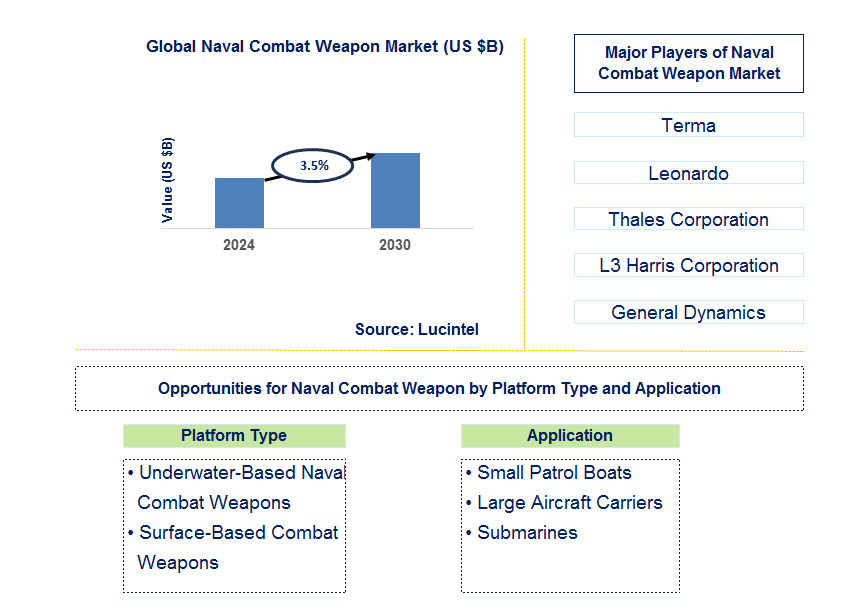
Key data points: The growth forecast = 3.5% annually for the next 6 years. Scroll below to get more insights. This market report covers trends, opportunities, and forecasts in the global naval combat weapon market to 2030 by platform type (underwater-based naval combat weapons and surface-based combat weapons), application (small patrol boats, large aircraft carriers, and submarines), and region (North America, Europe, Asia Pacific, and the Rest of the World)
We'll send your sample report shortly.
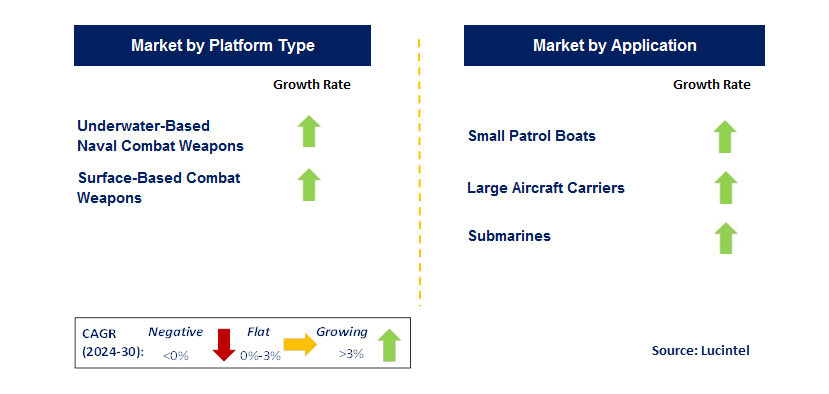
• Lucintel forecasts that, within the type category, underwater-based naval combat weapons is expected to witness a higher growth over the forecast period.
• Within the application category, submarines will remain the largest segment due to enlarging the navy and updating the current submarine fleet.
• In terms of regions, APAC is expected to witness the highest growth over the forecast period due to increase investment in defense in this region. Gain valuable insight for your business decisions with our comprehensive 150+ page report
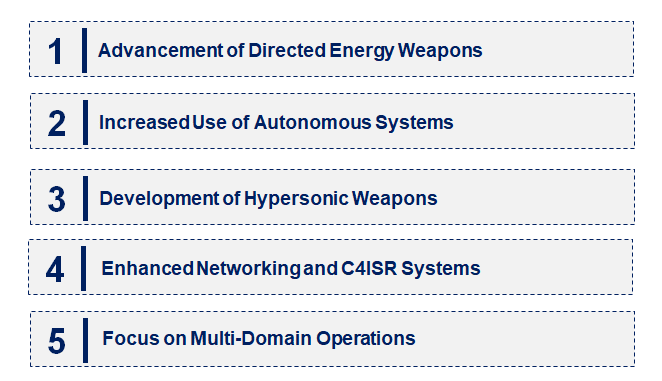
• Advancement of Directed Energy Weapons: Directed energy weapons, such as lasers and high-energy microwave systems, are becoming more common among naval forces in combat. They can neutralize incoming threats, including missiles or drones, with minimal collateral damage and high precision. Directed energy weapons provide advanced naval force capabilities for intercepting or neutralizing strikes, including hypersonic ones. These platforms integrate efficiency and accuracy, making it easier to deal with future threats.
• Increased Use of Autonomous Systems: Naval forces are increasingly integrating autonomous systems, including unmanned surface vehicles (USVs) and unmanned underwater vehicles (UUVs). These platforms are used for reconnaissance, mine countermeasures, and anti-submarine warfare, among other capabilities. They can operate in dangerous areas, reducing risks for human personnel. There is a shift toward increased autonomy and agility in naval operations to improve mission efficacy through automation and limit operational risks.
• Development of Hypersonic Weapons: A major emerging trend in the market is the development of hypersonic weapons. With speeds greater than Mach 5, hypersonic missiles are fast and maneuverable, making them difficult to intercept. These weapons enhance offensive capabilities by providing better strike potential for deterrence purposes. This focus on supersonic technology highlights the importance of deep-strike capabilities and the need for rapid response during modern maritime warfare.
• Enhanced Networking and C4ISR Systems: Advanced Command, Control, Communications, Computers, Intelligence, Surveillance, and Reconnaissance (C4ISR) systems have contributed to the advancement of naval combat capabilities. Improved networking and the integration of C4ISR systems result in better situational awareness, real-time data sharing, and coordinated responses within naval forces. Network-centric warfare is facilitated by more sophisticated C4ISR systems, improving the Navy’s ability to operate effectively in complex and dynamic military environments.
• Focus on Multi-Domain Operations: The future of naval combat systems is being shaped by the emphasis on multi-domain operations (MDO), combining air, land, and cyber domains with naval forces to achieve operational synergy. The development of multi-domain combat systems allows navies to operate seamlessly across different domains while addressing a wide range of threats. This trend reflects the growing necessity for a holistic approach to modern naval warfare in a volatile and interconnected operating environment. The naval combat weapon market is experiencing emerging trends such as the rise of directed energy weapons, the increased use of autonomous systems, the development of hypersonic weapons, improved networking and C4ISR systems, and a focus on multi-domain operations. These trends indicate an increased demand for precision-guided munitions (PGMs), unmanned platforms (UxVs), and networked forces in modern maritime warfare. This enables naval forces to carry out various military missions efficiently and effectively.
• Advancement of Directed Energy Weapons: Modern naval battle plans include laser and microwave-directed energy weapons, designed for use at sea. The US Navy has deployed the Laser Weapon System (LaWS) on the USS Ponce, demonstrating its capability to neutralize small boats, drones, or approaching missiles. High-energy microwave systems also promise efficient ways of disabling adversary vessels’ electrical systems. These technologies offer scalable solutions against multiple threats, enhancing the Navy's defense capabilities.
• Development of Hypersonic Weapons: The trend toward hypersonic speed has shaped many naval weapons programs, such as the US Navy’s Conventional Prompt Strike program. Hypersonic missiles are fast and maneuverable, making them difficult to intercept. Their development enhances offensive power and provides a strategic advantage in maritime combat, influencing force projection and deterrence strategies.
• Integration of Advanced Anti-Ship Missiles: There is a growing emphasis on integrating anti-ship missile systems into naval platforms as part of the global arms race. Examples include China’s DF-21D/DF-26 anti-ship ballistic missiles and India’s BrahMos missile. These missiles are designed for precision strikes over long distances, significantly enhancing maritime strike capabilities and supporting anti-access/area denial (A2/AD) strategies.
• Enhancement of Naval Platforms with Advanced Sensors: Modern warships are equipped with advanced sensors and radar systems to improve situational awareness and combat effectiveness. The U.S. Navy’s Zumwalt-class destroyers possess state-of-the-art multi-function radars and stealth capabilities. Similarly, Japan’s Atago-class destroyers feature the latest radar technology for improved detection and tracking of various threats, enhancing naval warfare efficiency.
• Increased Focus on Autonomous Systems: Autonomous systems, such as unmanned underwater vehicles (UUVs) and unmanned surface vehicles (USVs), are increasingly used in naval operations for reconnaissance, surveillance, and combat. The US Navy’s Sea Hunter, an unmanned autonomous surface vessel, represents growing interest in autonomous naval platforms. The use of autonomous systems broadens operational scope while reducing risks to human personnel, reflecting the trend toward automation in naval warfare. The recent developments in the naval combat weapon market indicate a shift toward more sophisticated systems. These innovations, driven by advancements in directed energy weapons, hypersonic missiles, anti-ship missile systems, and improved sensors and autonomous technology, enhance both offensive and defensive capabilities. They enable naval forces to project power and maintain maritime superiority in a rapidly evolving security environment.
• Advanced Missile Systems: The development and integration of advanced missile systems offer significant growth potential. Technological advancements have improved the accuracy of surface-to-air, air-to-surface, and anti-ship missiles, enhancing strike capabilities. The deployment of hypersonic and long-range anti-ship missiles is driving demand for sophisticated missile technology, creating opportunities for companies specializing in missile development and integration.
• Directed Energy Weapons: Directed energy weapons, such as lasers and high-energy microwave systems, are an emerging focus for the industry. These systems provide precise defense solutions against drones and missiles. The development of directed-energy systems presents opportunities for companies to gain a competitive edge by offering cost-effective and adaptable defense technologies.
• Autonomous and Unmanned Systems: There are many growth opportunities in autonomous and unmanned systems, including unmanned underwater vehicles (UUVs) and unmanned surface vehicles (USVs). These systems improve reconnaissance, surveillance, and combat capabilities while minimizing risks to human personnel. The increased operational flexibility and cost efficiency of autonomous systems create prospects for companies offering advanced solutions in this field.
• Network-Centric Warfare Systems: The development of advanced network-centric warfare systems presents a significant growth opportunity. Improved communication and integration systems enhance situational awareness and operational coordination among naval forces. Companies that offer networking and integration solutions can meet the growing demand for more effective naval combat operations.
• Integration of Advanced Sensor Systems: The incorporation of advanced sensor systems into naval platforms presents growth opportunities by improving threat detection, tracking, and engagement. Companies specializing in sensor technology and integration will experience increased demand as navies worldwide upgrade their fleets with state-of-the-art sensors Advancements in missile systems, directed energy weapons, autonomous systems, network-centric warfare, and sensor technology present strategic growth opportunities in the naval combat weapon market. These emerging areas reflect the evolving needs of modern navies and the demand for innovative approaches to enhance combat effectiveness. Companies that focus on these areas can strengthen their market positions and contribute to high-tech naval combat solutions.
• Technological Advancements: Technological advancement has been a major driver of growth in the naval combat weapon market. Innovations in arms such as directed energy systems, hypersonic missiles, and autonomous systems have strengthened naval capabilities for battle situations. These advancements lead to investments as new technologies emerge since competitors aim to maintain supremacy, thus enhancing defense against emerging threats facing the navy sector. Performance improvements and the extension of scope in aquatic operations require evolving technologies.
• Geopolitical Tensions: Geopolitics and regional conflicts can drive demand for weaponry used in maritime warfare. Increased tensions between states or disagreements over borders cause an increase in funds spent on sophisticated naval capabilities while securing territorial waters within nations’ exclusive economic zones (EEZs). The quest by countries to enhance their defense postures while countering potential threats leads to an increased demand for advanced carriers of military equipment at sea levels internationally.
• Modernization of Naval Fleets: Modernization of the world’s navies is a major driver in the market. Navies have been investing in upgrading old platforms and replacing them with new systems and technologies. This modernization includes new weapon systems, sensors, and combat ships. Modernizing naval forces is essential for addressing emerging threats and increasing operational competence, which drives growth in the naval combat weapons market.
• Increased Defense Budgets: Enhanced defense budgets, particularly among prominent naval powers, drive investments in naval weaponry. Higher budget allocations to defense spending allow governments to acquire more sophisticated arms technology, develop new weaponry, and build up their navies. States with growing security budgets allocate significant funds to naval warfare capabilities as a strategy for safeguarding territorial integrity and ensuring maritime security.
• Focus on Multi-Domain Operations: The emphasis on multi-domain operations combining navy, air, land, and cyber domains leads to the development of new types of combat systems. For effective operation in multi-domain warfare, merging various capabilities is necessary. This encourages the creation of networks facilitating cooperation between different domains, driving demand for sophisticated naval battle approaches. Challenges in the naval combat weapon market include:
• Regulatory Constraints: Export controls and international arms agreements present major challenges in the naval combat weapon market. The development, deployment, and international sale of advanced weaponry are affected by strict regulations. Complying with these regulations can prevent entry into markets and slow the adoption of new technology. Companies wishing to expand their market presence must carefully navigate the complex regulatory environment to comply with legal requirements.
• Budget Constraints: Defense procurement and investment in naval combat systems face challenges from budget constraints. Decreases in military spending due to economic fluctuations or fiscal limitations can lead to reductions in defense budgets, causing delays in modernization programs. The availability of funds influences navies' ability to invest in high-end technologies while maintaining operational readiness. Strategic prioritization of investments is necessary to address budgetary pressures while continuing to enhance capabilities.
• Technological Integration: Incorporating new technologies into existing naval platforms is a significant challenge. Modern naval combat systems require seamless integration between advanced weaponry, sensors, and communication systems. These technologies are complex, and achieving interoperability makes integration difficult. Overcoming these obstacles is essential for maximizing the effectiveness of new systems to ensure they operate cohesively during missions. Effective integration strategies are needed to attain the desired performance and capabilities for advanced naval combat systems. The growth and development of the naval combat weapons market are influenced by several drivers and challenges. Key factors include technological advancements, geopolitical tensions, fleet modernization programs, increasing defense budgets, and a focus on multi-domain operations that drive innovation and expand the market's scope. Meanwhile, regulatory constraints, budget limitations, and technological integration challenges hinder market dynamics. Stakeholders who understand these drivers can leverage them to chart a course through the evolving landscape of the naval combat weapon market and facilitate further growth in naval combat capabilities.
• Terma
• Leonardo
• Thales Corporation
• L3 Harris Corporation
• General Dynamics Corporation
• SAAB
• Elbit Systems
• Kongsberg Gruppen
• Raytheon Corporation
• Lockheed Martin Corporation
• Underwater-Based Naval Combat Weapons
• Surface-Based Combat Weapons
• Small Patrol Boats
• Large Aircraft Carriers
• Submarines
• North America
• Europe
• Asia Pacific
• The Rest of the World
• United States: The recent changes in U.S. naval combat weapons focus on improved operational capabilities and the integration of advanced technologies. To counter evolving missile threats, the U.S. Navy has invested in directed energy weapons such as laser systems. Furthermore, the development and deployment of Zumwalt-class destroyers feature advanced stealth technology coupled with multi-function radar systems. The country also plans to integrate hypersonic weapons to maintain its superiority in sea warfare. Efforts are underway to overhaul existing platforms while developing new ones to address both asymmetric and conventional threats.
• China: China has made significant strides in its naval combat weapon capabilities, focusing mainly on advanced missile systems along with naval platforms. Anti-ship missiles such as the DF-21D and DF-26 have enhanced the People's Liberation Army Navy’s (PLAN) Anti-Access/Area Denial (A2/AD) capabilities. The commissioning of new Type 052D destroyers and Type 055 destroyers reflects China's intention to increase its naval firepower while improving multi-role capacities across its navy. Investments in electromagnetic railguns and submarine-based missiles signal China’s plans for naval deterrence and power projection in the Indo-Pacific.
• Germany: Germany continues to develop its naval combat capabilities with next-generation frigates and corvettes. The German Navy's new F125-class frigates come with improved stealth features and advanced combat systems, including electronic warfare and missile defense technologies. Germany is also incorporating unmanned systems, such as autonomous underwater vehicles (AUVs), for mine countermeasures. Participation in European collaborative defense projects, such as the European Patrol Corvette (EPC) program, demonstrates Germany's commitment to naval modernization and strengthening collective European defense capabilities.
• India: India is aggressively expanding and modernizing its naval combat capabilities to enhance maritime security and power projection. Indian Navy’s latest platforms, such as Kolkata-class destroyers and Vishal-class aircraft carriers, are equipped with advanced weaponry and radar systems. The BrahMos supersonic cruise missile program has significantly boosted India’s striking capabilities. India also plans to invest in indigenous defense technologies, including advanced submarine-launched ballistic missiles (SLBMs) and network-centric warfare systems, to strengthen deterrence and boost its strategic outreach in the Indian Ocean region.
• Japan: Japan is putting considerable effort into modernizing its naval combat systems to address regional security challenges and enhance maritime capabilities. The Japan Maritime Self-Defense Force (JMSDF) has been incorporating advanced technologies into its Aegis-equipped destroyers and new Atago-class destroyers. Japan is also developing next-generation anti-ship and anti-submarine warfare systems. These include the deployment of the Type 12 anti-ship missile and advancements in naval robotics and autonomous systems. These improvements underscore Japan's focus on enhancing its defensive and offensive capabilities, aimed at maintaining maritime security and regional stability.


• Terma
• Leonardo
• Thales Corporation
• L3 Harris Corporation
• General Dynamics Corporation
• SAAB
• Elbit Systems
• Kongsberg Gruppen
• Raytheon Corporation
• Lockheed Martin Corporation Q6. Which naval combat weapon market segment will be the largest in future? Answer: Lucintel forecasts that underwater-based naval combat weapons is expected to witness a higher growth over the forecast period. Q7. In naval combat weapon market, which region is expected to be the largest in next 5 years? Answer: APAC is expected to witness the highest growth over the forecast period due to increase investment in defense in this region. Q.8 Do we receive customization in this report? Answer: Yes, Lucintel provides 10% customization without any additional cost.


Choose a license that fits your team. Instant PDF delivery.
Prices exclude taxes. Instant delivery. Custom licensing available on request.
Market Report · July 31, 2026
Market Report · July 31, 2026
Market Report · July 31, 2026
Trusted partner for strategic intelligence and business growth


Receive a complimentary market analysis tailored to your industry. Our analysts will identify key growth opportunities and competitive dynamics specific to your business.

Market size, growth rate, and key trend analysis for your specific sector.

Top competitor positioning and market share analysis.

Strategic recommendations backed by data-driven insights.
Get curated market intelligence and competitive moves straight to your inbox.
By subscribing, you agree to receive our monthly insights. Unsubscribe anytime.
Receive a complimentary market analysis tailored to your industry. Our analysts will identify key growth opportunities and competitive dynamics specific to your business.
Market size, growth rate, and key trend analysis for your specific sector.
Top competitor positioning and market share analysis.
Strategic recommendations backed by data-driven insights.
Get curated market intelligence, emerging trends, and competitive moves straight to your inbox each month.
By subscribing, you agree to receive our monthly insights. Unsubscribe anytime.
We'll send your sample report shortly.