
Market Report · July 31, 2026

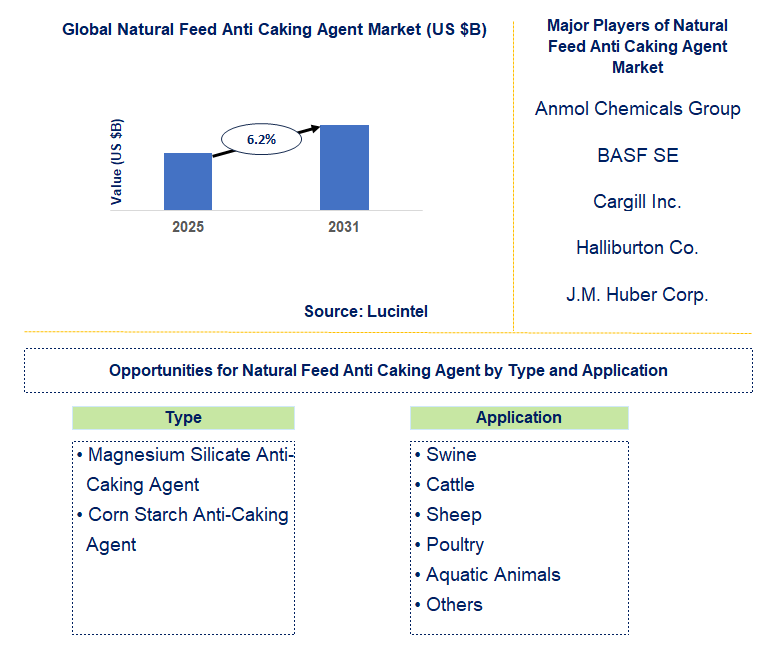
Key data points: The growth forecast = 6.2% annually for the next 7 years. Scroll below to get more insights. This market report covers Trends, opportunities and forecasts in natural feed anti caking agent market to 2031 by type (magnesium silicate anti-caking agent and corn starch anti-caking agent), application (swine, cattle, sheep, poultry, aquatic animals, and others), and region (North America, Europe, Asia Pacific, and the Rest of the World)
We'll send your sample report shortly.
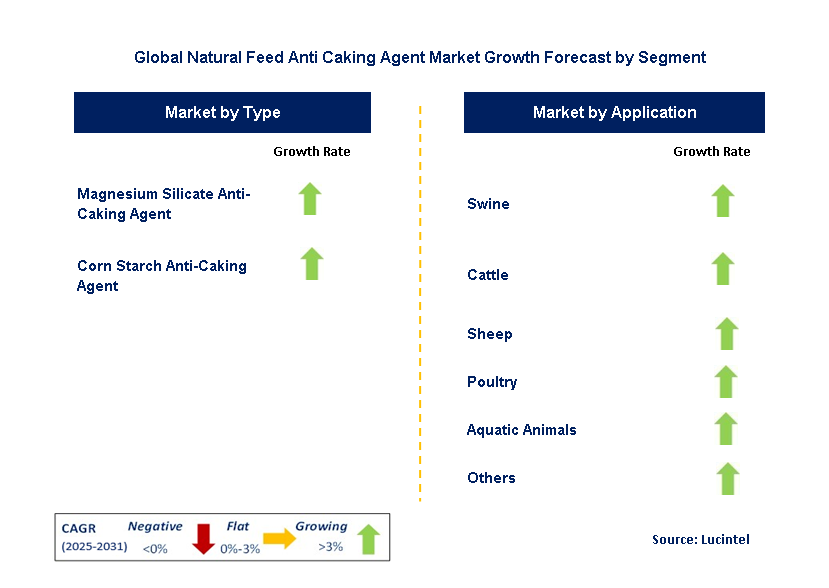
• Lucintel forecasts that, within the type category, magnesium silicate anti-caking agent is expected to witness higher growth over the forecast period due to the growing usage in feed formulations.
• Within the application category, poultry is expected to witness the highest growth due to the rising demand for poultry products.
• In terms of region, APAC is expected to witness the highest growth over the forecast period due to the increasing adoption of anti-caking agents.
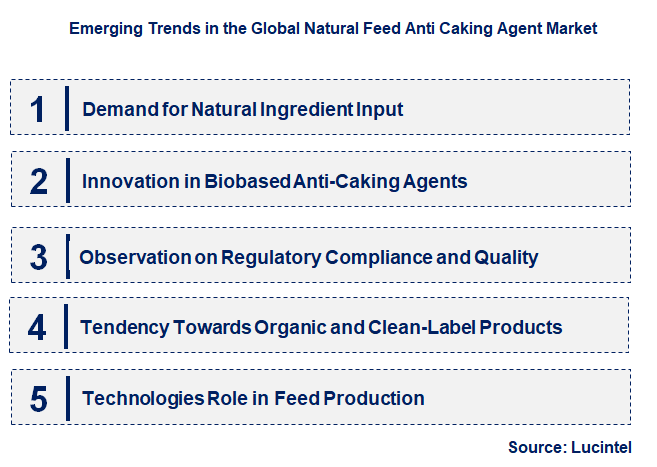
• Demand for Natural Ingredient Input: The use of natural ingredients in animal feed products have been increasing due to the growing demand for organic and non-GMO products. Plant-based natural anti-caking agents are gaining more attention, as manufacturers are starting to use them more in their products. This is particularly true in the United States, Germany, and Japan where there is a growing consumer demand for product ingredient transparency. Moreover, anti-caking plant or mineral options are becoming more popular as their safety and sustainability compared to synthetic options is much higher.
• Innovation in Biobased Anti-Caking Agents: A major trend in the market is the production of biobased anti-caking agents from renewable resources. Investments into new technologies by firms aimed at developing effective and environmentally friendly plant-based agents is on the rise. The need for increased sustainability alongside growing regulatory requirements makes the use of biobased agents much more desirable. Using these agents aids in reducing the environmental footprint from feed production which is increasingly desired. This makes it highly likely that the bio-based segment will experience dramatic growth in the foreseeable future, specifically around Europe where sustainability is heavily emphasized.
• Observation on Regulatory Compliance and Quality: There are governmental regulations that pertain specifically to the safety of animal feed. Compliance with these regulations drives the need for safe, quality anti-caking agents. In Europe and the US, regulations are now guiding feed producers toward the use of more transparent and safer food grade ingredients. These regulations are influencing the market for natural feed additives that require non-toxic, natural, and compliant agents with health and services standards. Thus, the market is shifting towards ingredients that conform to local laws and global safety regulations.
• Tendency Towards Organic and Clean-Label Products: The anti-caking feed additives are naturally organic, and as the demand for clean label products grows, so does their use. Clean-label products are on the rise, especially for the consumers who are concerned about the agro-industrial supply chain ingredients. Consequently, manufacturers of feeds are adopting the use of natural ingredients to improve the additive value of their products. This is more pronounced in developed economies like USA and Germany where the citizens understand the advantages of non-GMO and organic feeds.
• Technologies Role in Feed Production: The adoption of new technologies in feed production is improving its sustainability and efficiency. Automated systems as well as monitoring in real time are now being utilized to maximize the application of natural feed additives, such as anti-caking agents. In addition, the use of precision farming is enabling livestock feed formulations to be more accurately matched with the particular requirements of the animals, increases efficiency and quality. Innovations of these kinds are increasing the consistency and effectiveness of the feeds which subsequently increases the need for high grade anti-caking agents which can aid in these modern methods of production. The emerging trends such as the increase of natural components bio-based anti caking agents, law compliance, rising demand for organic products, and new technology are changing the dynamics of the natural feed anti caking agent market. The market is expected to expand with the evolution of these trends as consumers shift towards more environmentally friendly, safe, and capable feed solutions. Those manufacturers who meet these trends by providing natural, non-toxic, and excellent products will benefit in meeting the anticipated high demand.
• Increase in Usage of Cellulose, Rice Husk, and Algae as Anti Caking Feed Additives: The rise in adoption of clean-label products is one of the significant trends that affected the marketing, which subsequently led to its increased use in animal feed. Anti caking agents utilize unconventional feed materials such as cellulose, rice husk,, and algae. These plant materials are comparatively safer with lesser chances of impacting the ecology and environment. The set of emerging plant-based agents is gaining more significant traction due to rising demand and emerging consumers' preference for organic products. Apart from that, it is also associated with the drastic shift towards sustainable approach in agriculture and livestock farming in Europe and North America.
• Improvement of Production Methods through New Technologies: The creation of a natural feed anti caking agent has recently become more cost-effective as well as effective. Companies have been able to produce more cost effective and efficient agents due to new manufacturing processes such as better drying techniques and biodegradable material utilization. These changes are encouraging the use of natural feed additives in the livestock sector where quality and cost is very important. Improved production procedures is also aiding in fulfilling the rising demand for these agents in various regions.
• Enhanced Attention towards Feed Safety Compliance by Regulators: Important market regulators like the U.S., EU, and China have started implementing additional regulations pertaining to the safety of feed products as well as their ingredients. This has brought about the need for compliance by natural feed additives. The heightened concern for feed safety has contributed to the growing use of natural anti-caking agents in the apprehension by manufacturers to comply with safety standards and the use of chemicals. This change in regulation is motivating businesses to transform their strategies in the use of feed additives that are clean and sustainable which is advantageous to the market and customers.
• Growth in the Asia Pacific Region: The natural feed anti-caking market is evolving with the expansion of the Asia Pacific region which is caused by the demand for animal feed due to the increased consumption of meat and livestock. The rising economies of India and China are now becoming more concerned with the quality of feed which is resulting in the use of natural feed additives that help in maintaining the integrity of feed during storage and transportation. As the agricultural infrastructure of the region continues to develop, the need for natural feed additives is greatly anticipated, allowing for market growth opportunities.
• Partnership with Agricultural Firms: Partnerships between agricultural service providers and manufacturers of feed additives is on the rise, thereby encouraging innovation and product development. These partnerships enable firms to create tailored anti-caking products for livestock producers, helping to meet their specific requirements. It is expected that these partnerships will accomplish more targeted and effective feed additives that improve the quality of feed and promote environmentally friendly farming. There has been a shift towards innovation, sustainability, and policy compliance within the natural feed anti caking agents industry. The market is expanding due to the heightened adoption of plant-based agents, improvements in production technologies, changes in regulation, and growth of the market in Asia. As the industry develops, these changes will continue to impact the future of feed additives for the positive and sustain the success of the market.
• Organic Feed Additives: Bio-based solutions such as organic branded products seem to be gaining more interest especially from consumers in North America and Europe as these countries look for clean labeled products. The efficiency and market capture of bio-based solutions mark a progression for economies still developing. Anti-caking bio-based agents help prevent the agglomeration of feed while having less impact on the environment. There is a growing acceptance for the use of bio-based feed additives in production processes. Their use should follow the rise of demand for sustainable and non-toxic feed solutions. Bio-based feed additives have the potential to mark new growth opportunities.
• Organic Feed Production: Food safety and sustainability have proven to make people more conscious which in turn increases the demand for organic solutions in animal feed production. The marketing and selling of feed that meets organic standards is actively spreading around the globe thanks to greater acceptance of such products. These provide added value to animal feed and use natural substances these feed additives that are claimed organic. As these trends increase sustainably, the demand in organic anti-caking agents will also increase, thus providing further growth potential to Natural Feed Additives manufacturers.
• Surge of Animal Feed Exports: The global trade of animal feed is growing, especially in developing regions of Asia and Africa, and with it, the demand for effective feed additives, like anti-caking agents, is rising. For these regions’ livestock industries to thrive, local manufacturers need to tailor their products accordingly. Export markets provide a great opportunity, especially for those suppliers who specialize in premium natural feed additives and are willing to focus on these growing economies.
• Adoption of New Technologies in Feed Manufacture: Innovations in feed manufacture, like automation and precision farming, open new windows for the use of sophisticated feed additives. The adoption of these technologies will greatly enhance the demand for specially-designed natural anti-caking agents. If producers outfit their systems with natural additives, they can simplify the automation and data collection processes, resulting in greater efficiency and product uniformity. This will ultimately benefit the industry.
• Tailored Feed Additives: The increasing shift towards individualized animal nutrition gives an impetus for the manufacturers to formulate specialized anti-caking agents. Custom-made feed additives for various livestock species or production systems can improve the efficiency and quality of feed. This movement is particularly strong in the U.S. and Europe, where highly qualified and precise solutions are needed. Customization helps companies stand out in a competitive market. The market of natural feed anti caking agent has many potential avenues for forward movement in the form of bio-based and organic feedstock, foreign market sourcing, incorporation of new technology, and specialization. Using these potentials, manufacturers will have better chances of being successful in a developing global market which is focused on quality and sustainability.
• Anmol Chemicals Group
• BASF
• Cargill
• Halliburton
• J.M. Huber
• Kao
• Kemin Industries
• Mitsui
• RAG-Stiftung
• Roquette Freres
• Magnesium Silicate Anti-Caking Agent
• Corn Starch Anti-Caking Agent
• Swine
• Cattle
• Sheep
• Poultry
• Aquatic Animals
• Others
• North America
• Europe
• Asia Pacific
• The Rest of the World
• United States: The emphasis on premium feed has surged the demand for natural feed anti caking agents tremendously in the United States. Plant-based additives are driving the U.S. market because they are much safer and provide better value for money to livestock. It has become common practice among primary stakeholders in the feed industry to adopt these agents in order to improve feed quality and prevent the feed from clumping and becoming stale during storage. There is a growing demand for information on the composition of ingredients by regulatory bodies which has resulted in the increased use of organic non-GMO anti-caking agents that comply with consumer's changing needs for environmentally friendly and safer feeds.
• China: The expanding middle class in China, which is leading to more consumption of animal products, is increasing the demand for natural feed anti caking agents within the livestock industry. Innovations in plant-derived anti-caking agents are being developed as they are seen as less harmful to the environment than synthetic ones. Additionally, the Chinese government has implemented stricter quality and safety regulations concerning the animal feed industry, which encourages the application of natural agents in feeds. All of these factors have culminated in a greater movement towards more natural and sustainable feed products in order to comply with government regulations and consumer demands for clean-label products.
• Germany: Germany holds a prominent position within the European market for the natural feed anti caking agent business due to its strong agriculture and livestock sectors. German companies are increasingly shifting towards sustainable and organic options of synthetic anti-caking agents because of the increased demand for green solutions. The shift towards safe plant-based vitality anti-caking agents, like those made from natural clays and cellulose, is on the rise as they improve feed safety and quality. In addition, the European Union guidelines, which are some of the most stringent in the world for animal feed safety and environmental effect, have enabled the use of these natural agents in order to ensure compliance with such high standards.
• India: The market for natural feed anti caking agents is growing rapidly in India due to the increasing quality requirements of animal feed for the upliftment of livestock. The focus is on rice husk and plant-based natural anti-caking agents that are economical. The uptake of these agents is being driven by the government’s efforts towards enhancing agriculture efficiency and encouraging green farming practices. Moreover, the modernization of the Indian feed industry will lead to increased application of natural feed additives because of the rising concerns regarding the quality of feed and the safety of animal products.
• Japan: The livestock sector in Japan is advanced, hence the need for natural feed anti caking agents are used with much attention on quality and sustainability. The use of plant and mineral based anti-caking agents is now being embraced by feed manufacturers due to the stringent needs of Japanese consumers for clean label products. Also, the Japan regulations which demand food safety and careful assessment of environmental impacts encourage the use of natural additives which comply with the set stringent standards. As Innovation of animal feed technology progresses in Japan, the compliance of consumers and regulation demands will be achieved by increasing the use of natural feed anti caking agents.


• Anmol Chemicals Group
• BASF
• Cargill
• Halliburton
• J.M. Huber
• Kao
• Kemin Industries
• Mitsui
• RAG-Stiftung
• Roquette Freres Q5. Which natural feed anti caking agent market segment will be the largest in future? Answer: Lucintel forecasts that, within the type category, magnesium silicate anti-caking agent is expected to witness higher growth over the forecast period due to the growing usage in feed formulations. Q6. In natural feed anti caking agent market, which region is expected to be the largest in next 5 years? Answer: In terms of region, APAC is expected to witness the highest growth over the forecast period due to the increasing adoption of anti-caking agents. Q7. Do we receive customization in this report? Answer: Yes, Lucintel provides 10% customization without any additional cost.


Choose a license that fits your team. Instant PDF delivery.
Prices exclude taxes. Instant delivery. Custom licensing available on request.
Market Report · July 31, 2026
Market Report · July 31, 2026
Market Report · July 31, 2026
Trusted partner for strategic intelligence and business growth


Receive a complimentary market analysis tailored to your industry. Our analysts will identify key growth opportunities and competitive dynamics specific to your business.

Market size, growth rate, and key trend analysis for your specific sector.

Top competitor positioning and market share analysis.

Strategic recommendations backed by data-driven insights.
Get curated market intelligence and competitive moves straight to your inbox.
By subscribing, you agree to receive our monthly insights. Unsubscribe anytime.
Receive a complimentary market analysis tailored to your industry. Our analysts will identify key growth opportunities and competitive dynamics specific to your business.
Market size, growth rate, and key trend analysis for your specific sector.
Top competitor positioning and market share analysis.
Strategic recommendations backed by data-driven insights.
Get curated market intelligence, emerging trends, and competitive moves straight to your inbox each month.
By subscribing, you agree to receive our monthly insights. Unsubscribe anytime.
We'll send your sample report shortly.