
Report Feature
Nanowire Battery Market Trends and Forecast
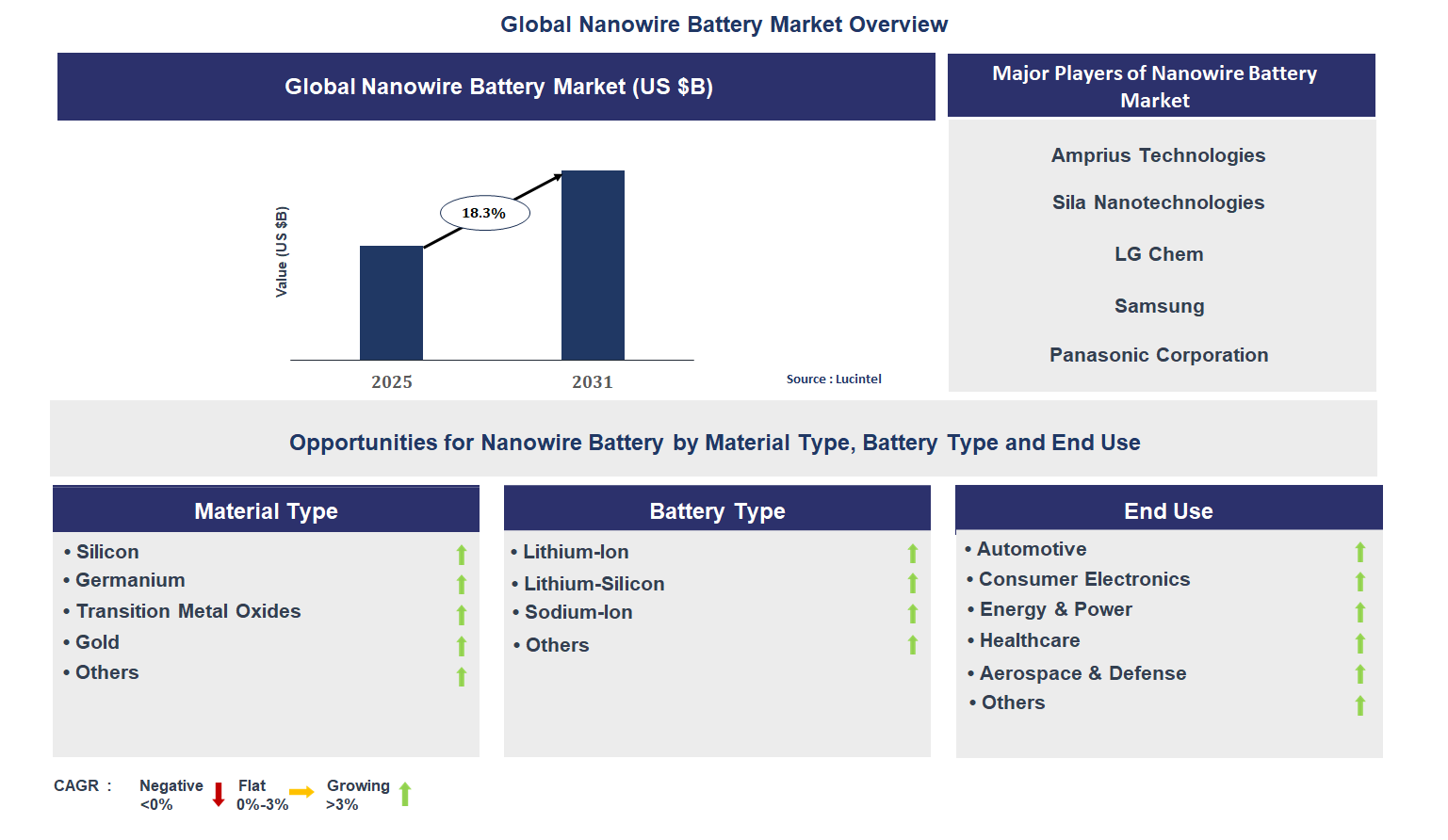
The future of the global nanowire battery market looks promising with opportunities in the automotive, consumer electronics, energy & power, healthcare, and aerospace & defense markets. The global nanowire battery market is expected to grow with a CAGR of 18.3% from 2025 to 2031. The major drivers for this market are the increasing demand for high-capacity energy storage, the rising investment in advanced battery technologies, and the growing adoption of electric vehicles.• Lucintel forecasts that, within the material type category, silicon is expected to witness the highest growth over the forecast period.
• Within the end use category, automotive is expected to witness the highest growth.
• In terms of region, APAC is expected to witness the highest growth over the forecast period. Gain valuable insights for your business decisions with our comprehensive 150+ page report. Sample figures with some insights are shown below.
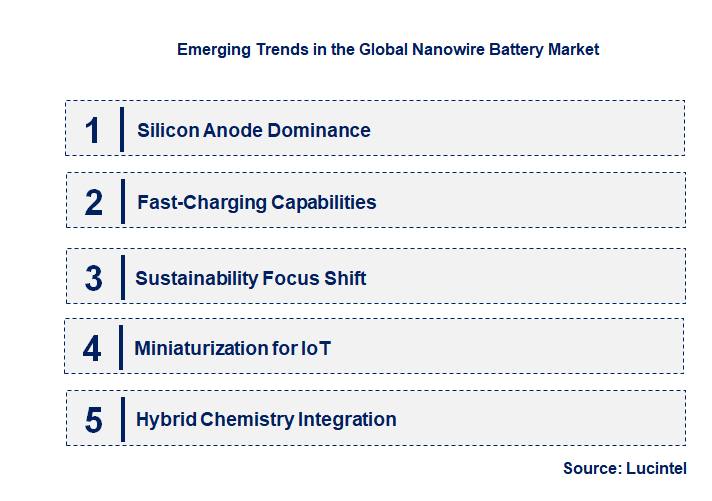
Emerging Trends in the Nanowire Battery Market
Trends in the nanowire battery market emphasize anode enhancements for superior performance in compact devices. Advancements in synthesis and integration tackle expansion issues, fueling EV and IoT growth. These shifts challenge conventional limits with eco-friendly scalability. They unlock versatile, rapid-charging energy options.• Silicon Anode Dominance: Nanowires mitigate silicons swelling for 10x capacity over graphite, enabling slimmer packs. Coatings stabilize cycles. Impact boosts EV ranges, trims weights, and attracts automakers, redefining portability in electronics.
• Fast-Charging Capabilities: Optimized structures cut recharge to minutes via improved ion pathways. Electrolyte pairings prevent heat buildup. This revolutionizes fleets, reduces urban downtime, and integrates with grids for peak efficiency.
• Sustainability Focus Shift: Recyclable nanowires reduce rare-metal use, aligning with green regs. Bio-derived supports minimize impacts. The trend secures subsidies, appeals to eco-brands, and promotes circular chains in renewables.
• Miniaturization for IoT: Micro-scale designs power sensors with high density in tiny volumes. Precision printing ensures uniformity. Impact drives edge computing, extends remote ops, and inspires swarm tech with lightweight energy.
• Hybrid Chemistry Integration: Pairings with solid-state yield safer, denser cells for wearables. Nanostructuring curbs dendrites. This enhances thermal stability, widens consumer apps, and draws investments for reliable storage. Conclusion: These trends reshape the nanowire battery market by prioritizing density and eco-viability. They bridge tech hurdles, expand from EVs to IoT. Overall, innovations foster dynamic scaling. This cements nanowires as disruptors in energy paradigms.
Recent Development in the Nanowire Battery Market
Nanowire battery developments spotlight synthesis and electrode breakthroughs for commercialization. From pilots to material refinements, they overcome durability gaps. These milestones merge labs with industry for deployment. They herald a niche sector maturing toward broad impact.• Silicon Nanowire Scaling: U.S. prototypes achieve 1,000 cycles at high capacity, using low-cost catalysts. Integrates with EV packs. This accelerates automotive pilots, cuts costs, and sets endurance benchmarks for transport.
• Graphene-Enhanced Foam: Chinese variants retain 99.7% conductivity post-cycles, suiting renewables. Lab outputs rival premiums. The innovation slashes degradation, boosts grid buffering, and elevates export competitiveness.
• Sodium-Ion Pilot Launch: Indian fast-charging designs hit 80% in minutes for off-grid use. Abundant materials aid scalability. Impact empowers rural access, diversifies chemistries, and models affordable storage.
• Manganese-Boost Density Leap: Japanese cells reach 820 Wh/kg without decay, targeting hybrids. Alloy tweaks enhance output. This greens aviation, extends missions, and inspires consumer analogs.
• Recyclable Coating Advance: Global R&D yields 95% recoverable nanostructures for wearables. Printing compatibility streamlines. Consequences align with regs, lower lifecycles, and promote sustainable production. These developments impact the nanowire battery market by amplifying practicality and reach. They ignite partnerships, surmount stability issues, and diversify roles. Collectively, they propel innovation surges. This transforms storage into efficient, accessible essentials.
Strategic Growth Opportunities in the Nanowire Battery Market
Growth opportunities in the nanowire battery market exploit nanostructures for demanding sectors. From EVs to sensors, they leverage speed for penetration. These strategies fuse tech with applications, capturing values. They drive adoption in electrified ecosystems.• Electric Vehicle Anodes: Nanowires extend ranges by 50% in compact packs, suiting urban fleets. Quick charges minimize stops. Impact hastens electrification, reduces infra costs, and seizes auto shares.
• Consumer Electronics Power: Slim cells energize gadgets with prolonged life, cutting bulk. Durability withstands daily use. This surges sales, fosters loyalty, and embeds in digital portables.
• Grid Storage Buffering: High-cycle modules handle solar variability for dispatch. Scalable fits utilities. Growth secures supplies, optimizes trades, and taps decarbonization aids.
• Wearable Tech Integration: Flexible nanowires fuel trackers seamlessly, boosting comfort. Biocompatibility aids skin use. The opportunity explodes health monitoring, enhances IoT, and yields medtech gains.
• Aerospace Sensor Powering: Lightweight designs prolong drone flights in extremes. Custom fits payloads. This revolutionizes surveillance, lightens loads, and unlocks aerial contracts. These opportunities impact the nanowire battery market by filling performance voids. They amplify integrations, generate revenues, and align with trends. Ultimately, this builds a vibrant domain. It advances sustainable, tech-driven energy worldwide.
Nanowire Battery Market Driver and Challenges
The nanowire battery market grapples with technological, economic, and regulatory dynamics. Drivers like EV booms spur density quests, as synthesis complexities test scalability. These forces interplay for progress. They outline a promising, rigorous field. The factors responsible for driving the nanowire battery market include: 1. Electric Vehicle Surge: EV proliferation demands high-range anodes, favoring nanowires capacity. Incentives accelerate fleets. Implications yield booms, emission cuts, and OEM alliances for packs. 2. Consumer Electronics Demand: Portables crave compact, long-life power, suiting miniaturization. Gadget evolutions multiply need. This fuels shares, spurs refinements, and heightens daily reliance. 3. Renewable Pairing Imperative: Intermittent need durable buffering, where nanowires excel in cycles. Policies favor advanced tech. The driver stabilizes grids, enables arbitrage, and scales clean energy. 4. Synthesis Tech Progress: Nano structuring yields faster ions and stability. R&D collaborations hasten. Consequences boost outputs, diversify apps, and forge edges in storage. 5. Sustainability Mandates: Low-impact designs unlock grants, reducing metals. Recycling matures. This complies with norms, draws eco-funds, and integrates circular practices. Challenges in the nanowire battery market are: 1. Manufacturing Complexity: Intricate nanowire growth inflates costs and yields inconsistencies. Scale lags. This delays markets, limits entrants, and urges process efficiencies. 2. Expansion Volume Issues: Silicon swelling degrades cycles despite coatings. Binders falter. Implications restrict blends, hike redesigns, and demand overhauls for potential. 3. Scalability Barriers: Uniform volume production faces supply volatilities. Chains vulnerable. The challenge confines pilots, widens gaps, and needs infra for rollout. Drivers such as EVs and renewables elevate nanowires to prominence. Challenges like complexity require fixes to realize gains. Net, strong trajectory forms resiliently. This crafts paths for dense, enduring energy breakthroughs.List of Nanowire Battery Companies
Companies in the market compete on the basis of product quality offered. Major players in this market focus on expanding their manufacturing facilities, R&D investments, infrastructural development, and leverage integration opportunities across the value chain. With these strategies nanowire battery companies cater increasing demand, ensure competitive effectiveness, develop innovative products & technologies, reduce production costs, and expand their customer base. Some of the nanowire battery companies profiled in this report include-• Amprius Technologies
• Sila Nanotechnologies
• LG Chem
• Samsung
• Panasonic Corporation
• CATL
• QuantumScape Corporation
• Nexeon Limited
• OneD Battery Sciences
• XG Sciences
Nanowire Battery Market by Segment
The study includes a forecast for the global nanowire battery market by material type, battery type, end use, and region.Nanowire Battery Market by Material Type [Value from 2019 to 2031]:
• Silicon
• Germanium
• Transition Metal Oxides
• Gold
• Others
Nanowire Battery Market by Battery Type [Value from 2019 to 2031]:
• Lithium-Ion
• Lithium-Silicon
• Sodium-Ion
• Others
Nanowire Battery Market by End Use [Value from 2019 to 2031]:
• Automotive
• Consumer Electronics
• Energy & Power
• Healthcare
• Aerospace & Defense
• Others
Nanowire Battery Market by Region [Value from 2019 to 2031]:
• North America
• Europe
• Asia Pacific
• The Rest of the World
Country Wise Outlook for the Nanowire Battery Market
The nanowire battery market advances with silicon-based innovations boosting energy density and charging speeds for EVs and portables. Focus on scalability and cost reduction counters lithium-ion limits amid sustainability drives. Key nations invest in R&D and pilots to lead commercialization. These efforts promise compact, high-performance storage solutions globally.• United States: U.S. firms scale silicon nanowire anodes for fast-charging EV prototypes, achieving higher capacities with federal grants. Recycling integrations reduce waste in consumer electronics. This strengthens supply chains, enhances aerospace endurance, and positions the market for grid-scale adoption, cutting reliance on imports.
• China Innovations: China expands nanowire production for affordable EV cells, leveraging state funds for graphene-enhanced variants. Hybrid systems target urban renewables, improving ion flow. This dominates exports, lowers global prices, and accelerates high-volume manufacturing in electronics and transport.
• Germany: German R&D pilots sodium-ion nanowire batteries for safer wind integration, backed by EU investments. Modular designs suit automotive hybrids, emphasizing recyclability. These align with green mandates, bolster grid stability, and advance material recovery in industrial storage.
• India: Indian labs develop silicon nanowires on current collectors for low-cost Li-ion upgrades in two-wheelers. Fast-charging sodium variants address rural solar needs. This spurs local assembly, creates jobs, and embeds sustainable power in off-grid mobility solutions.
• Japan: Japanese innovators refine manganese-boosted nanowire cells for 820 Wh/kg density in EVs, focusing on cycle life. Solid-state hybrids enhance wearables endurance. This elevates precision exports, supports aerospace, and drives clean tech in infrastructure.

Features of the Global Nanowire Battery Market
Market Size Estimates: Nanowire battery market size estimation in terms of value ($B). Trend and Forecast Analysis: Market trends (2019 to 2024) and forecast (2025 to 2031) by various segments and regions. Segmentation Analysis: Nanowire battery market size by material type, battery type, end use, and region in terms of value ($B). Regional Analysis: Nanowire battery market breakdown by North America, Europe, Asia Pacific, and Rest of the World. Growth Opportunities: Analysis of growth opportunities in different material types, battery types, end uses, and regions for the nanowire battery market. Strategic Analysis: This includes M&A, new product development, and competitive landscape of the nanowire battery market. Analysis of competitive intensity of the industry based on Porter’s Five Forces model.
FAQ
Q1. What is the growth forecast for nanowire battery market? Answer: The global nanowire battery market is expected to grow with a CAGR of 18.3% from 2025 to 2031. Q2. What are the major drivers influencing the growth of the nanowire battery market? Answer: The major drivers for this market are the increasing demand for high-capacity energy storage, the rising investment in advanced battery technologies, and the growing adoption of electric vehicles. Q3. What are the major segments for nanowire battery market? Answer: The future of the nanowire battery market looks promising with opportunities in the automotive, consumer electronics, energy & power, healthcare, and aerospace & defense markets. Q4. Who are the key nanowire battery market companies? Answer: Some of the key nanowire battery companies are as follows:• Amprius Technologies
• Sila Nanotechnologies
• LG Chem
• Samsung
• Panasonic Corporation
• CATL
• QuantumScape Corporation
• Nexeon Limited
• OneD Battery Sciences
• XG Sciences Q5. Which nanowire battery market segment will be the largest in future? Answer: Lucintel forecasts that, within the material type category, silicon is expected to witness the highest growth over the forecast period. Q6. In nanowire battery market, which region is expected to be the largest in next 5 years? Answer: In terms of region, APAC is expected to witness the highest growth over the forecast period. Q7. Do we receive customization in this report? Answer: Yes, Lucintel provides 10% customization without any additional cost.
Table of Contents
List of Figures
List of Tables
Methodology
- In-depth interviews of the major players in this market
- Detailed secondary research from competitors’ financial statements and published data
- Extensive searches of published works, market, and database information pertaining to industry news, company press releases, and customer intentions
- A compilation of the experiences, judgments, and insights of Lucintel’s professionals, who have analyzed and tracked this market over the years.


Buy Now
Choose a license that fits your team. Instant PDF delivery.
Prices exclude taxes. Instant delivery. Custom licensing available on request.
Key Questions
- • What are some of the most promising, high-growth opportunities for the nanowire battery market by material type (silicon, germanium, transition metal oxides, gold, and others), battery type (lithium-ion, lithium-silicon, sodium-ion, and others), end use (automotive, consumer electronics, energy & power, healthcare, aerospace & defense, and others), and region (North America, Europe, Asia Pacific, and the Rest of the World)?
- • Which segments will grow at a faster pace and why?
- • Which region will grow at a faster pace and why?
- • What are the key factors affecting market dynamics? What are the key challenges and business risks in this market?
- • What are the business risks and competitive threats in this market?
- • What are the emerging trends in this market and the reasons behind them?
- • What are some of the changing demands of customers in the market?
- • What are the new developments in the market? Which companies are leading these developments?
- • Who are the major players in this market? What strategic initiatives are key players pursuing for business growth?
- • What are some of the competing products in this market and how big of a threat do they pose for loss of market share by material or product substitution?
- • What M&A activity has occurred in the last 5 years and what has its impact been on the industry? For any questions related to Nanowire Battery Market, Nanowire Battery Market Size, Nanowire Battery Market Growth, Nanowire Battery Market Analysis, Nanowire Battery Market Report, Nanowire Battery Market Share, Nanowire Battery Market Trends, Nanowire Battery Market Forecast, Nanowire Battery Companies, write Lucintel analyst at email: helpdesk@lucintel.com. We will be glad to get back to you soon.


