
Market Report · July 29, 2026

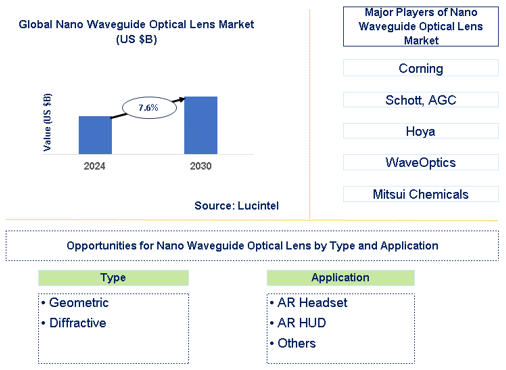
Key data points: The growth forecast = 7.6% annually for the next 6 years. Scroll below to get more insights. This market report covers trends, opportunities, and forecasts in the global nano waveguide optical lens market to 2030 by type (geometric and diffractive), application (AR headset, AR HUD, and others), and region (North America, Europe, Asia Pacific, and the Rest of the World)
We'll send your sample report shortly.
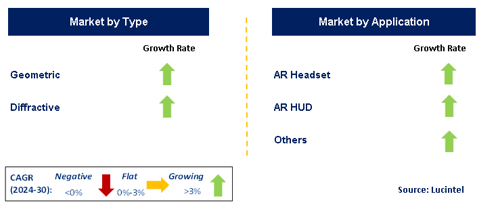
• Lucintel forecasts that, within the type category, the geometric is expected to witness a higher growth over the forecast period.
• Within the application category, AR headset is expected to witness a higher growth.
• In terms of regions, APAC is expected to witness the highest growth over the forecast period. Gain valuable insights for your business decisions with our comprehensive 150+ page report.
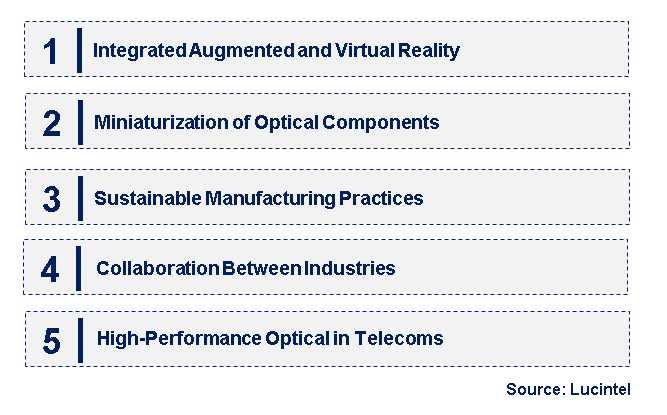
• Integrated Augmented and Virtual Reality: As AR and VR technologies evolve, nano waveguide lenses will experience increased demand to enhance the visual experience. They offer designs that are more compact and provide higher image quality, performing better in immersive applications.
• Miniaturization of Optical Components: Nano waveguide lenses have become necessary as the trend in optical elements moves toward smaller and lighter designs. This miniaturization allows for greater design flexibility in consumer electronics and medical devices, potentially leading to a better user experience.
• Sustainable Manufacturing Practices: Growing environmental consciousness is compelling manufacturers to adopt practices that do not harm the environment. The use of eco-friendly materials and processes in the production of nano waveguide lenses has become a significant factor attracting environmentally conscious consumers to this product.
• Collaboration Between Industries: Cross-industry collaborations are increasingly occurring, primarily between tech companies and research institutions. This cooperation creates opportunities for new developments in optics and enables advanced optical solutions to reach the marketplace more rapidly. Nearly all applications—from telecommunications to healthcare—highlight the potential of these collaborations.
• High-Performance Optics in Telecom: The demand for high-performance optical components is growing significantly in the telecom industry. Nano waveguide lenses, along with other optical components, play a crucial role in increasing data transmission speed and efficiency in next-generation networks like 5G. Emerging trends are renewing the Nano Waveguide Optical Lens market, fostering innovation, improving product lines, and expanding usage in various industries. Over time, these trends will impact the competitive landscape and dynamics of the market.
• Advanced Manufacturing Techniques: New manufacturing methods, such as 3D printing and laser fabrication, increase precision and scalability in the development of nano waveguide lenses. These methods also enhance efficiency and decrease production costs, making advanced optics more affordable.
• Integration in Medical Devices: Nano waveguide lenses are now integrated into medical imaging tools. These lenses improve image resolution, making diagnoses more accurate and surgical results better. This benefit ultimately extends to both healthcare providers and patients.
• Hybrid Systems Development: Several organizations are actively developing hybrid optical systems that combine nano waveguide lenses with traditional optical systems. This integration improves performance and incorporates the advantages of established traditional technologies into a broader set of applications.
• Increased Investments in R&D: Nano waveguide technology is driven by significant investments in research and development. Companies invest in new materials and designs while focusing on increasing energy efficiency and optical performance.
• Market Growth in Emerging Economies: Demand for nano waveguide optical lenses is rising in emerging markets, primarily in the Asia-Pacific region. Companies continue to extend their sales channels to reach more consumer groups, creating greater access to high-tech optical solutions. These recent developments reflect a dynamic and rapidly evolving Nano Waveguide Optical Lens market, with a focus on innovation, accessibility, and application expansion. This sets the course for the future of the industry as optical solutions in these sectors grow stronger.
• Telecommunications Infrastructure: The deployment of 5G networks presents an excellent opportunity for developing nano waveguide lenses that enhance optical communication systems. These lenses will facilitate increased data transmission rates, responding to the demand for high-speed internet access.
• Consumer Electronics: By offering high performance and compact devices such as wearables and smartphones, new market opportunities will emerge for nano waveguide lenses. There will be opportunities to design new products with enhanced functionalities through the incorporation of these lenses.
• Healthcare Imaging Solutions: This sector offers lucrative growth prospects in diagnostic imaging technologies. Nano waveguide lenses will provide improved clarity and resolution, enhancing imaging quality, benefiting both practitioners and patients.
• Autonomous Vehicles: As the automotive industry shifts toward autonomous technology, the implementation of complex optical systems is rapidly gaining momentum. Nano waveguide lenses can introduce enhanced capabilities into sensor systems for safety and navigation purposes.
• Robotics and Automation: With the spread of robotics into various markets, there is an open door for applying nano waveguide lenses in sensors and vision systems. This application can lead to improved operations and performance in automated processes. These strategic growth opportunities promise that nano waveguide optical lenses will significantly impact several segments of the industry. By accessing these opportunities, firms can strengthen their market positions while driving new innovations in optical technology.
• Technological Advances: Rapid advancements in nano-fabrication methods and nano-materials enhance the performance capabilities of waveguide optical lenses. High precision and functionality increase demand across various applications.
• Increasing Demand for Miniature Devices: The trend toward miniaturization exists not only in consumer electronics but also in various other fields. This trend necessitates reducing the size of optical components without impairing performance, and nano waveguide lenses are highly suitable for this purpose.
• Increased R&D Investment: Investment from both public and private sectors in nano-optics research has accelerated innovation. This investment will lead to new applications and make existing options more competitive.
• Rising Demand for High-Speed Communication: The expanding telecom industry, especially with the advent of 5G, creates a strong demand for advanced optical components. Nano waveguide lenses are essential for enhancing data transfer speed and network efficiency.
• Environmental Sustainability: Growing awareness of sustainability compels manufacturers to adopt eco-friendly materials and production methods. This shift caters to consumer awareness and meets global environmental demands. Challenges in the nano waveguide optical lens market include:
• High Development Costs: The design complexity of nano waveguide technologies results in high initial investment costs. This capital-intensive barrier may prevent small firms from entering the market or restrain R&D investments.
• Intense Competition: The nano-optics market is highly competitive due to numerous strong contenders. This competition has led to price wars and increased margin pressures, making it difficult for many companies to survive.
• Regulation Compliance: Future regulations for optical devices can be confusing, with various international standards and requirements complicating market entry and increasing costs. The drivers and challenges significantly impact the growth of nano waveguide optical lenses. By addressing the primary drivers and overcoming challenges, competitors can position themselves better and drive new concepts in optical solutions.
• Corning
• Schott
• Hoya
• WaveOptics
• Mitsui Chemicals
• SVG Tech
• NedPlus AR
• Geometric
• Diffractive
• AR Headset
• AR HUD
• Others
• North America
• Europe
• Asia Pacific
• The Rest of the World
• United States: Significant nano waveguide developments in the United States focus on improving optics efficiency and reducing manufacturing costs. Research institutions and companies are collaborating to develop waveguide lenses for AR and VR applications. Additionally, R&D investments are being made to support innovation and entrepreneurship among startups specializing in nano-optics.
• China: The market in China is rapidly evolving due to substantial government incentives for developing nano-optical technologies. Chinese companies have established leadership in mass production capabilities, especially focusing on telecommunications and consumer electronics applications. Innovations that integrate nano waveguides into smartphones and other products reduce costs without compromising optical performance, accelerating local and global demand.
• Germany: Germany is known for its exceptional engineering skills. Recent innovations in nano waveguide optical lenses showcase this expertise. German companies are concentrating on precision manufacturing and high-quality materials to create advanced optical systems for the industrial sector. Collaborations between academia and industry are advancing fields such as automotive sensors and high-resolution imaging systems, positioning Germany as a leader.
• India: The nano waveguide optical lens market in India is growing rapidly due to increasing investments in technology and a focus on research and development. Local startups are exploring unique applications in medical imaging and telecommunications. The government is promoting initiatives for indigenous manufacturing, further boosting market growth and creating job opportunities in the technology sector.
• Japan: Japan's nano waveguide optical lens market is characterized by strong technological developments, particularly in robotics and consumer electronics. Companies are developing compact and efficient lenses for use in imaging systems and autonomous vehicle applications. Overall, miniaturization and integration into sophisticated electronics are driving growth, supported by healthy domestic demand and international collaborations that promote technology exchange.


• Corning
• Schott
• Hoya
• WaveOptics
• Mitsui Chemicals
• SVG Tech
• NedPlus AR Q5. Which nano waveguide optical lens market segment will be the largest in future? Answer: Lucintel forecasts that geometric is expected to witness a higher growth over the forecast period. Q6. In nano waveguide optical lens market, which region is expected to be the largest in next 5 years? Answer: APAC is expected to witness the highest growth over the forecast period. Q.7 Do we receive customization in this report? Answer: Yes, Lucintel provides 10% customization without any additional cost.


Choose a license that fits your team. Instant PDF delivery.
Prices exclude taxes. Instant delivery. Custom licensing available on request.
Market Report · July 29, 2026
Market Report · July 20, 2026
Market Report · July 20, 2026
Trusted partner for strategic intelligence and business growth


Receive a complimentary market analysis tailored to your industry. Our analysts will identify key growth opportunities and competitive dynamics specific to your business.

Market size, growth rate, and key trend analysis for your specific sector.

Top competitor positioning and market share analysis.

Strategic recommendations backed by data-driven insights.
Get curated market intelligence and competitive moves straight to your inbox.
By subscribing, you agree to receive our monthly insights. Unsubscribe anytime.
Receive a complimentary market analysis tailored to your industry. Our analysts will identify key growth opportunities and competitive dynamics specific to your business.
Market size, growth rate, and key trend analysis for your specific sector.
Top competitor positioning and market share analysis.
Strategic recommendations backed by data-driven insights.
Get curated market intelligence, emerging trends, and competitive moves straight to your inbox each month.
By subscribing, you agree to receive our monthly insights. Unsubscribe anytime.
We'll send your sample report shortly.