
Market Report · May 18, 2026

This market report covers trends, opportunities, and forecasts in the global nano pulsed fiber lasers market to 2031 by technology (uv, visible light, infrared, and others), application (industrial, medical, aerospace & defense, and others), and region (North America, Europe, Asia Pacific, and the Rest of the World)
We'll send your sample report shortly.
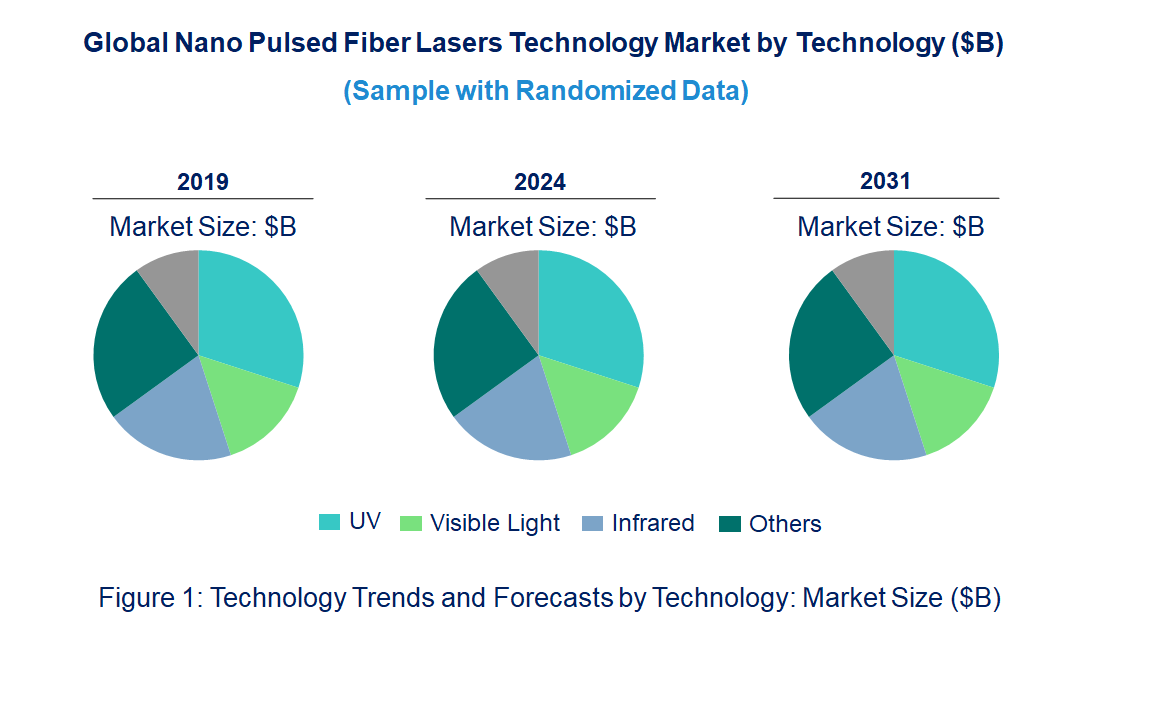
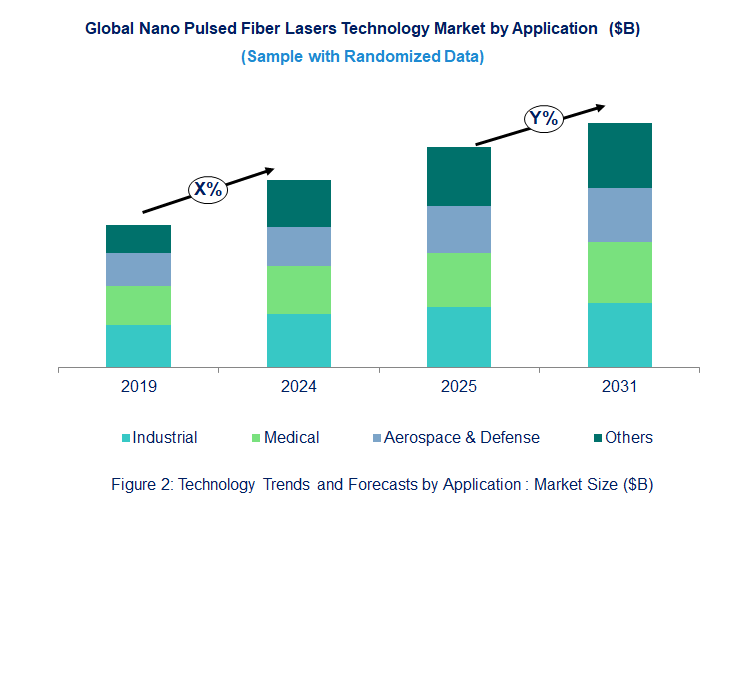
• Higher Power and Higher Efficiency: The design of nano pulsed fiber lasers has led to significant peak powers and increased energy efficiency. This trend enables more precise cutting, welding, and marking in the automotive and manufacturing industries while reducing energy consumption and improving output quality.
• Pulse Duration Decreased for Precision Applications: With ultra-short pulse duration lasers being developed, Nano Pulsed Fiber Lasers are opening up new application areas for precision applications in micro-machining and medical treatments. This laser allows one to carry out complex operations without damaging the surrounding materials thermally; therefore, this is suitable for fine work.
• More Reliability and Long Life: Innovations in the material used for Nano Pulsed Fiber Lasers are becoming more reliable and long-lasting. More robust durability would make them useful for those applications requiring reliability over lengthy periods of operation, from aerospace and defense to communications and even biomedical applications. Compact and Modular Designs There has been a shift toward smaller, modular designs in Nano Pulsed Fiber Lasers, making them easier to port and integrate into diverse systems. These compact systems enable the use of mobile platforms and portable diagnostic equipment, opening up more applications in medical imaging and field applications.
• Integration with Advanced Technologies (AI and Automation): Nano Pulsed Fiber Lasers are increasingly being integrated with automation systems and AI for better precision control and real-time performance monitoring. This synergy enhances the manufacturing capability, enabling higher production speeds and reducing human error in complex tasks. The most important trends in nano pulsed fiber laser technology are redefining the market, as innovation drives this product in almost every sector. Improvements in power, precision, and integration with automation systems have enhanced the role of lasers in healthcare, materials science, and telecommunications, among other areas. Such developments are creating new opportunities and opening the boundaries for what can be achieved through these lasers.
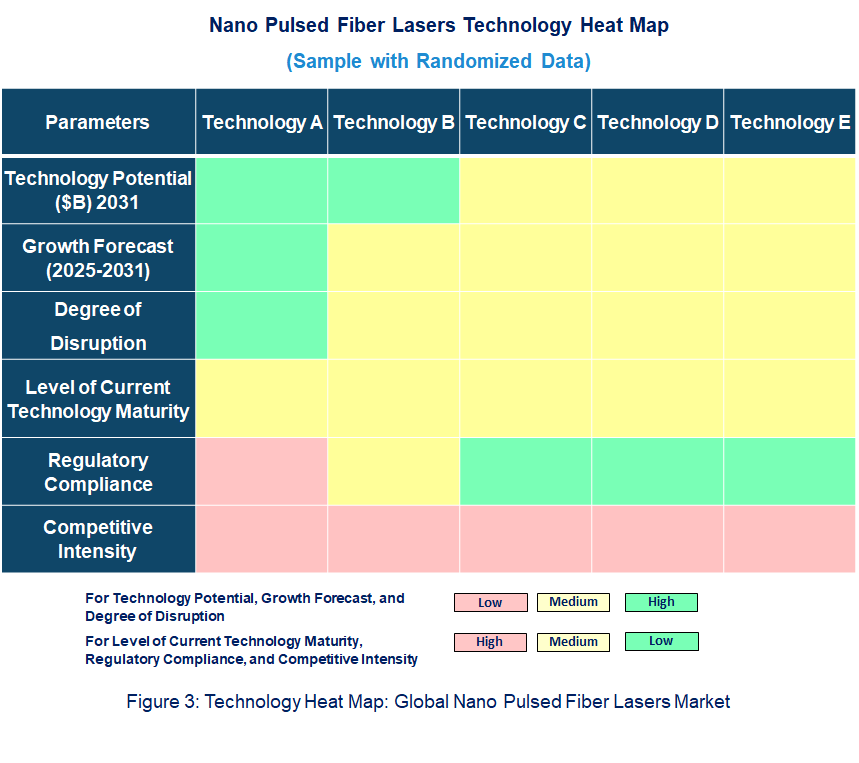
• Technology Potential: Nano Pulsed Fiber Lasers offer tremendous technology potential, particularly through their ability to generate high peak powers in compact form factors. This allows applications ranging from micro-machining and microelectronics fabrication to the latest medical treatments, including laser surgery and imaging. These lasers can operate with precise minimal heat generation, opening new doors in sensitive material processing and delicate medical procedures.
• Degree of Disruption: Nano Pulsed Fiber Lasers have the potential to disrupt many sectors because they are much more efficient, consume less energy, and process faster compared to other lasers. Their miniaturization and precision are leading to innovation in aerospace, automotive, and healthcare, which all demand high accuracy and low-energy use.
• Technology Maturity Level: The technology is mature for most commercial applications; it has been successfully implemented across many manufacturing and medical contexts. Further development will likely be needed to extend much wider and more niche uses, particularly in quantum technologies.
• Regulatory Compliance: As with any advanced laser technology, nano pulsed fiber lasers should abide by the severe standards for safety, primarily within medical and defense contexts. Among these are safe operational performance in defined parameters, not to mention adherence to internationally recognized standards in such lines as ISO and FDA guidelines.
• IPG Photonics: IPG Photonics continues to improve its offerings in high-power, compact fiber lasers with increased efficiency. The company has introduced more robust and flexible Nano Pulsed Fiber Lasers that cater to high-precision cutting and welding in industrial applications. This development expands IPG's reach in manufacturing and automation, enabling faster and more reliable production processes.
• Coherent: Coherent has focused on developing its nano pulsed fiber lasers to enhance its precision medical applications. The latest models have the capability of delivering ultra-short pulse durations with increased peak power, making them perfect for minimally invasive surgery and diagnostics. This progress further enhances Coherent's position in the medical and biomedical markets.
• MKS Instruments: MKS Instruments continues broadening its portfolio of advanced nano pulsed fiber lasers that can be readily coupled to automated systems in use. The lasers now possess much greater wavelength control and much better operational lifetimes. High-volume manufacturing environments with all kinds of semiconductor and electronic product manufacturing are highly affected by using this laser.
• Thorlabs: Thorlabs has launched new ultrafast pulsed fiber laser systems for excellent power stability in research and development applications. Their latest Nano Pulsed Fiber Lasers are designed to support further advancements in optical communication, spectroscopy, and material science, offering significant improvements in flexibility and ease of integration.
• Ekspla: Ekspla has advanced its pulsed fiber laser technology by developing models capable of generating ultra-short pulses with extremely high precision, opening up opportunities in advanced micromachining and scientific research. This innovation is particularly beneficial in applications requiring fine detail and minimal thermal effects.
• Photonics Industries: Photonics Industries has been on the leading edge of high-energy pulsed fiber lasers, bringing new systems into industrial manufacturing, including laser marking and engraving. Its advancements improved the scalability of Nano Pulsed Fiber Lasers in the commercial space and helped businesses to adopt more efficient and cost-effective systems.
• Quantel: Quantel's new developments in nano pulsed fiber lasers focus on compactness and portability, making them ideal for field applications in environmental monitoring and remote sensing. Their smaller form factors and improved reliability contribute to enhanced performance in real-time data collection and analysis. These developments show the growing versatility and impact of nano pulsed fiber lasers across various industries, from precision medical applications to industrial and scientific research.
• Increasing Demand for Medical and Scientific Research: The growing demand for high-precision lasers in medical and scientific research is the driving force for the market. Nano pulsed fiber lasers offer advantages in minimally invasive surgeries, diagnostics, and lab-based research. The expansion of medical applications is driving significant investment and market interest in these technologies.
• Integration of Nano Pulsed Fiber Lasers in Automation: Nano Pulsed Fiber Lasers are being widely used in automation systems for manufacturing. This trend has seen the use of laser technology in semiconductor production, 3D printing, and micro-machining. These lasers are efficient and precise, which helps reduce waste in production lines and produces high-quality products with reduced operating costs.
• High Initial Investment and Cost Constraints: One of the significant challenges in this market is the high initial investment required for setting up Nano Pulsed Fiber Laser systems. While these systems provide high efficiency, the upfront costs can be prohibitive for smaller manufacturers and startups. This limits the accessibility of the technology for certain industries. Challeges
• Regulatory Compliance and Safety Standards: Compliance with industry-specific regulations, especially in healthcare and aerospace, is another issue. The safety standards are very high, and so are the regulatory frameworks surrounding the deployment of these lasers in critical environments. This poses a continuous challenge to the manufacturers in the Nano Pulsed Fiber Lasers market. Technological innovations and an increasingly wide range of applications in medical, manufacturing, and scientific sectors are molding the Nano Pulsed Fiber Lasers market. The growth of the market in the future will be based on the development of precision, power efficiency, and automation integration, overcoming high costs and regulatory compliance. These opportunities are expanding the market and placing Nano Pulsed Fiber Lasers in a versatile and valuable technology across industries.
• IPG Photonics
• Coherent
• MKS Instruments
• Thorlabs
• Ekspla
• Photonics Industries
• Technology Readiness of Different Technologies (UV, Visible Light, Infrared, Others): UV, visible light, and infrared technologies vary in their level of maturity depending on the application. UV technology is well-established in water purification and sterilization applications. Visible light technology is very mature and widely used in consumer electronics, communications, and lighting. Infrared technology is mature in the application of thermal imaging, and increasingly in industrial inspection and health diagnostics. Other technologies, like terahertz radiation, are still under research and development but are promising for future use, especially in security and materials science. All types of these technologies are under active evolution, promoting innovation in the sectors where they are being developed.
• Competitive Intensity and Regulatory Compliance of Various Technologies (UV, Visible Light, Infrared, etc.): The nano pulsed fiber lasers competitive intensity among UV, visible light, infrared, and other light-based technologies is quite high due to the demand for more efficient, cost-effective, and versatile solutions. Continuous innovation by key players improves offerings, leading to intense rivalry. Regulatory compliance, particularly regarding safety standards, is an important aspect of UV and infrared technologies, as their misuse can have an impact on health and the environment. Visible light technologies are less regulated, though there are still standards in terms of energy efficiency and environmental impact. These regulatory frameworks ensure consumer protection and environmental sustainability as well as competition.
• Disruption Potential of Various Technologies (UV, Visible Light, Infrared, Others): The disruption potential of UV, visible light, and infrared technologies lies in their ability to transform various industries through advanced sensing and imaging capabilities. UV technology has precision in applications such as sterilization and material characterization. Visible light technology, with advancements in LED and laser technology, is critical for communications and displays. Infrared technology plays a critical role in thermal imaging, surveillance, and industrial inspections. These technologies, in isolation and combination, are disruptive in healthcare, security, telecommunication, and industrial automation as they pave the way to smarter systems and processes. As these technologies evolve, integrating them into everyday life would drive innovations across sectors with safer, more efficient systems.
• UV
• Visible Light
• Infrared
• Others
• Industrial
• Medical
• Aerospace & Defense
• Others
• North America
• Europe
• Asia Pacific
• The Rest of the World
• Latest Developments and Innovations in the Nano Pulsed Fiber Lasers Technologies
• Companies / Ecosystems
• Strategic Opportunities by Technology Type


Choose a license that fits your team. Instant PDF delivery.
Prices exclude taxes. Instant delivery. Custom licensing available on request.
Market Report · May 18, 2026
Market Report · May 18, 2026
Market Report · May 18, 2026
Trusted partner for strategic intelligence and business growth


Receive a complimentary market analysis tailored to your industry. Our analysts will identify key growth opportunities and competitive dynamics specific to your business.

Market size, growth rate, and key trend analysis for your specific sector.

Top competitor positioning and market share analysis.

Strategic recommendations backed by data-driven insights.
Get curated market intelligence and competitive moves straight to your inbox.
By subscribing, you agree to receive our monthly insights. Unsubscribe anytime.
Receive a complimentary market analysis tailored to your industry. Our analysts will identify key growth opportunities and competitive dynamics specific to your business.
Market size, growth rate, and key trend analysis for your specific sector.
Top competitor positioning and market share analysis.
Strategic recommendations backed by data-driven insights.
Get curated market intelligence, emerging trends, and competitive moves straight to your inbox each month.
By subscribing, you agree to receive our monthly insights. Unsubscribe anytime.
We'll send your sample report shortly.