
Market Report · July 29, 2026

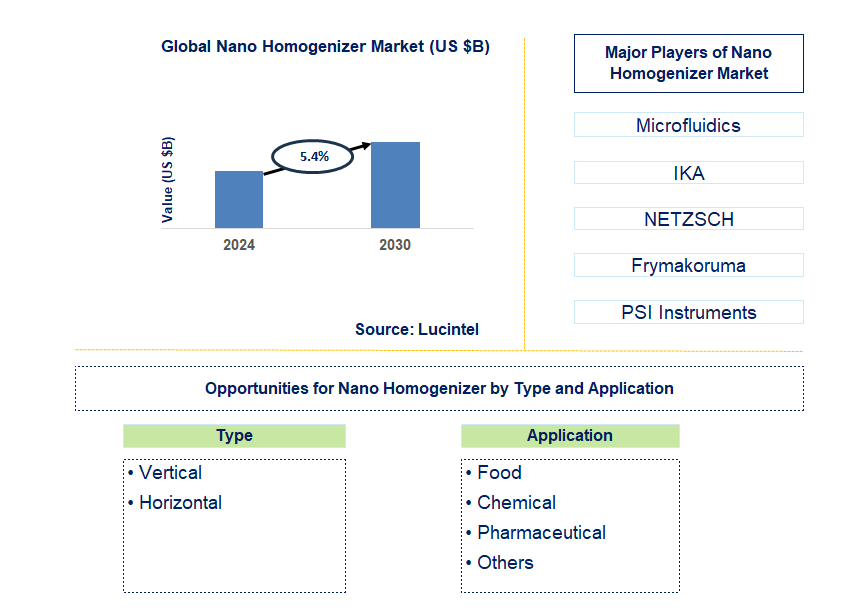
Key data points: The growth forecast = 5.4% annually next 6 years. Scroll below to get more insights. This market report covers trends, opportunities, and forecast in the global nano homogenizer market to 2030 by type (vertical and horizontal), application (food, chemical, pharmaceutical, and others), and region (North America, Europe, Asia Pacific, and the Rest of the World)
We'll send your sample report shortly.
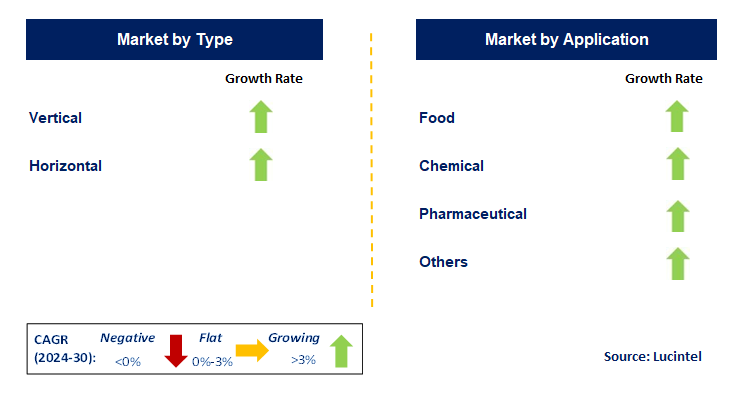
• Lucintel forecasts that, within the type category, vertical is expected to witness higher growth over the forecast period.
• Within this application category, food is expected to witness the highest growth.
• In terms of regions, APAC is expected to witness the highest growth over the forecast period. A more than 150-page report is developed to help in your business decisions.
• Integration with automation and IoT: Nano homogenizers are becoming more integrated with automation systems and the Internet of Things (IoT). This integration ensures that instant monitoring can be conducted, resulting in precise data collection and accurate process control. This reduces the chances of human error while increasing production throughput by boosting automation levels. Managing multiple products at different times may now be possible from anywhere within a company’s premises, as these devices can be remotely controlled via IoT connections, making them adaptable to any environment.
• Advancements in material science: New materials developed specifically for nano homogenizers enhance their durability. Innovations include coatings that provide better wear resistance and corrosion prevention. Consequently, the lifespan and efficiency of homogenizers are increased, allowing them to withstand the most stringent applications with reduced maintenance needs.
• Energy efficiency focus: There is an increasing focus on making nano homogenizers more energy efficient. Developments in design and technology aim to reduce the power consumption of these devices while maintaining high performance. Energy-efficient models not only lower operational costs but also meet global sustainability requirements, making them attractive to environmentally conscious industries.
• Customization for specific applications: Nano homogenizers are increasingly being adapted for specific applications within various sectors. Customized solutions target the needs of pharmaceuticals, food processing, and chemicals, enhancing their performance and efficiency. Customization allows for better control over particle size and consistency, leading to improved quality and functionality of the final products.
• Growing demand in biotechnology: The rise in drug development, especially in nanomedicine, has increased the need for efficient homogenization techniques to produce stable formulations. innovations in the nano homogenizer market are influenced by trends such as automation and IoT integration, advancements in material science, a focus on energy efficiency, and customization for specific applications. These developments enhance performance levels, promoting both sustainability and application versatility.

• Superior High-Pressure Homogenization Technologies: Recent technological advancements in high-pressure homogenization focus on enhancing particle size reduction and achieving more uniform dispersion. Innovations have led to improved pump designs and pressure control systems, resulting in increased performance levels with reliable operation. These changes enable a higher level of control over the homogenizing process, giving rise to premium end products in the pharmaceuticals and advanced materials sectors. They improve energy efficiency and reduce operational costs.
• Automation Integration: The integration of nano homogenizers with modern automation and control systems has been a significant development. Modern homogenizers come with automated process controls, real-time monitoring capabilities, and data logging facilities. This move enhances process consistency while reducing manual interventions, thereby improving overall effectiveness. Additionally, this increases scalability and reproducibility, making them best suited for large-scale production and complex applications.
• Energy-Efficient Models: There is a growing trend toward producing energy-efficient nano homogenizers. Power reduction through design and technology innovations that also maintain high performance is the goal of this trend. Energy-efficient models are increasingly sought after due to their lower operational costs and alignment with environmental sustainability goals. These changes will help reduce the carbon footprint of industrial processes, thereby supporting greener manufacturing practices.
• Material Durability and Coatings Advancement: Recent developments include the use of sophisticated materials and coatings that improve the durability and performance of nano homogenizers. New composites, along with surface treatments, enhance resistance to wear, corrosion, and chemical attacks. This extends the lifespan of homogenizers, decreases maintenance requirements, and ensures consistent functionality even in demanding applications like petrochemicals and pharmaceuticals. recent developments in nano homogenizers include improvements in high-pressure technologies, automation integration, energy efficiency, and material durability. These innovations enhance performance, sustainability, and application versatility.
• Substantial growth potential exists in emerging markets, where there is increasing industrialization and technological adoption. Nano homogenizers can serve growing sectors such as pharmaceuticals and food processing. Entering these markets involves matching products to local requirements and partnering with regional distributors to capture market share.
• Advancement in Customization for Specific Applications: The development of custom nano homogenizers for particular applications has great potential. When designing solutions to meet specific requirements, such as those in pharmaceuticals, chemicals, and food processing, it is important to consider how performance can be improved. In addition, creating product models targeted at specific application areas can significantly increase their attractiveness and popularity among particular industries.
• Leveraging Technological Innovations: This can be achieved by embracing technological innovations such as Internet of Things (IoT) integration, automation, and more advanced control systems to enhance the functionality of nano homogenizers. These technologies improve process control, efficiency, and data management. They provide opportunities to manufacture better products with increased functionality that satisfy the needs of today’s industrial processes.
• Focus on Sustainability and Energy Efficiency: The demand for energy-efficient industrial equipment with low environmental impact has been growing. Environmentally conscious customers can be attracted through sustainable production practices and energy-efficient designs of nano homogenizers. Firms should focus on creating products that lead to minimal environmental pollution and reduced power consumption to remain compliant with globally accepted sustainable trends. strategic growth opportunities in the nano homogenizer market include expanding into emerging markets, advancing customization for specific applications, leveraging technological innovations, and focusing on sustainability and energy efficie
• Rising Demand for Precision in Various Industries: High precision particle processing in different industries like pharmaceuticals, food, and chemicals drives demand for advanced nano homogenizers (NH). These devices enable high control over particle size distribution that meets the standards set by modern manufacturing processes.
• Technological Advancements in Nanotechnology: Advances in nanotechnology have enabled the development of better-performing nano homogenizers. Improved market performance is accelerated by growth in materials, design, and control systems.
• Increasing Focus on Sustainable and Energy-Efficient Solutions: In industrial processes, sustainability and energy efficiency are envisioned to play key roles going forward. As a result, there is an increasing demand for environmentally friendly technologies with lower energy consumption levels among such industries. Challenges in the nano homogenizer market are:
• High Initial Investment Costs: It may not be possible for smaller firms or developing countries to enter this market because they cannot afford costly devices like advanced nano homogenizers. The initial investments required for purchasing and maintenance could hinder entry into the market.
• Technical Complexity and Maintenance Requirements: Technical complexity may pose challenges when operating or maintaining nano homogenizers (NH). Users should be adequately trained to overcome these difficulties, thus improving overall performance.
• Regulatory and Compliance Issues: Regulations applicable to homogenizers that utilize nanomaterials and high-end technologies might be very stringent. Manufacturers face challenges from these regulations, which often impede their development activities, thereby limiting their possibilities of entering the respective markets. Drivers such as increasing demand for precision, technological advances, environmental considerations, and a wider range of applications are boosting the market for nano homogenizers. However, challenges like high costs, technical complexity, regulatory issues, and the need for market education must be addressed to ensure continued growth in this industry. Understanding and overcoming these obstacles will be critical for stakeholders looking to thrive in the evolving nano homogenizers market.
• Microfluidics
• IKA
• NETZSCH
• Frymakoruma
• PSI Instruments
• PHD Technology
• Sonic
• Vertical
• Horizontal
• Food
• Chemical
• Pharmaceutical
• Others
• North America
• Europe
• Asia Pacific
• The Rest of the World
• United States: In America, new developments in nanohomogenizers include improvements in high-pressure dispersion technologies that reduce particle size distribution by enhancing uniformity. Focus has been placed on innovations that improve efficiency in energy use and help cut operational costs. The pharmaceutical industry demands more precision through automation, which involves real-time monitoring systems to meet this growing demand.
• China: China has made significant strides toward cost-effective production of nano homogenizers due to advances in manufacturing technologies and materials used. Recent developments include cheaper models with improved capabilities for processing nanoparticles, such as those used in 3D printing. Additionally, Chinese companies seek nano machines that can work across various sectors, such as food processing, since these devices need to be scalable.
• Germany: Germany leads in producing high-performance nanohomogenizers, emphasizing precision engineering and quality control processes. Recent designs feature advanced control systems coupled with increased safety measures. Notably, Germany manufactures nanohomogenizers in compliance with regulations for the pharmaceutical and chemical sectors in Europe.
• India: The Indian nano homogenizer market is growing, with an emphasis on affordability and accessibility. Recently, there has been an increase in inexpensive brands tailored for local industries, such as pharmaceuticals and food production. Additionally, manufacturers in India are investing in research and development to enhance the efficiency and performance of their machines, aiming to reduce imports from other countries.
• Japan: In Japan, ultrasonic technology has been utilized in the design of advanced nanohomogenizers, while research on microfluidics continues. In recent years, however, the trend has shifted toward precision improvements in particle size reduction processes. Japanese companies are also beginning to use this type of equipment as an alternative treatment for various diseases and as a means of generating new types of products not yet available on any commercial scale.


• Microfluidics
• IKA
• NETZSCH
• Frymakoruma
• PSI Instruments
• PHD Technology
• Sonic Q5. Which nano homogenizer market segment will be the largest in the future? Answer: Lucintel forecasts that vertical is expected to witness higher growth over the forecast period. Q6. In the nano homogenizer market, which region is expected to be the largest in the next 5 years? Answer: APAC is expected to witness the highest growth over the forecast period. Q.7 Do we receive customization in this report? Answer: Yes, Lucintel provides 10% customization without any additional cost.


Choose a license that fits your team. Instant PDF delivery.
Prices exclude taxes. Instant delivery. Custom licensing available on request.
Market Report · July 29, 2026
Market Report · July 20, 2026
Market Report · July 20, 2026
Trusted partner for strategic intelligence and business growth


Receive a complimentary market analysis tailored to your industry. Our analysts will identify key growth opportunities and competitive dynamics specific to your business.

Market size, growth rate, and key trend analysis for your specific sector.

Top competitor positioning and market share analysis.

Strategic recommendations backed by data-driven insights.
Get curated market intelligence and competitive moves straight to your inbox.
By subscribing, you agree to receive our monthly insights. Unsubscribe anytime.
Receive a complimentary market analysis tailored to your industry. Our analysts will identify key growth opportunities and competitive dynamics specific to your business.
Market size, growth rate, and key trend analysis for your specific sector.
Top competitor positioning and market share analysis.
Strategic recommendations backed by data-driven insights.
Get curated market intelligence, emerging trends, and competitive moves straight to your inbox each month.
By subscribing, you agree to receive our monthly insights. Unsubscribe anytime.
We'll send your sample report shortly.