
Market Report · July 31, 2026

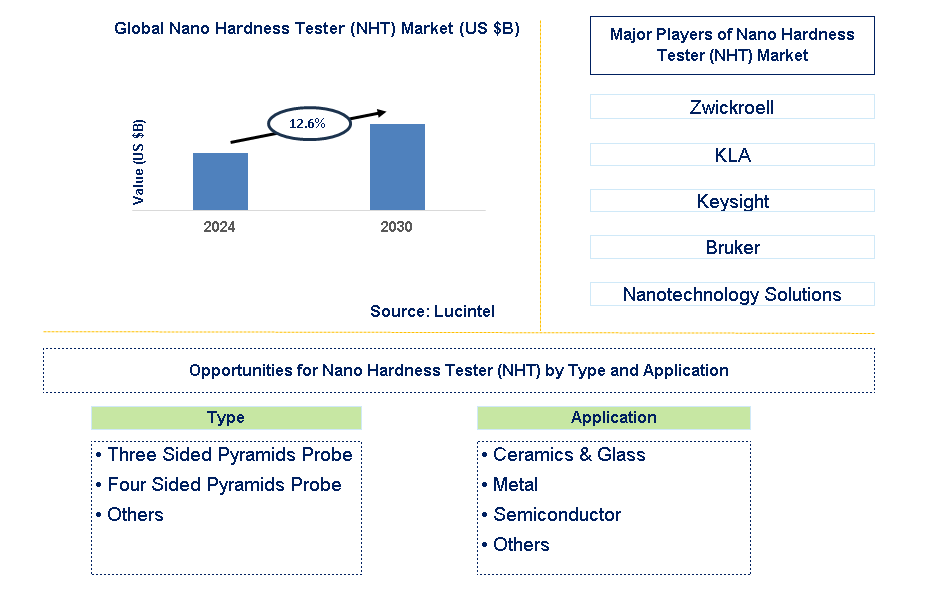
Key data points: The growth forecast = 12.6% annually next 6 years. Scroll below to get more insights. This market report covers trends, opportunities, and forecast in the global nano hardness tester (NHT) market to 2030 by type (three sided pyramids probe, four sided pyramids probe, and others), application (ceramics & glass, metal, semiconductor, and others), and region (North America, Europe, Asia Pacific, and the Rest of the World)
We'll send your sample report shortly.
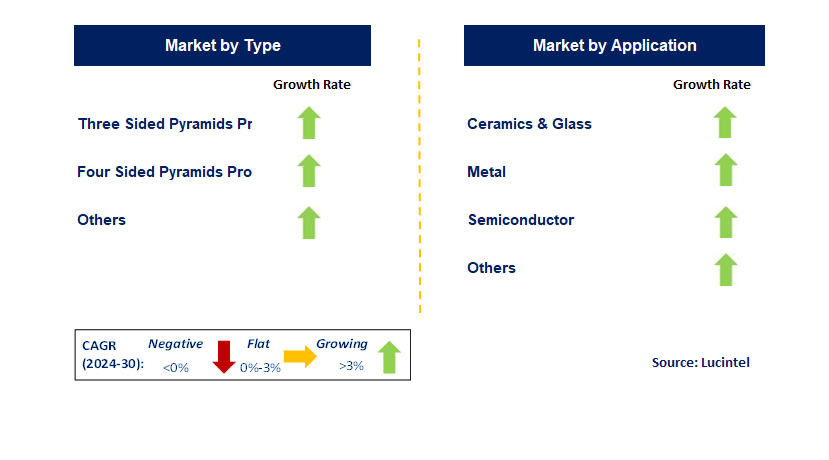
• Lucintel forecasts that, within the type category, the three-sided pyramid probe is expected to witness higher growth over the forecast period.
• Within this application category, ceramic & glass is expected to witness the highest growth.
• In terms of regions, APAC is expected to witness the highest growth over the forecast period. A more than 150-page report is developed to help in your business decisions.
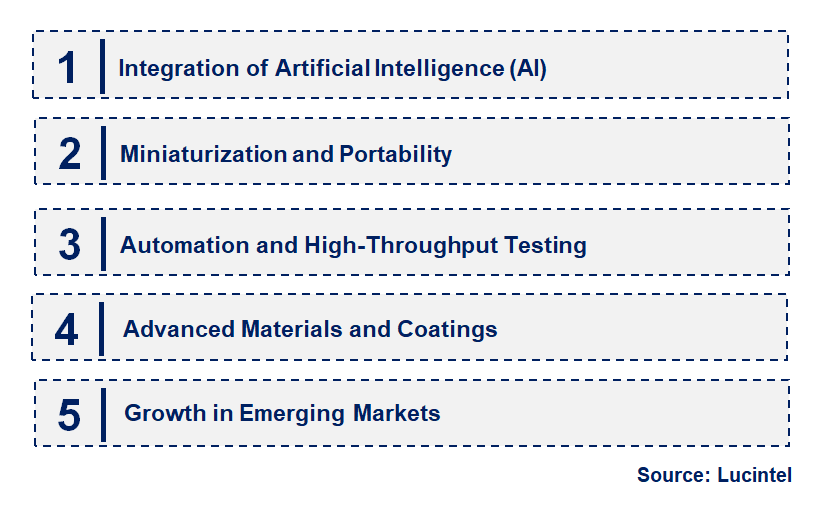
• Integration of artificial intelligence (AI): AI technology is gaining ground in NHT systems because it improves data analysis, predictive maintenance, and process optimization. This makes testing more accurate and efficient, thereby reducing human error while ensuring dependability.
• Miniaturization and portability: There is a growing demand for portable nano hardness testers beyond traditional laboratory environments. The convenience and flexibility offered by miniaturized systems make them suitable for field applications or on-site use.
• Automation and high-throughput testing: The rise of automation in testing processes allows for increased throughput capacity, thus minimizing manual intervention. Automated systems improve efficiency, consistency, and accuracy, making them applicable in high-volume testing environments.
• Advanced materials and coatings: The utilization of advanced materials and coatings in nano hardness testers improves durability and effectiveness. This is achieved by using materials that can withstand the harsh conditions of testing while ensuring a long lifespan for the equipment, thus making it cost-effective.
• Growth in emerging markets: The growth of various industrial sectors and improvements in technology in emerging markets have increased the demand for nano hardness testers. Advanced testing solutions are increasingly being adopted by these regions to support their expanding industrial sectors. Technological innovation, functionality enhancement, and expansion into new markets are changing the trends in the nano hardness tester market. Companies are responding to these changes to keep pace with evolving customer demands while remaining competitive within a fast-evolving industry.
• Embedding AI: The incorporation of artificial intelligence into NHTs has greatly improved data analysis and predictive capabilities. Material properties can be tested faster through the use of AI algorithms, which lead to greater accuracy while reducing process steps.
• New Imaging Technologies: Recent advances have enhanced imaging technologies to allow high-resolution measurements. Nano hardness testers enable the determination of material hardness, particularly at the microstructure level, resulting in precise and in-depth results
• Automation and Robotics: Automation and robotics technologies have transformed the testing procedures of nano hardness testers. Robots improve pipetting uniformity and throughput, making them very suitable for mass screening applications, including single-use drug assays.
• Portability and Miniaturization: Efforts have been directed towards making smaller nano hardness testers that can be carried conveniently. These testers allow for flexible use, such as onsite testing, thus going beyond conventional lab-based methods.
• Cost-Effective Solutions: Advances in manufacturing processes and materials have led to the production of nano hardness testers that are more affordable. These solutions provide high precision at lower costs, thereby making sophisticated testing technology accessible to a wider range of industries and applications. These advancements have made nano hardness testers more efficient, accessible, and effective, thus driving growth in the industry. Companies are adopting these technologies for improved product offerings in response to ever-changing customer preferences.
• Aerospace Industry: The aerospace industry requires extremely accurate hardness testing for use on aircraft and spacecraft materials. Modern NHT systems possess the precision required for appraising critical components, thereby enabling this area to expand its high-tech base.
• Semiconductor Manufacturing: Accurate hardness testing is important for evaluating materials used in microelectronics during the semiconductor manufacturing process. Nano hardness testers assist in achieving the excellent quality and reliability needed by semiconductor components, leading to a vibrant business environment.
• Bio-Medical Devices: Medical devices need accurate hardness measurements of their materials since they can be inserted into the body. A nano hardness tester is useful for material selection and quality control issues within the rapidly growing medical sector.
• Advanced Materials Research: Precise hardness testing remains vital for research into advanced novel materials like nanomaterials and composites. These materials facilitate research and development activities aimed at developing nanomaterials, providing greater insight through better understanding and analysis of such innovative substances.
• Asia Pacific Region: This part of the world, especially China, serves as one of the main markets that may contribute to significant client volumes, alongside others like the USA and Japan.
• Automotive Industry: The automotive industry is increasingly leaning towards nano hardness testers to ensure that materials used in vehicle components are durable and perform well. This demand for accurate testing has been a major stimulus for growth in the sector. These expanding applications highlight growth opportunities for nano hardness testers across different industries. Market growth and technological advancement are supported by these opportunities, which address specific needs and enhance material testing capabilities.
• Technological Advancements: Innovations in technology, such as artificial intelligence (AI) and automation, drive demand for advanced nano hardness testers that can provide more precise results.
• Increasing Industrialization: As global industries expand and modernize, there is a rising need for exact material testing. This growing demand for quality raw materials promotes the use of improved nano hardness testers, thus contributing to market expansion.
• Rising Demand for High-Precision Testing: The need for high-precision nano hardness testers has been driven by an increased emphasis on quality control and performance among sectors like aerospace and semiconductor manufacturing.
• Expansion of Emerging Markets: Rapid industrialization, coupled with the fast adoption of new technologies, particularly in the Asia-Pacific region, has resulted in the emergence of new markets that require nanotechnology solutions, leading to an overall rise in this field worldwide.
• Innovations in Materials Science: Advances made in materials science have led to the development of novel nanoscale materials, whose precision testing is now possible through nano hardness testers. This explains why the market has continued to grow. Challenges in the nano hardness tester (NHT) market are:
• High Cost of Advanced Systems: The high costs of modern nano hardness testers may limit their usage in small businesses and research institutions. Consequently, market access is limited because the costs associated with these testers make them unaffordable for many.
• Regulatory Compliance: Adherence to international standards and regulations significantly contributes to the cost of developing and operating nano hardness testers due to complex regulatory requirements for test equipment. Understanding these drivers and challenges is vital for navigating the changing landscape of nano hardness testers.
• Technological Complexity: Many companies find it difficult to keep up with fast-evolving technologies because they cannot adapt quickly enough or invest in new systems due to compatibility issues with older technologies. In several vital segments, the nano hardness tester (NHT) market has experienced substantial progress. The demand for accurate nano hardness testing in ceramics and glass is on the rise due to their use in electronics and construction, ensuring material durability and performance. The metals segment is growing with increased demand from industries requiring accurate testing of different alloys and components necessary for quality control and innovation. The semiconductor industry has also grown significantly, as it requires high-precision tests for advanced materials in microelectronics.
• Zwickroell
• KLA
• Keysight
• Bruker
• Nanotechnology Solutions
• Micro Materials
• Alemnis
• Three Sided Pyramids Probe
• Four Sided Pyramids Probe
• Others
• Ceramics & Glass
• Metal
• Semiconductor
• Others
• North America
• Europe
• Asia Pacific
• The Rest of the World
• United States: Recent developments have seen the integration of AI with machine learning algorithms to improve data accuracy and analysis, in addition to hardening test methodology that enables real-time data interpretation. Companies are also focusing on miniaturization to offer portable solutions for on-site testing, serving wider industry needs.
• China: China is investing heavily in research and development aimed at improving the performance of nano hardness testers. This emphasis is on developing cost-effective alternatives without sacrificing precision. This has resulted in affordable models with competitive features that widen market access.
• Germany: Germany continues to lead in the adoption of cutting-edge technologies such as advanced imaging systems and automated testing processes to enhance test speed and accuracy, making German-made NHT systems highly desired due to their reliability and precision.
• India: In India, the application of nano hardness testers is expanding into pharmaceuticals and nanotechnology. This expansion is driven by industrial growth and technological advancements that require sophisticated testing equipment.
• Japan: Innovations in high-throughput testing systems and automation have been introduced in Japan for its nano hardness testers. By doing so, they are able to enhance productivity and provide higher throughput, in line with Japan’s reputation for technological excellence and precision engineering.


• Zwickroell
• KLA
• Keysight
• Bruker
• Nanotechnology Solutions
• Micro Materials
• Alemnis Q5. Which nano hardness tester (NHT) market segment will be the largest in the future? Answer: Lucintel forecasts that the three-sided pyramid probe is expected to witness higher growth over the forecast period. Q6. In the nano hardness tester (NHT) market, which region is expected to be the largest in the next 5 years? Answer: APAC is expected to witness the highest growth over the forecast period. Q.7 Do we receive customization in this report? Answer: Yes, Lucintel provides 10% customization without any additional cost.


Choose a license that fits your team. Instant PDF delivery.
Prices exclude taxes. Instant delivery. Custom licensing available on request.
Market Report · July 31, 2026
Market Report · July 22, 2026
Market Report · July 20, 2026
Trusted partner for strategic intelligence and business growth


Receive a complimentary market analysis tailored to your industry. Our analysts will identify key growth opportunities and competitive dynamics specific to your business.

Market size, growth rate, and key trend analysis for your specific sector.

Top competitor positioning and market share analysis.

Strategic recommendations backed by data-driven insights.
Get curated market intelligence and competitive moves straight to your inbox.
By subscribing, you agree to receive our monthly insights. Unsubscribe anytime.
Receive a complimentary market analysis tailored to your industry. Our analysts will identify key growth opportunities and competitive dynamics specific to your business.
Market size, growth rate, and key trend analysis for your specific sector.
Top competitor positioning and market share analysis.
Strategic recommendations backed by data-driven insights.
Get curated market intelligence, emerging trends, and competitive moves straight to your inbox each month.
By subscribing, you agree to receive our monthly insights. Unsubscribe anytime.
We'll send your sample report shortly.