
Market Report · July 31, 2026

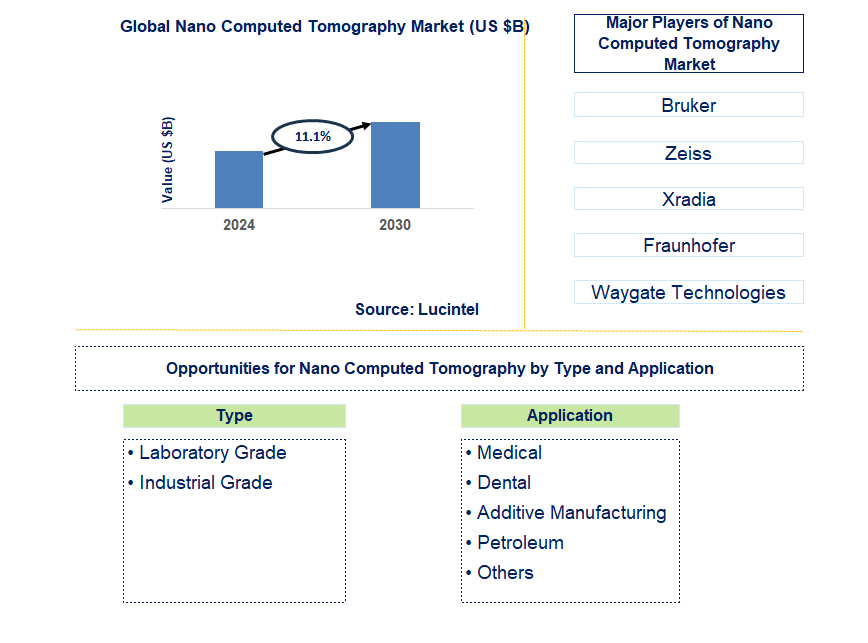
Key data points: The growth forecast = 11.1% annually next for the 6 years. Scroll below to get more insights. This market report covers trends, opportunities, and forecasts in the global nano computed tomography market to 2030 by type (laboratory grade and industrial grade), application (medical, dental, additive manufacturing, petroleum, and others), and region (North America, Europe, Asia Pacific, and the Rest of the World)
We'll send your sample report shortly.
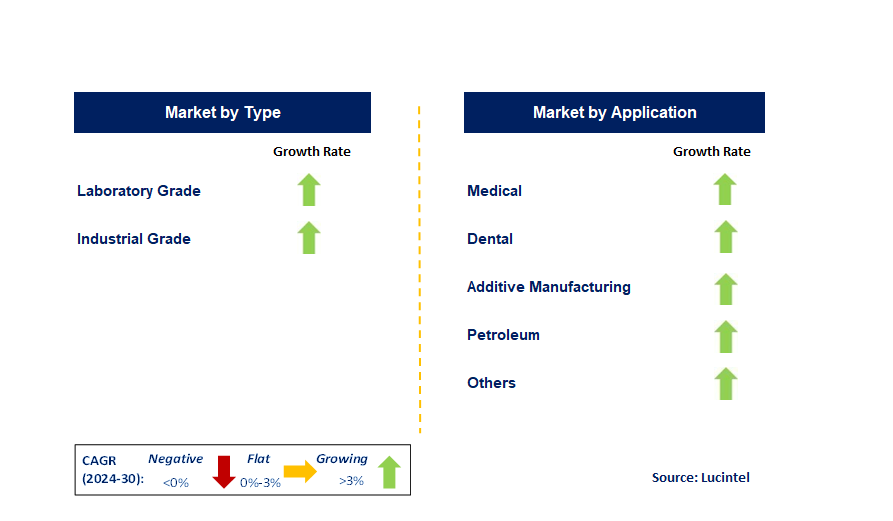
• Lucintel forecasts that, within the type category, laboratory grade is expected to witness themhigher growth over the forecast period.
• Within this application category, medical is expected to witness the highest growth.
• In terms of regions, APAC is expected to witness the highest growth over the forecast period A more than 150-page report is developed to help in your business decisions.
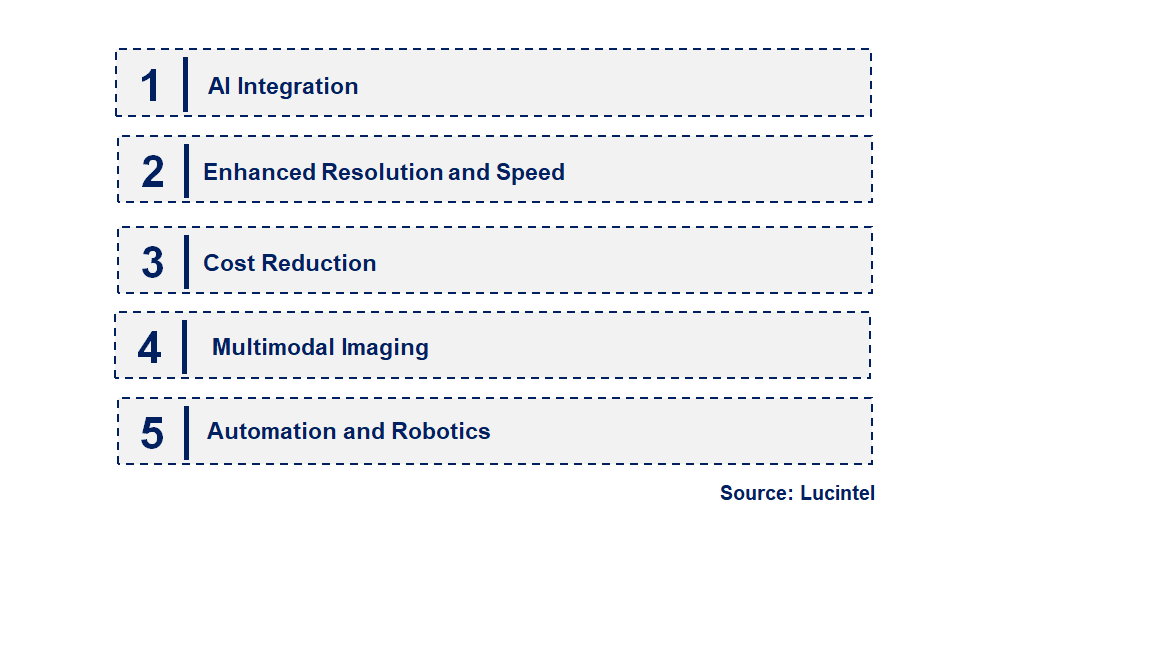
• AI Integration: The use of AI algorithms in nano computed tomography can automate image interpretation, improve diagnostic accuracy, and shorten analysis duration, thereby increasing efficiency across research and industrial applications.
• Enhanced Resolution and Speed: Advances in detector technology, coupled with novel image reconstruction algorithms, have resulted in higher resolutions and faster scanning rates. In fields like nanotechnology and materials science, which demand precision, this translates to enhanced high-resolution imaging capabilities.
• Cost Reduction: Efforts to lower the cost of nano computed tomography systems contribute significantly to democratizing advanced imaging technology. New component manufacturing methods, along with system design innovations, are resulting in cheaper solutions, thus expanding the market to include smaller research labs and emerging economies.
• Multimodal Imaging: There is an increasing trend toward fusing nano computed tomography with other imaging techniques such as SEM (scanning electron microscopy) and AFM (atomic force microscopy). By combining these different strengths, a multimodal approach leads to holistic studies, enabling researchers to explore broader areas within specific subject matters.
• Automation and Robotics: Automation increases efficiency through improved reproducibility and has been used for some time in sample handling mechanisms, including robotized systems. Thanks to these developments, robotic arms can perform most tasks involved with sample handling while also carrying out scans without human intervention, thereby minimizing errors and speeding up workflows during research activities. The dynamic nature of the nano computed tomography market is captured by these emerging trends, which are driven by technology and availability. Innovations in AI, cost reduction, resolution, multimodal integration, and automation have created new benchmarks for imaging capabilities and applications.
• Ultra-High-Resolution Detectors: The development of ultra-high-resolution detectors has significantly improved imaging capabilities, allowing researchers to view atomic-level structures. Such improvements are essential, particularly in nanotechnology and material science, where understanding qualitative details of materials’ property behavior is necessary.
• AI and Machine Learning Integration: Image analysis in nano-CT systems has been revolutionized with the integration of AI and machine learning. These technologies can define features through automated algorithms that enhance image quality and provide advanced analytics. This reduces manual analysis time, leading to more accurate results, making it beneficial for both research purposes and industrial applications.
• Cost-Effective Systems: Access to high-end imaging technology has become easier with the introduction of budget-friendly nano-CT systems for smaller research labs and emerging markets. Market reach has increased due to innovative manufacturing processes that reduce costs while maintaining high performance levels.
• Automated Sample Handling: Automation of sample handling has recently improved efficiency and reproducibility in nano-CT systems. The imaging process has been made more efficient via robotic systems, reducing human error and enabling large-scale research projects to be analyzed at high speeds.
• Multimodal Imaging Integration: Combining SEM or AFM with nano-CT allows for a complete examination of samples. By using different imaging modalities simultaneously, researchers can maximize their benefits, leading to deeper insights into highly complex materials or living specimens. these developments reflect the fast-paced progress experienced within nano-CT technology, such as improving resolution, integrating AI, reducing costs, automating procedures, and adopting multimodal imaging. They are widening the scope of usage and capabilities of nano-CT systems in diverse research and industrial setups.
• Emerging Market Expansion: Expansion into emerging markets comes with great prospects. It enables companies to satisfy the growing demand for advanced imaging technologies by developing affordable options and providing local support that adapts to the region's culture.
• Specialized Applications: By manufacturing specialized nano-CT systems for niche applications such as semiconductor inspection or biomedical research, manufacturers can benefit from new segments of customers. An industry-specific system has its own target market, which builds on market differentiation, thereby attracting a specific customer base.
• Technological Integration: Innovations can come through combining nano-CT with future investment technologies like robotics and AI. This will improve image analysis, make processes more efficient, and ensure a competitive advantage for both industrial players and researchers.
• Collaborations and Partnerships: Strategic partnerships with leading universities, research institutions, and industry players can spur technological advancements while expanding market reach. Such collaborations drive innovation, leading to quicker adoption and development of solutions within the industry.
• Sustainability Focus: Developing eco-friendly practices in producing nano-CT systems can attract customers who care about the environment. Inclusion of energy-saving technology, as well as using sustainable materials, helps create a good reputation for these devices, apart from complying with relevant legislation. These strategic opportunities serve as focal points for growth in the nano-CT market, including expansion into new markets, specialization, technological advancements, collaborations and partnerships, and sustainability focus. These opportunities, when leveraged, could drive innovations, thus improving their presence in the marketplace.
• Technological Advancements: The continuous enhancement of resolution and accuracy through detector technology and imaging algorithms improves the market. More detailed imaging is made possible by these developments, thereby supporting complex research and industrial applications.
• Growing Demand for Precision Imaging: Fields such as material science, nanotechnology, and biomedical research have increased the need for higher resolution and more detailed imaging, thus further growing the market. This makes nano-CT systems appropriate for such applications.
• Integration with Emerging Technologies: Incorporating AI and machine learning into nano-CT systems will improve image analysis and automation, thereby driving market growth. These technologies enhance accuracy, efficiency, and diagnostic capabilities.
• Expansion of R&D Activities: Complex materials and biological samples require examination using nano computed tomography (Nano-CT) systems. Nano-CT technology is increasingly being used in various industries such as health, materials science, and manufacturing. Its versatile nature and detailed insights into the microstructure of complex materials drive market expansion and open up opportunities for technological innovations.
• Increased Investment in Health Care: Growing investments in healthcare technology and diagnostics are fostering demand for advanced imaging solutions, including nano-CT systems. This investment supports the development of innovative applications and enhances the overall market landscape. Challenges in the nano computed tomography market are:
• High Costs: The high cost of nano-CT systems remains a significant barrier to the wide adoption of the technology. Advanced components may be expensive, making access difficult, especially for smaller laboratories in developing economies.
• Technical Complexity and Expertise: Operating, maintaining, and managing nano computed tomography requires specialized personnel. This need for expertise can lead to high training costs and may hinder accessibility, making usability difficult.
• Intense Competition: The market is highly competitive due to numerous players, leading to price pressures. This situation necessitates constant innovation and product differentiation by firms to remain competitive.
• Regulatory Compliance: Adhering to regulatory standards can pose challenges for manufacturers, making entry into certain markets tricky due to such regulations, which complicates the business landscape. These drivers and challenges exemplify the dynamic nature of the nano-CT market, characterized by technological advancements, demand for precision, emerging technologies, and R&D activities. Addressing issues related to costs, complexity, competition, and regulation is vital for the market to grow and develop.
• Bruker
• Zeiss
• Xradia
• Fraunhofer
• Waygate Technologies
• Delta-Engineering
• GE Measurement & Control Solutions
• Laboratory Grade
• Industrial Grade
• Medical
• Dental
• Additive Manufacturing
• Petroleum
• Others
• North America
• Europe
• Asia Pacific
• The Rest of the World
• United States: Recently, there have been developments in integrating AI and machine learning into the U.S. nano-CT market, which will enhance image analysis and automation. Additionally, companies are attempting to reduce scan times and increase resolution through innovative detector technologies. These advances seek to improve diagnostic capabilities and research and industrial efficiencies alike.
• China: As part of its initiatives to make nano-CT affordable, China has made significant strides. In particular, this includes recent advances such as local production of key components and cost-effective system designs that open access to sophisticated imaging techniques in research and quality control applications.
• Germany: Germany focus on ultra-high-resolution imaging and multimodal imaging system integration drives progress in nano-CT technology development. This involves linking nano-CT with other imaging technologies to allow more comprehensive studies of complex materials and biological samples, thereby enhancing research capabilities.
• India: To make nano-CT systems more accessible to research institutions and industries, India is attempting to localize production and reduce costs. Furthermore, there have been recent developments, such as collaborations with international firms aimed at bringing cutting-edge technology into India while upgrading its imaging capacity.
• Japan: Japanese nano-CT systems are increasingly being automated and employ robotic systems for sample handling and real-time imaging improvements. These advances will aid in simplifying the research process as well as enhancing precision in manufacturing and materials science sectors.


• Bruker
• Zeiss
• Xradia
• Fraunhofer
• Waygate Technologies
• Delta-Engineering
• GE Measurement & Control Solutions Q5. Which nano computed tomography market segment will be the largest in future? Answer: Lucintel forecasts that laboratory grade is expected to witness higher growth over the forecast period. Q6. In nano computed tomography market, which region is expected to be the largest in next 5 years? Answer: APAC is expected to witness the highest growth over the forecast period. Q.7 Do we receive customization in this report? Answer: Yes, Lucintel provides 10% customization without any additional cost.


Choose a license that fits your team. Instant PDF delivery.
Prices exclude taxes. Instant delivery. Custom licensing available on request.
Market Report · July 31, 2026
Market Report · July 31, 2026
Market Report · July 31, 2026
Trusted partner for strategic intelligence and business growth


Receive a complimentary market analysis tailored to your industry. Our analysts will identify key growth opportunities and competitive dynamics specific to your business.

Market size, growth rate, and key trend analysis for your specific sector.

Top competitor positioning and market share analysis.

Strategic recommendations backed by data-driven insights.
Get curated market intelligence and competitive moves straight to your inbox.
By subscribing, you agree to receive our monthly insights. Unsubscribe anytime.
Receive a complimentary market analysis tailored to your industry. Our analysts will identify key growth opportunities and competitive dynamics specific to your business.
Market size, growth rate, and key trend analysis for your specific sector.
Top competitor positioning and market share analysis.
Strategic recommendations backed by data-driven insights.
Get curated market intelligence, emerging trends, and competitive moves straight to your inbox each month.
By subscribing, you agree to receive our monthly insights. Unsubscribe anytime.
We'll send your sample report shortly.