
Market Report · July 29, 2026

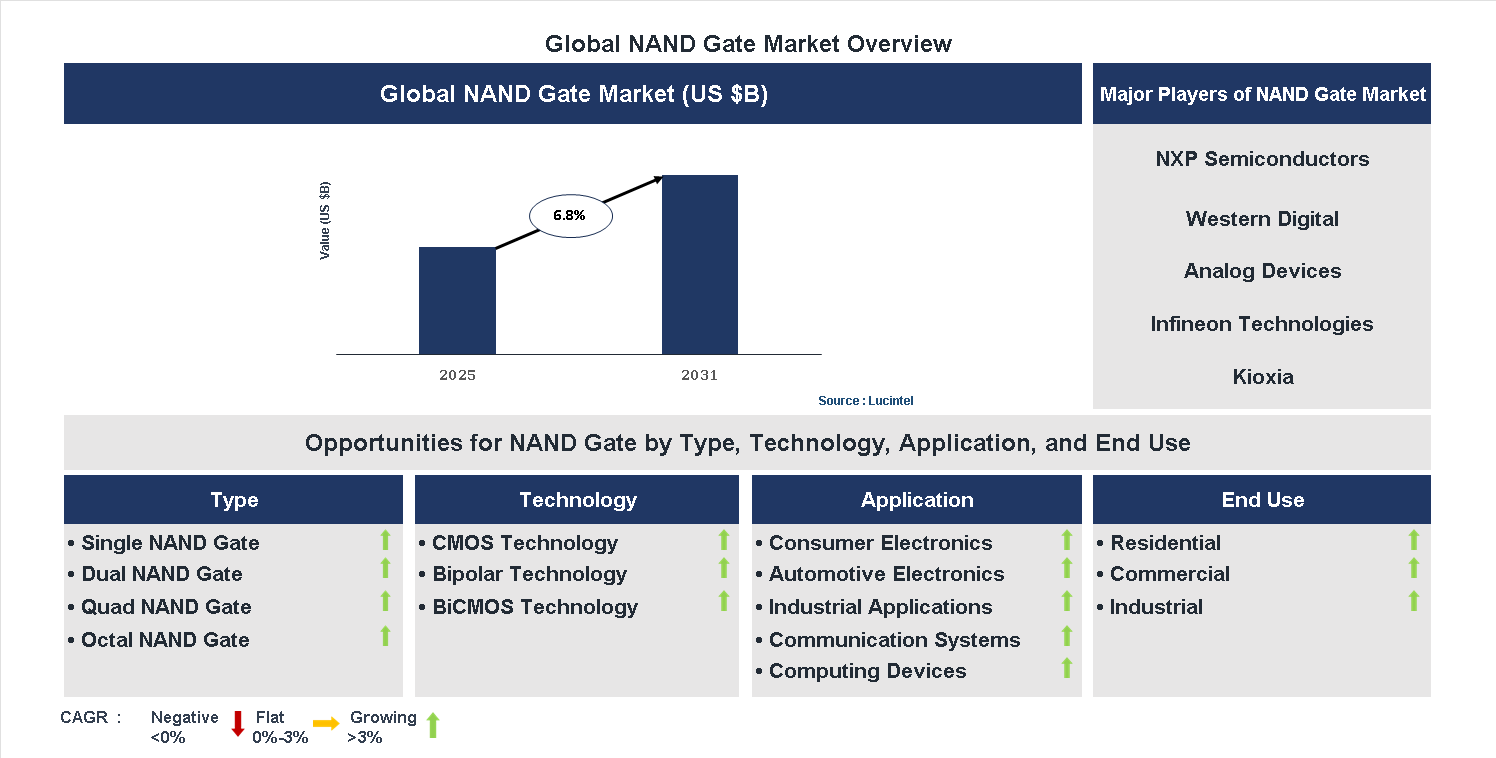
Key data points: The growth forecast = 6.8% annually for the next 7 years. Scroll below to get more insights. This market report covers trends, opportunities and forecasts in NAND gate market to 2031 by type (single NAND gate, dual NAND gate, quad NAND gate, and octal NAND gate), technology (CMOS technology, bipolar technology, and BICMOS technology), application (consumer electronics, automotive electronics, industrial applications, communication systems, and computing devices), end use (residential, commercial, and industrial), and region (North America, Europe, Asia Pacific, and the Rest of the World)
We'll send your sample report shortly.
• Lucintel forecasts that, within the type category, octal NAND gate is expected to witness the highest growth over the forecast period.
• Within the end use category, residential is expected to witness the highest growth.
• In terms of region, APAC is expected to witness the highest growth over the forecast period. Gain valuable insights for your business decisions with our comprehensive 150+ page report. Sample figures with some insights are shown below.
• Increasing Adoption of IoT Devices: The proliferation of Internet of Things (IoT) devices is driving demand for efficient logic components like NAND gates. IoT applications require compact, low-power, and high-speed logic circuits, which NAND gates can provide. This trend is expanding the market as more connected devices are integrated into homes, industries, and cities, necessitating scalable and reliable logic solutions. Manufacturers are developing specialized NAND gates optimized for IoT applications, boosting market growth and encouraging innovation in circuit design.
• Advancements in Semiconductor Technology: Innovations such as FinFET and 3D NAND technology are enhancing the performance and density of NAND gates. These technological improvements enable smaller, faster, and more energy-efficient chips, which are critical for modern electronics. As semiconductor fabrication processes evolve, NAND gates are becoming more complex and capable, supporting the development of advanced computing systems, smartphones, and data storage solutions. This trend is pivotal in maintaining the market’s momentum and meeting the increasing performance demands.
• Growing Demand for Data Storage Solutions: The exponential rise in data generation from cloud computing, streaming, and enterprise applications is fueling the need for high-capacity storage devices. NAND flash memory, which relies heavily on NAND gates, is central to SSDs, memory cards, and USB drives. As data storage needs continue to grow, manufacturers are investing in more sophisticated NAND gate architectures to improve speed, durability, and capacity. This trend significantly impacts the market by expanding its scope and driving innovation in memory technology.
• Integration of AI and Machine Learning: The deployment of AI and machine learning algorithms requires high-speed processing and efficient logic circuits. NAND gates are fundamental components in the development of AI hardware accelerators and neural network chips. The demand for intelligent devices and systems is pushing the market toward developing NAND gates that support faster data processing and lower power consumption. This integration is transforming the market by enabling smarter, more capable electronic systems across various sectors.
• Focus on Energy Efficiency and Sustainability: As environmental concerns grow, there is a strong emphasis on reducing power consumption in electronic devices. NAND gate manufacturers are innovating to produce energy-efficient components that contribute to greener electronics. This includes developing low-power logic circuits and optimizing manufacturing processes to minimize environmental impact. The trend toward sustainability is reshaping the market by aligning product development with global energy and environmental goals, fostering eco-friendly innovations, and expanding market opportunities. In summary, these emerging trends are collectively reshaping the NAND gate market by fostering innovation, enhancing performance, and aligning with global technological and environmental priorities. The market is becoming more dynamic, competitive, and integrated with cutting-edge applications, ensuring its continued growth and relevance in the digital age.

• Technological Innovation: Integration of CMOS Technology: The adoption of CMOS technology in NAND gates has enhanced power efficiency and switching speeds, leading to better performance in portable and high-speed devices. This innovation reduces energy consumption, making devices more sustainable and cost-effective, thereby expanding market applications in mobile and wearable electronics.
• Miniaturization and Advanced Fabrication: Development of smaller, more compact NAND gates through advanced fabrication techniques has enabled higher integration densities on chips. This miniaturization supports the trend toward smaller, more powerful devices, boosting demand in smartphones, tablets, and IoT applications, and fostering market growth.
• Rising Demand for Memory Devices: The increasing need for high-capacity storage solutions has driven the integration of NAND gates in flash memory and SSDs. This demand has led to innovations in NAND architecture, improving data transfer speeds and durability, which in turn fuels market expansion across consumer and enterprise sectors.
• Emergence of 3D NAND Technology: The shift towards 3D NAND architecture has significantly increased storage density and performance. This development has revolutionized data storage solutions, enabling larger capacities and faster access times, thus opening new avenues for market growth in data centers and cloud computing.
• Strategic Collaborations and Mergers: Major industry players are engaging in strategic alliances, mergers, and acquisitions to enhance technological capabilities and expand market reach. These collaborations facilitate innovation, reduce costs, and accelerate product development, strengthening competitive positioning and driving overall market growth. In summary, recent developments in the NAND gate market—spanning technological innovations, miniaturization, advanced memory solutions, 3D NAND technology, and strategic collaborations—are collectively propelling market growth. These advancements are enabling more efficient, high-capacity, and cost-effective products, thereby expanding application areas and reinforcing the markets trajectory toward increased adoption and innovation.
• Consumer Electronics: Growing adoption of smartphones, tablets, and smart home devices is driving demand for high-performance NAND gates, enabling faster processing and energy efficiency in compact devices.
• Automotive Electronics: Increasing integration of NAND gates in automotive systems for advanced driver-assistance systems (ADAS), infotainment, and electric vehicle (EV) control units is expanding market opportunities.
• Industrial Automation: The rise of Industry 4.0 and smart manufacturing relies heavily on NAND gates for automation control, robotics, and sensor systems, boosting market growth.
• Healthcare Equipment: NAND gates are crucial in medical devices such as imaging systems, patient monitoring, and diagnostic equipment, supporting the expansion of healthcare technology.
• Telecommunications: The deployment of 5G infrastructure and data centers requires high-speed, reliable NAND gates for signal processing and data management, creating substantial growth prospects. These opportunities are collectively transforming the NAND gate market by enhancing device capabilities, enabling new applications, and supporting the digital transformation across industries. The market is becoming more dynamic, with innovations driving increased demand and expanding the scope of NAND gate applications worldwide.
• Technological Innovation: Rapid advancements in semiconductor fabrication and miniaturization have significantly increased the efficiency and performance of NAND gates. Innovations such as 3D NAND technology enable higher storage capacities and faster data transfer rates, making NAND gates more suitable for high-performance applications. These technological improvements reduce costs and improve reliability, encouraging broader adoption across consumer electronics, data centers, and automotive sectors. As technology continues to evolve, the NAND gate market is expected to benefit from increased demand for faster, more efficient memory solutions, fueling overall growth.
• Growing Demand for Consumer Electronics: The proliferation of smartphones, tablets, laptops, and wearable devices has driven a substantial increase in NAND memory requirements. Consumers demand faster, more reliable, and higher-capacity storage solutions, which NAND gates provide efficiently. The expansion of digital content, streaming services, and cloud computing further amplifies this demand. As the consumer electronics industry continues to grow globally, manufacturers are investing heavily in NAND-based storage solutions, which directly boosts the NAND gate market. This trend is expected to persist, supporting sustained market expansion.
• Expansion of Data Centers and Cloud Computing: The exponential growth of data generation and the shift toward cloud-based services have created a massive demand for high-capacity, high-speed storage solutions. NAND gates are integral to solid-state drives (SSDs) used in data centers, offering faster data access and lower power consumption compared to traditional HDDs. The increasing adoption of cloud computing services by enterprises and consumers necessitates scalable and efficient storage infrastructure, which NAND technology provides. This expansion not only drives demand for NAND gates but also encourages innovation in NAND architectures, further strengthening the market.
• Increasing Adoption of IoT and Smart Devices: The rise of Internet of Things (IoT) devices and smart technologies across industries has created a significant need for compact, energy-efficient memory solutions. NAND gates are essential components in IoT devices, enabling data storage and processing in constrained environments. The deployment of smart home devices, industrial automation, and connected vehicles relies heavily on NAND-based memory modules. As IoT adoption accelerates globally, the demand for NAND gates is expected to grow correspondingly, supporting the development of more sophisticated, connected systems.
• Regulatory and Environmental Standards: Stringent regulations concerning electronic waste disposal, energy efficiency, and environmental safety influence the NAND gate market. Manufacturers are compelled to develop eco-friendly manufacturing processes and recyclable products to comply with global standards. These regulations can increase production costs and impact supply chains, but also drive innovation toward sustainable solutions. Companies investing in environmentally compliant NAND technology can gain competitive advantages, while non-compliance risks penalties and market restrictions. Overall, regulatory factors shape product development and market strategies within the NAND gate industry. The challenges facing this NAND gate market include:-
• Supply Chain Disruptions: The NAND gate market is highly dependent on a complex global supply chain involving raw material procurement, manufacturing, and distribution. Disruptions caused by geopolitical tensions, pandemics, or natural disasters can lead to shortages of critical components, delays in production, and increased costs. These disruptions hinder the ability of manufacturers to meet rising demand, impacting sales and profitability. Additionally, supply chain fragility can lead to price volatility, affecting market stability and investor confidence. Overcoming these challenges requires diversification of supply sources and strategic inventory management to ensure resilience.
• High Manufacturing Costs: Producing NAND gates involves sophisticated fabrication processes requiring significant capital investment in advanced semiconductor manufacturing facilities. The costs associated with research and development, cleanroom environments, and precision equipment are substantial. As technology advances toward smaller nodes and higher densities, costs escalate further. These high manufacturing expenses can limit profit margins and make it difficult for smaller players to compete. Consequently, price pressures may restrict market growth, especially in price-sensitive regions, unless technological innovations or economies of scale reduce costs.
• Stringent Regulatory Compliance: The NAND gate industry faces increasing regulatory scrutiny related to environmental impact, electronic waste management, and energy consumption. Compliance with international standards such as RoHS, REACH, and other environmental directives necessitates ongoing investments in sustainable manufacturing practices. Non-compliance can result in legal penalties, product recalls, and damage to brand reputation. Navigating these regulatory landscapes adds complexity and cost to product development and manufacturing processes. Companies must continuously adapt to evolving standards, which can slow innovation and increase time-to-market, posing a significant challenge to market players. In summary, the NAND gate market is driven by rapid technological advancements, increasing demand from consumer electronics, expanding data center infrastructure, and the proliferation of IoT devices. However, it faces challenges such as supply chain vulnerabilities, high production costs, and strict regulatory requirements. These factors collectively influence market growth, requiring stakeholders to innovate and adapt strategically. While expansion opportunities are substantial, addressing these challenges is crucial for sustained development and competitiveness in the evolving landscape of NAND technology.
• NXP Semiconductors
• Western Digital
• Analog Devices
• Infineon Technologies
• Kioxia
• Texas Instruments
• Samsung Electronics
• Micron Technology
• Intel
• STMicroelectronics
• Single NAND Gate
• Dual NAND Gate
• Quad NAND Gate
• Octal NAND Gate
• CMOS Technology
• Bipolar Technology
• BiCMOS Technology
• Consumer Electronics
• Automotive Electronics
• Industrial Applications
• Communication Systems
• Computing Devices
• Residential
• Commercial
• Industrial
• North America
• Europe
• Asia Pacific
• The Rest of the World
• United States: The US market has seen substantial growth driven by major semiconductor companies investing in advanced fabrication facilities and R&D. Innovations in low-power NAND technologies and 3D NAND architectures are prominent, with government initiatives like the CHIPS Act boosting domestic manufacturing capabilities. The US also focuses on strengthening supply chain security and reducing reliance on foreign sources, fostering collaborations between industry and academia to accelerate technological progress.
• China: China continues to expand its NAND manufacturing capacity through government-backed projects and local industry investments. The country is making strides in developing its own NAND memory technologies to reduce dependence on foreign suppliers. Recent advancements include the deployment of 3D NAND production lines and increased focus on integrating NAND solutions into domestic consumer electronics and data centers, aligning with national strategies for technological self-sufficiency.
• Germany: Germanys market is characterized by its emphasis on high-quality, reliable NAND components for industrial and automotive applications. Leading firms are investing in innovative manufacturing processes and sustainable practices to meet stringent European standards. Germany also benefits from strong collaborations within the European Union, fostering research in next-generation NAND technologies and enhancing the integration of NAND solutions into smart manufacturing and automotive sectors.
• India: India is rapidly emerging as a key player in the NAND market, driven by government initiatives like Make in India and Digital India. The country is attracting investments in semiconductor fabrication and research centers, aiming to develop indigenous NAND technologies. Recent developments include establishing local supply chains and partnerships with global firms to enhance NAND production capacity, supporting the growth of Indias digital infrastructure and electronics manufacturing ecosystem.
• Japan: Japan maintains a significant presence in the NAND market through its advanced semiconductor manufacturing capabilities and innovation in memory technology. Japanese firms are focusing on improving NAND performance, durability, and energy efficiency. The country is also investing in research for next-generation NAND architectures and fostering collaborations with global tech companies to stay at the forefront of NAND technology development, particularly in high-end applications like data centers and enterprise storage.


• NXP Semiconductors
• Western Digital
• Analog Devices
• Infineon Technologies
• Kioxia
• Texas Instruments
• Samsung Electronics
• Micron Technology
• Intel
• STMicroelectronics Q5. Which NAND gate market segment will be the largest in future? Answer: Lucintel forecasts that, within the type category, octal NAND gate is expected to witness the highest growth over the forecast period. Q6. In NAND gate market, which region is expected to be the largest in next 5 years? Answer: In terms of region, APAC is expected to witness the highest growth over the forecast period. Q7. Do we receive customization in this report? Answer: Yes, Lucintel provides 10% customization without any additional cost.


Choose a license that fits your team. Instant PDF delivery.
Prices exclude taxes. Instant delivery. Custom licensing available on request.
Market Report · July 29, 2026
Market Report · July 20, 2026
Market Report · July 20, 2026
Trusted partner for strategic intelligence and business growth


Receive a complimentary market analysis tailored to your industry. Our analysts will identify key growth opportunities and competitive dynamics specific to your business.

Market size, growth rate, and key trend analysis for your specific sector.

Top competitor positioning and market share analysis.

Strategic recommendations backed by data-driven insights.
Get curated market intelligence and competitive moves straight to your inbox.
By subscribing, you agree to receive our monthly insights. Unsubscribe anytime.
Receive a complimentary market analysis tailored to your industry. Our analysts will identify key growth opportunities and competitive dynamics specific to your business.
Market size, growth rate, and key trend analysis for your specific sector.
Top competitor positioning and market share analysis.
Strategic recommendations backed by data-driven insights.
Get curated market intelligence, emerging trends, and competitive moves straight to your inbox each month.
By subscribing, you agree to receive our monthly insights. Unsubscribe anytime.
We'll send your sample report shortly.