
Multi Material Recycling Market Trends and Forecast
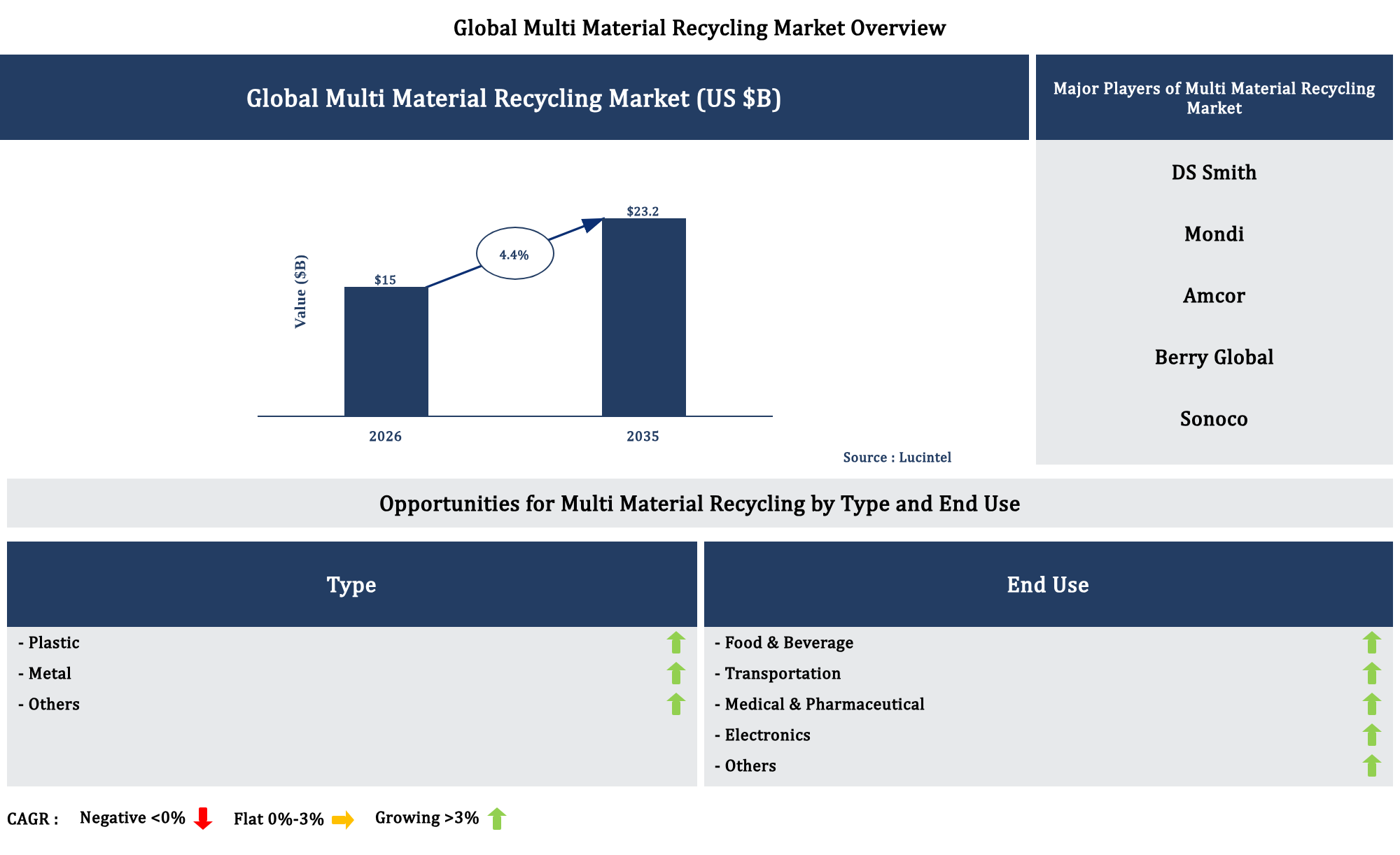
The future of the global multi material recycling market looks promising with opportunities in the food & beverage, transportation, medical & pharmaceutical, and electronic markets. The global multi material recycling market is expected to reach an estimated $23,289 million by 2035 with a CAGR of 4.4% from 2026 to 2035. The major drivers for this market are the increasing adoption of eco-friendly materials across industries, the growing innovation in multi material separation technologies, and the rising use for resource efficiency & material recovery.
• Lucintel forecasts that, within the type category, plastic is expected to witness higher growth over the forecast period.
• Within the end use category, food & beverage is expected to witness the highest growth.
• In terms of region, APAC is expected to witness the highest growth over the forecast period.
Gain valuable insights for your business decisions with our comprehensive 150+ page report. Sample figures with some insights are shown below.
Emerging Trends in the Multi Material Recycling Market
The multi material recycling market is experiencing rapid evolution driven by technological advancements, increasing environmental awareness, and stringent regulations. As consumers and industries seek sustainable solutions, the market is shifting towards more efficient, integrated recycling processes capable of handling diverse materials. These developments are not only reducing waste and conserving resources but also creating new economic opportunities. The following key trends highlight the major directions shaping this market, reflecting its transition towards a more sustainable and innovative future.
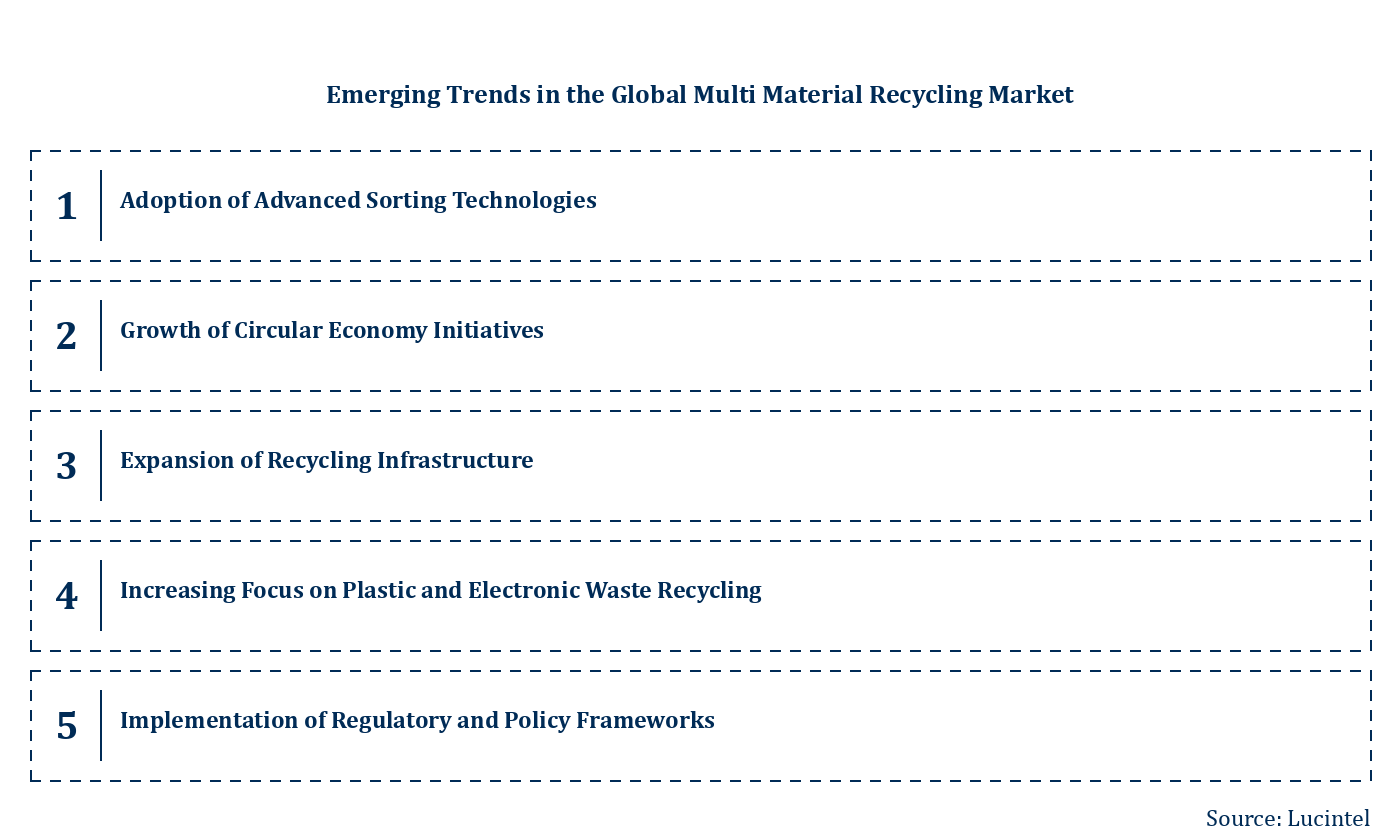
• Adoption of Advanced Sorting Technologies: The integration of AI, robotics, and sensor-based systems is revolutionizing material separation processes. These technologies enable precise identification and sorting of various materials, increasing recycling efficiency and purity. As a result, companies can process mixed waste streams more effectively, reducing contamination and improving the quality of recycled outputs. This trend is expected to lower operational costs and expand the range of recyclable materials, making multi-material recycling more viable and scalable.
• Growth of Circular Economy Initiatives: Increasing emphasis on sustainability is driving the adoption of circular economy principles within the recycling industry. Companies are designing products for easier disassembly and recyclability, promoting reuse and remanufacturing. Governments and organizations are implementing policies that incentivize recycling and resource recovery. This shift reduces reliance on virgin materials, minimizes waste, and fosters innovation in product design, ultimately creating a more sustainable and resilient market environment.
• Expansion of Recycling Infrastructure: Investments in recycling facilities and collection systems are accelerating globally. Enhanced infrastructure enables the collection, sorting, and processing of diverse materials at scale. Public-private partnerships and government funding are supporting the development of advanced recycling plants capable of handling complex multi-material waste streams. Improved infrastructure ensures broader access to recycling services, reduces landfill dependency, and promotes the integration of recycled materials into manufacturing supply chains.
• Increasing Focus on Plastic and Electronic Waste Recycling: The surge in plastic and electronic waste generation is prompting targeted recycling solutions. Innovations in chemical recycling and specialized processing techniques are enabling the recovery of valuable materials from complex waste streams. This focus not only addresses environmental concerns but also taps into lucrative markets for recycled plastics and metals. Enhanced recycling of these waste types is crucial for reducing pollution, conserving resources, and meeting regulatory standards.
• Implementation of Regulatory and Policy Frameworks: Governments worldwide are enacting stricter regulations and standards to promote multi-material recycling. These policies include extended producer responsibility (EPR), recycling mandates, and incentives for sustainable practices. Such frameworks compel industries to improve waste management and adopt eco-friendly technologies. The regulatory environment is fostering innovation, ensuring compliance, and driving market growth by creating a more predictable and supportive landscape for recycling initiatives.
These emerging trends are collectively transforming the multi material recycling market by enhancing technological capabilities, fostering sustainability, expanding infrastructure, and strengthening regulatory support. These developments are not only improving recycling efficiency and environmental outcomes but also opening new economic opportunities, ultimately reshaping the industry into a more innovative and sustainable sector.
Recent Developments in the Multi Material Recycling Market
The multi material recycling market is experiencing rapid growth driven by increasing environmental awareness, technological advancements, and stricter regulations. As industries seek sustainable solutions, the demand for efficient recycling of diverse materials is rising. Innovations in sorting technologies and expanding applications across sectors are further fueling market expansion. This evolving landscape presents significant opportunities for stakeholders to contribute to environmental conservation while capitalizing on new revenue streams. The following developments highlight key areas shaping the future of multi-material recycling.
• Technological Advancements in Sorting Equipment: The development of sophisticated sorting technologies, such as AI-powered sensors and robotics, has significantly improved material separation accuracy. These innovations enable faster processing and higher purity levels, reducing contamination and increasing recyclability. As a result, recycling facilities can handle complex multi-material waste streams more efficiently, lowering costs and enhancing sustainability. This progress is attracting investments and expanding market capacity, ultimately promoting broader adoption of multi-material recycling solutions.
• Regulatory Policies Promoting Sustainable Practices: Governments worldwide are implementing stricter regulations and incentives to encourage recycling and reduce landfill waste. Policies mandating higher recycling rates and banning single-use plastics are compelling industries to adopt multi-material recycling methods. These regulations create a favorable environment for market growth by driving demand for advanced recycling technologies and infrastructure. Companies that align with these policies can benefit from compliance incentives, improved brand reputation, and access to new markets, fostering overall industry expansion.
• Growing Demand from Electronics and Automotive Sectors: The electronics and automotive industries generate complex waste streams containing various materials like plastics, metals, and composites. The increasing production and disposal of electronic devices and vehicles are fueling the need for efficient multi-material recycling solutions. Enhanced recycling processes help recover valuable materials, reduce raw material dependency, and meet sustainability targets. This demand is prompting investments in specialized recycling facilities, thereby expanding the market and supporting circular economy initiatives within these sectors.
• Expansion of Recycling Infrastructure and Collection Systems: Investments in developing comprehensive recycling infrastructure and collection networks are vital for capturing diverse waste streams. Improved logistics, sorting centers, and community programs facilitate the collection of multi-material waste, increasing recycling rates. These developments enable more efficient processing and higher-quality output, making recycling more economically viable. As infrastructure expands globally, especially in emerging markets, the market for multi-material recycling is poised for substantial growth, contributing to environmental goals and resource conservation.
• Innovations in Material Recovery Technologies: New recovery methods, such as chemical recycling and advanced shredding techniques, are enhancing the ability to reclaim materials from complex waste streams. These innovations allow for the recycling of previously non-recyclable composites and mixed plastics, broadening the scope of recyclable materials. The improved efficiency and environmental benefits of these technologies are attracting industry interest and investment. Consequently, they are driving market growth by enabling more sustainable and comprehensive recycling solutions across various industries.
The overall impact of these developments is a robust expansion of the multi material recycling market, driven by technological, regulatory, and infrastructural advancements. These trends are fostering sustainable practices, reducing environmental footprints, and creating new economic opportunities. As the market evolves, stakeholders are better positioned to meet global sustainability goals while benefiting from increased efficiency and innovation in recycling processes.
Strategic Growth Opportunities in the Multi Material Recycling Market
The multi material recycling market is experiencing rapid growth driven by increasing environmental awareness, stringent regulations, and technological advancements. As consumers and industries seek sustainable solutions, the demand for efficient recycling of diverse materials is rising. This market offers significant opportunities for innovation, collaboration, and expansion across various sectors, including packaging, electronics, and automotive. Companies that capitalize on these trends can gain competitive advantages while contributing to environmental conservation and resource efficiency.
• Growing Demand for Sustainable Packaging Solutions: The increasing focus on reducing plastic waste and adopting eco-friendly packaging materials is driving the need for multi-material recycling. Consumers and regulators are pushing brands to develop recyclable packaging that combines different materials, such as plastics, metals, and paper. This creates opportunities for advanced sorting technologies and innovative recycling processes that can efficiently handle complex material combinations, reducing landfill waste and supporting circular economy initiatives.
• Technological Advancements in Sorting and Processing Equipment: Innovations in sensor-based sorting, AI-driven identification, and automated processing are enhancing the efficiency and accuracy of multi-material recycling. These technologies enable the separation of complex material streams with higher purity levels, reducing contamination and increasing recyclability. As these systems become more affordable and scalable, they will facilitate the handling of diverse waste streams, expanding recycling capacities and opening new markets for recycled materials.
• Increasing Regulations and Government Incentives: Governments worldwide are implementing stricter waste management policies and offering incentives for recycling initiatives. These regulations promote the collection, sorting, and processing of multi-material waste, encouraging industry players to invest in advanced recycling infrastructure. Such policies not only reduce environmental impact but also create a favorable environment for market growth, fostering innovation and collaboration among stakeholders to meet compliance standards.
• Expansion into Electronics and Automotive Sectors: The rising volume of electronic waste and the shift toward electric vehicles are creating new opportunities for multi-material recycling. Electronics contain valuable metals and plastics that require specialized recycling techniques, while automotive manufacturing involves complex composites. Developing efficient recycling methods for these sectors can recover critical materials, reduce dependency on virgin resources, and support sustainability goals, thereby expanding the market’s scope and revenue potential.
• Strategic Collaborations and Partnerships for Innovation: Collaboration among recyclers, material producers, technology providers, and policymakers is crucial for advancing multi-material recycling solutions. Partnerships facilitate knowledge sharing, joint research, and the development of standardized processes, accelerating innovation. Such alliances can also help scale up successful pilot projects, access new markets, and influence policy frameworks, ultimately strengthening the market’s growth trajectory and promoting sustainable resource management.
These growth opportunities collectively position the multi material recycling market for substantial expansion, driven by technological progress, regulatory support, and evolving industry needs. Embracing innovation and collaboration will enable stakeholders to optimize recycling processes, recover valuable materials, and meet sustainability targets. As a result, the market is poised to play a vital role in global waste management, resource conservation, and environmental protection, fostering a more sustainable future.
Multi Material Recycling Market Driver and Challenges
The multi material recycling market is influenced by a complex interplay of technological advancements, economic factors, and regulatory frameworks. As environmental concerns grow and sustainability becomes a priority, innovations in recycling technologies are driving market expansion. Economic incentives, such as cost savings and government subsidies, further stimulate industry growth. However, regulatory challenges, including strict waste management policies and international trade restrictions, pose hurdles. Market participants must navigate these dynamic factors to capitalize on opportunities while addressing obstacles. Understanding these drivers and challenges is essential for stakeholders aiming to optimize operations and foster sustainable development within the multi material recycling sector.
The factors responsible for driving the multi material recycling market include:
• Technological Innovation: The development of advanced sorting and processing technologies enhances efficiency and purity in recycling multi-material waste. Innovations like AI-powered sorting systems and improved shredding techniques enable better separation of complex materials, reducing contamination and increasing recyclability. These technological improvements lower operational costs and expand the range of recyclable materials, making recycling more economically viable and environmentally sustainable. As technology continues to evolve, the market benefits from increased throughput, higher quality output, and broader application possibilities, fueling overall growth.
• Rising Environmental Awareness: Growing global concern over environmental degradation and resource depletion is a significant driver. Consumers, governments, and corporations are increasingly prioritizing sustainable practices, leading to higher demand for recycled materials. This shift encourages industries to adopt eco-friendly waste management solutions, boosting the market. Additionally, public awareness campaigns and corporate social responsibility initiatives promote recycling habits, creating a favorable environment for market expansion. The emphasis on reducing landfill waste and conserving natural resources further propels the adoption of multi-material recycling solutions.
• Regulatory Support and Policies: Governments worldwide are implementing stricter regulations and policies to promote recycling and reduce waste. Initiatives such as bans on landfilling certain waste streams, mandatory recycling targets, and incentives for using recycled materials create a conducive environment for market growth. These policies compel industries to invest in recycling infrastructure and adopt sustainable practices. International agreements and standards also encourage cross-border cooperation and technology transfer, expanding market opportunities. Regulatory support not only drives compliance but also stimulates innovation and investment in the sector.
• Economic Benefits and Cost Savings: Recycling multi-material waste offers significant economic advantages, including cost savings on raw materials and waste disposal. Recycled materials often cost less than virgin resources, providing manufacturers with financial incentives to incorporate recycled content. Additionally, recycling reduces landfill fees and environmental compliance costs. The creation of green jobs and the development of a circular economy further enhance economic benefits. As businesses recognize these advantages, demand for efficient recycling solutions increases, fostering market growth and encouraging investment in advanced recycling technologies.
• Market Demand for Sustainable Products: The increasing consumer preference for eco-friendly and sustainable products is a key driver. Brands are incorporating recycled materials into their products to meet consumer expectations and differentiate themselves in the marketplace. This demand influences supply chains to prioritize recycled content, stimulating the development of multi-material recycling processes. The trend is reinforced by corporate commitments to sustainability goals and eco-labeling standards. As the market for sustainable products expands, so does the need for reliable, high-quality recycled materials, driving innovation and capacity expansion in the recycling industry.
The challenges facing the multi material recycling market include:
• Technological Limitations and Complexity: Despite advancements, recycling multi-material waste remains technically challenging due to the diverse and complex nature of materials involved. Effective separation and purification require sophisticated equipment and processes, which can be costly and energy-intensive. Inconsistent material quality and contamination further complicate recycling efforts, leading to lower yields and higher processing costs. These technological limitations hinder scalability and profitability, especially in regions lacking access to cutting-edge infrastructure. Overcoming these challenges necessitates ongoing innovation and significant capital investment, which may not be feasible for all market players.
• Regulatory and Policy Uncertainty: While regulations support recycling growth, inconsistent policies across regions create uncertainty. Changes in government policies, trade restrictions, and international agreements can disrupt supply chains and market stability. For example, bans on waste exports or stricter import standards can limit access to raw materials and affect profitability. Additionally, varying enforcement levels and compliance costs pose challenges for global operations. This regulatory unpredictability complicates strategic planning and investment decisions, potentially slowing market development and discouraging new entrants.
• Market Price Volatility and Economic Fluctuations: The recycling industry is sensitive to fluctuations in commodity prices, which directly impact the profitability of recycled materials. Volatility in raw material prices, driven by global economic conditions, supply-demand imbalances, and geopolitical factors, can lead to unpredictable revenue streams. Economic downturns may reduce industrial activity and demand for recycled products, further affecting market stability. Additionally, high operational costs associated with advanced recycling technologies can strain margins during periods of low market prices. This economic uncertainty poses a significant risk to investors and operators, potentially hindering long-term growth.
The multi material recycling market is shaped by technological progress, environmental and regulatory pressures, economic incentives, and consumer demand for sustainability. While these drivers foster growth and innovation, challenges such as technological complexity, regulatory uncertainty, and market volatility present obstacles. Navigating these factors requires strategic investment, technological innovation, and adaptive policies. Overall, the market‘s future depends on balancing these drivers and challenges to promote sustainable, efficient, and economically viable recycling solutions that meet global environmental goals.
List of Multi Material Recycling Companies
Companies in the market compete on the basis of product quality offered. Major players in this market focus on expanding their manufacturing facilities, R&D investments, infrastructural development, and leverage integration opportunities across the value chain. With these strategies multi material recycling companies cater increasing demand, ensure competitive effectiveness, develop innovative products & technologies, reduce production costs, and expand their customer base. Some of the multi material recycling companies profiled in this report include-
• DS Smith
• Mondi
• Amcor
• Berry Global
• Sonoco
• Lacroix
• Nefab Packaging
Multi Material Recycling Market by Segment
The study includes a forecast for the global multi material recycling market by type, end use, and region.
Multi Material Recycling Market by Type [Value from 2019 to 2035]:
• Plastic
• Metal
• Others
Multi Material Recycling Market by End Use [Value from 2019 to 2035]:
• Food & Beverage
• Transportation
• Medical & Pharmaceutical
• Electronics
• Others
Multi Material Recycling Market by Region [Value from 2019 to 2035]:
• North America
• Europe
• Asia Pacific
• The Rest of the World
Country Wise Outlook for the Multi Material Recycling Market
The multi material recycling market has experienced significant growth driven by increasing environmental awareness, technological advancements, and government policies promoting sustainable practices. Countries worldwide are adopting innovative recycling techniques to manage waste more efficiently and reduce environmental impact. The United States, China, Germany, India, and Japan are leading the way with unique developments tailored to their economic and environmental contexts. These countries are investing in new technologies, expanding recycling infrastructure, and implementing policies to enhance material recovery and promote circular economy principles. Their efforts are shaping the future landscape of multi-material recycling, fostering sustainability and resource efficiency globally.
• United States: The United States has seen substantial investments in advanced sorting technologies and recycling infrastructure. Innovations such as AI-driven sorting systems improve efficiency and material recovery rates. Federal and state policies incentivize recycling programs, leading to increased collection and processing of multi-material waste. Major corporations are adopting sustainable practices, and public awareness campaigns promote recycling participation. The market is also witnessing growth in the development of eco-friendly packaging materials to facilitate easier recycling. Overall, the US is focusing on technological innovation and policy support to enhance multi-material recycling capabilities.
• China: China has rapidly expanded its recycling infrastructure, becoming a global leader in waste processing. The government’s "National Sword" policy has significantly reduced the import of contaminated recyclables, prompting domestic innovation. China is investing heavily in automated sorting facilities and recycling plants capable of handling complex multi-material waste. The country is also promoting the use of recycled materials in manufacturing to reduce reliance on raw resources. Urban centers are adopting smart waste management systems, and local governments are incentivizing recycling initiatives. These developments aim to improve recycling efficiency and environmental sustainability across the country.
• Germany: Germany remains at the forefront of recycling innovation, driven by strict regulations and high public participation. The country has implemented advanced sorting technologies and waste-to-energy systems to maximize resource recovery. The "Green Dot" system encourages manufacturers to take responsibility for packaging waste, boosting recycling rates. Germany is also investing in research for biodegradable and recyclable materials to reduce waste generation. Circular economy strategies are integrated into industrial practices, and digital platforms facilitate waste tracking and management. These efforts position Germany as a leader in sustainable multi-material recycling practices.
• India: India is experiencing rapid growth in its recycling sector, driven by urbanization and increasing waste generation. The government has launched initiatives to formalize waste management and promote recycling industries. Investments are being made in mechanized sorting facilities and eco-friendly recycling technologies. Informal sector workers are being integrated into formal systems to improve efficiency and safety. The country is also focusing on community-based recycling programs and awareness campaigns to increase participation. With a large and growing waste stream, India’s developments aim to create a sustainable, inclusive recycling ecosystem that supports environmental and economic goals.
• Japan: Japan continues to innovate in multi-material recycling through advanced technology and strict regulations. The country emphasizes the recovery of rare and valuable materials from complex waste streams. Automated sorting and AI systems enhance efficiency and accuracy. Japan’s "Sound Material-Cycle Society" policy promotes resource conservation and recycling. The country is also investing in research for biodegradable plastics and eco-design to reduce waste. Public participation remains high, supported by comprehensive recycling guidelines. These initiatives reinforce Japan’s position as a leader in sustainable waste management and multi-material recycling innovation.
Features of the Global Multi Material Recycling Market
Market Size Estimates: Multi material recycling market size estimation in terms of value ($M).
Trend and Forecast Analysis: Market trends (2019 to 2025) and forecast (2026 to 2035) by various segments and regions.
Segmentation Analysis: Multi material recycling market size by type, end use, and region in terms of value ($M).
Regional Analysis: Multi material recycling market breakdown by North America, Europe, Asia Pacific, and Rest of the World.
Growth Opportunities: Analysis of growth opportunities in different type, end use, and regions for the multi material recycling market.
Strategic Analysis: This includes M&A, new product development, and competitive landscape of the multi material recycling market.
Analysis of competitive intensity of the industry based on Porter’s Five Forces model.
FAQ
Q1. What is the multi material recycling market size?
Answer: The global multi material recycling market is expected to reach an estimated $23,289 million by 2035.
Q2. What is the growth forecast for multi material recycling market?
Answer: The global multi material recycling market is expected to grow with a CAGR of 4.4% from 2026 to 2035.
Q3. What are the major drivers influencing the growth of the multi material recycling market?
Answer: The major drivers for this market are the increasing adoption of eco-friendly materials across industries, the growing innovation in multi material separation technologies, and the rising use for resource efficiency & material recovery.
Q4. What are the major segments for multi material recycling market?
Answer: The future of the multi material recycling market looks promising with opportunities in the food & beverage, transportation, medical & pharmaceutical, and electronic markets.
Q5. Who are the key multi material recycling market companies?
Answer: Some of the key multi material recycling companies are as follows:
• DS Smith
• Mondi
• Amcor
• Berry Global
• Sonoco
• Lacroix
• Nefab Packaging
Q6. Which multi material recycling market segment will be the largest in future?
Answer: Lucintel forecasts that, within the type category, plastic is expected to witness higher growth over the forecast period.
Q7. In multi material recycling market, which region is expected to be the largest in next 8 years?
Answer: In terms of region, APAC is expected to witness the highest growth over the forecast period.
Q8. Do we receive customization in this report?
Answer: Yes, Lucintel provides 10% customization without any additional cost.
This report answers following 11 key questions:
Q.1. What are some of the most promising, high-growth opportunities for the multi material recycling market by type (plastic, metal, and others), end use (food & beverage, transportation, medical & pharmaceutical, electronics, and others), and region (North America, Europe, Asia Pacific, and the Rest of the World)?
Q.2. Which segments will grow at a faster pace and why?
Q.3. Which region will grow at a faster pace and why?
Q.4. What are the key factors affecting market dynamics? What are the key challenges and business risks in this market?
Q.5. What are the business risks and competitive threats in this market?
Q.6. What are the emerging trends in this market and the reasons behind them?
Q.7. What are some of the changing demands of customers in the market?
Q.8. What are the new developments in the market? Which companies are leading these developments?
Q.9. Who are the major players in this market? What strategic initiatives are key players pursuing for business growth?
Q.10. What are some of the competing products in this market and how big of a threat do they pose for loss of market share by material or product substitution?
Q.11. What M&A activity has occurred in the last 5 years and what has its impact been on the industry?
For any questions related to Multi Material Recycling Market, Multi Material Recycling Market Size, Multi Material Recycling Market Growth, Multi Material Recycling Market Analysis, Multi Material Recycling Market Report, Multi Material Recycling Market Share, Multi Material Recycling Market Trends, Multi Material Recycling Market Forecast, Multi Material Recycling Companies, write Lucintel analyst at email: helpdesk@lucintel.com. We will be glad to get back to you soon.