
Market Report · July 24, 2026

Key data points: The market size in 2035 = $24,055 million, growth forecast = 17.7% annually for the next 8 years. Scroll below to get more insights. This market report covers trends, opportunities and forecasts in MRAM market to 2035 by type (toggle MRAM and STT-MRAM), end use (consumer electronics, robotics, automotive, enterprise storage, aerospace & defense, and others), and region (North America, Europe, Asia Pacific, and the Rest of the World)
We'll send your sample report shortly.
• Lucintel forecasts that, within the type category, STT-MRAM is expected to witness higher growth over the forecast period.
• Within the end use category, consumer electronic is expected to witness the highest growth.
• In terms of region, APAC is expected to witness the highest growth over the forecast period.
Gain valuable insights for your business decisions with our comprehensive 150+ page report. Sample figures with some insights are shown below.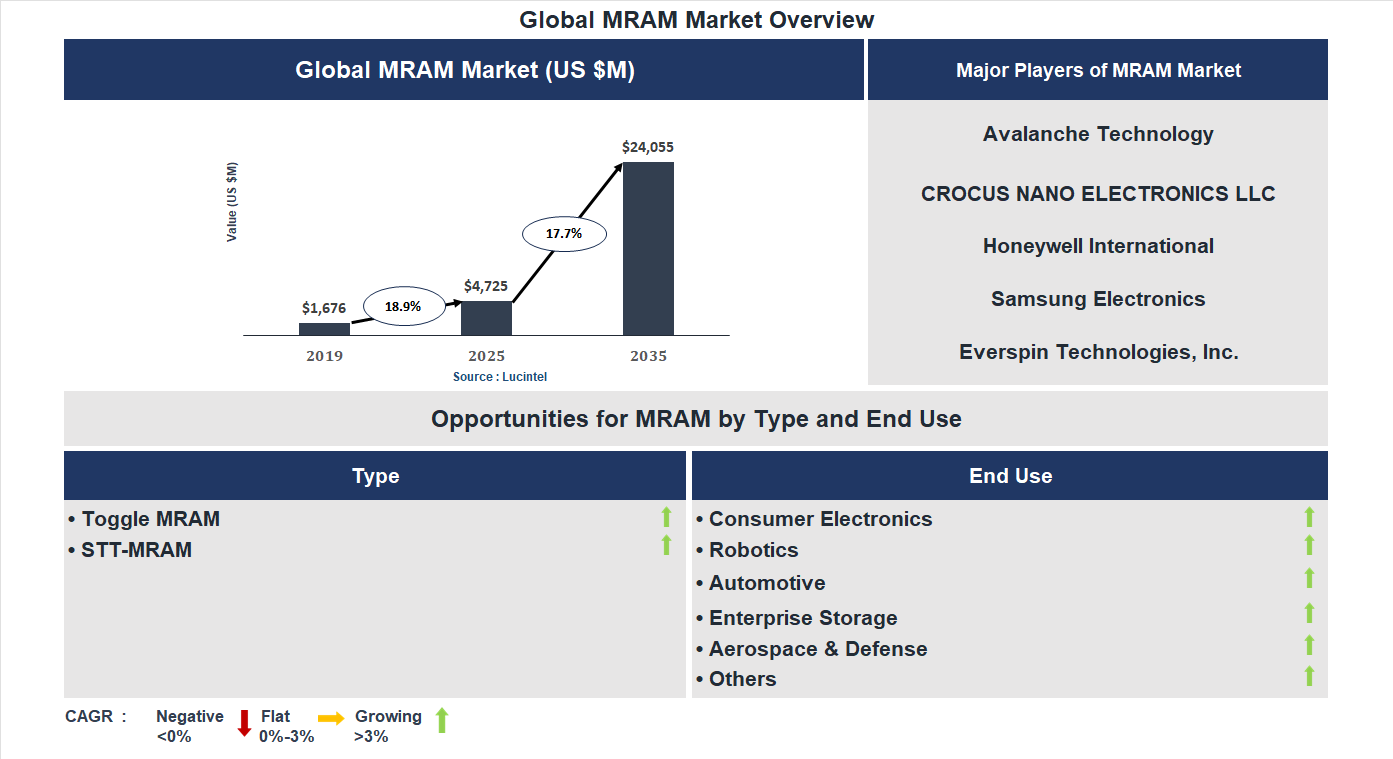
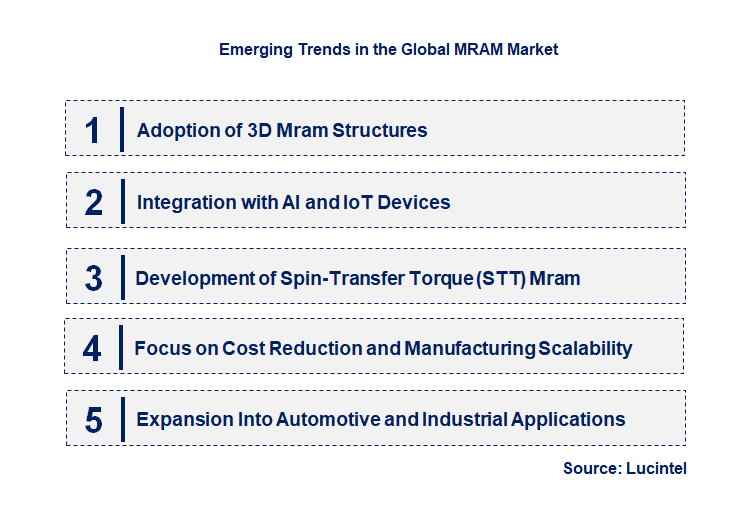
• Adoption of 3D MRAM Structures: This trend involves stacking multiple layers of MRAM cells vertically to increase storage density and improve performance. 3D architectures enable higher data capacity within a smaller footprint, making MRAM more suitable for compact devices like smartphones and IoT gadgets. The integration of 3D structures also enhances speed and reduces power consumption, which is vital for energy-efficient applications. As manufacturing techniques evolve, 3D MRAM is expected to become a standard in high-performance memory solutions, driving market growth and innovation.
• Integration with AI and IoT Devices: The proliferation of AI and IoT devices demands fast, reliable, and low-power memory solutions. MRAM‘s non-volatile nature, combined with its high speed and endurance, makes it ideal for these applications. Companies are increasingly integrating MRAM into edge devices, sensors, and smart systems to enable real-time data processing and reduce latency. This trend is expanding MRAM‘s market reach, fostering new product development, and supporting the growth of smart, connected technologies across industries.
• Development of Spin-Transfer Torque (STT) MRAM: STT-MRAM is gaining prominence due to its lower power consumption and faster switching speeds compared to traditional MRAM. This technology uses spin-polarized currents to write data, which enhances energy efficiency and durability. The shift towards STT-MRAM is driven by the need for sustainable and high-performance memory solutions in data centers, automotive, and consumer electronics. As research progresses, STT-MRAM is poised to replace existing memory types, significantly impacting the market landscape with its superior attributes.
• Focus on Cost Reduction and Manufacturing Scalability: To accelerate adoption, manufacturers are focusing on reducing production costs and improving scalability. Innovations in fabrication processes, such as advanced lithography and material optimization, are making MRAM more affordable. Cost-effective manufacturing is crucial for widespread adoption in mainstream consumer electronics and enterprise solutions. This trend is enabling MRAM to compete more effectively with established memory technologies like DRAM and NAND, broadening its market penetration and fostering industry-wide growth.
• Expansion into Automotive and Industrial Applications: MRAM‘s robustness, high endurance, and resistance to radiation make it suitable for automotive and industrial environments. The market is witnessing increased adoption of MRAM in automotive control systems, industrial automation, and harsh environment sensors. This expansion is driven by the need for reliable, long-lasting memory solutions in safety-critical applications. As these sectors demand more durable and energy-efficient memory, MRAM‘s role is expected to grow significantly, opening new revenue streams and market opportunities.
• Growing Demand for High-Speed memory: The increasing need for faster data processing in computing and mobile devices is boosting MRAM adoption. Its non-volatile nature combined with high speed makes it ideal for applications requiring quick data access and storage. This trend is encouraging manufacturers to innovate, leading to improved MRAM performance and cost-efficiency, which further accelerates market growth. The demand is particularly strong in data centers and enterprise storage solutions.
• Advancements in MRAM Manufacturing Technology: Innovations in fabrication processes, such as improved tunnel magnetoresistance (TMR) and scalable cell designs, are enhancing MRAM performance and reducing costs. These technological improvements enable mass production and integration into mainstream electronics. As manufacturing becomes more efficient, MRAM‘s competitive edge over traditional memory types strengthens, attracting more industry players and expanding its market share across various sectors.
• Expansion into Automotive and Industrial Applications: The automotive industry’s shift towards electric vehicles and autonomous systems is creating new opportunities for MRAM. Its durability, high-temperature stability, and fast switching capabilities make it suitable for automotive electronics and industrial automation. This diversification is broadening MRAM‘s application scope, encouraging investments and partnerships, and driving market growth in sectors demanding reliable, high-performance memory solutions.
• Increasing Investments in R&D for Next-Generation MRAM: Significant funding from governments and private firms is accelerating research into advanced MRAM technologies, such as 3D stacking and hybrid memory solutions. These innovations aim to improve capacity, speed, and energy efficiency, making MRAM more competitive. Enhanced R&D efforts are fostering breakthroughs that will likely lead to new product launches, expanding market applications and solidifying MRAM’s position in the memory landscape.
• Rising Adoption in Consumer Electronics and Data Centers: Consumer devices like smartphones, wearables, and gaming consoles are increasingly integrating MRAM for faster, more reliable performance. Simultaneously, data centers are adopting MRAM for cache and storage due to its speed and non-volatility. This dual adoption is expanding the market, encouraging manufacturers to develop tailored MRAM solutions, and driving overall market growth through increased demand for high-performance memory solutions.
• Expansion into Consumer Electronics: MRAM‘s fast read/write speeds and low power consumption make it ideal for smartphones, wearables, and IoT devices. As consumer demand for high-performance, energy-efficient gadgets grows, manufacturers are integrating MRAM to enhance device capabilities. Its non-volatile nature allows for instant-on functionality, reducing boot times and improving user experience. The scalability of MRAM also supports miniaturization trends, enabling more compact and efficient consumer products, thus opening significant growth avenues in this sector.
• Adoption in Automotive and Autonomous Vehicles: The automotive industry is increasingly adopting MRAM for advanced driver-assistance systems (ADAS), infotainment, and autonomous vehicle applications. MRAM‘s resilience to temperature fluctuations and high reliability under harsh conditions make it suitable for automotive environments. Its fast data access supports real-time processing essential for safety and navigation systems. As vehicle electronics become more sophisticated, MRAM offers a durable, high-performance memory solution, driving substantial growth opportunities in automotive electronics and autonomous vehicle infrastructure.
• Integration into Data Center and Cloud Infrastructure: MRAM‘s high-speed performance and non-volatile storage capabilities are transforming data center architectures. It offers faster data access, lower latency, and reduced power consumption compared to traditional memory solutions. This makes MRAM ideal for cache memory, persistent storage, and high-performance computing applications. As data centers seek more efficient and reliable memory options to handle increasing data loads, MRAM‘s scalability and durability position it as a strategic choice, fueling market expansion in cloud and enterprise sectors.
• Advancements in Manufacturing and Cost Reduction: Innovations in MRAM manufacturing processes, such as improved deposition techniques and wafer-scale production, are reducing costs and enhancing quality. These advancements enable mass production, making MRAM more economically viable for widespread adoption. Cost reductions will facilitate integration into a broader range of applications, including consumer electronics and industrial devices. As manufacturing becomes more efficient, the market will benefit from increased supply, lower prices, and accelerated adoption, further driving growth opportunities.
• Development of Multi-layer and 3D MRAM Technologies: The evolution of multi-layer and 3D MRAM architectures promises higher storage densities and improved performance. These innovations allow for stacking multiple memory layers, increasing capacity without enlarging the footprint. Enhanced scalability and performance make 3D MRAM suitable for next-generation computing, AI, and machine learning applications. The development of these advanced architectures is expected to unlock new markets, support miniaturization, and meet the growing demand for high-capacity, high-speed memory solutions across various industries.
• Technological Advancements: The continuous evolution of memory technologies has led to the development of MRAM as a promising alternative to traditional RAM. Innovations in magnetic tunnel junctions and spintronic devices have improved performance, reliability, and scalability. These advancements enable MRAM to offer faster read/write speeds, non-volatility, and lower power consumption, making it suitable for a wide range of applications from consumer electronics to industrial systems. As research progresses, the cost of production is expected to decrease, further boosting adoption. The technological momentum ensures MRAM remains competitive and relevant in the memory landscape.
• Growing Demand for High-Speed Data Storage: The exponential increase in data generation from cloud computing, IoT devices, and AI applications has created a pressing need for faster, more reliable memory solutions. MRAM‘s high-speed read/write capabilities and non-volatile nature make it ideal for data centers, enterprise storage, and edge computing. Its ability to retain data without power and provide rapid access enhances system performance and energy efficiency. As organizations seek to optimize data processing and reduce latency, the demand for MRAM is expected to surge, driving market growth significantly.
• Increasing Adoption in Consumer Electronics: Consumer electronics manufacturers are increasingly integrating MRAM into devices such as smartphones, wearables, and gaming consoles. The technology‘s low power consumption and durability align with consumer demands for longer battery life and device longevity. MRAM‘s ability to enable instant-on functionality and improve device responsiveness adds value to end-users. As the consumer electronics industry continues to innovate, the incorporation of MRAM is anticipated to expand, supported by the need for compact, energy-efficient, and high-performance memory solutions.
• Rising Investment in R&D and Strategic Collaborations: Major industry players and governments are investing heavily in research and development to overcome existing limitations of MRAM technology. Strategic collaborations between semiconductor companies, research institutions, and technology providers facilitate knowledge sharing and accelerate commercialization. These investments aim to improve manufacturing processes, reduce costs, and enhance device performance. The focus on innovation and partnership is crucial for overcoming technical barriers and establishing MRAM as a mainstream memory technology, thereby fueling market expansion.
• High Manufacturing Costs: Producing MRAM involves complex fabrication processes, including precise control of magnetic tunnel junctions and spintronic materials. These manufacturing complexities lead to higher costs compared to traditional memory technologies like DRAM and NAND flash. The elevated costs hinder large-scale adoption, especially in cost-sensitive markets. Additionally, scaling MRAM for mass production requires significant capital investment in specialized equipment and process optimization. Overcoming these cost barriers is essential for widespread commercialization and competitive pricing, but it remains a significant challenge for industry players.
• Technological Maturity and Reliability Concerns: Although MRAM has made significant progress, it still faces issues related to long-term reliability, data retention, and endurance. Variability in magnetic properties and thermal stability can impact device performance over time. Ensuring consistent quality and durability across manufacturing batches is challenging, which affects consumer confidence and industry adoption. Moreover, integrating MRAM with existing semiconductor processes requires overcoming compatibility issues. Addressing these technological maturity concerns is vital for establishing MRAM as a dependable memory solution in critical applications.
• Regulatory and Standardization Challenges: The lack of comprehensive standards and regulatory frameworks for MRAM technology poses hurdles for market growth. Data security, privacy concerns, and compliance with industry-specific regulations require clear guidelines. Variability in standards across regions can complicate global deployment and interoperability. Additionally, intellectual property rights and licensing issues may impede collaboration and innovation. Establishing universally accepted standards and regulatory policies is crucial for fostering trust, ensuring compatibility, and accelerating market adoption of MRAM solutions.
• Avalanche Technology
• CROCUS NANO ELECTRONICS LLC
• Honeywell International
• Samsung Electronics
• Everspin Technologies, Inc.
• Toshiba Corporation
• Spin Memory, Inc
• NVE Corporation
• Intel Corporation
• Infineon Technologies
• Toggle MRAM
• STT-MRAM
• Consumer Electronics
• Robotics
• Automotive
• Enterprise Storage
• Aerospace & Defense
• Others
• North America
• Europe
• Asia Pacific
• The Rest of the World
• United States: The US market for MRAM has seen rapid innovation, with major tech companies investing heavily in research to improve memory speed and durability. Several startups and established firms are developing next-generation MRAM products, focusing on integration with existing semiconductor technologies. The US government is also supporting research initiatives to advance memory technology, aiming to enhance data security and processing efficiency in cloud computing and AI applications. Additionally, US-based manufacturers are expanding production capacities to meet rising demand from data centers and consumer electronics sectors.
• China: China is rapidly advancing in MRAM technology, with significant government backing to develop indigenous memory solutions. Chinese companies are investing in research collaborations with universities and international firms to accelerate innovation. The country is focusing on reducing reliance on foreign memory technologies by establishing local manufacturing facilities and supply chains. Chinese firms are also exploring applications in automotive and IoT devices, aiming to capture a larger share of the global MRAM market through strategic partnerships and technological breakthroughs.
• Germany: Germany‘s MRAM market is characterized by strong industrial integration, particularly within automotive and industrial automation sectors. German companies are focusing on developing robust, high-temperature MRAM solutions suitable for harsh environments. The country is also investing in research to improve energy efficiency and miniaturization of MRAM chips. Collaborations between academia and industry are fostering innovation, with a focus on sustainable manufacturing processes and integration into European semiconductor ecosystems. Germany‘s emphasis on quality and reliability is driving the adoption of MRAM in critical applications.
• India: India is emerging as a key player in MRAM development, supported by government initiatives to boost semiconductor manufacturing and R&D. Indian startups and research institutions are working on cost-effective MRAM solutions tailored for local applications such as consumer electronics, IoT, and automotive sectors. The country is also focusing on building a skilled workforce and establishing manufacturing hubs to reduce import dependence. Strategic partnerships with global firms are helping India accelerate its MRAM technology development and expand its market presence regionally and globally.
• Japan: Japan continues to be a leader in memory technology innovation, with major corporations investing in advanced MRAM research. Japanese firms are developing high-performance, low-power MRAM chips for use in consumer electronics, automotive, and industrial applications. The country is also exploring hybrid memory solutions combining MRAM with other technologies to enhance overall system performance. Japan‘s focus on quality, reliability, and sustainable manufacturing practices positions it as a key player in the global MRAM market, with ongoing efforts to commercialize next-generation memory solutions.


• Avalanche Technology
• CROCUS NANO ELECTRONICS LLC
• Honeywell International
• Samsung Electronics
• Everspin Technologies, Inc.
• Toshiba Corporation
• Spin Memory, Inc
• NVE Corporation
• Intel Corporation
• Infineon Technologies
Q6. Which MRAM market segment will be the largest in future?

Choose a license that fits your team. Instant PDF delivery.
Prices exclude taxes. Instant delivery. Custom licensing available on request.
Market Report · July 24, 2026
Market Report · July 20, 2026
Market Report · July 20, 2026
Trusted partner for strategic intelligence and business growth


Receive a complimentary market analysis tailored to your industry. Our analysts will identify key growth opportunities and competitive dynamics specific to your business.

Market size, growth rate, and key trend analysis for your specific sector.

Top competitor positioning and market share analysis.

Strategic recommendations backed by data-driven insights.
Get curated market intelligence and competitive moves straight to your inbox.
By subscribing, you agree to receive our monthly insights. Unsubscribe anytime.
Receive a complimentary market analysis tailored to your industry. Our analysts will identify key growth opportunities and competitive dynamics specific to your business.
Market size, growth rate, and key trend analysis for your specific sector.
Top competitor positioning and market share analysis.
Strategic recommendations backed by data-driven insights.
Get curated market intelligence, emerging trends, and competitive moves straight to your inbox each month.
By subscribing, you agree to receive our monthly insights. Unsubscribe anytime.
We'll send your sample report shortly.