
Market Report · July 22, 2026

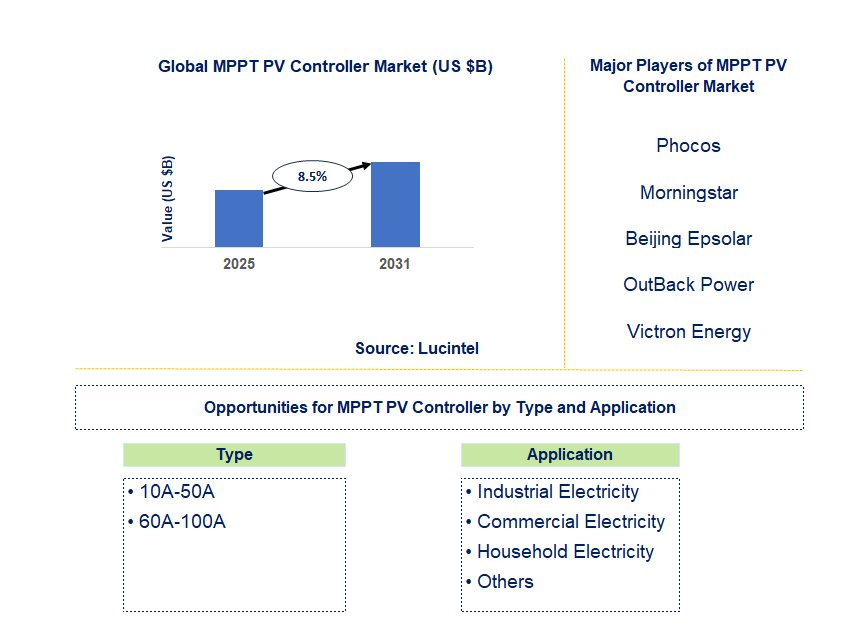
Key data points: The growth forecast = 8.5% annually for the next 7 years. Scroll below to get more insights. This market report covers Trends, opportunities and forecasts in MPPT PV controller market to 2031 by type (10A-50A and 60A-100A), application (industrial electricity, commercial electricity, household electricity, and others), and region (North America, Europe, Asia Pacific, and the Rest of the World)
We'll send your sample report shortly.
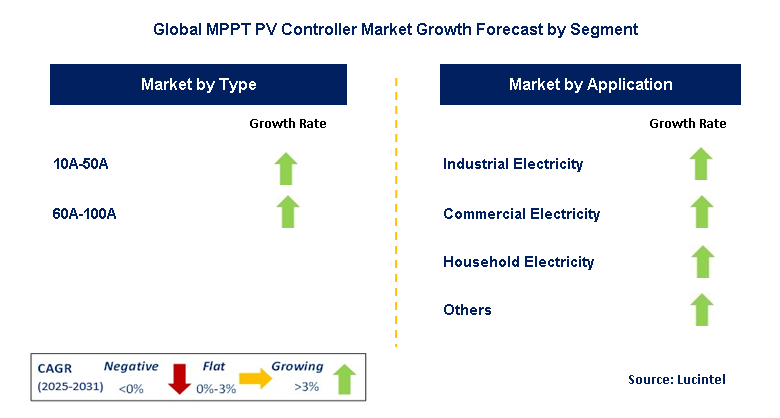
• Lucintel forecasts that, within the type category, 60A-100A is expected to witness higher growth over the forecast period.
• Within the application category, industrial electricity is expected to witness the highest growth.
• In terms of region, APAC is expected to witness the highest growth over the forecast period.
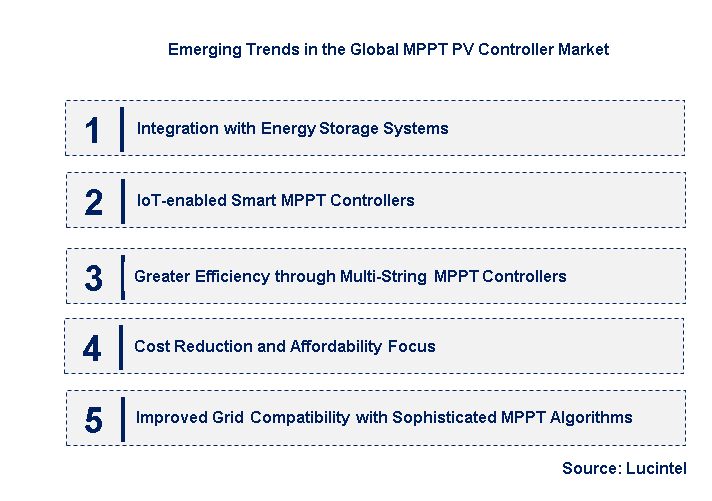
• Integration with Energy Storage Systems: The integration of MPPT controllers with energy storage systems is a growing trend, driven by the need for solar power systems to provide reliable power even when the sun isn’t shining. This integration enables better energy management by allowing excess energy generated during peak sunlight hours to be stored in batteries for later use. Through optimizing the charging and discharging of energy storage systems, MPPT controllers are able to enhance overall system efficiency and decrease grid dependency, particularly in off-grid or hybrid installations.
• IoT-enabled Smart MPPT Controllers: Following the advancement of the Internet of Things (IoT), intelligent MPPT controllers have been designed that can be remotely monitored and controlled through mobile apps or cloud-based interfaces. These intelligent controllers allow users to monitor system performance, detect faults, and fine-tune energy consumption remotely. IoT integration further facilitates predictive maintenance, which will ensure the life of PV systems. This movement is making solar energy management more convenient and efficient for residential as well as commercial consumers.
• Greater Efficiency through Multi-String MPPT Controllers: Multi-string MPPT controllers, where different PV strings are allowed to run independently, are becoming popular. These controllers maximize energy production by regulating the voltage and current from each string so that each operates at its optimal efficiency. This technology is especially beneficial in installations with shading or uneven orientation, where conventional controllers would perform poorly. Multi-string MPPT controllers should deliver greater energy yields, and they are becoming more appealing for residential as well as large commercial PV systems.
• Cost Reduction and Affordability Focus: With solar energy remaining at the core of the world's energy transition, emphasis on cost reduction along the value chain of solar energy has grown. Companies are focusing on making MPPT controllers more affordable by enhancing manufacturing processes, employing cost-efficient components, and gaining economies of scale. Consequently, MPPT controllers are becoming more accessible to a wider set of consumers, especially in emerging economies, and this is likely to propel growth in residential and commercial solar installations.
• Improved Grid Compatibility with Sophisticated MPPT Algorithms: The implementation of sophisticated MPPT algorithms, including perturb and observe (P&O) and incremental conductance (Income), is enhancing MPPT controller grid compatibility. These algorithms maximize the efficiency of solar power production even under fluctuating environmental conditions. With increasing grid management and integration requirements, advanced MPPT algorithms guarantee that PV systems will be able to interact with off-grid and grid-connected configurations smoothly. This is a trend necessary as the demand for stable, renewable energy sources and grid-interactive solar systems increases worldwide. These upcoming trends are remarkably transforming the MPPT PV controller market by stimulating efficiency innovations, integration of smart technology, and affordability. As the trends develop further, the market will have increased use of MPPT controllers, which will improve solar energy efficiency as well as increase the use of solar technologies globally.
• Hybrid Solar System Integration: Hybrid solar systems, which integrate solar power with other sources such as battery storage or backup generators, are becoming increasingly popular. Hybrid system MPPT controllers must be able to handle energy from more than one source efficiently, delivering maximum performance and power distribution. New hybrid MPPT controller technology allows for improved integration of renewable energy into conventional power grids, increasing the flexibility and efficiency of solar installations.
• AI and Machine Learning to Optimize Performance: AI and machine learning-based algorithms are being incorporated into MPPT controllers for optimizing the harvesting of solar energy and system performance. The technology enables MPPT controllers to respond more dynamically to varying weather patterns, forecast energy requirements, and fine-tune system performance automatically for maximum effectiveness. This innovation is likely to enhance the energy output and life of PV systems.
• Efficiency and Thermal Management Advances: Recent advances in MPPT controllers aim to enhance efficiency and thermal management. Better cooling methods and optimized circuit designs are assisting in minimizing the heat produced in MPPT controllers, which enhances their performance and lifespan. These advances are especially critical in high-ambient temperature regions, where thermal stress may reduce the performance of PV systems.
• Smarter Connectivity with Communication Standards: MPPT controllers are increasingly being integrated with communication protocols like Modbus, RS485, and Wi-Fi, which enable effortless communication with other units in a solar power system. This smarter connectivity makes real-time monitoring, diagnostics, and performance optimization possible. This trend is particularly significant for commercial installations that need remote monitoring and management.
• Development of Compact and Lightweight Designs: Manufacturers are focusing on developing smaller, lighter, and more compact MPPT controllers without sacrificing performance. This trend makes MPPT controllers easier to install, especially in residential applications where space is often limited. The development of compact designs also makes it easier to integrate MPPT controllers into pre-existing systems. These advancements are an indication of the growing need for more efficient, adaptable, and combined MPPT controllers in the solar power sector. The evolution of AI, hybrid systems, and connectivity is pushing the market towards more reliable and intelligent solar energy solutions, eventually enhancing the performance and accessibility of solar installations globally.
• Residential Solar Installations: The increasing use of solar power in residential communities creates vast opportunities for MPPT PV controllers. As the need for domestic solar systems rises, MPPT controllers play a crucial role in maximizing energy efficiency and ensuring that families receive the best out of their solar installations. The shift towards energy independence and reduced electricity bills is compelling the use of such systems.
• Commercial and Industrial Solar Applications: In the industrial and commercial segments, MPPT PV controllers play a vital role in maximizing big solar installations. The systems need highly efficient and reliable MPPT controllers for maximum energy output, cost savings, and smooth operation. The popularity of renewable energy sources among industries, especially those trying to minimize their carbon footprint, is fueling the growth of this segment.
• Remote and Off-Grid Regions: For remote or off-grid regions, MPPT PV controllers provide an efficient and trustworthy means of solar-powered electricity. These regions typically have no grid access, which makes solar energy a viable energy option. As demand for renewable and self-reliant power solutions increases, MPPT controllers play an ever-more crucial role in off-grid solar installations.
• Solar Power for Electric Vehicles (EVs): With the growing number of electric vehicles, solar-powered charging stations are in high demand. MPPT controllers play a crucial role in optimizing the efficiency of solar power collected by such stations. This is a growth area in the fast-growing EV market since solar-powered EV charging is viewed as one of the most important solutions for clean transport.
• Smart Grid Integration: The growing deployment of smart grids is a big opportunity for MPPT PV controllers. With increasingly interconnected and automated grids, MPPT controllers are essential for effective energy distribution and system stability. Smart grid integration enables enhanced energy management, increased system reliability, and increased use of renewable energy sources. MPPT PV controller industry is observing notable growth in numerous applications based on surging demand for solar power solutions. As the solar energy trend gains acceptance on a worldwide level, MPPT controllers are destined to play a dominant role in achieving peak efficiency, dependability, and usability in solar power systems.
• Phocos
• Morningstar
• Beijing Epsolar
• OutBack Power
• Victron Energy
• Studer Innotec
• Steca
• Remote Power
• Wuhan Wanpeng S&T
• Blue Sky Energy Technology
• 10A-50A
• 60A-100A
• Industrial Electricity
• Commercial Electricity
• Household Electricity
• Others
• North America
• Europe
• Asia Pacific
• The Rest of the World
• United States: In the United States, the MPPT PV controller market has registered significant growth with the growing emphasis on renewable energy and the increasing number of solar installations. The U.S. solar market remains one of the largest in the world, with residential and utility-scale solar systems employing MPPT technology for improved efficiency. Improvements in controller technology, including the integration of communication capabilities and cloud connectivity, are advancing MPPT controllers. Pressure to drive smart grids and energy storage has fueled development in MPPT controllers, which now tend to include energy management systems to optimize PV system performance.
• China: China continues to dominate the solar energy output globally and also accounts for a large share in the MPPT PV controller market. The nation's focus on solar energy as the central pillar of its green power revolution has accelerated innovation in MPPT technology. Chinese companies are concentrating on manufacturing affordable, high-performance MPPT controllers for application in residential, commercial, and utility-scale PV systems. Moreover, there is increasing demand for sophisticated MPPT controllers with monitoring data, remote control, and improved grid compatibility. As the solar market of China grows, MPPT controllers are likely to develop with growing use of hybrid and storage systems.
• Germany: Germany, the pioneer in adopting renewable energy, continues to have a high level of demand for MPPT PV controllers in both residential and commercial applications. Strong policy support in the country for solar power and its aggressive renewable energy goals have provided a positive market scenario for MPPT technologies. Latest developments in Germany revolve around optimizing the efficiency and reliability of MPPT controllers across various climatic conditions, such as cold and cloudy conditions. There is also a move to integrate MPPT controllers with battery storage systems in order to further increase energy autonomy and grid stability. This movement is part of Germany's general objectives for energy transition (Evergreened).
• India: The MPPT PV controller market in India is picking up pace with the country's accelerated solar adoption as well as its drive to achieve aggressive renewable energy goals. The government of India has been encouraging solar power as an indispensable component of its energy mix, with solar installation incentives and big solar farms. MPPT controllers in India are being utilized majorly for commercial, residential, and off-grid solar installations, particularly in rural regions. Given the rising requirement for efficient energy management systems, there is now greater emphasis placed on affordable MPPT controllers capable of addressing India's energy market diversity.
• Japan: Japan is leading the trend in solar power adoption, and MPPT PV controllers are essential in achieving high energy efficiency. Since the Fukushima accident, Japan has been pursuing its energy security and hastening the development of renewable energy. MPPT controllers are being progressively incorporated into home and industrial solar systems to attain maximum energy extraction. In addition, Japanese companies are driving innovations in ultra-efficient MPPT technologies, such as those which facilitate integration with energy storage systems, smart grids, and home energy management systems, to drive Japan's aggressive renewable energy ambitions.


• Phocos
• Morningstar
• Beijing Epsolar
• OutBack Power
• Victron Energy
• Studer Innotec
• Steca
• Remote Power
• Wuhan Wanpeng S&T
• Blue Sky Energy Technology Q5. Which MPPT PV controller market segment will be the largest in future? Answer: Lucintel forecasts that, within the type category, 60A-100A is expected to witness higher growth over the forecast period. Q6. In MPPT PV controller market, which region is expected to be the largest in next 5 years? Answer: In terms of region, APAC is expected to witness the highest growth over the forecast period. Q7. Do we receive customization in this report? Answer: Yes, Lucintel provides 10% customization without any additional cost.


Choose a license that fits your team. Instant PDF delivery.
Prices exclude taxes. Instant delivery. Custom licensing available on request.
Market Report · July 22, 2026
Market Report · July 22, 2026
Market Report · July 17, 2026
Trusted partner for strategic intelligence and business growth


Receive a complimentary market analysis tailored to your industry. Our analysts will identify key growth opportunities and competitive dynamics specific to your business.

Market size, growth rate, and key trend analysis for your specific sector.

Top competitor positioning and market share analysis.

Strategic recommendations backed by data-driven insights.
Get curated market intelligence and competitive moves straight to your inbox.
By subscribing, you agree to receive our monthly insights. Unsubscribe anytime.
Receive a complimentary market analysis tailored to your industry. Our analysts will identify key growth opportunities and competitive dynamics specific to your business.
Market size, growth rate, and key trend analysis for your specific sector.
Top competitor positioning and market share analysis.
Strategic recommendations backed by data-driven insights.
Get curated market intelligence, emerging trends, and competitive moves straight to your inbox each month.
By subscribing, you agree to receive our monthly insights. Unsubscribe anytime.
We'll send your sample report shortly.