
Report Feature
Mouse Controller Market Trends and Forecast
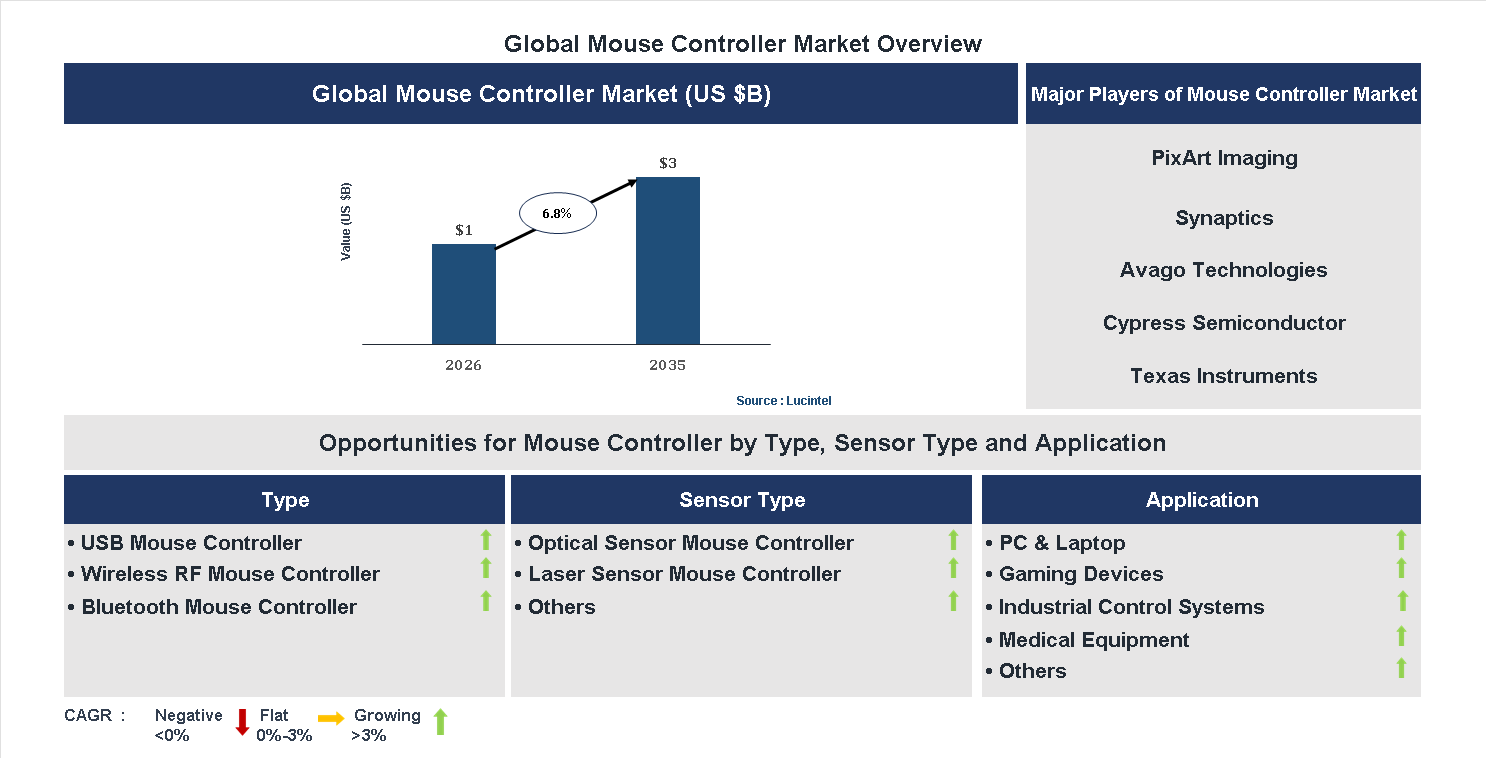
The future of the global mouse controller market looks promising with opportunities in the PC & laptop, gaming device, industrial control system, and medical equipment markets. The global mouse controller market is expected to reach an estimated $3 billion by 2035 with a CAGR of 6.8% from 2026 to 2035. The major drivers for this market are the increasing use of computers & laptops, the rising trend of wireless connectivity, and the growing adoption of ergonomic devices for comfort.• Lucintel forecasts that, within the type category, wireless RF mouse controller is expected to witness the highest growth over the forecast period.
• Within the application category, PC & laptop is expected to witness the highest growth.
• In terms of region, APAC is expected to witness the highest growth over the forecast period. Gain valuable insights for your business decisions with our comprehensive 150+ page report. Sample figures with some insights are shown below.
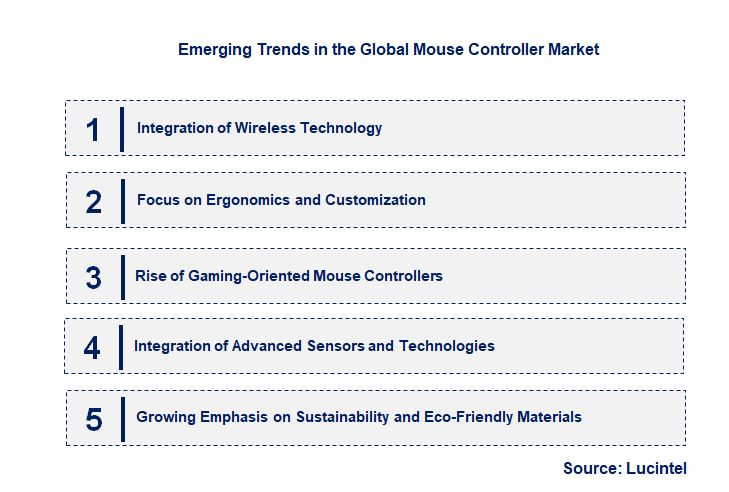
Emerging Trends in the Mouse Controller Market
The mouse controller market is experiencing rapid evolution driven by technological advancements, changing consumer preferences, and increasing demand for versatile input devices across gaming, professional, and accessibility sectors. As digital interaction becomes more sophisticated, manufacturers are innovating to meet diverse needs, resulting in emerging trends that are reshaping the landscape. These developments are not only enhancing user experience but also expanding market opportunities and competitive dynamics. Understanding these key trends is essential for stakeholders aiming to capitalise on the market's growth potential and adapt to the shifting technological environment.• Integration of Wireless Technology: Wireless mouse controllers are gaining popularity due to their convenience and mobility. Bluetooth and RF technologies enable users to enjoy clutter-free setups and greater flexibility, especially in gaming and professional environments. This trend reduces cable clutter, enhances portability, and improves user comfort, making wireless options a preferred choice among consumers. As wireless technology becomes more reliable and affordable, its adoption is expected to accelerate, driving market growth and encouraging manufacturers to innovate in wireless connectivity features.
• Focus on Ergonomics and Customisation: Ergonomic design and customizable features are increasingly prioritised to improve user comfort and reduce strain during prolonged use. Manufacturers are developing mice with adjustable grips, programmable buttons, and customizable weights to cater to individual preferences. This trend is particularly significant in gaming and professional sectors, where comfort and efficiency directly impact performance. Enhanced ergonomics and personalisation options are driving customer satisfaction and brand loyalty, fostering a competitive edge for companies that invest in user-centric designs.
• Rise of Gaming-Oriented Mouse Controllers: The gaming industry is a major driver of innovation in mouse controllers, with a focus on high precision, low latency, and programmable features. Gaming mice now incorporate advanced sensors, customizable DPI settings, and RGB lighting to enhance the gameplay experience. The demand for specialised gaming controllers is fueling product development, attracting a dedicated consumer base. This trend is transforming the market by elevating the importance of performance-specific features, leading to a surge in premium gaming mice and expanding the overall market size.
• Integration of Advanced Sensors and Technologies: The incorporation of high-precision sensors, optical tracking, and haptic feedback is revolutionising mouse controller capabilities. These technological advancements enable more accurate tracking, smoother movements, and immersive experiences. For professional users, such as designers and engineers, this means increased productivity and precision. The integration of AI and machine learning for adaptive sensitivity and gesture controls is also emerging, further enhancing functionality. This trend is pushing the boundaries of what mouse controllers can achieve, making them more versatile and efficient across various applications.
• Growing Emphasis on Sustainability and Eco-Friendly Materials: Environmental concerns are prompting manufacturers to adopt sustainable practices, including the use of eco-friendly materials and energy-efficient designs. Recyclable plastics, biodegradable packaging, and reduced energy consumption during manufacturing are becoming standard. Consumers are increasingly favouring brands that demonstrate environmental responsibility, influencing purchasing decisions. This trend is reshaping the market by encouraging innovation in sustainable product development and fostering a shift towards greener, more responsible manufacturing practices, aligning industry growth with environmental sustainability goals. These trends are collectively transforming the mouse controller market by enhancing technological capabilities, improving user comfort, and emphasising sustainability. They are expanding market opportunities, fostering innovation, and meeting evolving consumer demands, ultimately leading to a more dynamic and competitive landscape.
Recent Development in the Mouse Controller Market
The mouse controller market has experienced significant advancements driven by technological innovation and changing consumer preferences. As gaming and professional applications expand, new opportunities emerge for enhanced user experience and device integration. Companies are investing in smarter, more responsive controllers to meet increasing demand. These developments are shaping the future landscape of the market, offering both challenges and growth prospects for manufacturers and consumers alike.• Growing Demand for Wireless Controllers: The shift towards wireless technology has increased consumer preference for convenience and mobility. Wireless mouse controllers offer greater flexibility, reducing clutter and enhancing user experience. This trend is driven by advancements in Bluetooth and RF technologies, making wireless options more reliable and affordable. As a result, manufacturers are focusing on developing high-performance wireless controllers, which are expected to capture a larger market share and meet the needs of gamers and professionals seeking seamless connectivity.
• Integration of Haptic Feedback Technology: Haptic feedback enhances user immersion by providing tactile responses during gameplay or work tasks. This technology improves realism and engagement, making controllers more appealing. The integration of haptic feedback is also expanding into professional applications, such as virtual simulations and training modules. As a result, the market is witnessing increased innovation, with companies investing in sophisticated haptic systems to differentiate their products, ultimately boosting sales and user satisfaction across various segments.
• Adoption of Ergonomic Designs for Prolonged Use: Ergonomics is becoming a key focus to reduce fatigue and prevent strain injuries during extended use. Manufacturers are designing controllers with adjustable grips, textured surfaces, and customizable buttons to improve comfort. This trend caters to gamers and professionals who spend hours using controllers daily. The emphasis on ergonomic features is expected to drive higher adoption rates, enhance brand loyalty, and open new opportunities for premium product lines targeting health-conscious consumers.
• Expansion of AI and Sensor Integration: Incorporating AI and advanced sensors into controllers allows for personalised experiences and smarter interactions. Features like adaptive sensitivity, gesture controls, and real-time analytics improve performance and user engagement. This technological integration is particularly impactful in competitive gaming and professional environments, where precision and customisation are critical. As AI-driven features become more accessible, the market will see increased innovation, attracting tech-savvy consumers and expanding the scope of controller functionalities.
• Rise of Cross-Platform Compatibility: Consumers increasingly demand controllers that work seamlessly across multiple devices and platforms. Manufacturers are developing versatile controllers compatible with PCs, consoles, and mobile devices, simplifying the user experience. This trend enhances product appeal by offering flexibility and reducing the need for multiple devices. Cross-platform compatibility is expected to boost sales, foster brand loyalty, and expand market reach, especially as gaming ecosystems become more interconnected and users seek unified control solutions. The overall impact of these developments is a more dynamic, innovative, and user-centric mouse controller market. Enhanced connectivity, comfort, realism, intelligence, and versatility are driving growth, attracting new consumers, and expanding application areas. These advancements are fostering a competitive environment that encourages continuous innovation, ultimately benefiting both manufacturers and users through improved products and experiences.
Strategic Growth Opportunities in the Mouse Controller Market
The mouse controller market is experiencing significant growth driven by advancements in gaming, virtual reality, and ergonomic device design. Increasing demand for precise input devices across various applications, including professional and consumer segments, is fueling innovation and market expansion. Companies are focusing on integrating wireless technology, enhancing user comfort, and developing customizable features to meet diverse user needs. This evolving landscape presents numerous opportunities for market players to capitalise on emerging trends and expand their product portfolios.• Expansion into Gaming and E-Sports Markets: The rising popularity of competitive gaming and e-sports has created a substantial demand for high-precision, customizable mouse controllers. Gamers seek devices with enhanced sensitivity, programmable buttons, and ergonomic designs to improve performance. Market growth is driven by technological innovations such as wireless connectivity, RGB lighting, and adjustable DPI settings. Companies investing in gaming-specific features and branding are positioned to capture a larger share of this lucrative segment, fueling overall market expansion.
• Integration of Wireless and Bluetooth Technology: The shift from wired to wireless mouse controllers offers users greater convenience, mobility, and reduced clutter. Wireless and Bluetooth-enabled devices provide seamless connectivity, longer battery life, and improved user experience. This trend is particularly prominent in professional environments and gaming setups, where flexibility and ease of use are critical. Manufacturers focusing on developing reliable, low-latency wireless solutions are likely to gain competitive advantages, driving market growth and broadening application scopes.
• Development of Ergonomic and Customizable Designs: As awareness of health and comfort increases, there is a growing demand for ergonomic mouse controllers that reduce strain and fatigue during prolonged use. Customizable features such as adjustable weights, button configurations, and grip styles cater to individual preferences and specific application needs. This opportunity is especially relevant in professional settings, where comfort can enhance productivity. Companies investing in ergonomic research and user-centric design are poised to meet this demand, expanding their market reach.
• Adoption in Virtual Reality and Augmented Reality Applications: The integration of mouse controllers into VR and AR environments enhances user interaction and immersion. These controllers enable precise navigation, object manipulation, and gesture recognition, essential for gaming, training, and industrial applications. As VR/AR adoption accelerates across sectors, the demand for specialised input devices like advanced mouse controllers will grow. Innovating with motion tracking, haptic feedback, and wireless connectivity will position companies to capitalise on this expanding application area.
• Focus on Smart and Programmable Features for Professional Use: Professional users require versatile, programmable mouse controllers that can streamline workflows and improve efficiency. Features such as customizable macros, multi-device connectivity, and advanced sensor technology are increasingly sought after in fields like design, engineering, and data analysis. Developing smart controllers with integrated software for customisation and automation presents a significant growth opportunity. Companies that deliver tailored solutions for professional markets can differentiate themselves and expand their market share. The overall market is poised for substantial growth as these opportunities align with technological advancements and evolving user preferences. Companies that innovate in gaming, wireless connectivity, ergonomic design, VR integration, and professional features will shape the future landscape of the mouse controller market, driving increased adoption and diversification across applications.
Mouse Controller Market Driver and Challenges
The mouse controller market is influenced by a variety of technological, economic, and regulatory factors that shape its growth and development. Rapid advancements in gaming technology, increasing adoption of e-sports, and the proliferation of wireless connectivity are key drivers. Additionally, economic factors such as rising disposable incomes and the growing popularity of online gaming contribute significantly. Regulatory aspects, including standards for wireless devices and safety regulations, also impact market dynamics. These elements collectively create opportunities and challenges that determine the trajectory of the market, requiring stakeholders to adapt to evolving consumer preferences, technological innovations, and regulatory frameworks. The factors responsible for driving the mouse controller market include:-• Technological Innovation: The continuous development of advanced sensors, ergonomic designs, and wireless connectivity options enhances user experience and drives market growth. Innovations such as customizable buttons, high-precision tracking, and ergonomic features cater to gamers and professionals alike, increasing demand. The integration of Bluetooth and RF technologies allows for seamless wireless operation, reducing clutter and improving mobility. As technology evolves, manufacturers are able to offer more sophisticated and user-friendly products, fueling market expansion and attracting a broader consumer base.
• Growing Gaming Industry: The expansion of the gaming industry, especially in e-sports and mobile gaming, significantly boosts demand for high-performance mouse controllers. The increasing number of gamers worldwide, coupled with the rise of competitive gaming tournaments, creates a substantial market for specialised controllers. This growth is supported by investments in gaming infrastructure and content, which encourage consumers to upgrade their peripherals for better performance. As gaming becomes more mainstream, the need for precise, comfortable, and customizable controllers continues to rise, driving market growth.
• Rising Adoption of Wireless Technology: The shift from wired to wireless mouse controllers offers convenience, portability, and reduced clutter, which appeals to both gamers and professionals. Wireless controllers provide greater freedom of movement and ease of use, especially in multi-device setups. Advances in Bluetooth and RF technologies have improved connectivity stability and battery life, making wireless options more reliable. This trend is further supported by the increasing availability of affordable wireless controllers, expanding the market reach and encouraging consumers to transition from traditional wired devices.
• Increasing Focus on Ergonomics and Customisation: Consumers are increasingly seeking ergonomic designs to prevent strain and enhance comfort during prolonged use. Customizable features such as programmable buttons, adjustable DPI settings, and personalised aesthetics cater to individual preferences. Manufacturers are investing in ergonomic research and offering tailored solutions for gamers, professionals, and casual users. This focus on comfort and personalisation enhances user satisfaction and loyalty, thereby expanding the market as consumers look for controllers that suit their specific needs and preferences.
• Expansion of E-sports and Online Gaming: The rise of e-sports tournaments and online multiplayer games has driven demand for high-precision, durable mouse controllers. Competitive gaming requires quick response times and accuracy, prompting players to invest in specialised controllers. The growth of streaming platforms and gaming communities further amplifies this trend, encouraging new users to adopt advanced peripherals. As e-sports continues to gain popularity globally, the market for high-performance controllers is expected to expand, driven by both professional and amateur gamers seeking competitive advantages. The challenges facing this Market include:-
• Regulatory and Safety Standards: Stringent regulations regarding wireless device emissions, safety standards, and environmental compliance pose hurdles for manufacturers. Compliance costs and delays in certification can hinder product development and market entry. Variations in regulations across regions complicate global distribution and require companies to adapt products to meet diverse standards, increasing complexity and expenses. Additionally, evolving regulatory landscapes demand continuous monitoring and updates, which can slow innovation and market responsiveness.
• Rapid Technological Obsolescence: The fast-paced nature of technological advancements leads to the quick obsolescence of existing products. Manufacturers face pressure to innovate constantly, which can increase R&D costs and reduce profit margins. Consumers also expect frequent upgrades, making it challenging for companies to maintain a steady product lifecycle. This rapid evolution can result in inventory obsolescence and increased waste, impacting profitability and sustainability efforts within the industry.
• Intense Market Competition: The market is highly competitive, with numerous established brands and new entrants vying for market share. Price wars, marketing battles, and product differentiation are common, which can erode profit margins. Smaller players may struggle to compete with larger corporations that have extensive distribution networks and brand recognition. This competitive pressure necessitates continuous innovation and marketing investments, which can strain resources and impact overall profitability. The mouse controller market is driven by technological innovations, expanding gaming industries, wireless adoption, ergonomic focus, and e-sports growth. However, regulatory challenges, rapid technological changes, and intense competition pose significant hurdles. These factors collectively influence market dynamics, requiring stakeholders to innovate strategically and adapt swiftly. The overall impact is a dynamic, competitive landscape with substantial growth opportunities, provided companies can navigate regulatory complexities and technological obsolescence effectively.
List of Mouse Controller Companies
Companies in the market compete on the basis of product quality offered. Major players in this market focus on expanding their manufacturing facilities, R&D investments, infrastructural development, and leverage integration opportunities across the value chain. With these strategies mouse controller companies cater increasing demand, ensure competitive effectiveness, develop innovative products & technologies, reduce production costs, and expand their customer base. Some of the mouse controller companies profiled in this report include-• PixArt Imaging
• Synaptics
• Avago Technologies
• Cypress Semiconductor
• Texas Instruments
• NXP Semiconductors
• STMicroelectronics
• Elan Microelectronics
• Holtek Semiconductor
• Razer
Mouse Controller Market by Segment
The study includes a forecast for the global mouse controller market by type, sensor type, application, and region.Mouse Controller Market by Type [Value from 2019 to 2035]:
• USB Mouse Controller
• Wireless RF Mouse Controller
• Bluetooth Mouse Controller
Mouse Controller Market by Sensor Type [Value from 2019 to 2035]:
• Optical Sensor Mouse Controller
• Laser Sensor Mouse Controller
• Others
Mouse Controller Market by Application [Value from 2019 to 2035]:
• PC & Laptop
• Gaming Devices
• Industrial Control Systems
• Medical Equipment
• Others
Mouse Controller Market by Region [Value from 2019 to 2035]:
• North America
• Europe
• Asia Pacific
• The Rest of the World
Country Wise Outlook for the Mouse Controller Market
The mouse controller market has experienced significant shifts driven by technological innovation, increasing demand for gaming and professional applications, and evolving consumer preferences. As digital interaction becomes more sophisticated, countries are investing in advanced input devices to enhance user experience. The United States, China, Germany, India, and Japan are leading the way with unique developments, reflecting their technological capabilities and market demands. These countries are focusing on integrating new features, improving ergonomics, and expanding the adoption of wireless and customizable options to stay competitive in this dynamic industry.• United States: The US market has seen rapid growth in wireless and ergonomic mouse controllers, driven by the gaming industry and remote work trends. Major companies are investing in AI-enabled features and customizable designs, enhancing user experience and productivity. The rise of eSports has also spurred innovations in high-precision controllers tailored for competitive gaming.
• China: China remains a dominant player with a focus on affordable yet technologically advanced mouse controllers. Local manufacturers are expanding their product lines to include gaming-specific controllers with enhanced sensitivity and programmable buttons. The market is also witnessing increased adoption of wireless and Bluetooth-enabled devices, supported by a growing gaming community.
• Germany: Germany emphasizes high-quality, durable, and ergonomically designed mouse controllers, catering to professional and industrial users. Innovations include precision tracking and customizable features for CAD and design applications. The market also sees a focus on sustainability, with eco-friendly materials and energy-efficient wireless options gaining popularity.
• India: The Indian market is rapidly expanding, driven by increasing internet penetration and a burgeoning gaming community. Manufacturers are offering affordable, feature-rich controllers with multi-platform compatibility. There is a rising demand for wireless and ergonomic designs, especially among young consumers and professional gamers.
• Japan: Japan leads in technological innovation, with a focus on compact, highly responsive controllers that cater to both gaming and professional markets. Companies are integrating advanced sensors and haptic feedback to improve user immersion. The market also emphasizes sleek design and energy efficiency, aligning with consumer preferences for premium, innovative products.

Features of the Global Mouse Controller Market
Market Size Estimates: Mouse controller market size estimation in terms of value ($B). Trend and Forecast Analysis: Market trends (2019 to 2025) and forecast (2026 to 2035) by various segments and regions. Segmentation Analysis: Mouse controller market size by type, sensor type, application, and region in terms of value ($B). Regional Analysis: Mouse controller market breakdown by North America, Europe, Asia Pacific, and Rest of the World. Growth Opportunities: Analysis of growth opportunities in different types, sensor types, applications, and regions for the mouse controller market. Strategic Analysis: This includes M&A, new product development, and competitive landscape of the mouse controller market. Analysis of competitive intensity of the industry based on Porter’s Five Forces model.
FAQ
Q1. What is the mouse controller market size? Answer: The global mouse controller market is expected to reach an estimated $3 billion by 2035. Q2. What is the growth forecast for mouse controller market? Answer: The global mouse controller market is expected to grow with a CAGR of 6.8% from 2026 to 2035. Q3. What are the major drivers influencing the growth of the mouse controller market? Answer: The major drivers for this market are the increasing use of computers & laptops, the rising trend of wireless connectivity, and the growing adoption of ergonomic devices for comfort. Q4. What are the major segments for mouse controller market? Answer: The future of the mouse controller market looks promising with opportunities in the PC & laptop, gaming device, industrial control system, and medical equipment markets. Q5. Who are the key mouse controller market companies? Answer: Some of the key mouse controller companies are as follows:• PixArt Imaging
• Synaptics
• Avago Technologies
• Cypress Semiconductor
• Texas Instruments
• NXP Semiconductors
• STMicroelectronics
• Elan Microelectronics
• Holtek Semiconductor
• Razer Q6. Which mouse controller market segment will be the largest in future? Answer: Lucintel forecasts that, within the type category, wireless RF mouse controller is expected to witness the highest growth over the forecast period. Q7. In mouse controller market, which region is expected to be the largest in next 5 years? Answer: In terms of region, APAC is expected to witness the highest growth over the forecast period. Q8. Do we receive customization in this report? Answer: Yes, Lucintel provides 10% customization without any additional cost.
Table of Contents
List of Figures
List of Tables
Methodology
- In-depth interviews of the major players in this market
- Detailed secondary research from competitors’ financial statements and published data
- Extensive searches of published works, market, and database information pertaining to industry news, company press releases, and customer intentions
- A compilation of the experiences, judgments, and insights of Lucintel’s professionals, who have analyzed and tracked this market over the years.


Buy Now
Choose a license that fits your team. Instant PDF delivery.
Prices exclude taxes. Instant delivery. Custom licensing available on request.
Key Questions
- • What are some of the most promising, high-growth opportunities for the mouse controller market by type (USB mouse controller, wireless RF mouse controller, and bluetooth mouse controller), sensor type (optical sensor mouse controller, laser sensor mouse controller, and others), application (PC & laptop, gaming devices, industrial control systems, medical equipment, and others), and region (North America, Europe, Asia Pacific, and the Rest of the World)?
- • Which segments will grow at a faster pace and why?
- • Which region will grow at a faster pace and why?
- • What are the key factors affecting market dynamics? What are the key challenges and business risks in this market?
- • What are the business risks and competitive threats in this market?
- • What are the emerging trends in this market and the reasons behind them?
- • What are some of the changing demands of customers in the market?
- • What are the new developments in the market? Which companies are leading these developments?
- • Who are the major players in this market? What strategic initiatives are key players pursuing for business growth?
- • What are some of the competing products in this market and how big of a threat do they pose for loss of market share by material or product substitution?
- • What M&A activity has occurred in the last 7 years and what has its impact been on the industry? For any questions related to Mouse Controller Market, Mouse Controller Market Size, Mouse Controller Market Growth, Mouse Controller Market Analysis, Mouse Controller Market Report, Mouse Controller Market Share, Mouse Controller Market Trends, Mouse Controller Market Forecast, Mouse Controller Companies, write Lucintel analyst at email: helpdesk@lucintel.com. We will be glad to get back to you soon.


