
Market Report · May 18, 2026

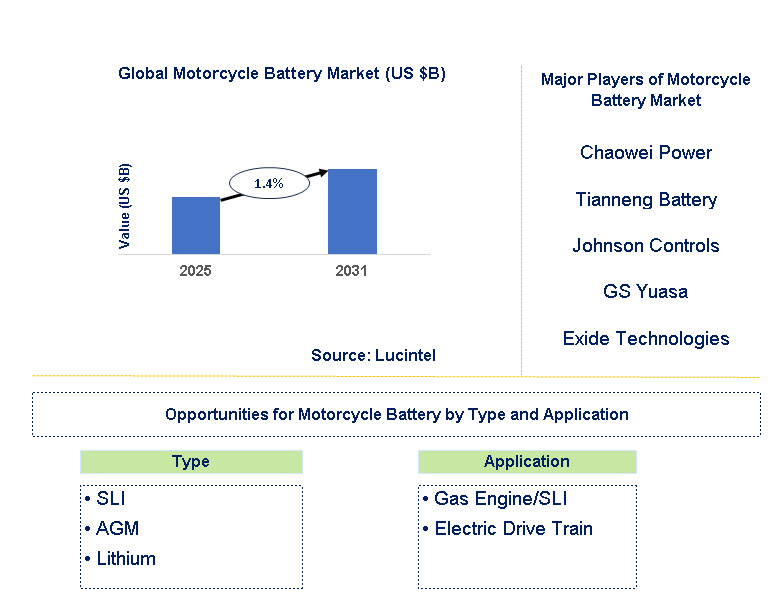
Key data points: The growth forecast = 1.4% annually for the next 7 years. Scroll below to get more insights. This market report covers Trends, opportunities and forecasts in motorcycle battery market to 2031 by type (SLI, AGM, and lithium), application (gas engine/SLI and electric drive train), and region (North America, Europe, Asia Pacific, and the Rest of the World)
We'll send your sample report shortly.
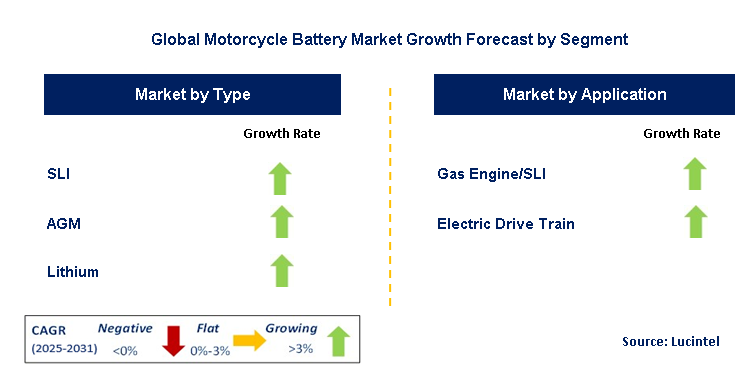
• Lucintel forecasts that, within the type category, AGM is expected to witness the highest growth over the forecast period.
• Within the application category, electric drive train is expected to witness higher growth.
• In terms of region, APAC is expected to witness the highest growth over the forecast period.
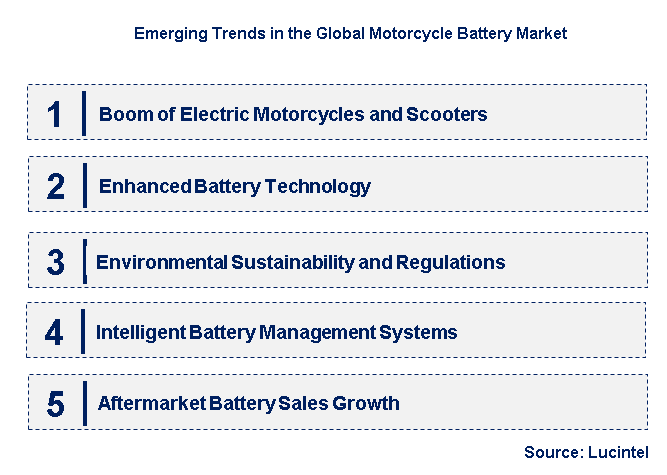
• Boom of Electric Motorcycles and Scooters: One of the most important trends affecting the battery market is the global boom in electric motorcycles and scooters. As sustainability concerns heighten the demand for cleaner, quieter vehicles, consumers are ever more likely to choose electric two-wheelers over conventional gasoline-powered two-wheelers. This shift has triggered a boom in demand for high-performance batteries, especially lithium-ion batteries, which are renowned for their efficiency and reduced weight. As governments worldwide encourage the use of electric vehicles, motorcycle battery are poised to grow significantly, and thus the electric motorcycle market is likely to be one of the primary growth drivers.
• Enhanced Battery Technology: As electric motorcycle demand grows, technological improvements in batteries are becoming increasingly important. Manufacturers are working towards creating batteries with greater energy densities, longer lifespan, and quick charging times. The movement towards lithium-ion and solid-state batteries is at the heart of this trend because these batteries have better performance characteristics than conventional lead-acid batteries. With ongoing research aimed at making batteries more efficient and less expensive to make, the motorcycle battery market is changing, and customers will have access to higher-performance, longer-lasting motorcycle batteries.
• Environmental Sustainability and Regulations: Environmental regulations are having a key influence on the motorcycle battery market. Governments globally are enforcing tougher emissions rules and providing incentives for electric vehicles. This policy change is spurring demand for electric motorcycles and their batteries. In addition to the transition to sustainability, manufacturers are also focusing on environmentally friendly battery manufacturing processes, including decreased use of toxic chemicals and improved recycling methods. The ongoing trend towards green technologies will continue to define the future of the motorcycle battery market.
• Intelligent Battery Management Systems: The use of intelligent battery management systems (BMS) in motorcycle batteries is an emerging trend. These track and manage battery performance, improving safety, battery lifespan, and giving consumers real-time information. Smart BMS also assists in balancing charging and discharging cycles so that the battery performs better in the long run. With consumers seeking more advanced and reliable batteries, manufacturers are integrating these technologies to offer a more efficient and user-friendly experience. Adoption of BMS is likely to increase as electric motorcycles gain popularity.
• Aftermarket Battery Sales Growth: With more electric motorcycles out on the streets, there is increasing potential in the aftermarket sales of motorcycle batteries. As the batteries start aging or losing their capacity, there will be numerous consumers who would need to upgrade or replace the existing batteries. This trend is driving the demand for aftermarket sales, which may not only feature replacement batteries but also upgraded versions with longer range or quicker charging times. The increasing demand for high-performance replacement batteries will stimulate innovation and competition in the market, most notably in electric vehicle adoption-driven regions. These nascent trends are transforming the motorcycle battery industry, with the growing popularity of electric vehicles, improvement in battery technology, and increasing emphasis on sustainability fueling expansion. The demand for more intelligent, longer-life, and more efficient batteries will keep on surging, driving the industry forward in the years to come. With the ongoing global transition to cleaner and greener transport, these trends will shape the design, production, and promotion of batteries in the motorcycle industry.
• Transition to Lithium-Ion Batteries: One of the most notable transitions in the motorcycle battery industry is the transition from conventional lead-acid batteries to lithium-ion batteries. Lithium-ion batteries have a number of benefits over lead-acid batteries, such as longer lifespan, lighter weight, and greater energy efficiency. With the growing popularity of electric motorcycles, which are based on lithium-ion technology, this transition will likely continue. Manufacturers are heavily investing in increasing the energy density, charging time, and cost-effectiveness of lithium-ion batteries, which will fuel increased adoption in both hybrid and electric motorcycles.
• Government Incentives for Electric Motorcycles: Governments across the globe are offering incentives for electric motorcycle adoption, which has contributed to the motorcycle battery market directly. These incentives generally take the form of tax rebates, subsidies, or lower registration fees for electric cars. Consequently, there is a rise in demand for electric motorcycles, leading to the need for efficient and reliable batteries. These efforts are crucial to the growth of sales in the motorcycle battery market, especially in markets such as Europe, the U.S., and China, where environmental regulations favor clean transport.
• Technological Advances in Battery Performance: Technological innovations in battery performance are propelling the transformation of the motorcycle battery market. Batteries are growing ever more energy-dense, allowing motorcycles to go farther on a full charge. Charging times are shortening too, making electric motorcycles easier and more practical for customers to use. Advances in solid-state batteries and other emerging technologies promise even bigger advances in energy storage and efficiency, driving the market toward mainstream adoption of electric two-wheelers.
• Growth of Charging Infrastructure: The expansion of charging infrastructure for electric motorcycles is a significant move in the market. As more electric motorcycles roll out, convenient and rapid charging stations become a must. Governments and private entities are investing in growing public and private charging infrastructures, making it more convenient for consumers to charge their electric motorcycles. All this increased infrastructure will fuel the development of the electric motorcycle market, leading to greater demand for advanced motorcycle batteries.
• Focus on Recycling and Sustainability: With increasing adoption of lithium-ion batteries, the need for recycling and sustainability is becoming increasingly prominent. Manufacturers are seeking solutions to decrease the environmental footprint of spent batteries with better recycling technology and processes. Initiatives to establish a circular economy for batteries, in which materials are recycled and re-used, will become critical in overcoming environmental issues related to the disposal of batteries. This development aligns with global sustainability goals and will impact the future growth of the motorcycle battery market. The advancements in the market for motorcycle battery indicate the trend of the industry moving towards more efficient and environmentally friendly solutions. The movement towards lithium-ion batteries, incentives from the government, and advancements in technology are all fueling the growth in the market. As the market for electric motorcycles continues to grow, these advancements will continue to influence the market so that batteries will continue to be a focal point in the evolution of the transportation industry.
• Electric Motorcycles: The electric motorcycle market is a big growth area for motorcycle batteries. With consumers and governments demanding cleaner transportation, electric motorcycles have become very popular because they are more eco-friendly. Manufacturers are meeting this demand with light-weight, high-energy lithium-ion batteries with greater ranges and faster charging. This transition to electric motorcycles is poised to fuel demand for high-performance battery solutions, offering a wide market for growth in the near future. Increased use of electric motorcycles will enlarge the overall market for motorcycle batteries, especially in markets such as Europe and Asia.
• Sustainability and Battery Recycling: Sustainability is emerging as a key element in the motorcycle battery market, particularly with increased use of lithium-ion batteries. As the number of electric motorcycles on the roads increases, recycling and reuse of batteries become more necessary in order to reduce the negative impact on the environment. Companies can take advantage of such demand by developing recycling programs and designing better batteries that are more environmentally friendly. Advances in battery life-cycle management and reuse of key materials from spent batteries are a major growth opportunity in the market, especially in countries with strong recycling regulations.
• Battery Management Systems: Battery Management Systems (BMS) integrated into motorcycle batteries is a strategic opportunity that can optimize battery performance and efficiency. BMS optimizes charging cycles, temperature monitoring, and prolongs the battery lifespan, which is specifically important in electric motorcycles. With the increased market for electric motorcycles, so does the demand for intelligent battery technologies. The creation of superior BMS solutions that offer real-time information and performance insights presents a growth opportunity for manufacturers to meet the increasing demand for efficient and reliable electric motorcycle batteries.
• Breakthrough in Battery Technology: Technological innovation in battery technology is a strong growth driver for the motorcycle battery market. Innovations such as solid-state batteries and high-density lithium-ion batteries have the potential to deliver improved energy storage, accelerated charging times, and longer lifespan. These are not only advantageous for electric motorcycles but can also be extended to hybrids, widening its potential market for battery makers. As customers increasingly seek more efficient and dependable energy solutions, battery makers will continue to invest in advanced technologies, allowing new products to keep pace with changing market demands.
• Growth in Emerging Markets: Emerging markets in Asia and Africa are offering strong opportunities for growth in the motorcycle battery market. These areas are undergoing rapid urbanization and growing use of motorcycles, with electric two-wheelers emerging as a sought-after option owing to their lower running costs and environmental advantages. Moreover, governments in nations such as India and China are launching subsidies and incentives to promote the use of electric vehicles. The manufacturers are able to tap into these expanding markets through affordable and high-performance battery solutions, thus fueling the global growth of the motorcycle battery market. These opportunities for growth are transforming the motorcycle battery market. From the popularity of electric motorcycles and innovations in battery technology to increasing demand for sustainable solutions, manufacturers have a variety of growth opportunities. The ongoing advancements in battery technology, recycling, and smart systems will drive the market's growth, and the new revenue streams in emerging markets will offer great opportunities for motorcycle battery makers. As these prospects keep evolving, the market will witness strong development both in the short and long terms.
• Chaowei Power
• Tianneng Battery
• Johnson Controls
• GS Yuasa
• Exide Technologies
• Sebang
• Chuanxi Storage
• Banner Batteries
• Exide Industries
• Camel
• SLI
• AGM
• Lithium
• Gas Engine/SLI
• Electric Drive Train
• North America
• Europe
• Asia Pacific
• The Rest of the World
• United States: In the US, there has been a trend towards greener and high-performance battery options for motorcycles, especially with the popularity of electric motorcycles. Lithium-ion batteries have become popular because they are lighter and more energy-efficient than older lead-acid batteries. With higher adoption of electric scooters and motorcycles, manufacturers are paying attention to extending battery life, charging time, and performance. In addition, the demand for environmentally friendly transport options has triggered government programs, providing tax credits to the purchase of electric motorcycles, further increasing the sale of batteries in the market.
• China: China continues to be a dominant force in the motorcycle battery market, both as the world's largest producer and consumer of batteries. The world's most stringent push towards electric vehicles (EVs), including motorcycles, has fueled demand for better-performance lithium-ion batteries. Government incentives encouraging EV uptake, combined with subsidies and incentives for battery-powered vehicles, have triggered high growth in the electric motorcycle industry. Chinese manufacturers are also working to enhance the lifespan and energy density of batteries to suit the needs of electric motorcycle users, whose numbers are increasing exponentially in urban cities because of their efficiency and eco-friendliness.
• Germany: Germany has experienced consistent growth in the market for motorcycle batteries, spurred by growing demand for electric scooters and motorcycles. German manufacturers are embracing the latest battery technology, with a focus on increasing battery efficiency, weight savings, and longevity in an effort to rival global markets. The growing popularity of electric motorcycles as a clean-transportation option is a fit with the EU's overall movement towards a reduction in emissions. With policies encouraging the adoption of green technologies, such as subsidies and incentives for the purchase of electric vehicles, Germany's motorcycle battery market will grow as more people switch to electric models.
• India: India's motorcycle battery market is developing very fast as a result of the increasing demand for electric scooters and motorcycles. The nation has serious urban air pollution, and there is increasing awareness of the environmental advantages of electric motorcycles. Government policies, like the Faster Adoption and Manufacturing of Hybrid and Electric Vehicles (FAME) scheme, are helping drive the shift to electric vehicles and, subsequently, the demand for lithium-ion batteries. Nevertheless, the market continues to be plagued by issues like high battery prices and inadequate charging infrastructure. Overcoming these challenges will be critical to speeding up the move to electric motorcycles in India.
• Japan: Japan has been the leader in adopting cutting-edge battery technologies, and this is the case even for its motorcycle sector. The Japanese government is going all out in encouraging the usage of electric vehicles, including motorcycles, through various subsidies and incentives. Japanese auto manufacturers are pouring significant amounts into research and development to develop more efficient, longer-lasting, and smaller batteries. The shift towards electric motorcycles will continue, and with it, increasing demand for lithium-ion batteries. Japan's strong infrastructure and strong drive for environmentally friendly transportation are assisting in creating a favorable environment for the expansion of the motorcycle battery market.


• Chaowei Power
• Tianneng Battery
• Johnson Controls
• GS Yuasa
• Exide Technologies
• Sebang
• Chuanxi Storage
• Banner Batteries
• Exide Industries
• Camel Q5. Which motorcycle battery market segment will be the largest in future? Answer: Lucintel forecasts that, within the type category, AGM is expected to witness the highest growth over the forecast period. Q6. In motorcycle battery market, which region is expected to be the largest in next 5 years? Answer: In terms of region, APAC is expected to witness the highest growth over the forecast period. Q7. Do we receive customization in this report? Answer: Yes, Lucintel provides 10% customization without any additional cost.


Choose a license that fits your team. Instant PDF delivery.
Prices exclude taxes. Instant delivery. Custom licensing available on request.
Market Report · May 18, 2026
Market Report · May 18, 2026
Market Report · May 18, 2026
Trusted partner for strategic intelligence and business growth


Receive a complimentary market analysis tailored to your industry. Our analysts will identify key growth opportunities and competitive dynamics specific to your business.

Market size, growth rate, and key trend analysis for your specific sector.

Top competitor positioning and market share analysis.

Strategic recommendations backed by data-driven insights.
Get curated market intelligence and competitive moves straight to your inbox.
By subscribing, you agree to receive our monthly insights. Unsubscribe anytime.
Receive a complimentary market analysis tailored to your industry. Our analysts will identify key growth opportunities and competitive dynamics specific to your business.
Market size, growth rate, and key trend analysis for your specific sector.
Top competitor positioning and market share analysis.
Strategic recommendations backed by data-driven insights.
Get curated market intelligence, emerging trends, and competitive moves straight to your inbox each month.
By subscribing, you agree to receive our monthly insights. Unsubscribe anytime.
We'll send your sample report shortly.