
Market Report · May 18, 2026

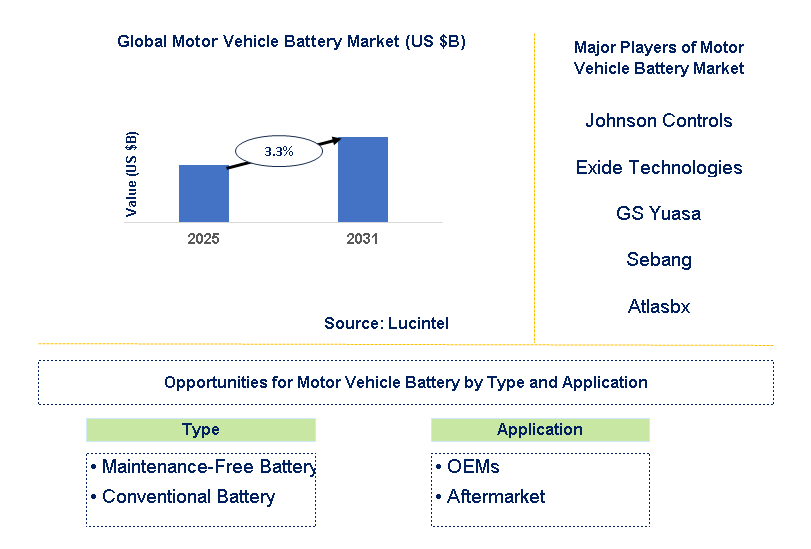
Key data points: The growth forecast = 3.3% annually for the next 7 years. Scroll below to get more insights. This market report covers Trends, opportunities and forecasts in motor vehicle battery market to 2031 by type (maintenance-free battery and conventional battery), application (OEMs and aftermarket), and region (North America, Europe, Asia Pacific, and the Rest of the World)
We'll send your sample report shortly.
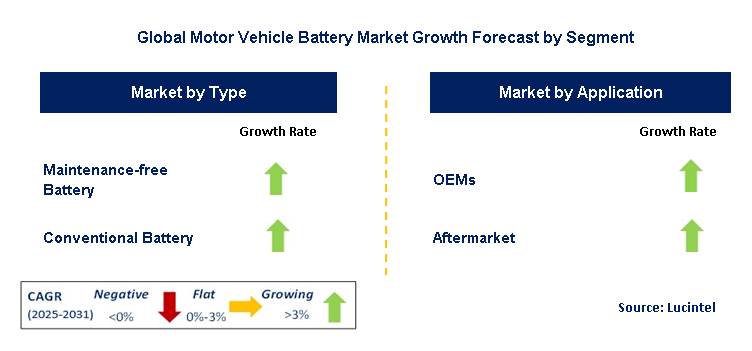
• Lucintel forecasts that, within the type category, maintenance-free battery is expected to witness higher growth over the forecast period.
• Within the application category, OEMs is expected to witness higher growth.
• In terms of region, APAC is expected to witness the highest growth over the forecast period.
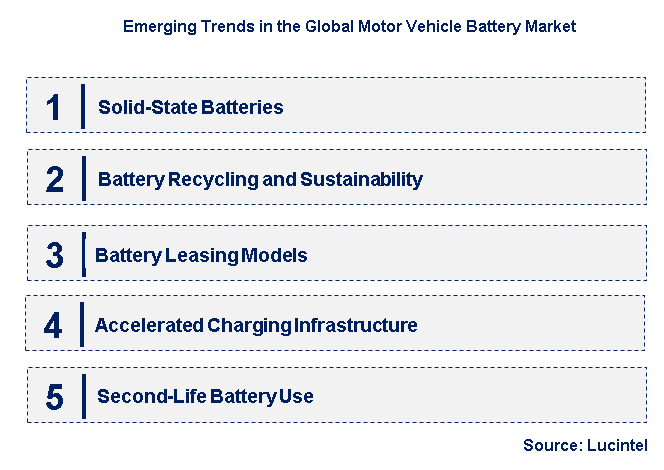
• Solid-State Batteries: Solid-state batteries are proving to be a strong contender to replace lithium-ion batteries, with more energy density and improved safety. Solid-state batteries use solid electrolytes rather than liquids, eliminating fire risks and improving performance. They also have the potential to charge faster, making them suitable for electric cars. Companies are heavily investing in solid-state technology, hoping it will transform battery performance over the next decade. The transition to solid-state batteries will likely increase the overall attractiveness of electric vehicles and provide longer driving ranges and quicker charging times.
• Battery Recycling and Sustainability: With the growth of the electric vehicle market, there is a growing need for sustainable battery solutions. Recycling batteries is becoming an essential part of the business, as it can lower the environmental footprint of raw material mining and provide a circular economy. Recycling technology is advancing, allowing producers to reclaim precious materials like lithium, cobalt, and nickel. The trend towards increased sustainability will make the motor vehicle battery supply chain more robust and cleaner. Increasing emphasis on sustainability is spurring innovation in battery design and recycling technologies.
• Battery Leasing Models: Battery leasing is gaining popularity as a way to overcome the high initial cost of electric vehicles. With this model, the customer can lease the battery instead of buying it, so the initial cost of acquiring an electric vehicle is lower. The model also facilitates an upgrade to newer battery technology when it becomes available. Apart from reducing the cost of electric vehicles, battery leasing can give manufacturers a constant flow of income from battery services, such as maintenance and replacement. This is especially applicable in markets where affordability is a major hindrance to EV uptake.
• Accelerated Charging Infrastructure: The establishment of accelerated charging infrastructure is one of the main trends driving the growth of electric vehicles. Consumers are increasingly concerned about the time it takes to charge their vehicles, and advancements in fast-charging technologies are addressing this challenge. Companies are expanding ultra-fast charging networks, enabling drivers to recharge their batteries to 80% in under 30 minutes. These developments are reducing range anxiety and making electric vehicles more practical for long-distance travel. As charging infrastructure improves, it will continue to increase EV adoption as well as the demand for motor vehicle batteries.
• Second-Life Battery Use: When electric vehicle batteries lose efficiency with aging, there has been increasing attention on repurposing them to secondary uses like energy storage. Second-life batteries can be implemented in stationary storage systems, as a cost-competitive and clean method of renewable energy storage. This is especially applicable as the need for renewable energy solutions continues to increase. By increasing the lifespan of batteries beyond their utilization in vehicles, manufacturers can lower waste and increase the overall sustainability of the electric vehicle system. These new developments are all coming together to redefine the market for motor vehicle battery. Solid-state technology, recycling breakthroughs, battery leasing schemes, fast-charging systems, and second-life battery use are all coming together to drive electric vehicle adoption and the motor vehicle battery business as a whole. As these new trends continue to mature, they will most certainly redefine the market, rendering EVs cheaper, more efficient, and sustainable in the long term.
• Growth in EV Battery Manufacturing Capacity: As demand for electric vehicles keeps growing, automakers and battery makers are increasing production capacity. Players such as Tesla, CATL, and LG Chem are making massive investments in increasing the capacity of their battery factories to cater to rising global demand. This expansion of production capacity is going to reduce costs and enhance economies of scale. Moreover, increasing the production capacity will provide a secure supply of batteries as the market for electric vehicles grows, decreasing production backlogs and providing prompt delivery to the consumers.
• Enhanced Battery Chemistry: Technological advancements in battery chemistry, such as the innovation of new materials such as lithium iron phosphate (LFP), are improving the performance of batteries. LFP batteries, for example, are cheaper and longer-lasting than the conventional lithium-ion batteries. Researchers are also working on solid-state batteries and other new chemistries that will further enhance energy density, safety, and performance. These innovations are expanding the capabilities of electric vehicle batteries, enabling consumers to have longer-range, faster-charging vehicles for more reasonable prices.
• Battery Storage Systems for Renewable Energy: As electric vehicles take off, battery storage systems are also finding growing acceptance in the renewable energy segment. By coupling batteries with renewable energy sources such as wind and solar, power can be stored for use at a later time, enhancing grid stability and boosting the efficiency of renewable energy systems. Battery storage systems are regarded as a vital part of the shift towards clean energy, and car manufacturers are starting to make investments in these technologies. This trend is generating new sources of revenue for battery manufacturers and offering additional support for clean energy adoption.
• Automaker and Battery Maker Collaborations: Automakers and battery makers are increasingly collaborating to create next-generation battery technologies and establish stable supply chains. Firms such as Ford and SK Innovation and General Motors and LG Energy Solutions are partnering to establish new battery technologies and secure a consistent supply of batteries for electric vehicles. The strategic partnerships are allowing automobile manufacturers to get access to the latest technologies while they have resources required to produce EVs at large scales. Such partnerships are anticipated to quicken innovation in the technology and manufacture of batteries.
• Government Policy and Regulation: Governments globally are enacting regulations and policies for promoting electric vehicle acceptance and battery manufacturing. The U.S. government, for instance, has brought forward tax rebates and research funding for next-generation battery technologies. China also has policies aimed at increasing electric vehicle manufacturing, while the European Union is investing largely in charging infrastructure and clean energy initiatives. These policies are making the environment conducive to the development of the motor vehicle battery market, speeding up the shift towards cleaner, greener transport solutions. These advancements are making a profound effect on the motor vehicle battery industry by expanding production capacity, enhancing battery chemistry, enabling renewable energy storage, and encouraging partnerships between automakers and battery makers. Government policies are also driving the market in a definitive direction. As these advancements keep advancing, the motor vehicle battery industry is set to expand exponentially, driving electric vehicle adoption and making the world shift towards cleaner transportation options.
• Electric Passenger Vehicles: The market for electric passenger vehicles (EVs) is picking up speed with government subsidies, technological progress, and consumer preference for greener modes of transport. With the worldwide demand to curtail carbon emissions gaining momentum, companies are making the switch from internal combustion to all-electric propulsion. This brings in an expanding demand for batteries that are more efficient, long-lasting, and cost-effective. The expansion of electric passenger cars is a tremendous opportunity for battery producers to innovate and create leading-edge technologies to meet these requirements and speed the deployment of EVs around the world.
• Electric Two-Wheelers and Three-Wheelers: Electric two-wheelers and three-wheelers, especially in developing countries, are a large growth potential for the sales market of motor vehicle batteries. India and China, among other countries, are witnessing growing popularity for electric scooters, motorcycles, and tuk-tuks because of their affordability, lower emissions, and efficiency in urban travel. Governments providing incentives to combat air pollution will further spur the adoption of electric two-wheelers and three-wheelers. Battery suppliers can capitalize on this demand by creating light-weight, low-cost, and high-performance batteries that can serve the special needs of such vehicles.
• Commercial Electric Vehicles: The commercial electric vehicle market, comprising electric buses, trucks, and delivery vans, has a high growth potential with the worldwide demand for cleaner modes of transportation. Companies are shifting toward electric fleets at an accelerated rate to save costs on operations and achieve sustainability targets. With advances in high-density batteries that enable long-distance hauls and heavy loads, commercial EVs have the potential to substitute conventional diesel-powered vehicles across most industries. Battery companies have a major opportunity to invest in the production of durable, high-performance batteries to address this burgeoning market and enable companies to make the transition to electrification.
• EV Battery Energy Storage Systems: Energy storage systems (ESS) present an significant growth opportunity in the motor vehicle battery market. With an increase in the launch of electric vehicles, there arises an increased urgency to create highly sophisticated energy storage systems that will efficiently store and control electricity derived from renewable means such as wind and solar power. ESS will also eliminate reliance on the grid by saving surplus energy at times of low demand for usage at times of peak demand. Through the integration of second-life electric vehicle batteries into energy storage systems, manufacturers are able to prolong the life of EV batteries, improve grid stability, and facilitate the adoption of renewable energy.
• Battery Leasing and Swapping Services: Battery leasing and swapping services are becoming feasible options to reduce the high initial cost of electric vehicles. Under battery leasing schemes, customers can pay a subscription price for battery use, so they can switch to newer battery technologies as they emerge. In countries such as China and India, where affordability is a key barrier to the adoption of EVs, this model can reduce the cost of electric vehicle ownership. Moreover, battery swapping stations provide customers with the ease of swapping spent batteries for fresh, fully charged batteries, further increasing the convenience and usability of electric cars. Leasing and swapping innovations can be leveraged by manufacturers of batteries for this purpose. These strategic expansion opportunities—electric passenger cars, two-wheelers and three-wheelers, commercial EVs, energy storage systems, and battery leasing and swapping services—are redefining the future of the motor vehicle battery market. As demand for electric vehicles increases and technology improves, battery manufacturers have many opportunities to grow and innovate. With government policies encouraging the shift towards sustainable transportation, these applications have high potential for growth in both developed and emerging markets.
• Johnson Controls
• Exide Technologies
• GS Yuasa
• Sebang
• Atlasbx
• East Penn
• Amara Raja
• FIAMM
• ACDelco
• Bosch
• Maintenance-Free Battery
• Conventional Battery
• OEMs
• Aftermarket
• North America
• Europe
• Asia Pacific
• The Rest of the World
• United States: In the United States, the market for motor vehicle batteries is gaining from strong government incentives for the take-up of electric vehicles and investment in local battery manufacturing. Tesla and General Motors are ramping up production of electric vehicles (EVs) and lithium-ion batteries. Moreover, the U.S. government has initiated programs such as the Infrastructure Investment and Jobs Act, which provides significant investment in EV charging infrastructure and battery manufacturing. This has increased U.S. battery manufacturing capacity, complementing the increasing demand for electric vehicles while providing energy security through domestic supply chains.
• China: China is still the biggest producer and seller of motor vehicle batteries. China is pursuing its target of going electric aggressively, investing heavily in battery production and recycling. BYD and CATL are the major players in the EV battery space, providing a consistent supply of high-end batteries to meet the increasing demand. Government incentives to encourage EV uptake, including tax breaks and subsidies, have hastened the rate of electric car sales, fueling a fast-growing battery market. China's leadership in EV production is set to remain dominant for the foreseeable future.
• Germany: Germany's motor vehicle battery market has witnessed strong growth due to the nation's drive for carbon neutrality and a transition toward electric mobility. Large automakers like Volkswagen, BMW, and Mercedes-Benz are all investing significantly in battery technology and infrastructure. The government has made aggressive targets for EV penetration with the hope of putting 10 million EVs on the road by 2030. Moreover, the European Union's Green Deal and German initiatives have also fueled the need for green transport solutions. This market will continue to grow steadily as Germany solidifies its position in the EV battery supply chain.
• India: India's motor vehicle battery market is being transformed with growing use of electric vehicles, fueled by government initiatives such as the Faster Adoption and Manufacturing of Hybrid and Electric Vehicles (FAME) scheme. The nation is concentrating on developing a strong EV infrastructure, with investments in manufacturing and charging points. Indian makers are also setting their sights on producing batteries with an aim towards a decrease in the need to import. While there is a continued increase in adoption of EVs, therefore demanding more batteries, there's been increased focus in research and development of suitable batteries for Indian climates and infrastructures.
• Japan: Japan is also a major force in the international motor vehicle battery industry, with Toyota, Honda, and Panasonic setting the pace in the manufacture of next-generation batteries for electric vehicles. The government has introduced policies to encourage the shift towards electric vehicles, such as a goal to stop the sale of new gasoline cars by 2035. Japan's emphasis on hydrogen fuel cell technology complements the battery electric vehicle segment, making the country a global leader in diversified green transportation solutions. The nation is also investing heavily in battery recycling technologies to ensure sustainable growth in the EV battery industry.


• Johnson Controls
• Exide Technologies
• GS Yuasa
• Sebang
• Atlasbx
• East Penn
• Amara Raja
• FIAMM
• ACDelco
• Bosch Q5. Which motor vehicle battery market segment will be the largest in future? Answer: Lucintel forecasts that, within the type category, maintenance-free battery is expected to witness higher growth over the forecast period. Q6. In motor vehicle battery market, which region is expected to be the largest in next 5 years? Answer: In terms of region, APAC is expected to witness the highest growth over the forecast period. Q7. Do we receive customization in this report? Answer: Yes, Lucintel provides 10% customization without any additional cost.


Choose a license that fits your team. Instant PDF delivery.
Prices exclude taxes. Instant delivery. Custom licensing available on request.
Market Report · May 18, 2026
Market Report · May 18, 2026
Market Report · May 18, 2026
Trusted partner for strategic intelligence and business growth


Receive a complimentary market analysis tailored to your industry. Our analysts will identify key growth opportunities and competitive dynamics specific to your business.

Market size, growth rate, and key trend analysis for your specific sector.

Top competitor positioning and market share analysis.

Strategic recommendations backed by data-driven insights.
Get curated market intelligence and competitive moves straight to your inbox.
By subscribing, you agree to receive our monthly insights. Unsubscribe anytime.
Receive a complimentary market analysis tailored to your industry. Our analysts will identify key growth opportunities and competitive dynamics specific to your business.
Market size, growth rate, and key trend analysis for your specific sector.
Top competitor positioning and market share analysis.
Strategic recommendations backed by data-driven insights.
Get curated market intelligence, emerging trends, and competitive moves straight to your inbox each month.
By subscribing, you agree to receive our monthly insights. Unsubscribe anytime.
We'll send your sample report shortly.