
Market Report · July 29, 2026

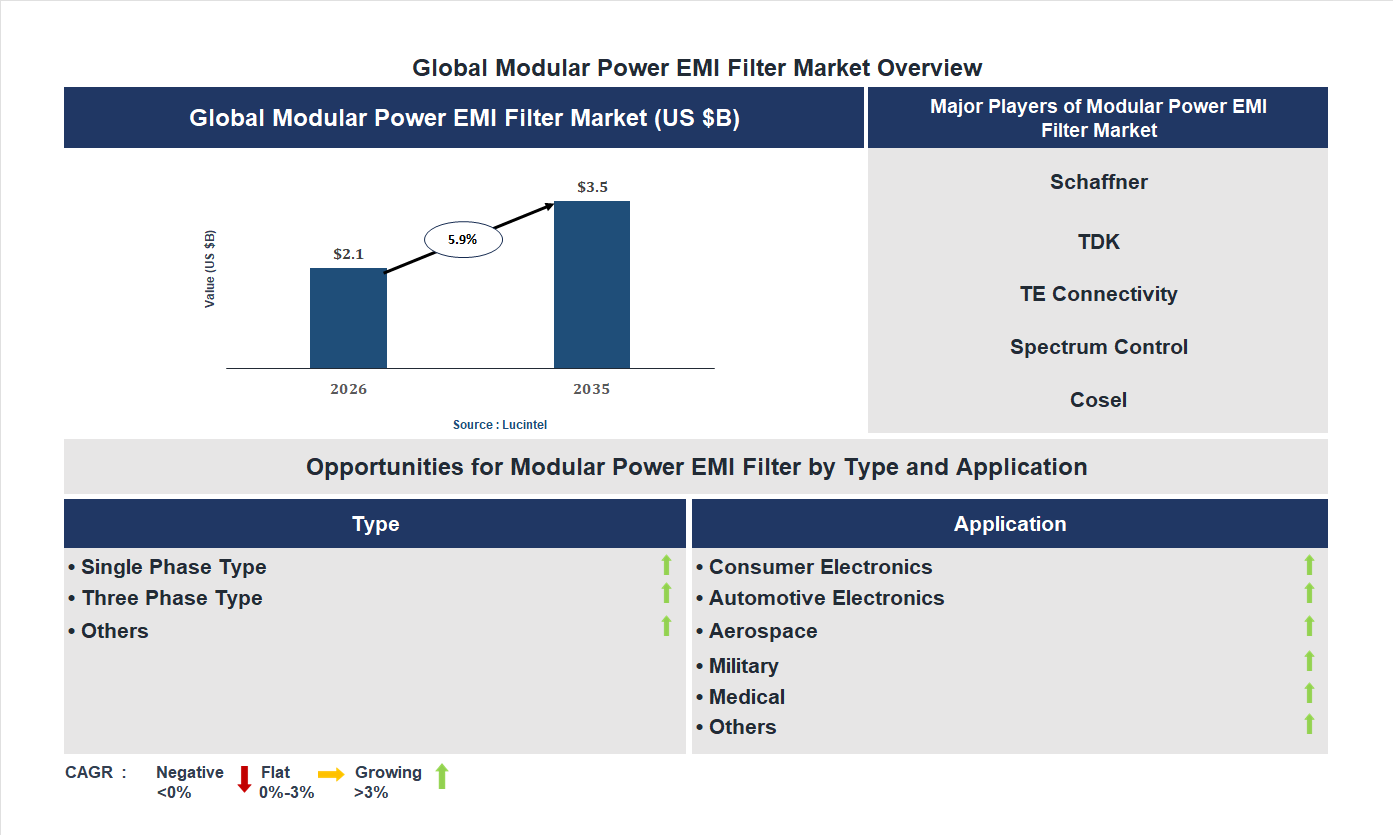
Key data points: The market size in 2035 = $3.5 billion, growth forecast = 5.9% annually for the next 8 years. Scroll below to get more insights. This market report covers trends, opportunities and forecasts in modular power EMI filter market to 2035 by type (single phase type, three phase type, and others), application (consumer electronics, automotive electronics, aerospace, military, medical, and others), and region (North America, Europe, Asia Pacific, and the Rest of the World)
We'll send your sample report shortly.
• Lucintel forecasts that, within the type category, single phase type is expected to witness higher growth over the forecast period.
• Within the application category, consumer electronic is expected to witness the highest growth.
• In terms of region, APAC is expected to witness the highest growth over the forecast period. Gain valuable insights for your business decisions with our comprehensive 150+ page report. Sample figures with some insights are shown below.
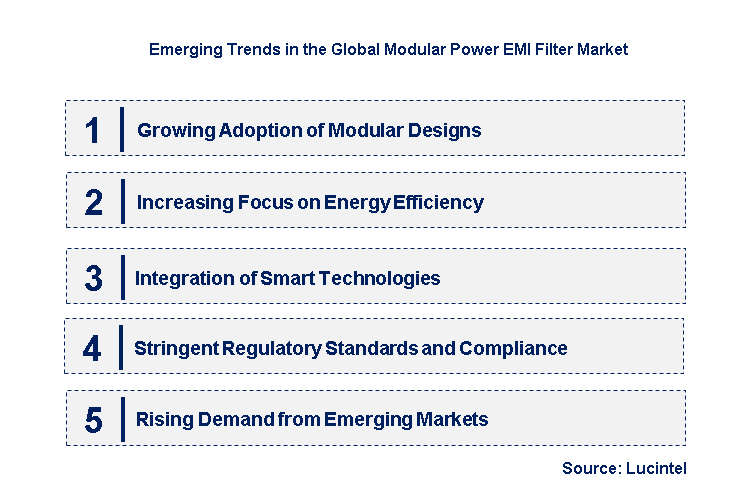
• Growing Adoption of Modular Designs: The market is witnessing a shift towards modular EMI filters due to their flexibility and ease of customization. Modular filters allow users to add or remove components based on specific requirements, reducing costs and simplifying maintenance. This trend is driven by the need for scalable solutions in complex power systems, enabling better integration with existing infrastructure. As industries prioritize adaptable and future-proof solutions, modular designs are becoming the preferred choice, fostering innovation and expanding market opportunities.
• Increasing Focus on Energy Efficiency: Energy efficiency is a critical concern across industries, prompting the development of EMI filters that minimize power loss and improve overall system performance. Manufacturers are investing in advanced materials and innovative circuit designs to enhance filter effectiveness while reducing energy consumption. This trend aligns with global sustainability goals and regulatory standards aimed at reducing carbon footprints. As a result, energy-efficient EMI filters are gaining traction, offering both environmental benefits and cost savings for end-users.
• Integration of Smart Technologies: The incorporation of smart features such as real-time monitoring, remote diagnostics, and adaptive filtering is transforming the market. These intelligent EMI filters enable proactive maintenance, optimize performance, and extend lifespan, thereby reducing downtime and operational costs. The integration of IoT and automation technologies is making filters more responsive and customizable, which is particularly valuable in critical applications like data centers and industrial automation. This trend enhances system reliability and provides a competitive edge to manufacturers adopting smart solutions.
• Stringent Regulatory Standards and Compliance: Governments and industry bodies are implementing stricter EMI and safety standards to ensure electromagnetic compatibility and reduce interference issues. This regulatory environment is driving demand for high-performance filters that meet or exceed compliance requirements. Manufacturers are investing in R&D to develop filters that can handle higher frequencies and power levels while adhering to evolving standards. Compliance not only ensures market access but also enhances product credibility, fostering trust among consumers and stakeholders.
• Rising Demand from Emerging Markets: Rapid industrialization and urbanization in emerging economies are fueling the demand for reliable power management solutions, including EMI filters. These markets require scalable, cost-effective, and easy-to-install solutions to support infrastructure development. The increasing adoption of renewable energy sources and smart grid technologies further amplifies this demand. Market players are expanding their presence in these regions through strategic partnerships and localized manufacturing, which is expected to drive significant growth and diversify the market landscape. These trends are collectively reshaping the modular power EMI filter market by promoting innovation, enhancing performance, and expanding application scope. The focus on modularity, energy efficiency, smart technology integration, regulatory compliance, and emerging market growth is creating a more dynamic, competitive, and sustainable industry landscape. These developments are not only meeting current demands but also paving the way for future advancements in electromagnetic interference management.
• Growing Adoption of Modular EMI Filters in Renewable Energy Systems: The shift towards renewable energy sources like solar and wind power necessitates reliable EMI filtering solutions. Modular filters offer customizable, scalable options that enhance system performance and compliance with regulatory standards. This trend boosts market demand, encouraging manufacturers to innovate and develop specialized modules for renewable applications, ultimately supporting the global transition to cleaner energy.
• Integration of Smart Features in EMI Filters: The incorporation of IoT and smart monitoring capabilities into EMI filters allows real-time performance tracking and predictive maintenance. This technological advancement improves system reliability and reduces downtime, appealing to industries seeking high operational efficiency. As a result, the market sees increased adoption of intelligent modules, fostering growth in sectors like aerospace, defense, and industrial automation.
• Rising Demand for Compact and Lightweight Modules: Miniaturization is a key trend driven by the need for space-saving solutions in electronics and industrial equipment. Modular EMI filters that are compact and lightweight enable easier integration into tight spaces without compromising performance. This development caters to consumer electronics, automotive, and aerospace sectors, expanding market opportunities and encouraging innovation in design and materials.
• Development of High-Performance Filters for Harsh Environments: Industries such as oil & gas, military, and aerospace require EMI filters capable of operating reliably under extreme conditions. Recent advancements focus on ruggedized modules with enhanced durability, temperature tolerance, and resistance to vibration and corrosion. These high-performance filters ensure compliance and safety, opening new avenues for market expansion into challenging environments.
• Increased Focus on Sustainable and Eco-Friendly Materials: Environmental concerns are prompting manufacturers to adopt eco-friendly materials in EMI filter production. Biodegradable and recyclable components reduce environmental impact and meet regulatory standards. This shift not only aligns with global sustainability goals but also appeals to environmentally conscious consumers, fostering market growth and encouraging innovation in sustainable product development. The overall impact of these developments is a more versatile, efficient, and sustainable modular power EMI filter market. Enhanced customization, technological integration, and environmental considerations are driving market expansion across multiple industries, leading to increased adoption and innovation. These trends position the market for sustained growth, meeting evolving customer needs and regulatory requirements worldwide.
• Expansion into Renewable Energy Systems: Modular power EMI filters are increasingly integrated into solar inverters, wind turbines, and energy storage systems to ensure compliance with electromagnetic compatibility standards. Their scalable design allows for tailored solutions that address the unique interference challenges of renewable installations, improving system reliability and efficiency. As renewable energy adoption accelerates globally, demand for these filters is expected to rise, driven by the need for robust EMI mitigation in complex power environments.
• Growing Adoption in Data Centers and Telecom Infrastructure: The surge in data traffic and the proliferation of 5G networks require high-performance EMI filtering solutions. Modular power EMI filters offer customizable configurations that can be easily integrated into data center power supplies and telecom equipment. Their compact design reduces space requirements while maintaining high filtering efficacy. This trend supports enhanced electromagnetic compatibility, reduces downtime, and ensures compliance with stringent industry standards, fueling market growth in digital infrastructure.
• Increasing Use in Industrial Automation and Manufacturing: As industries adopt Industry 4.0 technologies, the need for reliable EMI suppression becomes critical to prevent equipment malfunction and ensure safety. Modular power EMI filters provide flexible, scalable solutions suitable for complex industrial environments. They facilitate seamless integration into existing systems, improve electromagnetic compatibility, and support the deployment of smart manufacturing processes. The rising automation trend is expected to significantly boost demand for these adaptable filtering solutions.
• Development of Customizable and Compact Filter Solutions: Market players are focusing on designing modular EMI filters that are highly customizable and space-efficient to meet specific application requirements. These compact solutions enable easier installation in confined spaces such as medical devices, aerospace, and consumer electronics. Customization options include various attenuation levels, connector types, and form factors, allowing manufacturers to tailor solutions for diverse needs. This innovation enhances market competitiveness and broadens application scope.
• Implementation of Industry Standards and Regulatory Compliance: Increasing regulatory standards for electromagnetic compatibility across industries drives the demand for advanced EMI filtering solutions. Modular power EMI filters are being developed to meet these evolving standards, offering improved performance and reliability. Their modular nature allows for easy upgrades and maintenance, ensuring long-term compliance. As regulatory frameworks become more stringent, the market for compliant, high-performance filters is poised for substantial growth. The overall market outlook indicates that these growth opportunities will significantly influence the expansion and technological advancement of the modular power EMI filter market, fostering innovation and meeting the increasing demands of various high-tech industries.
• Technological Innovation: The continuous evolution of electronic devices necessitates advanced EMI filters to ensure electromagnetic compatibility. Innovations in materials and design enable more compact, efficient, and reliable filters, meeting the demands of modern power systems. This technological progress supports the integration of EMI filters into a broader range of applications, from consumer electronics to industrial machinery, thereby expanding market opportunities.
• Growing Industrial Automation: The surge in industrial automation and smart manufacturing increases the need for EMI filtering solutions to prevent electromagnetic interference that can disrupt sensitive equipment. As industries adopt IoT and Industry 4.0 standards, the demand for modular EMI filters that can be easily integrated into complex systems rises, fueling market growth.
• Expansion of Renewable Energy Projects: The global shift towards renewable energy sources such as solar and wind power requires sophisticated power management systems. EMI filters are essential for ensuring the stability and efficiency of these systems by mitigating electromagnetic disturbances, thus driving demand for modular solutions tailored for renewable energy applications.
• Regulatory Standards and EMC Compliance: Stringent government and industry regulations regarding electromagnetic compatibility compel manufacturers to incorporate effective EMI filtering solutions. Compliance with standards such as IEC and FCC ensures product reliability and safety, prompting increased adoption of modular EMI filters across various sectors. The challenges facing the market include:
• High Development and Manufacturing Costs: Developing advanced modular EMI filters involves significant research, testing, and certification expenses. These high costs can hinder entry for smaller players and limit the overall market growth, especially in price-sensitive regions where cost competitiveness is crucial.
• Technological Complexity: Designing filters that effectively operate across a wide frequency range while maintaining compactness and reliability is complex. This technological challenge requires specialized expertise and can lead to longer development cycles, delaying product launches and market penetration.
• Stringent Regulatory and Certification Processes: Navigating the complex landscape of international standards and obtaining necessary certifications can be time-consuming and costly. These regulatory hurdles may slow down product deployment and restrict market expansion, particularly in emerging markets with evolving compliance requirements. The modular power EMI filter market is shaped by rapid technological advancements, increasing industrial automation, and regulatory pressures that promote innovation and adoption. However, high costs, technological complexities, and regulatory challenges pose significant barriers. The interplay of these factors influences market dynamics, requiring stakeholders to innovate continuously and adapt to evolving standards. Overall, the markets growth potential remains strong, driven by the increasing need for electromagnetic compatibility solutions across diverse sectors, despite the hurdles faced.
• Schaffner
• TDK
• TE Connectivity
• Spectrum Control (Former APITech)
• Cosel
• Astrodyne TDI
• Delta Electronics
• KEMET (YAGEO Group)
• Schurter
• Crane Aerospace & Electronics
• Single Phase Type
• Three Phase Type
• Others
• Consumer Electronics
• Automotive Electronics
• Aerospace
• Military
• Medical
• Others
• North America
• Europe
• Asia Pacific
• The Rest of the World
• United States: The US market has seen rapid adoption of modular power EMI filters driven by stringent regulatory standards and the growth of renewable energy projects. Major players are investing in R&D to develop high-efficiency, compact filters suitable for smart grids and data centers. The rise of electric vehicles and industrial automation further boosts demand, with increased focus on compliance with FCC and IEEE standards. The US also emphasizes integrating filters with IoT-enabled systems for enhanced monitoring and control, fostering innovation in the sector.
• China: China remains a dominant force in the market, fueled by massive infrastructure development and a surge in manufacturing activities. The government’s push for green energy and smart city initiatives has increased demand for advanced EMI filters. Local companies are expanding their product portfolios to include customizable and cost-effective solutions, catering to the growing electronics and automotive sectors. Additionally, China’s focus on domestic innovation and export expansion is driving technological advancements in modular filter designs, making the country a key global supplier.
• Germany: Germany’s market is characterized by a strong emphasis on quality, efficiency, and compliance with European standards such as CE and RoHS. The country’s focus on Industry 4.0 and renewable energy integration has led to increased adoption of modular EMI filters in manufacturing and energy sectors. German companies are investing in sustainable and energy-efficient solutions, often collaborating with research institutions to develop innovative filter technologies. The market also benefits from the country’s robust automotive industry, which demands high-performance EMI filtering solutions for electric and hybrid vehicles.
• India: India’s rapidly growing industrial base and expanding renewable energy sector are driving demand for modular power EMI filters. The government’s initiatives to promote solar and wind energy projects have increased the need for reliable EMI mitigation solutions. Local manufacturers are focusing on developing affordable, scalable filters to serve small and medium enterprises. The increasing adoption of automation and smart manufacturing practices is also contributing to market growth. Additionally, rising awareness of electromagnetic compatibility standards is encouraging industries to upgrade their filtering systems.
• Japan: Japan’s market is characterized by technological innovation and a focus on high-performance solutions. The country’s advanced electronics and automotive industries are key drivers, requiring sophisticated EMI filters to meet strict quality and safety standards. Japanese companies are investing heavily in R&D to develop miniaturized, highly efficient filters suitable for compact devices and electric vehicles. The emphasis on sustainability and energy efficiency aligns with Japan’s broader environmental goals, fostering the development of eco-friendly filtering technologies. The market benefits from Japan’s strong industrial base and technological expertise, maintaining its position as a leader in high-quality EMI solutions.


• Schaffner
• TDK
• TE Connectivity
• Spectrum Control (Former APITech)
• Cosel
• Astrodyne TDI
• Delta Electronics
• KEMET (YAGEO Group)
• Schurter
• Crane Aerospace & Electronics Q5. Which modular power EMI filter market segment will be the largest in future? Answer: Lucintel forecasts that, within the type category, single phase type is expected to witness higher growth over the forecast period. Q6. In modular power EMI filter market, which region is expected to be the largest in next 5 years? Answer: In terms of region, APAC is expected to witness the highest growth over the forecast period. Q7. Do we receive customization in this report? Answer: Yes, Lucintel provides 10% customization without any additional cost.


Choose a license that fits your team. Instant PDF delivery.
Prices exclude taxes. Instant delivery. Custom licensing available on request.
Market Report · July 29, 2026
Market Report · July 20, 2026
Market Report · July 20, 2026
Trusted partner for strategic intelligence and business growth


Receive a complimentary market analysis tailored to your industry. Our analysts will identify key growth opportunities and competitive dynamics specific to your business.

Market size, growth rate, and key trend analysis for your specific sector.

Top competitor positioning and market share analysis.

Strategic recommendations backed by data-driven insights.
Get curated market intelligence and competitive moves straight to your inbox.
By subscribing, you agree to receive our monthly insights. Unsubscribe anytime.
Receive a complimentary market analysis tailored to your industry. Our analysts will identify key growth opportunities and competitive dynamics specific to your business.
Market size, growth rate, and key trend analysis for your specific sector.
Top competitor positioning and market share analysis.
Strategic recommendations backed by data-driven insights.
Get curated market intelligence, emerging trends, and competitive moves straight to your inbox each month.
By subscribing, you agree to receive our monthly insights. Unsubscribe anytime.
We'll send your sample report shortly.