
Report Feature
Mobile Substation Market Trends and Forecast
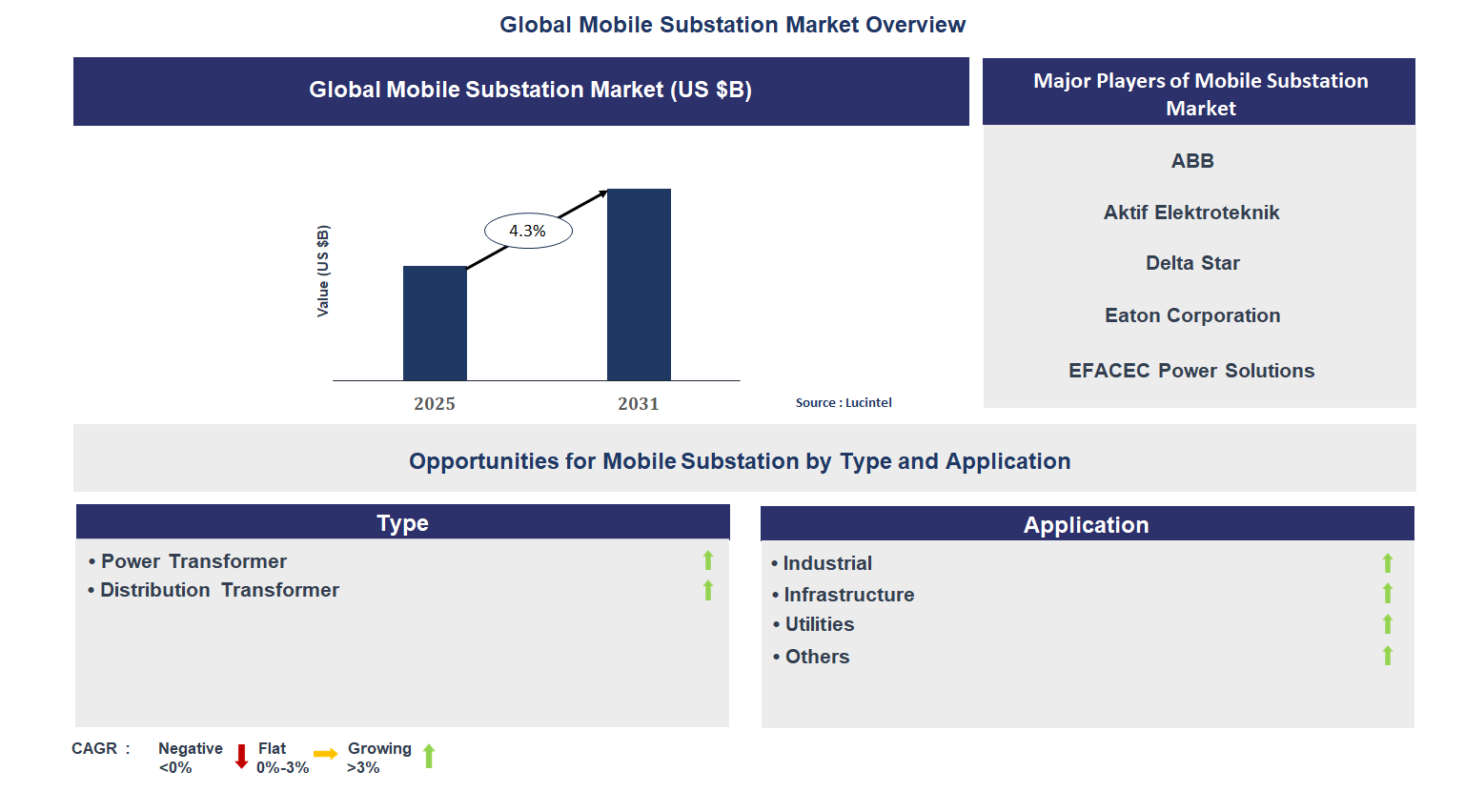
The future of the global mobile substation market looks promising with opportunities in the industrial, infrastructure, and utility markets. The global mobile substation market is expected to grow with a CAGR of 4.3% from 2025 to 2031. The major drivers for this market are the increasing demand for rapid power restoration, the rising investments in temporary power infrastructure, and the growing adoption in remote & emergency applications.• Lucintel forecasts that, within the type category, power transformer is expected to witness higher growth over the forecast period.
• Within the application category, industrial is expected to witness the highest growth.
• In terms of region, APAC is expected to witness the highest growth over the forecast period. Gain valuable insights for your business decisions with our comprehensive 150+ page report. Sample figures with some insights are shown below.
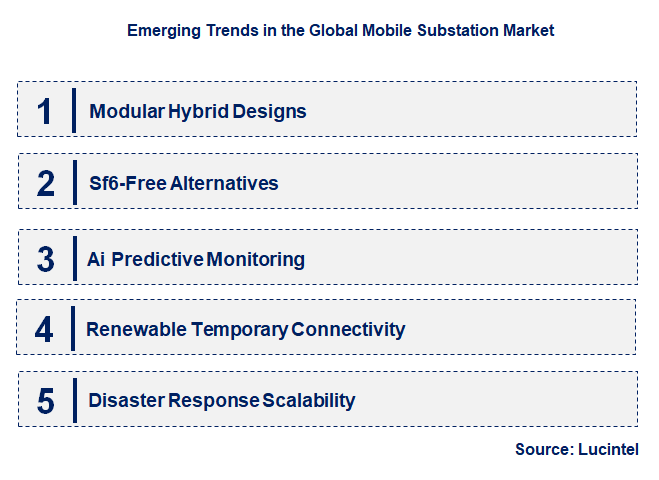
Emerging Trends in the Mobile Substation Market
Trends in the mobile substation market emphasize modularity and renewables amid disaster resilience and grid upgrades. Focus on SF6-free tech, AI monitoring, and hybrid integrations counters outages and emissions. These evolutions expand from utilities to industrials. They enable rapid, sustainable power deployment globally.• Modular Hybrid Designs: Containerized units combine GIS and transformers for quick GIS setup, suiting renewables and emergencies. Plug-and-play connectivity reduces deployment time. Impact accelerates rural electrification, cuts civil works, and boosts 44% trailer-mounted share, enhancing flexibility in off-grid sites.
• SF6-Free Alternatives: Natural gases and eco-oils replace SF6, slashing warming impacts in high-voltage apps. R&D stabilizes insulation for 72-84 kV. This complies with regs, qualifies subsidies, and appeals to green projects, fostering 7.2% CAGR in utilities.
• AI Predictive Monitoring: IoT sensors enable real-time failure prediction, integrating with SCADA for load optimization. Digital twins refine performance. The trend minimizes downtime 20%, extends life, and integrates EVs, transforming grids into responsive systems.
• Renewable Temporary Connectivity: Mobile units facilitate solar-wind farm links during commissioning, handling variable loads. High-density variants suit offshore. Impact maximizes yields, reduces curtailments, and aligns net-zero, driving Asia-Pacific dominance.
• Disaster Response Scalability: Trailer-mounted for rapid restoration in outages, with explosion-proof for mining. Custom recovery aids 5,500 outage hours prevention. This fortifies resilience, secures contracts, and expands in high-risk regions like North America. These trends reshape the mobile substation market by prioritizing adaptability and eco-efficiency. They bridge outage-permanence gaps, broadening from utilities to industrials. Overall, innovations spur resilient growth. This cements mobile units as enablers of flexible energy futures.
Recent Development in the Mobile Substation Market
Mobile substation developments spotlight modular pilots and eco-gas advancements for grid demands. From expansions to joint ventures, they tackle deployment and SF6 hurdles. These milestones fuse R&D with policy for scalability. They signal a sector maturing toward resilient, on-demand power.• GRIP Funding Projects: U.S. DOE awards $2.2 billion for 58 resilience initiatives, including mobile substations preventing 5,500 outage hours. Interregional connectors like North Plains integrate DERs. Impact fortifies grids, boosts renewables, and models federal collaborations.
• UHV Line Deployments: China completes three 1100 kV lines for 380 GW PV, enabling clean transfers. Hitachis GIS order supports provincial balancing. The expansion reduces curtailments, sets supergrid benchmarks, and drives exports.
• Amprion Transmission Upgrade: Germanys €36.4 billion plan deploys low-loss mobile units for 80% renewables by 2030. AI monitoring aids wind. This stabilizes intermittency, eases fees via subsidies, and promotes EU efficiency.
• Green Energy Corridors: Indias ₹2.4 lakh crore initiative installs 765 kV substations for 500 GW target, unlocking 200 GW. Smart meters hit 250 million. This connects solar areas, cuts losses, and spurs jobs.
• Arteche-Hitachi JV: Global venture launches SF6-free GIS for 72-84 kV, focusing on instrument transformers. Joint testing validates. Impact reduces emissions, inspires voltage growth, and models green partnerships. These developments impact the mobile substation market by enhancing flexibility and sustainability. They ignite efficiencies, align with renewables, and diversify roles. Collectively, they overcome deployment barriers, fueling momentum. This advances a modular, resilient power ecosystem.
Strategic Growth Opportunities in the Mobile Substation Market
Growth opportunities in the mobile substation market leverage portability for high-stakes sectors. From renewables to industrials, they exploit hybrids for dominance. These strategies fuse tech with demands, capturing revenues. They propel scaling in disaster-prone, electrified economies.• Utility Emergency Restoration: High-voltage trailers restore power in outages, suiting 5,500 hours prevention. Modular fits quick GIS. Impact ensures stability, taps GRIP incentives, and anchors grid resilience.
• Industrial Mining Operations: Explosion-proof units power remote sites with GIS hybrids. Custom recovery aids harsh environments. This optimizes extraction, reduces downtimes, and dominates oil & gas revenues.
• Renewable Farm Connectivity: Medium-voltage for solar-wind commissioning, handling 380 GW additions. Eco-oils suit offshore. Growth maximizes yields, cuts curtailments, and qualifies subsidies.
• Infrastructure Event Power: Containerized for construction and ports, with plug-and-play. Low-emission for urban. The opportunity greens megaprojects, boosts ROI, and embeds in smart cities.
• Data Center Backup: Scalable for AI loads with 75% surges, integrating VPPs. Edge designs fit hyperscalers. This secures connectivity, minimizes outages, and yields high contracts. These opportunities impact the mobile substation market by filling temporary voids. They amplify adoptions, innovate synergies, and match resilience waves. Ultimately, this forges a multifaceted domain. It advances equitable, high-performance power globally.
Mobile Substation Market Driver and Challenges
The mobile substation market grapples with technological, economic, and regulatory dynamics. Drivers like renewables spur modular quests, while high costs test scalability. These forces interplay for progress. They outline a high-potential, rigorous field. The factors responsible for driving the mobile substation market include: 1. Grid Modernization Surge: Aging infra demands flexible upgrades, with $2.2B U.S. funding for resilience. Policies incentivize. Implications boost capacity, cut losses, and scale integrations. 2. Renewable Energy Boom: 380 GW PV in China needs temporary connectivity, subsidies amplify. Offshore projects heighten. This stabilizes intermittency, enables arbitrage, and grows clean power. 3. Disaster Response Needs: Frequent outages drive rapid deployment, suiting 5,500 hours prevention. Urbanization fuels. The driver sustains volumes, spurs innovations, and heightens reliability. 4. Industrial Expansion Demand: Mining and oil & gas require uninterrupted power, with custom hybrids. Efficiency specs evolve. Consequences optimize ops, secure supplies, and diversify utilities. 5. Policy Incentive Alignment: GRIP and EU subsidies unlock grants for eco-designs. Recycling matures. This complies regs, draws eco-funds, and promotes circular practices. Challenges in the mobile substation market are: 1. High Initial Costs: Modular components inflate upfronts, limiting emergings. Scale lags. This tempers adoptions, favors leaders, and requires subsidies. 2. Maintenance Complexity: Frequent checks on trailers raise ops expenses. Tech lags automation. Implications pressure budgets, confine to premiums, and urge predictive tools. 3. Supply Chain Volatilities: Component shortages and logistics disrupt, geopolitics worsens. The challenge delays projects, heightens costs, and necessitates diversification. Drivers such as renewables and modernization elevate mobile substations to prominence. Challenges like costs demand innovative resolutions to realize gains. Net, strong trajectory forms resiliently. This crafts paths for flexible, enduring power breakthroughs.List of Mobile Substation Companies
Companies in the market compete on the basis of product quality offered. Major players in this market focus on expanding their manufacturing facilities, R&D investments, infrastructural development, and leverage integration opportunities across the value chain. With these strategies mobile substation companies cater increasing demand, ensure competitive effectiveness, develop innovative products & technologies, reduce production costs, and expand their customer base. Some of the mobile substation companies profiled in this report include-• ABB
• Aktif Elektroteknik
• Delta Star
• Eaton Corporation
• EFACEC Power Solutions
• EKOSinerji
• Elgin Power Solutions
Mobile Substation Market by Segment
The study includes a forecast for the global mobile substation market by type, application, and region.Mobile Substation Market by Type [Value from 2019 to 2031]:
• Power Transformer
• Distribution Transformer
Mobile Substation Market by Application [Value from 2019 to 2031]:
• Industrial
• Infrastructure
• Utilities
• Others
Mobile Substation Market by Region [Value from 2019 to 2031]:
• North America
• Europe
• Asia Pacific
• The Rest of the World
Country Wise Outlook for the Mobile Substation Market
The mobile substation market accelerates with grid modernization and renewable integrations, addressing outage risks and temporary power needs amid urbanization and disasters. Innovations in modular, SF6-free designs enhance deployment speed and sustainability. Key nations advance via investments, policies, and R&D. These efforts bolster resilience, supporting flexible energy solutions globally.• United States: U.S. market surges with $2.2 billion federal funding for resilience, including VPP pilots aggregating solar and storage. ABB and GE innovate hybrid GIS transformers for emergencies, driven by natural disasters and data center demands. This strengthens supply chains, reduces outages, and integrates renewables, positioning the U.S. for 8.2% CAGR through 2035.
• China: Chinas State Grid invests $88.7 billion in UHV lines, deploying modular mobile substations for 380 GW PV capacity and interregional balancing. Hitachi Energy secures 1100 kV GIS orders for clean energy transfers. This dominates exports, lowers curtailments, and supports 6.9% CAGR, cementing leadership in high-volume infrastructure.
• Germany: Germanys Energiewende targets 80% renewables by 2030, with €36.4 billion Amprion plan upgrading transmission via low-loss mobile units. R&D advances AI monitoring for wind integration, aligning with EU subsidies. This enhances stability, promotes recycling, and drives 5.4% CAGR in decentralized grids.
• India: Indias 476 GW capacity adds 30 GW renewables, backed by ₹2.4 lakh crore Green Energy Corridors for Rajasthan-Gujarat links. RDSS deploys 250 million smart meters, incorporating mobile substations for rural electrification. This unlocks 200 GW, cuts losses, and fuels 7.8% CAGR in infrastructure.
• Japan: Japans Seventh Energy Plan invests in sodium-ion hybrids for offshore wind, with Hitachi restructuring for GIS and transformers in FY2025. Precision mobile units target 36% renewable mix and GX data center relocations. This boosts resiliency, supports ASEAN exports, and aligns with 3.5% CAGR in high-reliability networks.

Features of the Global Mobile Substation Market
Market Size Estimates: Mobile substation market size estimation in terms of value ($B). Trend and Forecast Analysis: Market trends (2019 to 2024) and forecast (2025 to 2031) by various segments and regions. Segmentation Analysis: Mobile substation market size by type, application, and region in terms of value ($B). Regional Analysis: Mobile substation market breakdown by North America, Europe, Asia Pacific, and Rest of the World. Growth Opportunities: Analysis of growth opportunities in different types, applications, and regions for the mobile substation market. Strategic Analysis: This includes M&A, new product development, and competitive landscape of the mobile substation market. Analysis of competitive intensity of the industry based on Porter’s Five Forces model.
FAQ
Q1. What is the growth forecast for mobile substation market? Answer: The global mobile substation market is expected to grow with a CAGR of 4.3% from 2025 to 2031. Q2. What are the major drivers influencing the growth of the mobile substation market? Answer: The major drivers for this market are the increasing demand for rapid power restoration, the rising investments in temporary power infrastructure, and the growing adoption in remote & emergency applications. Q3. What are the major segments for mobile substation market? Answer: The future of the mobile substation market looks promising with opportunities in the industrial, infrastructure, and utility markets. Q4. Who are the key mobile substation market companies? Answer: Some of the key mobile substation companies are as follows:• ABB
• Aktif Elektroteknik
• Delta Star
• Eaton Corporation
• EFACEC Power Solutions
• EKOSinerji
• Elgin Power Solutions Q5. Which mobile substation market segment will be the largest in future? Answer: Lucintel forecasts that, within the type category, power transformer is expected to witness higher growth over the forecast period. Q6. In mobile substation market, which region is expected to be the largest in next 5 years? Answer: In terms of region, APAC is expected to witness the highest growth over the forecast period. Q7. Do we receive customization in this report? Answer: Yes, Lucintel provides 10% customization without any additional cost.
Table of Contents
List of Figures
List of Tables
Methodology
- In-depth interviews of the major players in this market
- Detailed secondary research from competitors’ financial statements and published data
- Extensive searches of published works, market, and database information pertaining to industry news, company press releases, and customer intentions
- A compilation of the experiences, judgments, and insights of Lucintel’s professionals, who have analyzed and tracked this market over the years.


Buy Now
Choose a license that fits your team. Instant PDF delivery.
Prices exclude taxes. Instant delivery. Custom licensing available on request.
Key Questions
- • What are some of the most promising, high-growth opportunities for the mobile substation market by type (power transformer and distribution transformer), application (industrial, infrastructure, utilities, and others), and region (North America, Europe, Asia Pacific, and the Rest of the World)?
- • Which segments will grow at a faster pace and why?
- • Which region will grow at a faster pace and why?
- • What are the key factors affecting market dynamics? What are the key challenges and business risks in this market?
- • What are the business risks and competitive threats in this market?
- • What are the emerging trends in this market and the reasons behind them?
- • What are some of the changing demands of customers in the market?
- • What are the new developments in the market? Which companies are leading these developments?
- • Who are the major players in this market? What strategic initiatives are key players pursuing for business growth?
- • What are some of the competing products in this market and how big of a threat do they pose for loss of market share by material or product substitution?
- • What M&A activity has occurred in the last 5 years and what has its impact been on the industry? For any questions related to Mobile Substation Market, Mobile Substation Market Size, Mobile Substation Market Growth, Mobile Substation Market Analysis, Mobile Substation Market Report, Mobile Substation Market Share, Mobile Substation Market Trends, Mobile Substation Market Forecast, Mobile Substation Companies, write Lucintel analyst at email: helpdesk@lucintel.com. We will be glad to get back to you soon.


