
Market Report · July 20, 2026

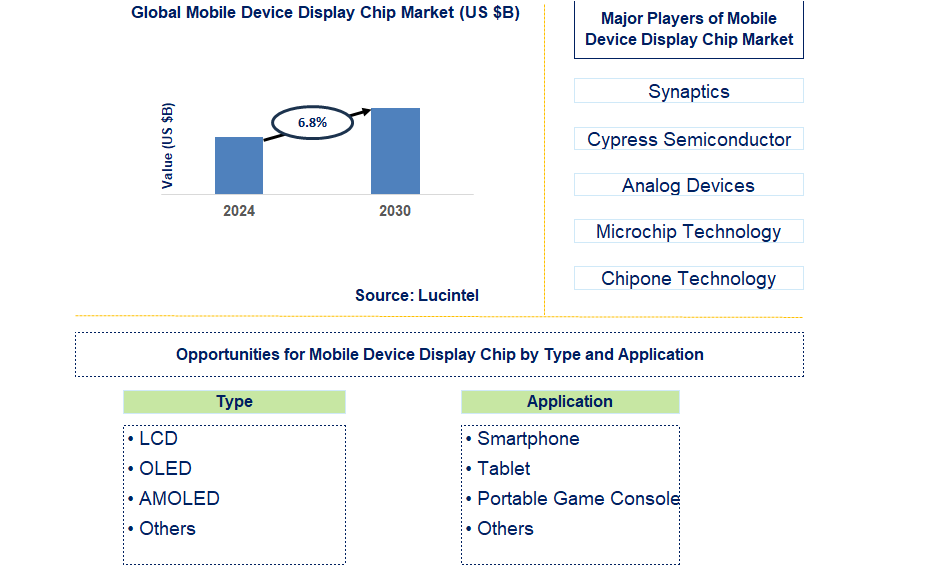
Key data points: The growth forecast = 6.8% annually for the next 6 years. Scroll below to get more insights. This market report covers trends, opportunities, and forecasts in the global mobile device display chip market to 2030 by type (LCD, OLED, AMOLED, and others), application (smartphone, tablet, portable game console, and others), and region (North America, Europe, Asia Pacific, and the Rest of the World)
We'll send your sample report shortly.
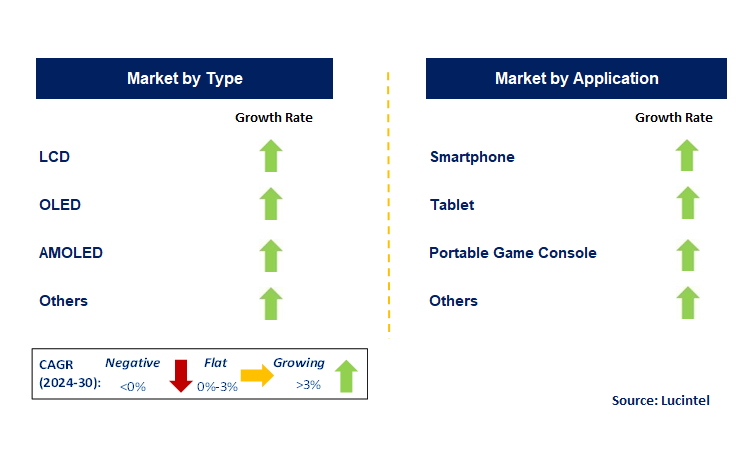
• Lucintel forecasts that, within the type category, LCD is expected to witness the highest growth over the forecast period.
• Within the application category, the smartphone is expected to witness the highest growth.
• In terms of regions, APAC is expected to witness the highest growth over the forecast period. A more than 150-page report is developed to help in your business decisions.
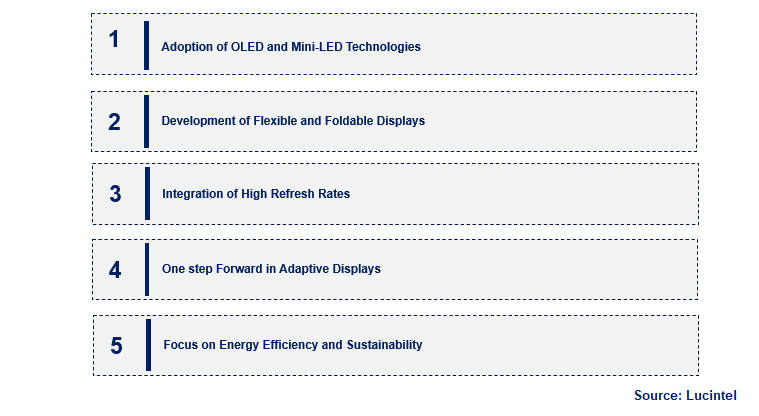
• Adoption of OLED and Mini-LED Technologies: OLED and mini-LED technologies find more users each day because of their superior color accuracy, contrast ratios, and energy efficiency. They enhance display quality in smartphones and tablets, leading to improved visual experiences along with extended battery lives.
• Development of Flexible and Foldable Displays: Flexible and foldable displays redefine mobile devices by enhancing innovative form factors and increasing the screen surface area available for use on such platforms. These types of screens give rise to new product designs and functionalities that can match premium smartphones, boosting growth rates in the respective markets.
• Integration of High Refresh Rates: In most high-end devices today, high refresh rate displays like 120Hz or even higher are becoming standard features. This means that the demand for better visuals, including those related to gaming, is increasing, creating a need for high-performance chips that support frequencies of 120Hz and above, within exceptionally complex chipsets.
• One Step Forward in Adaptive Displays: Adaptive display technologies are improving user experience by optimizing display performance based on content and environment, with features like dynamic refresh rates and auto-brightness adjustment. Such features contribute to both saving battery life and improving visual comfort.
• Focus on Energy Efficiency and Sustainability: There is increased attention towards energy-saving display technology coupled with eco-friendly approaches. Environmental concerns have been addressed through green production methods and low-power consumption display chips aimed at reducing the carbon footprint of display chip manufacturing. These trends are transforming the mobile device display chip market through technological enhancements, which address shifting consumer preferences. The future of mobile device displays will depend significantly on sustainability efforts and innovations in areas such as display technologies.
• Enhanced OLED and Mini-LED Displays: Advancements in OLED and mini-LED technologies have led to improved color accuracy in displays. High-end smartphones and tablets now use these technologies widely to enhance visual quality overall.
• Expansion of Flexible Display Technologies: Flexible and foldable displays are rapidly evolving, enabling different designs for devices with new capabilities. This has sparked innovation within the smartphone and tablet markets, leading to more portable options being released into the marketplace.
• Increased Focus on High Refresh Rates: A trend towards higher refresh rate display chips has led to smoother gaming experiences and improved multimedia applications, pushing for the development of chips that support higher refresh rates for better performance.
• Integration of AI for Adaptive Displays: The integration of AI into display chips enables adaptive displays that modify their screen parameters based on usage conditions, while saving battery power during mobile sessions and enhancing user experiences.
• Sustainable Manufacturing Practices: Display chip manufacturing is increasingly becoming sustainable, with more companies adopting green practices. The production process is becoming greener through the increased use of environmentally friendly materials and methods to meet the growing consumer demand for eco-friendly products. These developments are driving advancements in display technologies, improving performance, and addressing sustainability concerns. The future of the mobile device display chip market is defined by high-performance, flexible, and energy-saving displays.
• Smartphones: There are many opportunities for growth as demand for smartphones rises, driven by high-resolution and high-refresh-rate displays. Visual quality has been improved through innovations in OLEDs and mini-LEDs that target premium smartphone segments.
• Tablets: Tablets have also benefited from advances in display technology, such as flexible and foldable displays. The development of larger screens with better performance for media consumption and productivity apps is now possible.
• Portable Game Consoles: Portable game consoles require high-performance displays for immersive gaming experiences. Developments in this area include creating display chips with fast refresh rates, low latency, and superior color accuracy, addressing gamers’ needs.
• Wearable Devices: Wearable devices like smartwatches and fitness trackers now come with advanced display technologies. Compact but energy-efficient displays, which can withstand harsh conditions while remaining highly visible, are essential in this case study area.
• Augmented Reality/Virtual Reality Devices: Augmented and virtual reality (AR/VR) devices need advanced display technologies to provide immersive experiences. Opportunities for growth include developing high-resolution, low-latency displays that enhance user interactions and realism in AR/VR applications. These strategic growth opportunities highlight the main areas where mobile device display chips can drive market expansion. By concentrating on smartphones, tablets, portable game consoles, wearable gadgets, and AR/VR devices, companies can meet growing demand and promote innovation.
• Technological Advancements: Innovations in display technologies such as anti-reflective coatings, OLEDs, mini-LEDs, and flexible displays are driving market growth. These innovations improve the performance of displays while enhancing the user experience, allowing them to be adopted more widely across mobile devices.
• Growing Demand for High-Performance Displays: The high-resolution and high-refresh-rate displays required in smartphones and tablets are major drivers. Manufacturers are compelled to develop advanced display chips as consumers demand better visual quality and responsiveness in these two products.
• Emergence of Wearable and AR/VR Devices: Wearable technology has risen rapidly over the years, with many people using fitness trackers to monitor their health daily, while VR gear allows them to enter realistic virtual worlds that resemble real-life scenes.
• Cost Reduction and Manufacturing Efficiency: Efforts to reduce production costs and improve manufacturing efficiency contribute to market growth. This lowers the cost of advanced display technologies, making them more accessible and affordable for a larger number of devices.
• Focus on Energy Efficiency and Sustainability: There is an increasing emphasis on energy-efficient and sustainable display technologies. Reducing power consumption through these innovations remains the driving force behind growth, while addressing customer concerns about environmental pollution. Challenges in the mobile device display chip market include:
• High Material Costs: The price point may be influenced by material costs for display chips, which are made from rare earth elements or high-grade semiconductors. Maintaining performance while managing material costs is a key challenge in this area.
• Rapid Technological Changes: The rapid pace of technological advancements in display technologies can create challenges in keeping up with the latest developments. Manufacturers must continuously innovate to stay competitive.
• Regulatory Compliance: There are many regulatory factors to consider before starting a new business, especially in the technology sector. International approval often demands huge investments in certification processes, as well as quality assurance procedures, making it increasingly challenging to meet all safety measures, performance needs, and environmental requirements. These drivers and challenges influence product development, market demand, and regulatory compliance in the mobile device display chip market, shaping its trajectory through their corresponding implications. Successfully addressing these issues will lead to better navigation within industry channels and help achieve core targets.
• Synaptics
• Cypress Semiconductor
• Analog Devices
• Microchip Technology
• Chipone Technology (Beijing)
• Novatek Microelectronics
• Himax Technologies
• Ilitek
• Sitronix Technology
• Parade Technologies
• LCD
• OLED
• AMOLED
• Others
• Smartphone
• Tablet
• Portable Game Console
• Others
• North America
• Europe
• Asia Pacific
• The Rest of the World
• United States: There is an emphasis on improving display chip performance through developments in OLED and mini-LED technologies in the US. Power efficiency improvements and resolution enhancement are being invested upon to support premium smartphones as well as tablets. Furthermore; significant R&D activities have been undertaken to develop adaptive display technologies with better color accuracy which include adaptively controlling backlights.
• China: China is scaling up its production of display chips while cutting down on costs dramatically. Additionally, it has invested heavily on next generation display technologies including flexible OLEDs among others that can be offered globally at competitive prices. Consequently; Chinese companies aim at increasing yield rates as well make supply chain more effective so as to meets local demands both domestically and over international lines.
• Germany: Display chips with high-resolution high-refresh-rate displays are being innovated by Germany. German companies mainly focus on inclusion of advanced compounds into displays so that they can improve clarity of such devices while boosting their actual brightness levels on top of this one there is heavy emphasis put into environmentally friendly manufacturing processes which result carbon footprint emissions from producing display chips.
• India: The Indian mobile device display chip sector is growing with increased local production capacity. Indian companies are developing cost-effective solutions to meet the demand for affordable smartphones and tablets. Meanwhile; they embrace technological transfers and partnerships to grow the local display chip industry.
• Japan: Japan remains a key player in the development of cutting-edge display technologies. Japanese firms have made significant strides in high-performance display chips. In addition, they are also focusing on integrating AI into adaptive display technologies, which will further improve color accuracy while ensuring better user experience as well as touch sensitivity.


• Synaptics
• Cypress Semiconductor
• Analog Devices
• Microchip Technology
• Chipone Technology (Beijing)
• Novatek Microelectronics
• Himax Technologies
• Ilitek
• Sitronix Technology
• Parade Technologies Q5. Which mobile device display chip market segment will be the largest in future? Answer: Lucintel forecasts that LCD is expected to witness the highest growth over the forecast period. Q6. In mobile device display chip market, which region is expected to be the largest in next 5 years? Answer: APAC is expected to witness the highest growth over the forecast period. Q.7 Do we receive customization in this report? Answer: Yes, Lucintel provides 10% customization without any additional cost.


Choose a license that fits your team. Instant PDF delivery.
Prices exclude taxes. Instant delivery. Custom licensing available on request.
Market Report · July 20, 2026
Market Report · July 16, 2026
Market Report · July 15, 2026
Trusted partner for strategic intelligence and business growth


Receive a complimentary market analysis tailored to your industry. Our analysts will identify key growth opportunities and competitive dynamics specific to your business.

Market size, growth rate, and key trend analysis for your specific sector.

Top competitor positioning and market share analysis.

Strategic recommendations backed by data-driven insights.
Get curated market intelligence and competitive moves straight to your inbox.
By subscribing, you agree to receive our monthly insights. Unsubscribe anytime.
Receive a complimentary market analysis tailored to your industry. Our analysts will identify key growth opportunities and competitive dynamics specific to your business.
Market size, growth rate, and key trend analysis for your specific sector.
Top competitor positioning and market share analysis.
Strategic recommendations backed by data-driven insights.
Get curated market intelligence, emerging trends, and competitive moves straight to your inbox each month.
By subscribing, you agree to receive our monthly insights. Unsubscribe anytime.
We'll send your sample report shortly.