
Market Report · July 31, 2026

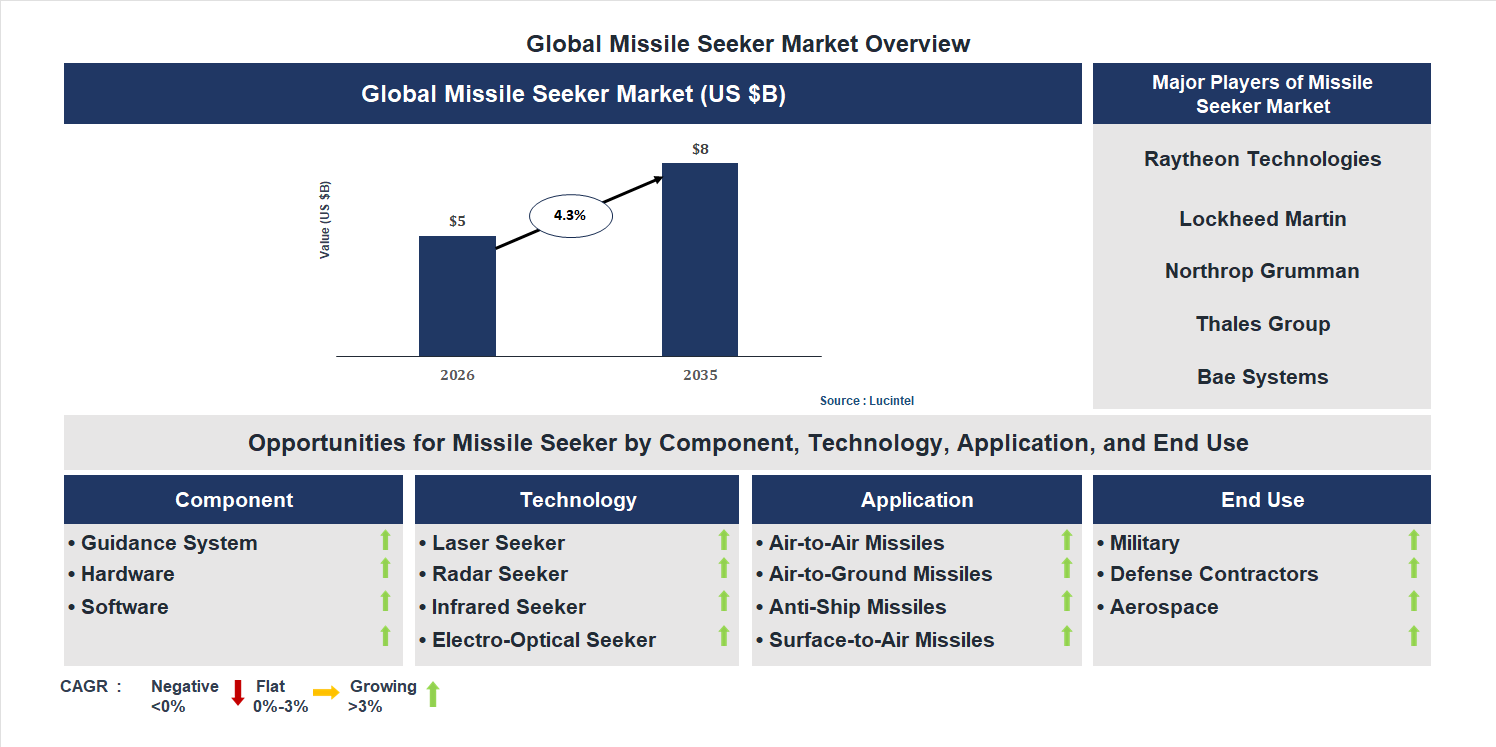
Key data points: The market size in 2035 = $8 billion, growth forecast = 4.3% annually for the next 8 years. Scroll below to get more insights. This market report covers trends, opportunities and forecasts in missile seeker market to 2035 by component (guidance system, hardware, and software), technology (laser seeker, radar seeker, infrared seeker, and electro-optical seeker), application (air-to-air missiles, air-to-ground missiles, anti-ship missiles, and surface-to-air missiles), end use (military, defense contractors, and aerospace), and region (North America, Europe, Asia Pacific, and the Rest of the World)
We'll send your sample report shortly.
• Lucintel forecasts that, within the component category, guidance system is expected to witness the highest growth over the forecast period.
• Within the end use category, military is expected to witness the highest growth.
• In terms of region, APAC is expected to witness the highest growth over the forecast period. Gain valuable insights for your business decisions with our comprehensive 150+ page report. Sample figures with some insights are shown below.
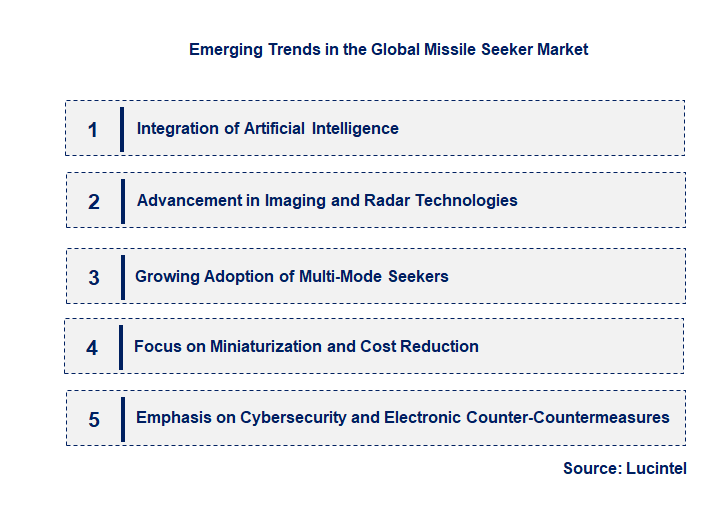
• Integration of Artificial Intelligence (AI): The incorporation of AI into missile seekers is revolutionizing target detection and tracking capabilities. AI algorithms enable real-time data processing, adaptive targeting, and improved decision-making, which significantly enhance missile accuracy and survivability. This trend allows missile systems to operate effectively in complex environments with multiple threats and electronic countermeasures. The AI-driven seekers are also facilitating autonomous operation, reducing reliance on human input, and enabling faster response times. As AI technology matures, its integration is expected to become a standard feature, boosting the overall performance and reliability of missile systems.
• Advancement in Imaging and Radar Technologies: Next-generation missile seekers are increasingly utilizing high-resolution imaging and advanced radar systems. These technologies provide superior target identification, discrimination, and tracking, even in cluttered or adverse weather conditions. Enhanced imaging seekers, such as infrared and multispectral sensors, improve target recognition accuracy, reducing false alarms. Advanced radar seekers offer long-range detection and high precision, crucial for modern missile defense. These technological improvements are expanding the operational envelope of missile systems, making them more effective against a wider range of targets, including stealth and low-observable threats.
• Growing Adoption of Multi-Mode Seekers: Multi-mode seekers combine different guidance technologies, such as infrared, radar, and semi-active laser, into a single system. This integration offers increased flexibility and reliability, allowing missiles to adapt to various combat scenarios and countermeasures. Multi-mode seekers improve target acquisition in complex environments and enhance resistance to electronic jamming. They are particularly valuable in modern warfare, where threats are diverse and constantly evolving. The ability to switch seamlessly between modes ensures higher hit probabilities and mission success rates, making multi-mode seekers a preferred choice for advanced missile platforms.
• Focus on Miniaturization and Cost Reduction: Efforts to miniaturize missile seekers are driven by the need to equip smaller, more agile missile platforms, including UAVs and cruise missiles. Advances in materials, electronics, and manufacturing processes are reducing size, weight, and power consumption, while maintaining or improving performance. Cost reduction initiatives aim to make sophisticated seeker technology accessible to a broader range of defense budgets, enabling widespread deployment. Miniaturized and affordable seekers expand the versatility of missile systems, allowing for integration into a variety of platforms and increasing overall defense capabilities without significantly escalating costs.
• Emphasis on Cybersecurity and Electronic Counter-Countermeasures (ECCM): As missile seekers become more sophisticated, protecting them from cyber threats and electronic warfare is critical. Enhanced cybersecurity measures safeguard data integrity and prevent hacking or spoofing attempts. ECCM technologies are being integrated to counter electronic jamming and deception tactics, ensuring reliable target tracking. This trend is vital for maintaining operational effectiveness in contested environments where adversaries employ advanced electronic warfare techniques. Strengthening cybersecurity and ECCM features ensures missile seekers remain resilient, secure, and capable of performing under sophisticated threat conditions. These emerging trends are fundamentally transforming the missile seeker market by enhancing precision, reliability, and adaptability. The integration of AI, advanced imaging, multi-mode capabilities, miniaturization, and robust cybersecurity measures are collectively elevating missile systems effectiveness. These developments are enabling defense forces to respond more swiftly and accurately to evolving threats, thereby reshaping the landscape of missile technology and strategic defense capabilities worldwide.
• Technological Innovations in Guidance Systems: The integration of AI and machine learning is revolutionizing missile seekers, enabling real-time target recognition and adaptive tracking. These advancements improve accuracy and reduce collateral damage, making missile systems more effective and reliable. Enhanced sensor capabilities and miniaturization are also contributing to more versatile missile designs. This progress is attracting investments from defense agencies seeking cutting-edge solutions, thereby expanding market opportunities and fostering competitive innovation.
• Increasing Defense Budgets and Military Modernization: Governments worldwide are boosting defense spending to counter emerging threats, leading to higher procurement of advanced missile systems. Countries are prioritizing modernization programs that include upgrading existing missile seekers with state-of-the-art technology. This trend is particularly prominent in Asia-Pacific and North America, where strategic tensions drive demand. The increased budget allocations are fueling market growth, encouraging research and development, and fostering partnerships between defense contractors and governments.
• Expansion of Missile Applications in Various Sectors: Beyond traditional military uses, missile seekers are finding applications in space exploration, anti-satellite systems, and missile defense. The diversification of applications is creating new revenue streams and market segments. For instance, space agencies are utilizing missile seeker technology for satellite deployment and debris removal. This expansion broadens the market scope, attracts new players, and accelerates technological advancements, ultimately strengthening the overall industry ecosystem.
• Development of Counter-Measure Technologies: As missile seekers become more sophisticated, counter-measure systems such as jamming and decoys are also evolving. This arms race drives innovation in seeker technology to improve resistance against electronic warfare tactics. The demand for resilient missile guidance systems is increasing, prompting manufacturers to develop multi-sensor and multi-mode seekers. This dynamic enhances the complexity and competitiveness of the market, encouraging continuous R&D investments and strategic collaborations.
• Growing Focus on Autonomous and Swarm Missile Systems: The trend toward autonomous missile systems and swarms is gaining momentum, driven by advancements in AI and robotics. These systems require highly sophisticated seekers capable of autonomous decision-making and coordination. The development of such technologies promises faster response times, increased battlefield survivability, and enhanced operational capabilities. This shift is attracting significant R&D funding and fostering innovation, positioning the missile seeker market at the forefront of military technological evolution. The overall impact of these developments is significantly transforming the missile seeker market, making it more innovative, competitive, and responsive to modern defense needs. Increased technological sophistication and expanding application areas are driving market growth, while strategic investments and technological arms races are shaping future industry dynamics. These trends collectively enhance national security capabilities and stimulate global defense industry advancements.
• Integration of Artificial Intelligence in Missile Seekers: Incorporating AI enhances target detection, tracking accuracy, and decision-making speed, enabling missile systems to adapt to complex combat scenarios. AI-driven seekers improve resistance to countermeasures and enable autonomous operation, reducing reliance on external guidance. This advancement is particularly valuable in modern warfare, where real-time data processing and adaptive targeting are critical. The development of machine learning algorithms and neural networks is expected to significantly boost seeker performance and operational efficiency.
• Development of Multi-Mode Seekers for Versatile Applications: Multi-mode seekers combine different guidance technologies such as radar, infrared, and laser to improve target acquisition and engagement accuracy across various environments. These seekers offer flexibility in engaging both stationary and moving targets, under diverse weather and battlefield conditions. The ability to switch modes enhances missile survivability and effectiveness, making them suitable for a broad range of military applications. Growing demand for adaptable missile systems is driving innovation in multi-mode seeker technology.
• Miniaturization of Missile Seekers for Smaller Missiles: Advances in materials and sensor technology are enabling the development of smaller, lightweight seekers suitable for tactical and short-range missile systems. Miniaturized seekers reduce overall missile weight, increase payload capacity, and improve maneuverability. This trend supports the deployment of more compact missile platforms, including drone-based systems and portable missile units. The miniaturization trend aligns with the increasing need for versatile, easily deployable missile solutions in modern combat scenarios.
• Expansion of Infrared and Radar Seeker Technologies: Infrared seekers provide high precision in heat signature detection, ideal for night operations and stealth targets. Radar seekers offer long-range target tracking and are effective in adverse weather conditions. The integration of these technologies enhances missile accuracy and operational reliability. Growing defense budgets and modernization programs are fueling investments in advanced infrared and radar seeker systems, which are crucial for countering evolving threats and ensuring strategic superiority.
• Increasing Focus on Countermeasure Resistance and Electronic Warfare Capabilities: Developing seekers with enhanced resistance to jamming, decoys, and electronic countermeasures is vital for maintaining missile effectiveness. Incorporating electronic warfare (EW) features allows seekers to identify and counteract enemy interference, ensuring target engagement success. As adversaries enhance their EW capabilities, missile seekers must evolve to include adaptive signal processing and anti-jamming techniques. This focus on resilience is critical for maintaining strategic advantage in complex combat environments. These growth opportunities are set to significantly influence the missile seeker market by fostering technological innovation, improving operational capabilities, and expanding application scopes. The integration of AI, multi-mode systems, miniaturization, advanced sensor technologies, and countermeasure resistance will drive market expansion and competitiveness. As defense agencies worldwide prioritize missile accuracy and reliability, these developments will shape the future landscape, ensuring strategic superiority and technological leadership in missile defense systems globally.
• Technological Innovation: The continuous development of advanced sensors, imaging systems, and signal processing algorithms enhances missile accuracy and reliability. Innovations such as multi-mode seekers and AI-powered targeting systems enable better target discrimination and adaptability in complex environments. These technological improvements are critical for maintaining strategic superiority and meeting evolving defense requirements. As countries invest heavily in R&D, the market experiences accelerated growth driven by cutting-edge capabilities that improve missile performance and operational effectiveness.
• Increasing Defense Budgets: Many nations are increasing their defense spending to modernize military arsenals amid rising geopolitical tensions. This surge in budgets allows for greater procurement of sophisticated missile systems equipped with advanced seekers. Governments prioritize national security, leading to sustained demand for missile seekers capable of countering emerging threats. The expansion of defense budgets directly correlates with increased investments in research, development, and procurement, fueling market expansion and technological progress.
• Geopolitical Tensions and Security Concerns: Heightened regional conflicts and global security threats compel countries to enhance their missile capabilities. The need for precise, reliable missile seekers to improve strike accuracy and survivability drives market growth. Countries seek to develop indigenous missile technology to reduce dependency on foreign suppliers, further stimulating local industry development. These geopolitical factors create a persistent demand for innovative seeker solutions that can operate effectively in contested environments, thereby expanding market opportunities.
• Growing Focus on Counter-Drone and Anti-Access/Area Denial (A2/AD) Capabilities: The proliferation of drone technology and A2/AD strategies necessitates advanced missile seekers capable of targeting fast-moving, low-flying, or stealthy threats. This demand pushes manufacturers to develop multi-spectral and multi-mode seekers with enhanced target discrimination. The market benefits from this focus as it drives innovation and diversification of seeker technologies, ensuring missile systems remain effective against evolving threats in complex operational scenarios. The challenges in the missile seeker market are:
• Technological Complexity and High R&D Costs: Developing sophisticated missile seekers involves complex engineering, extensive testing, and significant investment. The integration of multiple sensors, guidance algorithms, and communication systems increases technical complexity and costs. High R&D expenses can limit entry for smaller players and slow down innovation cycles. Additionally, the lengthy development timelines pose risks related to technological obsolescence and changing defense requirements, impacting overall market growth and competitiveness.
• Regulatory and Export Control Restrictions: International regulations governing arms exports and technology transfer impose restrictions on missile seeker development and sales. Countries must navigate complex legal frameworks, which can delay or restrict market access. These restrictions hinder global collaboration, limit market expansion, and increase compliance costs for manufacturers. As a result, regulatory hurdles can dampen growth prospects and create barriers for emerging players seeking to enter or expand within the market.
• Geopolitical and Political Instability: Political tensions and conflicts can disrupt supply chains, hinder international cooperation, and influence defense procurement decisions. Unstable geopolitical environments may lead to shifts in defense priorities, budget allocations, or sanctions that restrict market activity. Such instability introduces uncertainty, affecting long-term planning and investment in missile seeker technologies, thereby posing a significant challenge to sustained market growth. The missile seeker market is driven by rapid technological advancements, increased defense spending, and geopolitical tensions that demand sophisticated missile guidance solutions. However, challenges such as high R&D costs, regulatory restrictions, and geopolitical instability pose significant hurdles. These factors collectively influence market dynamics, requiring stakeholders to innovate continuously while navigating complex legal and political landscapes. Overall, the markets growth potential remains substantial, provided that technological and regulatory challenges are effectively managed to meet evolving defense needs.
• Raytheon Technologies
• Lockheed Martin
• Northrop Grumman
• Thales Group
• Bae Systems
• Leonardo S.P.A.
• Hensoldt
• Saab Ab
• Rafael Advanced Defense Systems
• Elbit Systems
• Guidance System
• Hardware
• Software
• Laser Seeker
• Radar Seeker
• Infrared Seeker
• Electro-Optical Seeker
• Air-to-Air Missiles
• Air-to-Ground Missiles
• Anti-Ship Missiles
• Surface-to-Air Missiles
• Military
• Defense Contractors
• Aerospace
• North America
• Europe
• Asia Pacific
• The Rest of the World
• United States: The US missile seeker market has seen substantial innovation, with a focus on multi-mode seekers combining radar, infrared, and imaging capabilities for enhanced target accuracy. The Department of Defense has increased investments in autonomous and AI-driven seeker systems to improve target discrimination and counter advanced threats. Recent developments include the integration of advanced sensors in cruise missile systems and the deployment of next-generation seekers in missile defense platforms, emphasizing precision and survivability.
• China: China has rapidly advanced its missile seeker technology, emphasizing multi-spectral and infrared seekers to improve target tracking in complex environments. The country has made significant progress in developing indigenous seeker systems for its ballistic and cruise missiles, aiming for greater accuracy and resistance to electronic countermeasures. Recent innovations include the deployment of advanced seekers in hypersonic missile platforms, reflecting China’s focus on strategic deterrence and technological self-reliance.
• Germany: Germany’s missile seeker market is characterized by high-precision, sensor fusion technologies, primarily driven by its defense industry’s focus on European and NATO collaborations. Recent developments include the integration of advanced infrared and radar seekers in missile systems for enhanced target acquisition and tracking. Germany is also investing in research to improve seeker resilience against electronic warfare, aligning with broader European defense modernization efforts.
• India: India has made notable progress in developing indigenous missile seeker technology, focusing on infrared and radar seekers for its ballistic and cruise missile programs. Recent advancements include the successful testing of seeker systems with improved target discrimination and resistance to jamming. India’s emphasis on self-reliance is evident in its efforts to upgrade existing missile platforms with advanced seeker technologies, aiming to bolster its strategic deterrence capabilities.
• Japan: Japan continues to innovate in missile seeker technology, emphasizing infrared and radar seekers for its missile defense systems. Recent developments include the integration of advanced sensors in Aegis missile systems to improve target detection and tracking in complex scenarios. Japan is also exploring AI-enhanced seekers to increase missile accuracy and counter emerging threats, reflecting its focus on regional security and technological sovereignty.


• Raytheon Technologies
• Lockheed Martin
• Northrop Grumman
• Thales Group
• Bae Systems
• Leonardo S.P.A.
• Hensoldt
• Saab Ab
• Rafael Advanced Defense Systems
• Elbit Systems Q6. Which missile seeker market segment will be the largest in future? Answer: Lucintel forecasts that, within the component category, guidance system is expected to witness the highest growth over the forecast period. Q7. In missile seeker market, which region is expected to be the largest in next 8 years? Answer: In terms of region, APAC is expected to witness the highest growth over the forecast period. Q8. Do we receive customization in this report? Answer: Yes, Lucintel provides 10% customization without any additional cost.


Choose a license that fits your team. Instant PDF delivery.
Prices exclude taxes. Instant delivery. Custom licensing available on request.
Market Report · July 31, 2026
Market Report · July 31, 2026
Market Report · July 31, 2026
Trusted partner for strategic intelligence and business growth


Receive a complimentary market analysis tailored to your industry. Our analysts will identify key growth opportunities and competitive dynamics specific to your business.

Market size, growth rate, and key trend analysis for your specific sector.

Top competitor positioning and market share analysis.

Strategic recommendations backed by data-driven insights.
Get curated market intelligence and competitive moves straight to your inbox.
By subscribing, you agree to receive our monthly insights. Unsubscribe anytime.
Receive a complimentary market analysis tailored to your industry. Our analysts will identify key growth opportunities and competitive dynamics specific to your business.
Market size, growth rate, and key trend analysis for your specific sector.
Top competitor positioning and market share analysis.
Strategic recommendations backed by data-driven insights.
Get curated market intelligence, emerging trends, and competitive moves straight to your inbox each month.
By subscribing, you agree to receive our monthly insights. Unsubscribe anytime.
We'll send your sample report shortly.