
Mining Equipment Market Trends and Forecast
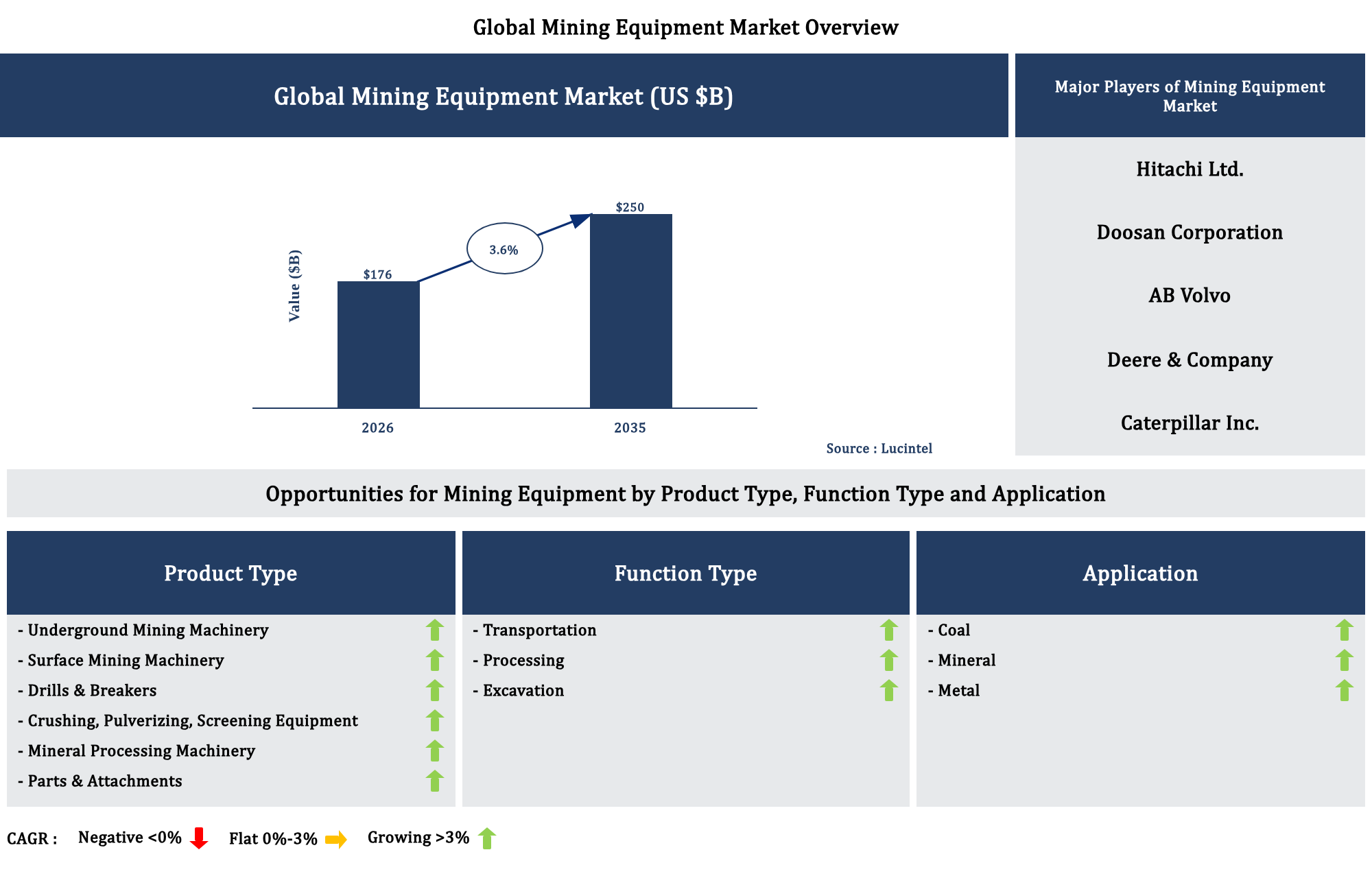
The future of the global mining equipment market looks promising with opportunities in the coal, mineral, and metal markets. The global mining equipment market is expected to reach an estimated $250 billion by 2035 with a CAGR of 3.6% from 2026 to 2035. The major drivers for this market are the increasing focus on efficient & high productivity equipment, the growing demand for electric & sustainable mining solutions, and the rising government initiatives supporting mining sector development.
• Lucintel forecasts that, within the product type category, surface mining machinery is expected to witness the highest growth over the forecast period.
• Within the application category, coal is expected to witness the highest growth.
• In terms of region, APAC is expected to witness the highest growth over the forecast period.
Gain valuable insights for your business decisions with our comprehensive 150+ page report. Sample figures with some insights are shown below.
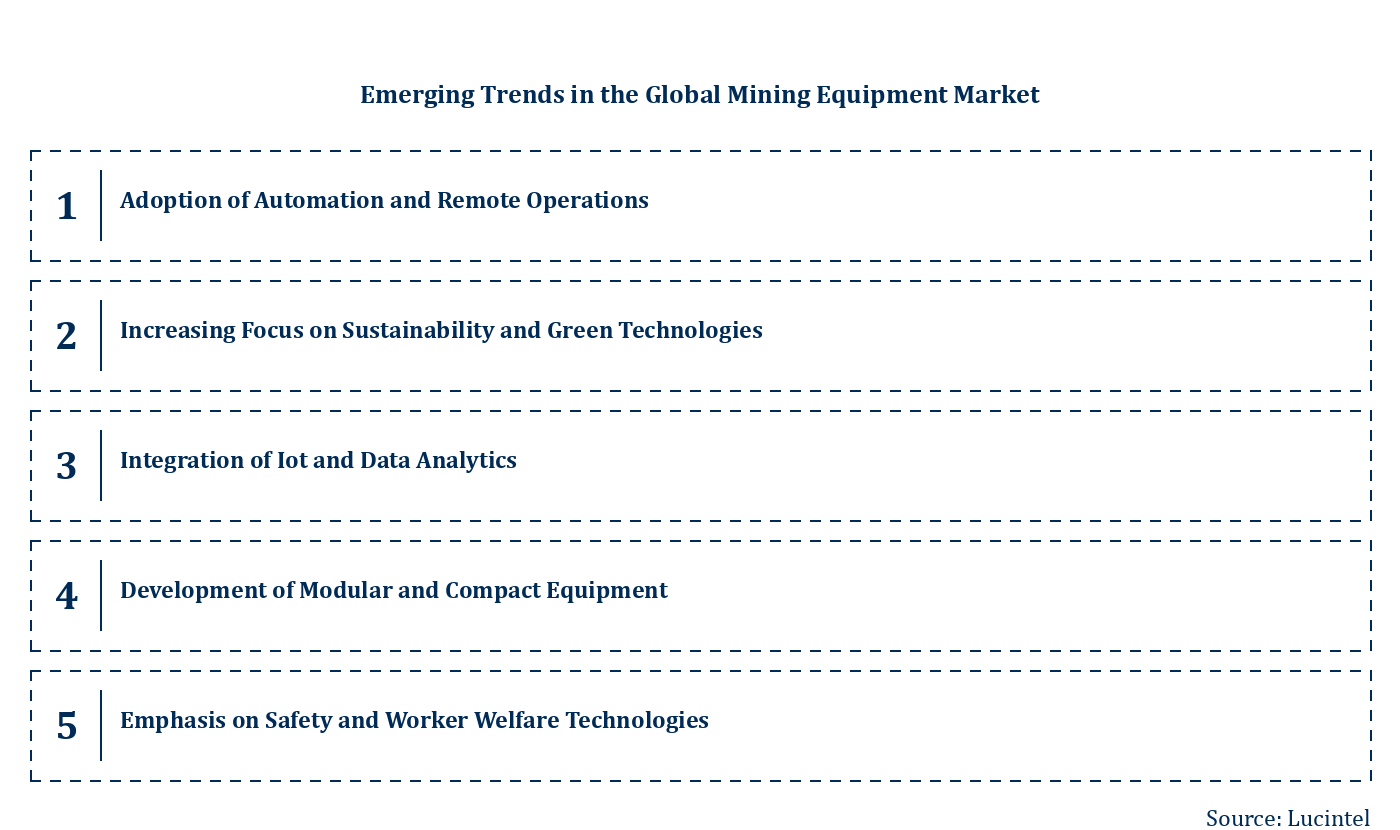
Emerging Trends in the Mining Equipment Market
The mining equipment market is experiencing rapid transformation driven by technological advancements, environmental concerns, and shifting global demand. As the industry adapts to these changes, new trends are emerging that are reshaping how mining operations are conducted, improving efficiency, safety, and sustainability. These developments are also influencing market dynamics, investment strategies, and competitive landscapes. Stakeholders must stay informed about these trends to capitalize on opportunities and mitigate risks. The following five key trends highlight the most significant shifts currently shaping the mining equipment market, reflecting a move towards smarter, greener, and more efficient mining practices.
• Adoption of Automation and Remote Operations: The integration of automation technologies and remote-controlled equipment is revolutionizing mining operations. Automated drills, trucks, and conveyor systems enhance productivity by enabling continuous operation with minimal human intervention. Remote operation centers improve safety by reducing workers‘ exposure to hazardous environments. This trend also reduces operational costs and increases precision in resource extraction. As technology advances, more mines are adopting these solutions, leading to a significant shift towards fully automated mining processes that promise higher efficiency and safety standards.
• Increasing Focus on Sustainability and Green Technologies: Environmental concerns are prompting the industry to adopt sustainable practices. Innovations such as electric and hybrid equipment reduce carbon emissions and reliance on fossil fuels. Companies are investing in renewable energy sources to power mining operations, aiming to minimize environmental footprints. Additionally, eco-friendly waste management and water recycling technologies are gaining prominence. This shift not only helps in complying with stricter regulations but also enhances corporate social responsibility. The move towards green technologies is reshaping market offerings and encouraging the development of cleaner, more sustainable mining solutions.
• Integration of IoT and Data Analytics: The deployment of Internet of Things (IoT) devices and advanced data analytics is enabling smarter mining operations. Sensors monitor equipment health, environmental conditions, and operational parameters in real-time, facilitating predictive maintenance and reducing downtime. Data analytics optimize resource allocation, improve safety protocols, and enhance decision-making processes. This interconnected approach leads to increased operational efficiency and cost savings. As IoT adoption grows, mining companies are gaining better insights into their operations, leading to more proactive management and innovation in equipment design and operational strategies.
• Development of Modular and Compact Equipment: The demand for modular and compact mining equipment is rising, driven by the need for flexibility and efficiency in diverse mining environments. These smaller, easily transportable units enable quick deployment and scalability, especially in remote or challenging locations. Modular designs facilitate easier maintenance and upgrades, reducing downtime and operational costs. This trend supports the shift towards more agile mining operations capable of adapting to changing resource demands and site conditions. The development of such equipment is making mining more accessible and cost-effective, opening new opportunities in smaller or emerging markets.
• Emphasis on Safety and Worker Welfare Technologies: Enhancing safety remains a top priority in the mining industry. Advanced safety systems, including collision avoidance, real-time monitoring, and wearable safety devices, are being integrated into equipment. These technologies help prevent accidents, improve emergency response, and ensure compliance with safety standards. Additionally, innovations aimed at improving worker comfort and reducing fatigue are gaining traction. The focus on safety and welfare not only protects workers but also boosts productivity and morale. As safety technologies evolve, they are becoming integral to modern mining equipment, fostering a safer working environment.
These emerging trends are collectively transforming the mining equipment market by promoting automation, sustainability, smarter operations, flexibility, and safety. This evolution is leading to more efficient, environmentally friendly, and safer mining practices, ultimately reshaping the industry landscape and opening new avenues for growth and innovation.
Recent Developments in the Mining Equipment Market
The mining equipment market is experiencing rapid transformation driven by technological advancements, increasing demand for minerals, and a focus on sustainable practices. These developments are reshaping industry dynamics, creating new opportunities for growth and innovation. Companies are investing heavily in automation, eco-friendly solutions, and digital integration to enhance efficiency and safety. As the market evolves, stakeholders must adapt to these changes to remain competitive and capitalize on emerging trends that promise to redefine mining operations globally.
• Automation and AI Integration: Enhancing efficiency and safety in mining operations by deploying autonomous vehicles and AI-driven systems, reducing human risk, and increasing productivity. This shift allows for continuous operation, minimizes errors, and lowers operational costs, making mining more sustainable and profitable. Companies adopting these technologies are gaining a competitive edge, attracting investments, and setting new industry standards for safety and operational excellence.
• Focus on Sustainable and Eco-Friendly Equipment: Developing environmentally friendly machinery with reduced emissions and energy consumption to meet stricter regulations and public demand for sustainability. This innovation helps companies lower their carbon footprint, comply with global standards, and improve community relations. The adoption of green technologies also opens new market segments, attracting environmentally conscious investors and customers, ultimately fostering long-term industry growth.
• Digitalization and Data Analytics: Implementing advanced digital tools and data analytics to optimize mining processes, improve resource management, and predict maintenance needs. This integration enhances operational efficiency, reduces downtime, and enables better decision-making. As data-driven strategies become mainstream, companies can achieve higher productivity, lower costs, and better risk management, positioning themselves strongly in a competitive global market.
• Increasing Demand for Rare Minerals: Rising consumption of rare earth elements and minerals for electronics, renewable energy, and electric vehicles is driving exploration and extraction activities. This surge creates significant growth opportunities for mining equipment providers specializing in handling complex and high-value materials. It also encourages technological innovation to access difficult deposits, ensuring supply chain stability and supporting the global shift toward sustainable energy solutions.
• Expansion of Remote and Underground Mining Technologies: Advancements in remote operation and underground mining equipment are enabling access to previously unreachable deposits, reducing safety risks, and increasing operational efficiency in challenging environments. These technologies facilitate continuous operations in hazardous areas, lower labor costs, and improve safety standards. As demand for minerals grows, these innovations are crucial for expanding mining capacity while maintaining safety and environmental standards.
These recent developments are significantly transforming the mining equipment market by fostering innovation, sustainability, and efficiency. Automation, eco-friendly solutions, digitalization, resource demand, and remote technologies are collectively driving growth, reducing costs, and enhancing safety. As these trends continue, the market is poised for substantial expansion, attracting investments and enabling companies to meet global mineral demands responsibly. Overall, these advancements are setting a new trajectory for sustainable and technologically advanced mining industry growth.
Strategic Growth Opportunities in the Mining Equipment Market
The mining equipment market is poised for significant expansion driven by increasing global demand for minerals, technological advancements, and sustainable practices. Rising infrastructure projects and the need for efficient extraction methods are fueling growth. Companies are investing in innovative solutions to improve productivity, safety, and environmental compliance. This evolving landscape presents numerous opportunities for market players to capitalize on emerging applications and regional developments, ensuring long-term growth and competitiveness.
• Growing Adoption of Automation and AI in Mining Equipment: The integration of automation and artificial intelligence enhances operational efficiency, safety, and precision in mining activities. Automated machinery reduces labor costs and minimizes human risk, enabling continuous operation in challenging environments. AI-driven analytics optimize resource extraction and maintenance schedules, leading to cost savings. As technology advances, the adoption of smart equipment is expected to accelerate, creating substantial growth opportunities across various mining segments.
• Expansion of Underground Mining Equipment for Deeper Deposits: As surface deposits become depleted, the focus shifts toward underground mining for deeper mineral reserves. This drives demand for specialized equipment such as continuous miners, longwall systems, and roof supports. Innovations in underground machinery improve safety, efficiency, and environmental impact. The need for durable, high-performance equipment tailored to complex underground conditions presents significant growth prospects, especially in regions with rich mineral deposits requiring deep extraction techniques.
• Increasing Demand for Environmentally Sustainable Mining Solutions: Environmental concerns and stricter regulations are prompting the adoption of eco-friendly mining equipment. Innovations include electric and hybrid machinery, dust suppression systems, and water recycling technologies. These solutions reduce carbon emissions, noise pollution, and water usage, aligning with sustainability goals. Growing awareness and regulatory pressures are encouraging miners to invest in greener equipment, opening new markets and fostering innovation in sustainable mining practices.
• Rising Investments in Mineral Exploration and Infrastructure Development: Increased exploration activities and infrastructure projects worldwide are boosting demand for mining equipment. Governments and private firms are investing heavily in discovering new mineral reserves and developing transportation networks. This expansion necessitates a wide range of equipment, from drilling rigs to material handling systems. The surge in exploration and infrastructure development creates substantial opportunities for equipment manufacturers to supply advanced, reliable machinery tailored to diverse geological and logistical challenges.
• Technological Advancements in Equipment Safety and Maintenance: Innovations in sensor technology, predictive maintenance, and safety systems are transforming equipment management. Real-time monitoring reduces downtime and prevents accidents, ensuring safer working environments. Advanced diagnostics enable proactive maintenance, extending equipment lifespan and reducing operational costs. As safety standards tighten and technology becomes more accessible, companies investing in these innovations will gain competitive advantages, driving growth in the market through improved reliability and compliance.
The overall impact of these opportunities is set to significantly enhance market growth, fostering innovation, sustainability, and efficiency. Companies that leverage these trends will be better positioned to meet evolving industry demands, expand their market share, and contribute to a more sustainable and technologically advanced mining sector.
Mining Equipment Market Driver and Challenges
The mining equipment market is influenced by a complex interplay of technological advancements, economic conditions, and regulatory frameworks. Rapid innovations in machinery, automation, and data analytics are transforming operational efficiencies. Economic factors such as commodity prices, global demand, and investment levels significantly impact market growth. Additionally, regulatory policies related to environmental standards and safety protocols shape industry practices and investment decisions. These drivers and challenges collectively determine the market‘s trajectory, requiring stakeholders to adapt swiftly to changing conditions. Understanding these factors is essential for strategic planning and sustainable growth in the competitive landscape of mining equipment.
The factors responsible for driving the mining equipment market include:
• Technological Innovation: The integration of automation, IoT, and data analytics enhances operational efficiency, safety, and productivity. Advanced machinery reduces downtime and improves resource management, making mining operations more cost-effective and environmentally friendly. Continuous R&D investments foster the development of smarter, more efficient equipment, attracting industry players seeking competitive advantages. This technological evolution is crucial for meeting increasing demand and adhering to stricter regulatory standards, ultimately driving market expansion.
• Rising Demand for Minerals and Metals: Growing urbanization, infrastructure development, and renewable energy initiatives boost the need for minerals and metals such as copper, lithium, and rare earth elements. This surge in demand compels mining companies to upgrade and expand their equipment fleets to meet production targets. The increasing extraction activities, especially in emerging economies, directly contribute to market growth, as companies invest heavily in modern, high-capacity machinery to optimize extraction processes.
• Environmental Regulations and Sustainability Initiatives: Stricter environmental policies and sustainability commitments compel mining companies to adopt eco-friendly equipment and practices. Regulations on emissions, water usage, and land rehabilitation necessitate the deployment of specialized machinery designed to minimize environmental impact. This shift encourages innovation in cleaner technologies and promotes the adoption of electric and hybrid equipment, which, although initially costly, offers long-term benefits and compliance advantages, thereby influencing market dynamics.
• Economic Growth and Investment Trends: Fluctuations in global economic conditions influence mining investments and equipment procurement. During periods of economic expansion, increased capital expenditure on mining projects drives demand for new equipment. Conversely, economic downturns can lead to reduced investments and delayed projects. Stable economic growth fosters confidence among investors and operators, ensuring steady demand for mining machinery and supporting market stability and growth.
• Strategic Mergers and Acquisitions: Industry consolidation through mergers and acquisitions enhances technological capabilities, expands product portfolios, and increases market reach. Larger firms benefit from economies of scale and improved R&D capabilities, fostering innovation and competitive positioning. These strategic moves often lead to increased market share and influence pricing strategies, shaping the competitive landscape and accelerating technological adoption across the industry.
The challenges facing the mining equipment market include:
• Volatility in Commodity Prices: Fluctuations in prices of key minerals and metals directly impact mining operations and equipment demand. When prices decline, mining companies often cut back on capital expenditure, delaying or canceling equipment purchases. Conversely, high prices can lead to increased investment, but the unpredictability creates planning uncertainties. This volatility hampers long-term strategic planning and can result in inconsistent market growth, affecting equipment manufacturers and suppliers.
• High Capital and Operating Costs: The initial investment in advanced mining equipment is substantial, and operational costs such as maintenance, energy, and labor further strain profitability. These high costs can deter smaller operators and limit market expansion, especially in regions with limited financial resources. Additionally, the need for specialized skills to operate sophisticated machinery increases training expenses, impacting overall profitability and market growth prospects.
• Regulatory and Environmental Compliance Challenges: Navigating complex and evolving regulations requires significant investment in compliance measures. Non-compliance can lead to hefty fines, operational shutdowns, and reputational damage. The cost of adopting new environmentally friendly technologies and meeting safety standards can be prohibitive, especially for smaller firms. These regulatory hurdles can slow down technological adoption and restrict market entry, posing challenges to industry growth and innovation.
The mining equipment market is shaped by rapid technological advancements, increasing demand for minerals, and stringent environmental regulations, which collectively drive growth. However, market volatility, high costs, and regulatory complexities pose significant challenges. The interplay of these factors influences investment decisions, technological adoption, and operational strategies. Overall, the market‘s future depends on how effectively industry players navigate these drivers and challenges, balancing innovation with sustainability and cost management to sustain growth in a competitive environment.
List of Mining Equipment Companies
Companies in the market compete on the basis of product quality offered. Major players in this market focus on expanding their manufacturing facilities, R&D investments, infrastructural development, and leverage integration opportunities across the value chain. With these strategies mining equipment companies cater increasing demand, ensure competitive effectiveness, develop innovative products & technologies, reduce production costs, and expand their customer base. Some of the mining equipment companies profiled in this report include-
• Hitachi Ltd.
• Doosan Corporation
• AB Volvo
• Deere & Company
• Caterpillar Inc.
• Komatsu Ltd.
• Sandvik AB
Mining Equipment Market by Segment
The study includes a forecast for the global mining equipment market by product type, function type, application, and region.
Mining Equipment Market by Product Type [Value from 2019 to 2035]:
• Underground Mining Machinery
• Surface Mining Machinery
• Drills & Breakers
• Crushing, Pulverizing, Screening Equipment
• Mineral Processing Machinery
• Parts & Attachments
Mining Equipment Market by Function Type [Value from 2019 to 2035]:
• Transportation
• Processing
• Excavation
Mining Equipment Market by Application [Value from 2019 to 2035]:
• Coal
• Mineral
• Metal
Mining Equipment Market by Region [Value from 2019 to 2035]:
• North America
• Europe
• Asia Pacific
• The Rest of the World
Country Wise Outlook for the Mining Equipment Market
The mining equipment market has experienced significant shifts driven by technological innovation, environmental regulations, and geopolitical factors. Countries are investing in advanced machinery to improve efficiency, reduce environmental impact, and meet increasing demand for minerals and resources. The United States, China, Germany, India, and Japan are key players, each adapting to unique economic and regulatory landscapes. These developments reflect a global push toward sustainable mining practices, automation, and digitalization, shaping the future of the industry. Understanding these regional trends is crucial for stakeholders aiming to capitalize on emerging opportunities and navigate challenges effectively.
• United States: The US market has seen increased adoption of automation and electric mining equipment, driven by stricter environmental regulations and a focus on sustainability. Major companies are investing in R&D for autonomous trucks and drilling systems, enhancing safety and productivity. The government’s infrastructure projects also boost demand for mining machinery, especially for mineral extraction critical to technology sectors. Additionally, there is a rising trend toward digitalization, integrating IoT and AI to optimize operations and reduce costs.
• China: China remains the largest consumer and producer of mining equipment, with rapid technological advancements and government support. The country emphasizes green mining practices, leading to innovations in energy-efficient machinery and pollution control. Domestic manufacturers are expanding their global footprint through strategic alliances and exports. The Chinese government’s focus on securing mineral resources for its industrial growth fuels continuous investment in advanced equipment, including high-capacity excavators and processing machinery, to meet domestic and international demand.
• Germany: Germany’s market is characterized by high-quality, precision-engineered mining equipment, with a strong emphasis on automation and safety standards. The country is investing heavily in Industry 4.0 technologies, integrating robotics and AI into mining operations. Sustainability initiatives are promoting the development of eco-friendly machinery that minimizes environmental impact. German firms are also focusing on digital twins and predictive maintenance solutions, enhancing operational efficiency and reducing downtime in mining activities.
• India: India’s mining equipment market is expanding due to increased government initiatives to boost mineral production and infrastructure development. The focus is on affordable, durable machinery suitable for the country’s diverse geological conditions. There is a growing trend toward mechanization to improve productivity and safety. The government’s push for mineral exploration and the development of mineral corridors are expected to drive demand for excavators, drills, and processing equipment, with local manufacturers gaining prominence through innovation and cost competitiveness.
• Japan: Japan’s market is driven by technological innovation and a focus on environmental sustainability. The country is investing in energy-efficient and compact mining equipment suitable for its limited natural resources. Advanced automation, robotics, and sensor technologies are being integrated to improve safety and operational efficiency. Japan’s emphasis on research and development fosters the creation of cutting-edge machinery that aligns with global sustainability standards, positioning it as a leader in high-tech mining solutions.
Features of the Global Mining Equipment Market
Market Size Estimates: Mining equipment market size estimation in terms of value ($B).
Trend and Forecast Analysis: Market trends (2019 to 2025) and forecast (2026 to 2035) by various segments and regions.
Segmentation Analysis: Mining equipment market size by product type, function type, application, and region in terms of value ($B).
Regional Analysis: Mining equipment market breakdown by North America, Europe, Asia Pacific, and Rest of the World.
Growth Opportunities: Analysis of growth opportunities in different product type, function type, application, and regions for the mining equipment market.
Strategic Analysis: This includes M&A, new product development, and competitive landscape of the mining equipment market.
Analysis of competitive intensity of the industry based on Porter’s Five Forces model.
FAQ
Q1. What is the mining equipment market size?
Answer: The global mining equipment market is expected to reach an estimated $250 billion by 2035.
Q2. What is the growth forecast for mining equipment market?
Answer: The global mining equipment market is expected to grow with a CAGR of 3.6% from 2026 to 2035.
Q3. What are the major drivers influencing the growth of the mining equipment market?
Answer: The major drivers for this market are the increasing focus on efficient & high productivity equipment, the growing demand for electric & sustainable mining solutions, and the rising government initiatives supporting mining sector development.
Q4. What are the major segments for mining equipment market?
Answer: The future of the mining equipment market looks promising with opportunities in the coal, mineral, and metal markets.
Q5. Who are the key mining equipment market companies?
Answer: Some of the key mining equipment companies are as follows:
• Hitachi Ltd.
• Doosan Corporation
• AB Volvo
• Deere & Company
• Caterpillar Inc.
• Komatsu Ltd.
• Sandvik AB
Q6. Which mining equipment market segment will be the largest in future?
Answer: Lucintel forecasts that, within the product type category, surface mining machinery is expected to witness the highest growth over the forecast period.
Q7. In mining equipment market, which region is expected to be the largest in next 8 years?
Answer: In terms of region, APAC is expected to witness the highest growth over the forecast period.
Q8. Do we receive customization in this report?
Answer: Yes, Lucintel provides 10% customization without any additional cost.
This report answers following 11 key questions:
Q.1. What are some of the most promising, high-growth opportunities for the mining equipment market by product type (underground mining machinery, surface mining machinery, drills & breakers, crushing, pulverizing, screening equipment, mineral processing machinery, and parts & attachments), function type (transportation, processing, and excavation), application (coal, mineral, and metal), and region (North America, Europe, Asia Pacific, and the Rest of the World)?
Q.2. Which segments will grow at a faster pace and why?
Q.3. Which region will grow at a faster pace and why?
Q.4. What are the key factors affecting market dynamics? What are the key challenges and business risks in this market?
Q.5. What are the business risks and competitive threats in this market?
Q.6. What are the emerging trends in this market and the reasons behind them?
Q.7. What are some of the changing demands of customers in the market?
Q.8. What are the new developments in the market? Which companies are leading these developments?
Q.9. Who are the major players in this market? What strategic initiatives are key players pursuing for business growth?
Q.10. What are some of the competing products in this market and how big of a threat do they pose for loss of market share by material or product substitution?
Q.11. What M&A activity has occurred in the last 5 years and what has its impact been on the industry?
For any questions related to Mining Equipment Market, Mining Equipment Market Size, Mining Equipment Market Growth, Mining Equipment Market Analysis, Mining Equipment Market Report, Mining Equipment Market Share, Mining Equipment Market Trends, Mining Equipment Market Forecast, Mining Equipment Companies, write Lucintel analyst at email: helpdesk@lucintel.com. We will be glad to get back to you soon.