
Report Feature
Mini Excavator Market Trends and Forecast
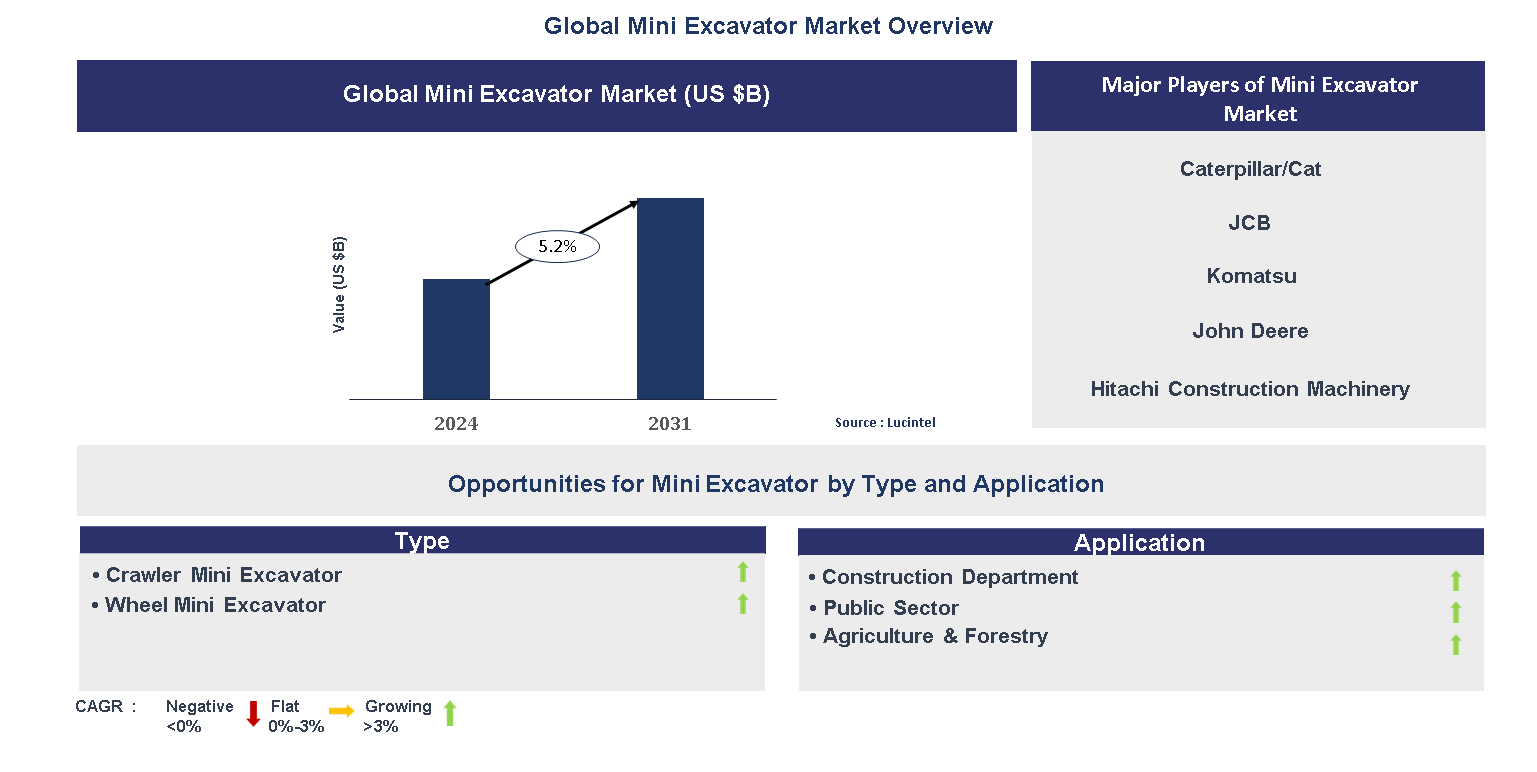
The future of the global mini excavator market looks promising with opportunities in the construction department, public sector, and agriculture & forestry markets. The global mini excavator market is expected to grow with a CAGR of 5.2% from 2025 to 2031. The major drivers for this market are the increasing residential construction activities, the rising demand for versatile equipment, and the growing investments in infrastructure development projects.• Lucintel forecasts that, within the type category, crawler mini excavator is expected to witness higher growth over the forecast period.
• Within the application category, construction department is expected to witness the highest growth.
• In terms of region, APAC is expected to witness the highest growth over the forecast period. Gain valuable insights for your business decisions with our comprehensive 150+ page report. Sample figures with some insights are shown below.
Emerging Trends in the Mini Excavator Market
The mini excavator market is being reinvigorated by a perfect storm of technology advancement, evolving end-user requirements, and worldwide movement towards sustainability. The sector is going beyond elementary functionality to provide smart, optimized, and eco-friendly solutions. These latest trends are changing the paradigms of mini excavator design, production, and operation, making the machines more efficient, productive, and adaptable to the new construction environment.• Electrification and Hybridization: The market is witnessing a significant movement towards hybrid and electric mini excavators. It is triggered by the strict environmental norms and zero emission and low-noise demands, especially in urban and indoor construction sites. Companies are coming up with battery-powered and hybrid versions that provide similar performance as their diesel variants. The effect is considerable, as these machines decrease the environmental impact of construction, decrease operating costs with less fuel usage and maintenance, and enable operation in areas that were once off-limits.
• Telematics and IoT Integration: There is also a trend towards the integration of telematics and Internet of Things (IoT) into mini excavators. This technology enables real-time monitoring of machine performance, fuel usage, and location. It provides remote diagnostics, predictive maintenance, and optimized fleet operations. The effect is a dramatic rise in operating efficiency, minimized costly downtime, and improved decision-making for fleet operators. It makes it possible to utilize a data-driven maintenance and resource allocation strategy, optimizing profitability and machine life.
• Operator Comfort and Safety Focus: The industry is experiencing a renewed focus on improving operator comfort and safety. This encompasses the creation of ergonomically conceived cabins with easy-to-use controls, sophisticated suspension seats, and enhanced climatic control. Safety mechanisms like collision avoidance systems, cameras, and better visibility are becoming mainstream. This is affecting productivity by lessening operator fatigue and improving job site safety.
• Rise of Zero Tail Swing and Compact Models: The rising demand for mini excavators is partly driven by the popularity of zero tail swing (ZTS) and ultra-compact models. These machines are designed to work in very cramped environments without the danger of the back of the machine swinging outside its tracks. The effect is a tremendous boost in the versatility of mini excavators so that they can be employed in urban, residential, and indoor jobs where there is little space.
• Specialized Attachments and Versatility: Mini excavators versatility is being further enhanced by advancements in a variety of specialized attachments. Such accessories that range from hydraulic breakers, augers, grapples, and trenchers enable a machine to complete various tasks. This trend is significantly influencing the market by enhancing the value proposition and utility of mini excavators. It enables contractors to minimize their fleet size and capital outlay while being able to perform a range of jobs using a single machine.

Recent Development in the Mini Excavator Market
The mini excavator industry has witnessed a series of significant developments over the last few years, led by a worldwide emphasis on efficiency, sustainability, and technology integration. These developments are revolutionizing the business, turning the mini excavator into more than a basic earth-moving equipment. It is now a very advanced, versatile, and green product that is fast becoming indispensable for numerous applications. The most important developments are a reaction to an increasingly complex and demanding construction industry.• Introduction of Fully Electric Machines: One of the most significant developments is the commercial introduction and increasing availability of fully electric mini excavators from major brands. These machines, like Volvo CE and Caterpillar, provide zero emissions and much lower noise levels. This makes them suitable for their application in sensitive areas such as residential areas, hospitals, and indoor demolitions. The result is a paradigm change in the market, creating new uses and pushing the industry towards a more sustainable, noiseless future with reduced operational expenses from fewer fuel and maintenance requirements.
• Telematics and GPS Technology Advancements: Recent innovations have witnessed a quantum leap in bringing together telematics and GPS. Todays mini excavators are equipped with sophisticated systems that offer real-time information on everything from fuel economy to engine performance and asset location. The result is a fleet management revolution. Contractors are able to track their machines remotely, plan predictive maintenance to prevent costly breakdowns, and maximize machine utilization.
• Improved Operator Controls and Ergonomics: There is a tremendous evolution in the design of mini excavator cabs, with great emphasis on ergonomics and user-friendliness. This comprises the addition of joystick controls, easy-to-use digital displays, and spacious, climate-controlled cabs. The effect is an evident upgrade in operator comfort and a decrease in fatigue. Not only does this boost productivity on the job site, but it also assists businesses in attracting and retaining skilled operators, which is an important factor considering the industrys labor challenges.
• Smart Attachments Introduction: Development of smart attachments is another area of significant advancement. Hydraulic thumbs and sensors embedded in quick couplers that can be accurately controlled are becoming increasingly popular. These attachments are tailored to operate with the hydraulic system of the excavator, offering improved control and accuracy. The effect is a significant boost in the versatility of the mini excavator to perform specialized work more accurately and efficiently, for example, laser-guided grading or complex demolition jobs.
• Design of Rental Market-Specific Models: The expansion of the rental market has given rise to the creation of mini excavators that are specifically tailored to this market. They are designed to be durable and maintainable so that they can sustain use by a group of operators. They are also typically designed with simplified controls and heavy-duty constructions to reduce the impact of damage. The innovation is contributing to the market by opening up the mini excavators to a broader set of customers ranging from small contractors to home DIY users, thus driving market growth and adoption.
Strategic Growth Opportunities in the Mini Excavator Market
The market for mini excavator is on the verge of strong strategic expansion, fueled by a wide array of diverse applications that are moving beyond their historical roots in traditional construction. With urbanization, sustainability, and technology advancements continuing to drive the industry, strong growth opportunities are on the horizon for manufacturers and rental houses. By targeting particular applications, companies can create specialized products and services that meet the distinctive requirements of various customer groups.• Residential Construction and Landscaping: The landscaping and residential markets are a significant growth opportunity. Mini excavators are ideal for the digging out for pools, irrigation system installation, and the construction of intricate landscape elements. Their small size and low ground pressure prevent them from causing excessive damage to established grass and gardens. Producers can take advantage of this by creating an entire line of landscaping-oriented attachments and providing rental packages geared to homeowners and small-scale contractors, thus broadening their customer base beyond the traditional construction.
• Utilities and Trenching: Ongoing demand for new and replacement utility infrastructure, such as fiber optic cables, gas mains, and water mains, represents a massive growth opportunity. Mini excavators are particularly suited for trenching and utility applications because they are precise and can work in tight spaces. Firms can concentrate on creating models with greater digging depth and trenching buckets specifically designed for specific trenching applications. In addition, creating electric models for this use is a significant opportunity since they can be utilized in inner cities with little noise and disturbance.
• Interior Demolition and Renovation: Electric powertrain mini excavators are building a new opportunity for growth in interior demolition and renovation. They can be employed within buildings to demolish walls, break concrete, and clear away debris without releasing bad fumes or making a high noise level. By promoting these specialized, zero-emissions models, manufacturers can address the expanding market for health-and-safety compliant and environmentally friendly construction. This specialist application will be a top growth driver for the sales of electric mini excavators.
• Farming and Agriculture: Mini excavators are discovering a new place in farming and agriculture. They are utilized for digging drainage trenches, excavating, clearing fields of stumps, and the maintenance of irrigation systems. The smaller size of the machines allows them to easily traverse small pieces of land without causing any damage to crops. The market opportunity is to build bespoke agricultural attachments and promote mini excavators to farmers as a one-size-fits-all and economically viable substitute for bigger and more specialized farming machinery.
• Urban Construction and Repairing of Infrastructure: The continuous urbanization and need to replace aging infrastructure in urban cities are giving mini excavators a constant flow of jobs to work on. Their capacity to operate in crowded city life, close to existing structures and public areas, makes them irreplaceable. Opportunities for growth come from the development and marketing of specialized equipment for road and sidewalk construction, utility installation, and small-scale municipal works. By providing machines that cause minimal disruption to city existence, firms can win government and municipal contracts.
Mini Excavator Market Driver and Challenges
The mini excavator industry is being influenced by several strong drivers and substantial challenges. The drivers, consisting of technological development and economic patterns, are driving the industry towards expansion and fresh uses. Yet, challenges, like high prices and skilled labor deficit, are posing obstacles that need to be overcome to avoid reversing the expansion. An in-depth knowledge of these factors is necessary for every stakeholder, ranging from the manufacturing and dealer sides to rental businesses and end-users, to position themselves strategically in this changing market. The factors responsible for driving the mini excavator market include: 1. Increasing Urbanization and Infrastructure Growth: The key driver is the worldwide trend of urbanization and the resultant demand for compact construction equipment. As urban populations grow, there is a need for mini excavators that can operate in small spaces, neighborhoods, and on small projects. Governments globally are also making huge investments in infrastructure, ranging from road maintenance to the upgrade of utilities, which constantly drives demand for these highly efficient machines. 2. Growth of the Rental Market: Expansion of the equipment rental industry is a big driving force, especially for mini excavators. Homeowners and small to medium-sized contractors frequently prefer renting over buying equipment because it is more economical for them. This behavior reduces the entry barrier for possible customers, thus growing the customer base and driving overall demand. Rental firms serve as an important distribution channel, opening up mini excavators for more users. 3. Technology developments: Innovation is an influential catalyst. The combination of telematics, GPS, and high-tech hydraulics is enhancing the efficiency and productivity of mini excavators. Electric and hybrid models are being developed to meet the increasing call for sustainability and silence. These technology advances are making mini excavators more attractive to a new generation of customers and creating new uses in urban and indoor settings. 4. Versatility and Variety. Use: Mini excavators are not only for digging anymore. Today, thanks to the availability of numerous attachments, they can trench, drill, demolish, and handle material. The versatility is a major push factor, as it enables contractors to accomplish various jobs with a single machine. This minimizes the use of specialized equipment and diminishes capital outlays, making mini excavators a better investment. 5. Shortage of Labor and Higher Mechanization: Shortage of skilled labor in the construction sector is a major reason for the use of mini excavators. With manual labor being more costly and hard to obtain, contractors are opting for machinery to make their work more productive and less dependent on human labor. Mini excavators with their efficiency and ease of operation are a top option for mechanization of work that used to be done manually. Challenges in the mini excavator market are: 1. High Initial Cost and Maintenance: Although less expensive than larger excavators, the upfront cost of a brand new mini excavator remains a high price point for small companies and solo contractors. Additionally, the advanced components and sophisticated hydraulics of newer units create elevated maintenance and repair costs, which may be a deterrent to ownership for certain customers. 2. Shortage of Skilled Operators: The sophisticated features of contemporary mini excavators, including built-in telematics and advanced control systems, need skilled operators. Nonetheless, there is a worldwide shortage of well-trained professionals who can work on and service these machines efficiently. Such a challenge can curtail the entry into new technology and lower the equipments potential output. 3. High Market Competition: The market for mini excavators is very competitive with numerous international and regional players. The high competition can cause price wars that can squeeze the manufacturers profit margins. It also requires constant investment in research and development to remain competitive, which could be challenging for small firms. The interplay between these drivers and challenges is creating a mini excavator market that is growing and demanding at the same time. Urbanization, technological revolution, and sustainability are giving the market a strong tailwind for growth by driving demand for more efficient and sustainable machines. The high expense of technology, requirement of a skilled labor force, and high competition are huge headwinds. The successful players will be those who can effectively leverage the drivers by providing innovative, high-value solutions while strategically navigating the challenges to ensure long-term viability and growth.List of Mini Excavator Companies
Companies in the market compete on the basis of product quality offered. Major players in this market focus on expanding their manufacturing facilities, R&D investments, infrastructural development, and leverage integration opportunities across the value chain. With these strategies mini excavator companies cater increasing demand, ensure competitive effectiveness, develop innovative products & technologies, reduce production costs, and expand their customer base. Some of the mini excavator companies profiled in this report include-• Caterpillar/Cat
• JCB
• Komatsu
• John Deere
• Hitachi Construction Machinery
• Guangxi LiuGong Machinery
• BEML
• Zoomlion
• XCMG
• Yanmar
Mini Excavator Market by Segment
The study includes a forecast for the global mini excavator market by type, application, and region.Mini Excavator Market by Type [Value from 2019 to 2031]:
• Crawler Mini Excavator
• Wheel Mini Excavator
Mini Excavator Market by Application [Value from 2019 to 2031]:
• Construction Department
• Public Sector
• Agriculture & Forestry
Mini Excavator Market by Region [Value from 2019 to 2031]:
• North America
• Europe
• Asia Pacific
• The Rest of the World
Country Wise Outlook for the Mini Excavator Market
The world mini excavator market is experiencing a phase of immense change, fueled by a rising demand for compact, all-purpose, and efficient construction machinery. These units, well suited to negotiate congested urban environments, landscapers, and homebuilding applications, are changing to keep up with contemporary pressures for sustainability and cutting-edge technology. Some major trends involve the adoption of electric and hybrid powertrains, sophisticated telematics for long-distance monitoring, and enhanced operator comfort and protection features.• United States: The US mini excavator industry is motivated chiefly by residential building, landscaping, and an increasingly large rental market. One of the most significant developments is the widespread use of zero tail swing models, much sought after for their capability to maneuver in tight urban and suburban areas without risk of colliding with obstructions. There is also an increasing demand for electric and hybrid mini excavators, driven by green regulations and a general emphasis on noise reduction and emissions reduction on construction sites.
• China: The market for mini excavators in China is dominated by its massive size and rapid technological innovation, much of which is led by government initiatives. Recent trends involve a vigorous drive for electrification to address rigorous environment requirements, resulting in high growth in the production and take-up of electric units. Chinese producers are also significantly investing in intelligent systems and automation, and some of their models come with AI-based controls and remote operation features.
• Germany: Germanys mini excavator industry is at the forefront of sustainable and high-quality engineering. Recent innovations are dominated by the environmental and safety legislations of the European Union. They have an emphasis on bio-based hydraulic fluids and electric mini excavators, both providing low-noise and zero-emission technology, making them suitable for noise-sensitive environments in urban and residential building construction. Strong emphasis is also placed on operator comfort and innovative safety devices, including increased visibility and collision avoidance systems.
• India: The Indian mini excavator market is growing very fast, led by growth in infrastructure development, urbanization, and agricultural mechanization. The major developments are the high demand for low-maintenance, fuel-efficient machines to handle harsh operating conditions. The "Make in India" initiative has also resulted in a rise in localized production, with manufacturers building models that are specifically tailored to meet the needs of the Indian market. Another burgeoning market is that of rentals, which presents contractors with a cheaper option to buying and is driving interest in tough and resilient machines that can be run on a wide variety of applications.
• Japan: Japans mini excavator market is a mature and highly innovative one, characterized by attention to precision, quality, and compactness. Recent trends are about developing even more efficient and maneuverable machines for urban redevelopment and utility work. Advanced hydraulic systems and specialized attachments are emphasized to maximize versatility for niche uses. Japanese manufacturers are also leaders in embedding telematics for remote diagnosis and predictive maintenance.

Features of the Global Mini Excavator Market
Market Size Estimates: Mini excavator market size estimation in terms of value ($B). Trend and Forecast Analysis: Market trends (2019 to 2024) and forecast (2025 to 2031) by various segments and regions. Segmentation Analysis: Mini excavator market size by type, application, and region in terms of value ($B). Regional Analysis: Mini excavator market breakdown by North America, Europe, Asia Pacific, and Rest of the World. Growth Opportunities: Analysis of growth opportunities in different types, applications, and regions for the mini excavator market. Strategic Analysis: This includes M&A, new product development, and competitive landscape of the mini excavator market. Analysis of competitive intensity of the industry based on Porter’s Five Forces model.
FAQ
Q1. What is the growth forecast for mini excavator market? Answer: The global mini excavator market is expected to grow with a CAGR of 5.2% from 2025 to 2031. Q2. What are the major drivers influencing the growth of the mini excavator market? Answer: The major drivers for this market are the increasing residential construction activities, the rising demand for versatile equipment, and the growing investments in infrastructure development projects. Q3. What are the major segments for mini excavator market? Answer: The future of the mini excavator market looks promising with opportunities in the construction department, public sector, and agriculture & forestry markets. Q4. Who are the key mini excavator market companies? Answer: Some of the key mini excavator companies are as follows:• Caterpillar/Cat
• JCB
• Komatsu
• John Deere
• Hitachi Construction Machinery
• Guangxi LiuGong Machinery
• BEML
• Zoomlion
• XCMG
• Yanmar Q5. Which mini excavator market segment will be the largest in future? Answer: Lucintel forecasts that, within the type category, crawler mini excavator is expected to witness higher growth over the forecast period. Q6. In mini excavator market, which region is expected to be the largest in next 5 years? Answer: In terms of region, APAC is expected to witness the highest growth over the forecast period. Q7. Do we receive customization in this report? Answer: Yes, Lucintel provides 10% customization without any additional cost.
Table of Contents
List of Figures
List of Tables
Methodology
- In-depth interviews of the major players in this market
- Detailed secondary research from competitors’ financial statements and published data
- Extensive searches of published works, market, and database information pertaining to industry news, company press releases, and customer intentions
- A compilation of the experiences, judgments, and insights of Lucintel’s professionals, who have analyzed and tracked this market over the years.


Buy Now
Choose a license that fits your team. Instant PDF delivery.
Prices exclude taxes. Instant delivery. Custom licensing available on request.
Key Questions
- • What are some of the most promising, high-growth opportunities for the mini excavator market by type (crawler mini excavator and wheel mini excavator), application (construction department, public sector, and agriculture & forestry), and region (North America, Europe, Asia Pacific, and the Rest of the World)?
- • Which segments will grow at a faster pace and why?
- • Which region will grow at a faster pace and why?
- • What are the key factors affecting market dynamics? What are the key challenges and business risks in this market?
- • What are the business risks and competitive threats in this market?
- • What are the emerging trends in this market and the reasons behind them?
- • What are some of the changing demands of customers in the market?
- • What are the new developments in the market? Which companies are leading these developments?
- • Who are the major players in this market? What strategic initiatives are key players pursuing for business growth?
- • What are some of the competing products in this market and how big of a threat do they pose for loss of market share by material or product substitution?
- • What M&A activity has occurred in the last 5 years and what has its impact been on the industry? For any questions related to Mini Excavator Market, Mini Excavator Market Size, Mini Excavator Market Growth, Mini Excavator Market Analysis, Mini Excavator Market Report, Mini Excavator Market Share, Mini Excavator Market Trends, Mini Excavator Market Forecast, Mini Excavator Companies, write Lucintel analyst at email: helpdesk@lucintel.com. We will be glad to get back to you soon.


