
Report Feature
Mine IED Detection System Market Trends and Forecast
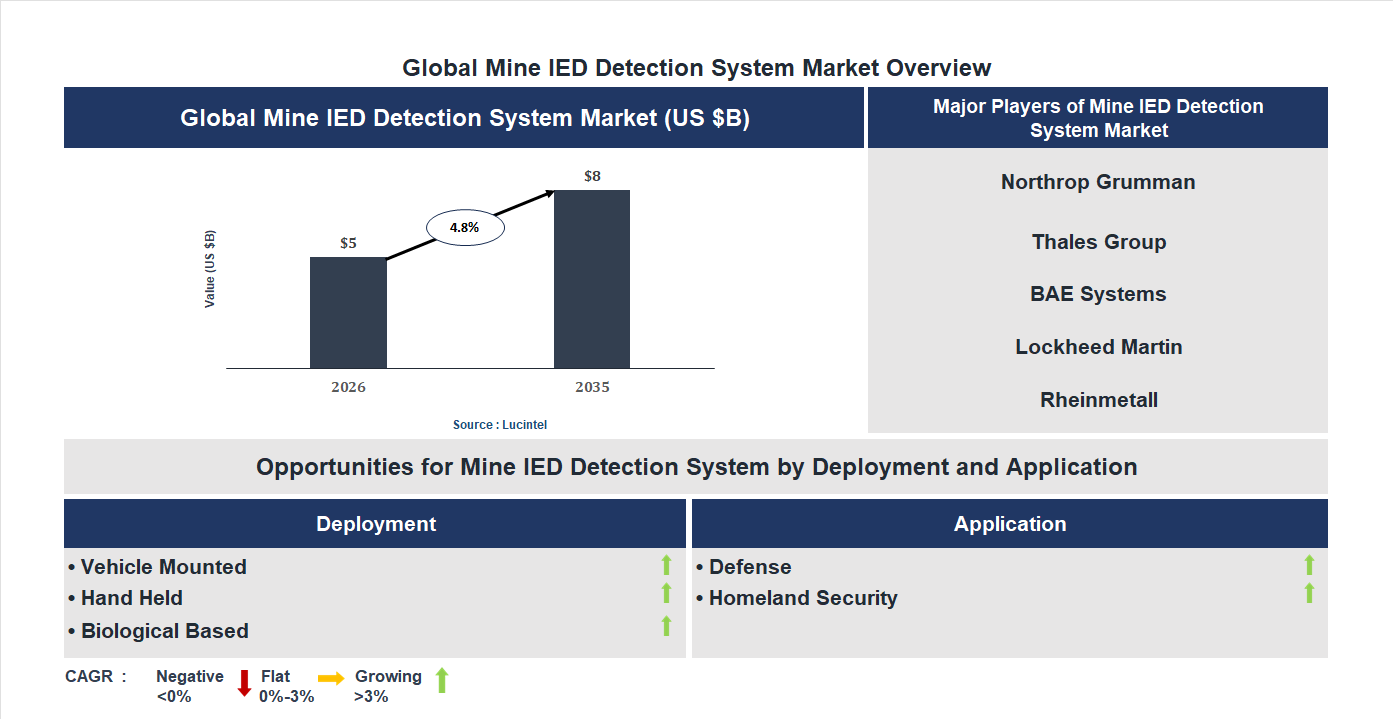
The future of the global mine IED detection system market looks promising with opportunities in the defense and homeland security markets. The global mine IED detection system market is expected to reach an estimated $8 billion by 2035 with a CAGR of 4.8% from 2026 to 2035. The major drivers for this market are the increasing demand for advanced threat detection systems, the rising security concerns in defense sectors, and the growing adoption of AI based detection technologies.• Lucintel forecasts that, within the deployment category, vehicle mounted is expected to witness the highest growth over the forecast period.
• Within the application category, defense is expected to witness higher growth.
• In terms of region, APAC is expected to witness the highest growth over the forecast period. Gain valuable insights for your business decisions with our comprehensive 150+ page report. Sample figures with some insights are shown below.
Emerging Trends in the Mine IED Detection System Market
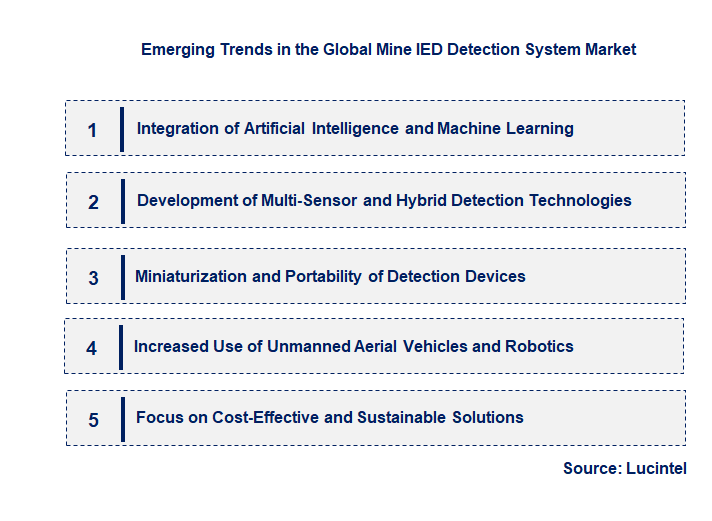
The mine IED detection system market is experiencing rapid evolution driven by technological advancements, increasing security concerns, and the need for safer military and civilian operations. As threats become more sophisticated, the industry is adopting innovative solutions to improve detection accuracy, operational efficiency, and safety standards. These developments are reshaping the landscape, creating new opportunities and challenges for manufacturers, governments, and security agencies. The following key trends highlight the major directions in which this market is heading, reflecting a shift towards smarter, more integrated, and versatile detection systems that cater to diverse operational needs.• Integration of Artificial Intelligence and Machine Learning: AI and ML are revolutionizing mine detection by enabling systems to analyze vast data sets, identify patterns, and improve accuracy over time. These technologies facilitate real-time decision-making, reduce false alarms, and enhance the ability to detect complex IEDs in challenging environments. The integration of AI-driven algorithms also allows for autonomous operation, reducing the need for human intervention and increasing safety for personnel. This trend is expected to significantly boost the efficiency and reliability of mine detection systems across military and civilian applications.
• Development of Multi-Sensor and Hybrid Detection Technologies: The market is witnessing a shift towards multi-sensor systems that combine different detection modalities such as ground-penetrating radar, chemical sensors, and acoustic sensors. Hybrid systems improve detection capabilities by compensating for the limitations of individual sensors, providing comprehensive situational awareness. These advanced systems are more effective in diverse terrains and under various environmental conditions, making them suitable for both military operations and humanitarian demining efforts. The adoption of multi-sensor technology enhances overall system robustness and operational versatility.
• Miniaturization and Portability of Detection Devices: Advances in materials and electronics are enabling the development of smaller, lightweight detection devices that are easier to deploy and operate in confined or difficult terrains. Portable systems facilitate rapid deployment in emergency situations, border security, and field operations, increasing operational flexibility. Miniaturized systems also reduce logistical burdens and allow for integration with unmanned vehicles and drones, expanding their reach and effectiveness. This trend is transforming mine detection from bulky, stationary setups to agile, mobile solutions suitable for diverse operational scenarios.
• Increased Use of Unmanned Aerial Vehicles (UAVs) and Robotics: Drones and robotic systems are increasingly employed for mine detection, offering safer and more efficient alternatives to manual methods. UAVs equipped with advanced sensors can survey large areas quickly, identify potential threats, and relay real-time data to operators. Robotics provide the capability to access hazardous zones without risking human lives, especially in conflict zones or contaminated areas. The integration of autonomous systems enhances operational safety, reduces detection time, and allows for continuous monitoring, making them indispensable tools in modern mine clearance and threat detection strategies.
• Focus on Cost-Effective and Sustainable Solutions: As the demand for mine detection systems grows globally, there is a strong emphasis on developing affordable, durable, and environmentally friendly technologies. Cost-effective systems enable wider deployment in developing regions with limited budgets, supporting humanitarian demining initiatives. Sustainable solutions focus on reducing environmental impact through the use of eco-friendly materials and energy-efficient components. This trend promotes broader adoption of mine detection technologies, ensuring safer environments and supporting global security efforts while maintaining economic viability. These emerging trends are transforming the mine IED detection system market by making detection more accurate, versatile, and safer. The integration of advanced technologies like AI, multi-sensor systems, and autonomous vehicles is leading to smarter, more efficient solutions. Miniaturization and portability are enhancing operational flexibility, while a focus on cost and sustainability broadens market accessibility. Collectively, these developments are reshaping the landscape, enabling more effective counter-IED strategies and contributing to global security and humanitarian efforts.
Recent Developments in the Mine IED Detection System Market
The mine IED detection system market is experiencing rapid advancements driven by increasing security concerns and technological innovations. Governments and private sectors are investing heavily to improve detection accuracy and operational efficiency. Emerging technologies such as AI, drone integration, and advanced sensors are transforming the landscape. These developments are creating new opportunities for manufacturers and service providers, ultimately enhancing safety measures in military, border security, and humanitarian operations. The markets evolution reflects a focus on smarter, faster, and more reliable detection solutions.• Technological Innovation in Sensor Technology: Enhanced sensors with higher sensitivity and specificity are improving detection accuracy, reducing false alarms, and enabling faster response times. These advancements are crucial for military and civilian applications, increasing operational efficiency and safety. The integration of multi-sensor systems allows for better differentiation between threats and benign objects, expanding the scope of detection capabilities. As sensor technology continues to evolve, market players are investing in R&D to develop more compact, durable, and cost-effective solutions, broadening application areas.
• Integration of Artificial Intelligence and Machine Learning: AI and ML algorithms are revolutionizing IED detection by enabling real-time data analysis and pattern recognition. These systems improve decision-making accuracy, reduce human error, and speed up threat identification. AI-driven systems can adapt to new threat patterns, making them more resilient against evolving tactics. This integration enhances operational efficiency in complex environments like urban warfare and border security. As AI technology matures, it is expected to significantly increase the markets growth potential by offering smarter, autonomous detection solutions.
• Deployment of Drone-Based Detection Systems: Drones equipped with advanced sensors and AI are providing rapid, remote detection capabilities in difficult terrains and hazardous zones. They reduce the need for personnel exposure to danger and enable quick area assessments. Drone technology enhances coverage and operational flexibility, especially in large or inaccessible areas. The development of lightweight, long-endurance drones with high-resolution sensors is expanding their use in military, humanitarian, and border security missions. This trend is expected to drive market growth by offering innovative, scalable detection solutions.
• Development of Portable and Handheld Detection Devices: Portable IED detection systems are becoming more compact, user-friendly, and reliable, facilitating quick deployment in diverse environments. These devices are essential for frontline troops, law enforcement, and emergency responders, providing immediate threat assessment. Advances in miniaturization and battery technology are making handheld systems more efficient and accessible. The market is witnessing increased adoption due to the need for rapid, mobile detection solutions in urban and rural settings, boosting overall market expansion and operational readiness.
• Focus on Counter-IED System Integration and Interoperability: Combining detection systems with other security infrastructure enhances overall threat management. Interoperable solutions enable seamless communication between different devices and agencies, improving coordination and response times. This integration supports comprehensive security strategies in military bases, border crossings, and critical infrastructure. The development of standardized protocols and platforms is facilitating broader adoption. As interoperability becomes a priority, the market is poised for growth through integrated, holistic detection and response systems that address complex threat environments. These recent developments are significantly transforming the mine IED detection system market by enhancing detection accuracy, operational efficiency, and safety. The integration of AI, drone technology, portable devices, and system interoperability is creating more effective and scalable solutions. As these innovations continue to evolve, the market is expected to experience sustained growth, driven by increasing security demands across military, border, and civilian sectors. This evolution will ultimately lead to safer environments and more resilient security infrastructures worldwide.
Strategic Growth Opportunities in the Mine IED Detection System Market
The mine IED detection system market is experiencing rapid growth driven by increasing security concerns, technological advancements, and the need for safer military and civilian operations. Governments and defense agencies are investing heavily in innovative detection solutions to prevent terrorist activities and improve battlefield safety. The market encompasses various applications, including military, homeland security, and humanitarian demining efforts. As threats evolve, the demand for more accurate, portable, and automated detection systems continues to rise, creating significant opportunities for industry players to expand their product offerings and market reach.• Advanced Sensor Technologies Enhance Detection Capabilities: The integration of advanced sensors such as ground-penetrating radar, metal detectors, and chemical sensors significantly improves IED detection accuracy. These innovations enable faster identification of hidden threats in complex environments, reducing false alarms and increasing operational efficiency. Sub-segments like portable handheld devices and vehicle-mounted systems are gaining popularity, providing versatile solutions for military and civilian applications. Continuous R&D efforts are expected to further refine sensor performance, opening new growth avenues.
• Artificial Intelligence and Machine Learning Improve System Accuracy: The adoption of AI and machine learning algorithms in mine detection systems enhances threat recognition and reduces false positives. These technologies enable real-time data analysis, pattern recognition, and adaptive learning, making detection more reliable in diverse terrains and conditions. AI-powered systems are increasingly integrated into autonomous vehicles and robotic platforms, facilitating remote operations and reducing personnel risk. The ongoing development of smarter algorithms is poised to revolutionize detection efficiency and expand market opportunities.
• Increasing Demand for Portable and Handheld Detection Devices: The need for lightweight, easy-to-use detection systems is driving innovation in portable mine detection solutions. Handheld devices equipped with advanced sensors and user-friendly interfaces are preferred for quick deployment in urban, rural, and conflict zones. These systems are vital for humanitarian demining, border security, and military operations, offering mobility and rapid response capabilities. Growing adoption of such devices is expected to boost sales and foster new product development in the portable segment.
• Growing Focus on Humanitarian Demining and Post-Conflict Recovery: Governments and NGOs are prioritizing demining activities to restore safety in post-conflict zones, creating a substantial market for mine detection systems. These efforts involve specialized equipment designed for humanitarian purposes, including ground-penetrating radar and robotic systems. Funding from international organizations and increased awareness about landmine hazards are fueling market growth. The development of cost-effective, efficient solutions tailored for humanitarian use is expected to expand the market further.
• Integration of Autonomous Vehicles and Robotics for Safer Operations: The deployment of autonomous ground vehicles and robotic systems in mine detection reduces human exposure to danger. These platforms can operate in hazardous environments, cover large areas quickly, and perform detailed inspections with minimal risk. Advances in navigation, sensor integration, and remote control technology are making autonomous systems more reliable and affordable. The trend toward automation is anticipated to significantly enhance operational efficiency and open new markets in military, humanitarian, and security sectors. The overall impact of these growth opportunities is set to transform the mine IED detection system market by increasing detection accuracy, operational safety, and deployment efficiency. As technological innovations and strategic focus areas evolve, the market is expected to expand rapidly, attracting investments and fostering the development of next-generation solutions. This will ultimately lead to safer environments and more effective counter-IED measures worldwide.
Mine IED Detection System Market Driver and Challenges
The mine IED detection system market is influenced by a variety of technological, economic, and regulatory factors. Rapid advancements in detection technologies, increasing security concerns worldwide, and government initiatives to enhance military and civilian safety are key drivers. Conversely, challenges such as high system costs, technological limitations, and regulatory hurdles impact market growth. The interplay of these factors shapes the overall landscape, influencing investment, innovation, and deployment strategies. Understanding these drivers and challenges is essential for stakeholders aiming to capitalize on emerging opportunities while navigating potential obstacles in this dynamic sector. The factors responsible for driving the mine IED detection system market include:-• Technological Innovation: The continuous development of advanced detection technologies such as ground-penetrating radar, chemical sensors, and drone-based systems enhances detection accuracy and operational efficiency. These innovations reduce false positives and improve safety, encouraging military and civilian agencies to adopt newer systems. As technology evolves, the market experiences increased demand for more reliable, portable, and cost-effective solutions, fostering growth and competitive advancements.
• Rising Security Concerns: The increasing threat of IED attacks in conflict zones and urban areas has heightened the need for effective detection systems. Governments and military organizations prioritize safety measures to protect personnel and infrastructure, leading to increased procurement and deployment of mine detection systems. This heightened security focus drives market expansion, especially in regions prone to insurgency and terrorism.
• Government Initiatives and Funding: Many governments are allocating substantial budgets toward counter-IED measures, including research, development, and procurement of detection systems. Initiatives such as NATO’s counter-IED programs and national security strategies promote market growth by providing financial support and regulatory frameworks that facilitate adoption and deployment of advanced detection solutions.
• Growing Military Expenditure: The global increase in military spending, particularly in regions facing security threats, directly impacts the demand for mine detection systems. Countries are investing in modernizing their armed forces with sophisticated detection equipment to enhance battlefield safety and peacekeeping operations, thereby fueling market growth and technological innovation. The challenges in the mine IED detection system market are:
• High System Costs: The advanced detection systems involve significant research, development, and manufacturing expenses, resulting in high procurement costs. This financial barrier limits adoption, especially among smaller or budget-constrained agencies. Additionally, maintenance and operational costs further restrict widespread deployment, impacting overall market growth.
• Technological Limitations: Despite advancements, current detection systems face challenges such as limited detection range, false positives, and difficulty in detecting buried or deeply concealed IEDs. These technological limitations hinder operational efficiency and reliability, creating a need for ongoing research and development to improve system capabilities.
• Regulatory and Legal Barriers: Stringent regulations regarding the deployment and use of detection systems, especially in civilian areas, can delay or restrict market expansion. Compliance with international standards and obtaining necessary approvals can be time-consuming and costly, posing hurdles for manufacturers and end-users seeking rapid deployment. The mine IED detection system market is shaped by significant technological advancements, increasing security concerns, and supportive government initiatives, which collectively drive growth. However, high costs, technological challenges, and regulatory barriers present notable obstacles. The interplay of these factors influences market dynamics, requiring stakeholders to innovate continuously and navigate complex regulatory landscapes. Overall, the market is poised for growth, driven by the urgent need for effective detection solutions amid evolving security threats, but sustained success depends on overcoming current challenges through technological and regulatory advancements.
List of Mine IED Detection System Companies
Companies in the market compete on the basis of product quality offered. Major players in this market focus on expanding their manufacturing facilities, R&D investments, infrastructural development, and leverage integration opportunities across the value chain. With these strategies mine IED detection system companies cater increasing demand, ensure competitive effectiveness, develop innovative products & technologies, reduce production costs, and expand their customer base. Some of the mine IED detection system companies profiled in this report include-• Northrop Grumman
• Thales Group
• BAE Systems
• Lockheed Martin
• Rheinmetall
• Elbit Systems
• General Dynamics
Mine IED Detection System Market by Segment
The study includes a forecast for the global mine IED detection system market by deployment, application, and region.Mine IED Detection System Market by Deployment [Value from 2019 to 2035]:
• Vehicle Mounted
• Hand Held
• Biological Based
Mine IED Detection System Market by Application [Value from 2019 to 2035]:
• Defense
• Homeland Security
Mine IED Detection System Market by Region [Value from 2019 to 2035]:
• North America
• Europe
• Asia Pacific
• The Rest of the World
Country Wise Outlook for the Mine IED Detection System Market
The mine IED detection system market has experienced significant technological advancements and increased adoption across various regions due to ongoing security concerns and military modernization efforts. Countries are investing in innovative detection technologies to improve safety and operational efficiency in conflict zones and border security. The market dynamics are influenced by government funding, technological breakthroughs, and the rising need for effective mine clearance solutions. As regional security threats evolve, nations are prioritizing the development and deployment of advanced mine detection systems to enhance their defense capabilities and humanitarian demining efforts.• United States: The US has seen substantial investments in autonomous and drone-based mine detection systems, integrating AI and machine learning for improved accuracy. Military agencies are focusing on portable, rapid-deployment solutions to support both combat and humanitarian missions. The government’s increased funding for defense modernization has accelerated the adoption of advanced detection technologies, including ground-penetrating radar and chemical sensors. Additionally, collaborations with private tech firms are fostering innovation in sensor miniaturization and data analytics, enhancing operational efficiency.
• China: China is rapidly expanding its mine detection capabilities through the development of sophisticated electronic and robotic systems. The country emphasizes integrating AI-driven algorithms for better target identification and reduced false alarms. China’s military modernization program prioritizes the deployment of multi-sensor systems that combine ground-penetrating radar, metal detectors, and chemical sensors. The government’s focus on border security and regional stability has driven increased procurement and domestic manufacturing of mine detection equipment, fostering a robust local industry.
• Germany: Germany continues to lead in the development of high-precision, environmentally friendly mine detection systems. The country emphasizes research into non-invasive detection technologies, such as advanced ground-penetrating radar and acoustic sensors. German firms are also innovating in portable systems suitable for humanitarian demining and peacekeeping operations. The government’s support for international demining initiatives and strict safety standards have contributed to the market’s growth, with a focus on sustainable and effective solutions.
• India: India is investing heavily in indigenous mine detection technologies to address its extensive landmine contamination issues. The country is developing multi-sensor systems that combine metal detection, ground-penetrating radar, and chemical sensors, tailored for rugged terrains. Government initiatives aim to enhance the capabilities of paramilitary forces and border security agencies. India is also collaborating with international organizations to adopt advanced demining techniques and improve training programs, thereby strengthening its domestic market and reducing reliance on foreign technology.
• Japan: Japan is focusing on integrating advanced robotics and AI into mine detection systems to improve safety and efficiency. The country’s emphasis on disaster response and post-conflict demining has led to innovations in autonomous vehicles and remote-operated systems. Japanese firms are also exploring environmentally sustainable detection methods, including eco-friendly sensors and non-invasive techniques. The government supports research and development through grants and international cooperation, aiming to maintain Japan’s leadership in innovative mine detection solutions for both military and humanitarian applications.

Features of the Global Mine IED Detection System Market
Market Size Estimates: Mine ied detection system market size estimation in terms of value ($B). Trend and Forecast Analysis: Market trends (2019 to 2025) and forecast (2026 to 2035) by various segments and regions. Segmentation Analysis: Mine ied detection system market size by deployment, application, and region in terms of value ($B). Regional Analysis: Mine ied detection system market breakdown by North America, Europe, Asia Pacific, and Rest of the World. Growth Opportunities: Analysis of growth opportunities in different deployments, applications, and regions for the mine IED detection system market. Strategic Analysis: This includes M&A, new product development, and competitive landscape of the mine IED detection system market. Analysis of competitive intensity of the industry based on Porter’s Five Forces model.
FAQ
Q1. What is the mine IED detection system market size? Answer: The global mine IED detection system market is expected to reach an estimated $8 billion by 2035. Q2. What is the growth forecast for mine IED detection system market? Answer: The global mine IED detection system market is expected to grow with a CAGR of 4.8% from 2026 to 2035. Q3. What are the major drivers influencing the growth of the mine IED detection system market? Answer: The major drivers for this market are the increasing demand for advanced threat detection systems, the rising security concerns in defense sectors, and the growing adoption of AI based detection technologies. Q4. What are the major segments for mine IED detection system market? Answer: The future of the mine IED detection system market looks promising with opportunities in the defense and homeland security markets. Q5. Who are the key mine IED detection system market companies? Answer: Some of the key mine IED detection system companies are as follows:• Northrop Grumman
• Thales Group
• BAE Systems
• Lockheed Martin
• Rheinmetall
• Elbit Systems
• General Dynamics Q6. Which mine IED detection system market segment will be the largest in future? Answer: Lucintel forecasts that, within the deployment category, vehicle mounted is expected to witness the highest growth over the forecast period. Q7. In mine IED detection system market, which region is expected to be the largest in next 8 years? Answer: In terms of region, APAC is expected to witness the highest growth over the forecast period. Q8. Do we receive customization in this report? Answer: Yes, Lucintel provides 10% customization without any additional cost.
Table of Contents
List of Figures
List of Tables
Methodology
- In-depth interviews of the major players in this market
- Detailed secondary research from competitors’ financial statements and published data
- Extensive searches of published works, market, and database information pertaining to industry news, company press releases, and customer intentions
- A compilation of the experiences, judgments, and insights of Lucintel’s professionals, who have analyzed and tracked this market over the years.


Buy Now
Choose a license that fits your team. Instant PDF delivery.
Prices exclude taxes. Instant delivery. Custom licensing available on request.
Key Questions
- • What are some of the most promising, high-growth opportunities for the mine IED detection system market by deployment (vehicle mounted, hand held, and biological based), application (defense and homeland security), and region (North America, Europe, Asia Pacific, and the Rest of the World)?
- • Which segments will grow at a faster pace and why?
- • Which region will grow at a faster pace and why?
- • What are the key factors affecting market dynamics? What are the key challenges and business risks in this market?
- • What are the business risks and competitive threats in this market?
- • What are the emerging trends in this market and the reasons behind them?
- • What are some of the changing demands of customers in the market?
- • What are the new developments in the market? Which companies are leading these developments?
- • Who are the major players in this market? What strategic initiatives are key players pursuing for business growth?
- • What are some of the competing products in this market and how big of a threat do they pose for loss of market share by material or product substitution?
- • What M&A activity has occurred in the last 5 years and what has its impact been on the industry? For any questions related to Mine IED Detection System Market, Mine IED Detection System Market Size, Mine IED Detection System Market Growth, Mine IED Detection System Market Analysis, Mine IED Detection System Market Report, Mine IED Detection System Market Share, Mine IED Detection System Market Trends, Mine IED Detection System Market Forecast, Mine IED Detection System Companies, write Lucintel analyst at email: helpdesk@lucintel.com. We will be glad to get back to you soon.


