
Close Lucintel Chat
Didn't Find What You're Looking for?
Call us at +1972 636 5056 or write at helpdesk@Lucintel.com
Ask an Expert Provide Custom Requirements Download Sample Report Search Available Reports
  • helpdesk@Lucintel.com
  • |
  • Call Lucintel +1 972 636 5056
  • |
  • Login
  • |
  • Register
  • |
  • Search
  • |
'
...

The Impact of COVID-19 is included in Military Sensor Market Report. Buy it today to get an advantage.

Request the impact of COVID-19 on your product or industry


Military Sensor Market Trends and Forecast

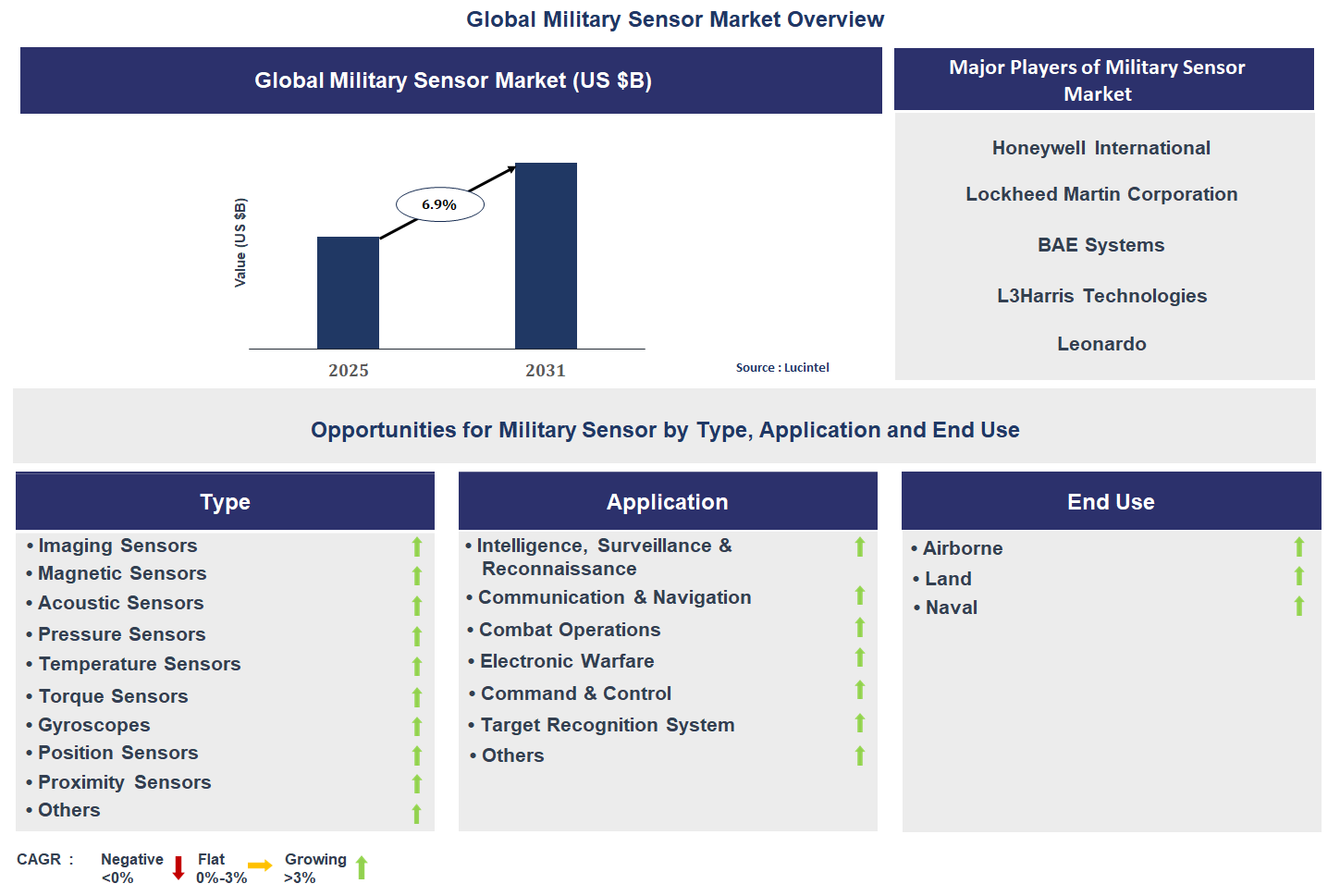
The future of the global military sensor market looks promising with opportunities in the airborne, land, and naval markets. The global military sensor market is expected to grow with a CAGR of 6.9% from 2025 to 2031. The major drivers for this market are the increasing demand for advanced surveillance systems, the rising need for battlefield situational awareness, and the growing adoption of unmanned military vehicles.

• Lucintel forecasts that, within the type category, imaging sensor is expected to witness the highest growth over the forecast period.
• Within the end use category, airborne is expected to witness the highest growth.
• In terms of region, North America is expected to witness the highest growth over the forecast period.
Gain valuable insights for your business decisions with our comprehensive 150+ page report. Sample figures with some insights are shown below.
Military Sensor Market Trends and Forecast

Emerging Trends in the Military Sensor Market

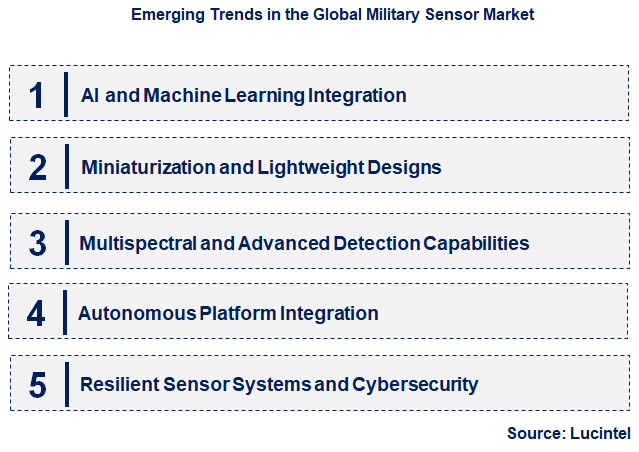
Emerging trends in the military sensor market are influenced by fast-paced technological changes, changing battlefield needs, and worldwide defense modernization initiatives. Trends encompass AI integration, miniaturization, multispectral sensing, autonomous platform deployment, and cyber-resilient sensor systems. These technologies provide improved situational awareness, shorten response times, and improve operational efficiency. Nations such as the United States, China, Germany, India, and Japan are investing in sensor fusion, light engineering, and intelligent analytics to assist contemporary warfare approaches.
• AI and Machine Learning Integration: Threat detection, image recognition, and predictive analysis are improved through AI-powered sensors. Real-time processing of sensor data by machine learning algorithms facilitates rapid decision-making and target identification through automation. UAVs, vehicles, and naval platforms integration boost operational effectiveness and minimize human error. Predictive maintenance is also supported by AI-based systems for ensuring reliability in challenging environments.
• Miniaturization and Lightweight Designs: Lighter, miniaturized sensors enable use on UAVs, handheld devices, and small platforms without affecting performance. Miniaturized designs minimize energy, enhance mobility, and increase installation versatility. New manufacturing processes and materials enable compact sensor modules for air, land, and sea applications. This trend allows for cost-effective, high-performance sensor solutions for agile, modern military forces.
• Multispectral and Advanced Detection Capabilities: Sensors with infrared, thermal, optical, radar, and acoustic capability offer detailed situational awareness. Multispectral systems improve target detection in hostile environments, including smoke, fog, or low visibility conditions. Merging several sensing modalities enhances threat analysis, identification, and tracking. This trend supports better battlefield intelligence and mission success for surveillance, reconnaissance, and targeting missions.
• Autonomous Platform Integration: Sensors are being installed more and more on unmanned air, land, and sea platforms for autonomous reconnaissance, surveillance, and targeting. Autonomous integration minimizes the risk to people, maximizes the efficiency of missions, and extends operational reach. Autonomous integration is fueling innovation in small, robust, and AI-capable sensor systems that can enable fully autonomous military platforms.
• Resilient Sensor Systems and Cybersecurity: Data integrity and immunity from electronic warfare are paramount. Resilient sensor networks protect against hacking, signal jamming, and data compromise. Secure communication protocols and encryption are being developed to safeguard sensor data by manufacturers. The trend enhances operational dependability, safeguards sensitive intelligence, and enables resilient military networks in progressively contested environments.
New trends such as AI integration, miniaturization, multispectral sensing, autonomous deployment, and cybersecurity are transforming the military sensor market. These trends maximize intelligence, operational effectiveness, and combat survivability. Investments in cutting-edge sensor technologies allow states to retain strategic superiority, enhance interoperability, and rapidly respond to changing threats. The adoption of these innovations is the core of global defense modernization in the United States, China, Germany, India, and Japan.
Emerging Trends in the Military Sensor Market

Recent Development in the Military Sensor Market

The military sensor industry is experiencing major developments spurred by defense upgradation, technology, and operational requirements. Deployment of sensors with AI capability, miniaturized modules, multispectral systems, autonomous integration, and cyber-resilient designs is improving surveillance, targeting, and threat detection. The United States, China, Germany, India, and Japan are concentrating on research, indigenous research and development, and integration of sensors with advanced capabilities into defense platforms. Advances in material science, signal processing, and smart analytics are enhancing performance, reliability, and longevity.
• AI-Enabled Sensor Systems: AI integration enhances real-time threat assessment, target identification, and predictive maintenance. AI-based systems enhance operational efficiency and minimize human error.
• Miniaturization for UAVs and Handheld Platforms: Light weight and compact sensors facilitate deployment on drones, unmanned vehicles, and handheld devices. Miniaturization promotes mobility, energy efficiency, and installation flexibility.
• Multispectral Sensor Deployment: Blending infrared, radar, optical, and thermal capabilities provides improved detection and situational awareness in varied environments of operations. Multispectral systems facilitate precise reconnaissance, surveillance, and targeting.
• Autonomous Platform Integration: Sensors mounted on unmanned aerial, ground, and maritime platforms enhance mission effectiveness, decrease human risk, and increase operational reach.
• Cyber-Resilient and Secure Sensor Networks: Secure data transmission and encrypted communication protocols guard sensors against hacking, signal jamming, and electronic warfare, guaranteeing operational dependability.
Important developments such as AI-powered systems, miniaturization, multispectral sensors, autonomous platform integration, and cybersecurity enhancement are revamping the military sensor market. These developments increase situational awareness, operational efficiency, and mission success. Countries investing in sophisticated military sensors are gaining technological superiority, enhanced intelligence gathering, and better defense capabilities.

Strategic Growth Opportunities in the Military Sensor Market

Military sensor present considerable growth opportunities in surveillance and reconnaissance, targeting and weapons guidance, electronic warfare, homeland security, and autonomous platforms. Advanced, compact, and trusted sensor demand is increasing with modernization programs, new threats, and technology developments. United States, China, German, Indian, and Japanese manufacturers are investing in AI, multispectral, miniaturized, and cyber-resilient sensor technologies. These applications enhance operational effectiveness, decision-making, and mission accomplishment.
• Surveillance and Reconnaissance: High-performance sensors provide battlefield intelligence in real time, monitoring, and tracking. UAV, satellite, and ground vehicle deployment improves situational awareness. Expansion of surveillance capacity facilitates quick response, threat reduction, and analysis of intelligence, giving a competitive edge to military activities.
• Targeting and Weapons Guidance: Weapons systems integrated with sensors enhance fire control, missile guidance, and precision targeting. Electro-optical sensors coupled with sophisticated infrared sensors deliver greater accuracy in various operational environments. This use minimizes collateral damage and maximizes mission effectiveness while enabling future defense strategies.
• Electronic Warfare and Signal Intelligence: Sensors intercept, observe, and process adversary signals for strategic benefit. Cyber-resilient integration provides secure collection of data and minimizes susceptibility to electronic attack. Development in electronic warfare increases situational awareness and operational superiority.
• Homeland Security and Border Surveillance: Sensors enable border surveillance, threat detection, and disaster response. Deployment of multispectral and AI-enabled systems enhances situational awareness, response time, and national security operations. Demand in this sector creates growth opportunities for sophisticated sensor solutions.
• Autonomous and Unmanned Platforms: Sensors used in UAVs, UGVs, and unmanned maritime systems facilitate autonomous operations with less risk to humans. Unmanned system growth creates demand for low-profile, light-weight, and dependable sensors merged with AI and intelligent analytics.
Growth opportunities for strategy in surveillance, targeting, electronic warfare, homeland security, and autonomous platforms are increasing the military sensor market. Usage of advanced, miniaturized, and AI-based sensors increases mission efficacy, operational effectiveness, and national security.

Military Sensor Market Driver and Challenges

The market for military sensors is influenced by economic, regulatory, and technology factors. Key drivers are AI integration, need for small and light sensors, multispectral capabilities, autonomous deployment on platforms, and cybersecurity needs. Drivers are high R&D costs, ruggedization in harsh environments, and low penetration in emerging defense markets. Manufacturers, defense organizations, and policymakers need to understand these drivers and challenges.
The factors responsible for driving the military sensor market include:
1. AI and Machine Learning: Supports real-time data analysis, predictive maintenance, and automated threat detection. AI-based sensors enhance operational efficiency, accuracy, and decision-making across multiple platforms.
2. Miniaturization and Light Weight Configurations: Small, light sensors enable integration onto UAVs, portable platforms, and unmanned vehicles, enhancing mobility, energy efficiency, and installation convenience.
3. Multispectral Functionality: Integration of infrared, optical, radar, and acoustic sensing enhances detection, tracking, and situational awareness in various environments.
4. Autonomous Platform Integration: Sensors installed on unmanned aerial, ground, and naval vehicles optimize mission efficiency, eliminate human risk, and increase operational reach.
5. Data Integrity and Cybersecurity: Encrypted data and secure communication protocols protect against interference and hacking, providing consistent sensor operation in hostile environments.
Challenges in the military sensor market are:
1. Harsh Environment and Durability Performance: Sensors need to survive extreme temperatures, mechanical stress, and water exposure. Durability issues lower operational reliability and adoption.
2. High Development and Manufacturing Expenses: Sophisticated sensors demand high R&D, manufacturing, and integration expenses, making them unavailable in cost-constrained markets.
3. Emerging Market Limited Adoption: Low levels of awareness of the advantages of advanced sensors and finite defense budgets limit market penetration in some markets.
Factors such as AI integration, miniaturization, multispectral abilities, autonomous deployment, and cybersecurity are driving military sensor uptake worldwide. Issues like exorbitant pricing, environmental robustness, and low awareness can limit expansion if left unaddressed.

List of Military Sensor Companies

Companies in the market compete on the basis of product quality offered. Major players in this market focus on expanding their manufacturing facilities, R&D investments, infrastructural development, and leverage integration opportunities across the value chain. With these strategies military sensor companies cater increasing demand, ensure competitive effectiveness, develop innovative products & technologies, reduce production costs, and expand their customer base. Some of the military sensor companies profiled in this report include-
• Honeywell International
• Lockheed Martin Corporation
• BAE Systems
• L3Harris Technologies
• Leonardo
• Teledyne Technologies Incorporated
• Safran
• Textron
• Curtiss-Wright Corporation
• TE Connectivity

Military Sensor Market by Segment

The study includes a forecast for the global military sensor market by type, application, end use, and region.

Military Sensor Market by Type [Value from 2019 to 2031]:


• Imaging Sensors
• Magnetic Sensors
• Acoustic Sensors
• Pressure Sensors
• Temperature Sensors
• Torque Sensors
• Gyroscopes
• Position Sensors
• Proximity Sensors
• Others

Military Sensor Market by Application [Value from 2019 to 2031]:


• Intelligence, Surveillance & Reconnaissance
• Communication & Navigation
• Combat Operations
• Electronic Warfare
• Command & Control
• Target Recognition System
• Others

Military Sensor Market by End Use [Value from 2019 to 2031]:


• Airborne
• Land
• Naval

Military Sensor Market by Region [Value from 2019 to 2031]:


• North America
• Europe
• Asia Pacific
• The Rest of the World

Country Wise Outlook for the Military Sensor Market

The military sensor market is undergoing rapid transformation as a result of growing demand for sophisticated surveillance, reconnaissance, targeting, and threat detection systems on land, sea, and air platforms. Countries are spending on next-generation technologies like electro-optical, infrared, radar, and multispectral sensors to improve situational awareness, operational effectiveness, and combat effectiveness. United States, China, Germany, India, and Japan are modernizing sensor capacities with research, defense modernization initiatives, and systems integration with unmanned and manned vehicles. Breakthroughs in miniaturization, signal processing, AI incorporation, and ruggedized systems are fueling worldwide adoption and transforming military tactics.
• United States: The United States is at the forefront of deploying advanced military sensors in UAVs, fighter aircraft, naval vessels, and ground vehicles. Investments concentrate on AI-powered electro-optical and infrared sensors, radar technology, and multispectral detection for improving situational awareness and reaction to threats. Sensor integration with autonomous platforms and real-time data processing enhances operational efficiency. Investment in quantum sensors and light-weight and compact designs increases accuracy and range.
• China: China is augmenting its military sensor systems with massive investments in radar, infrared, and optical sensors for air, naval, and ground platforms. Indigenous development, miniaturization, and integration with UAVs and autonomous systems are the focus. Multispectral and artificial intelligence-supported sensors are used for surveillance, reconnaissance, and missile detection. Domestic firms are improving signal processing, ruggedization, and performance in a variety of operational environments. China focuses on modernizing military platforms, with sensor systems enabling rapid response, enhanced targeting accuracy, and strategic intelligence gathering.
• Germany: Germany emphasizes technologically sophisticated, high-precision military sensors coupled with defense vehicles, aircraft, and naval systems. The focus is on radar, thermal imaging, electro-optical, and multispectral sensors conforming to NATO standards. German industry is improving durability, accuracy, and signal processing capabilities. Investments in smart integration, artificial intelligence-based analysis, and miniaturization enhance situational awareness and operational effectiveness. Germanys defense modernization initiatives give high priority to energy-efficient, high-reliability sensors for reconnaissance, threat detection, and border security in favor of national as well as allied military capabilities.
• India: India is growing its military sensor industry by way of defense modernization programs, indigenization efforts, and strategic alliances. Emphasis is on electro-optical, infrared, radar, and sonar sensors for UAVs, fighter aircraft, naval vessels, and land-based platforms. Focus is on integration with network-centric warfare systems, real-time analysis of data, and hardened designs for varied operational environments. Indigenous R&D is enhancing detection accuracy, range, and longevity. India is enhancing surveillance, reconnaissance, and missile tracking capabilities while fostering indigenous defense manufacturing, curtailing import dependence, and bolstering strategic autonomy in military sensor technology.
• Japan: Japan is developing military sensors for naval, air, and land uses with emphasis on radar, sonar, infrared, and electro-optics. Integration with unmanned systems, AI-based analytics, and sophisticated signal processing improves situational awareness and combat accuracy. Japanese industry prioritizes miniaturization, power efficiency, and ruggedized designs ideal for defense and homeland security applications. Spending on advanced detection, threat surveillance, and data fusion platforms enhances naval and air defense. Japan emphasizes interoperability with allied forces and defense regulation compliance, enabling high-performance and trusted military sensor deployment in intricate operational environments.

Lucintel Analytics Dashboard

Features of the Global Military Sensor Market

Market Size Estimates: Military sensor market size estimation in terms of value ($B).
Trend and Forecast Analysis: Market trends (2019 to 2024) and forecast (2025 to 2031) by various segments and regions.
Segmentation Analysis: Military sensor market size by type, application, end use, and region in terms of value ($B).
Regional Analysis: Military sensor market breakdown by North America, Europe, Asia Pacific, and Rest of the World.
Growth Opportunities: Analysis of growth opportunities in different types, applications, end uses, and regions for the military sensor market.
Strategic Analysis: This includes M&A, new product development, and competitive landscape of the military sensor market.
Analysis of competitive intensity of the industry based on Porter’s Five Forces model.

Lucintel Consulting Services

FAQ

Q1. What is the growth forecast for military sensor market?
Answer: The global military sensor market is expected to grow with a CAGR of 6.9% from 2025 to 2031.
Q2. What are the major drivers influencing the growth of the military sensor market?
Answer: The major drivers for this market are the increasing demand for advanced surveillance systems, the rising need for battlefield situational awareness, and the growing adoption of unmanned military vehicles.
Q3. What are the major segments for military sensor market?
Answer: The future of the military sensor market looks promising with opportunities in the airborne, land, and naval markets.
Q4. Who are the key military sensor market companies?
Answer: Some of the key military sensor companies are as follows:
• Honeywell International
• Lockheed Martin Corporation
• BAE Systems
• L3Harris Technologies
• Leonardo
• Teledyne Technologies Incorporated
• Safran
• Textron
• Curtiss-Wright Corporation
• TE Connectivity
Q5. Which military sensor market segment will be the largest in future?
Answer: Lucintel forecasts that, within the type category, imaging sensor is expected to witness the highest growth over the forecast period.
Q6. In military sensor market, which region is expected to be the largest in next 5 years?
Answer: In terms of region, North America is expected to witness the highest growth over the forecast period.
Q7. Do we receive customization in this report?
Answer: Yes, Lucintel provides 10% customization without any additional cost.

This report answers following 11 key questions:

Q.1. What are some of the most promising, high-growth opportunities for the military sensor market by type (imaging sensors, magnetic sensors, acoustic sensors, pressure sensors, temperature sensors, torque sensors, gyroscopes, position sensors, proximity sensors, and others), application (intelligence, surveillance & reconnaissance, communication & navigation, combat operations, electronic warfare, command & control, target recognition system, and others), end use (airborne, land, and naval), and region (North America, Europe, Asia Pacific, and the Rest of the World)?
Q.2. Which segments will grow at a faster pace and why?
Q.3. Which region will grow at a faster pace and why?
Q.4. What are the key factors affecting market dynamics? What are the key challenges and business risks in this market?
Q.5. What are the business risks and competitive threats in this market?
Q.6. What are the emerging trends in this market and the reasons behind them?
Q.7. What are some of the changing demands of customers in the market?
Q.8. What are the new developments in the market? Which companies are leading these developments?
Q.9. Who are the major players in this market? What strategic initiatives are key players pursuing for business growth?
Q.10. What are some of the competing products in this market and how big of a threat do they pose for loss of market share by material or product substitution?
Q.11. What M&A activity has occurred in the last 5 years and what has its impact been on the industry?

For any questions related to Military Sensor Market, Military Sensor Market Size, Military Sensor Market Growth, Military Sensor Market Analysis, Military Sensor Market Report, Military Sensor Market Share, Military Sensor Market Trends, Military Sensor Market Forecast, Military Sensor Companies, write Lucintel analyst at email: helpdesk@lucintel.com. We will be glad to get back to you soon.
                                           Table of Contents

            1. Executive Summary

            2. Market Overview

                        2.1 Background and Classifications
                        2.2 Supply Chain

            3. Market Trends & Forecast Analysis

                        3.1 Macroeconomic Trends and Forecasts
                        3.2 Industry Drivers and Challenges
                        3.3 PESTLE Analysis
                        3.4 Patent Analysis
                        3.5 Regulatory Environment
                        3.6 Global Military Sensor Market Trends and Forecast

            4. Global Military Sensor Market by Type

                        4.1 Overview
                        4.2 Attractiveness Analysis by Type
                        4.3 Imaging Sensors : Trends and Forecast 2025 to 2031
                        4.4 Magnetic Sensors : Trends and Forecast 2025 to 2031
                        4.5 Acoustic Sensors : Trends and Forecast 2025 to 2031
                        4.6 Pressure Sensors : Trends and Forecast 2025 to 2031
                        4.7 Temperature Sensors : Trends and Forecast 2025 to 2031
                        4.8 Torque Sensors : Trends and Forecast 2025 to 2031
                        4.9 Gyroscopes : Trends and Forecast 2025 to 2031
                        4.10 Position Sensors : Trends and Forecast 2025 to 2031
                        4.11 Proximity Sensors : Trends and Forecast 2025 to 2031
                        4.12 Others : Trends and Forecast 2025 to 2031

            5. Global Military Sensor Market by Application

                        5.1 Overview
                        5.2 Attractiveness Analysis by Application
                        5.3 Intelligence, Surveillance & Reconnaissance : Trends and Forecast 2025 to 2031
                        5.4 Communication & Navigation : Trends and Forecast 2025 to 2031
                        5.5 Combat Operations : Trends and Forecast 2025 to 2031
                        5.6 Electronic Warfare : Trends and Forecast 2025 to 2031
                        5.7 Command & Control : Trends and Forecast 2025 to 2031
                        5.8 Target Recognition System : Trends and Forecast 2025 to 2031
                        5.9 Others : Trends and Forecast 2025 to 2031

            6. Global Military Sensor Market by End Use

                        6.1 Overview
                        6.2 Attractiveness Analysis by End Use
                        6.3 Airborne : Trends and Forecast 2025 to 2031
                        6.4 Land : Trends and Forecast 2025 to 2031
                        6.5 Naval : Trends and Forecast 2025 to 2031

            7. Regional Analysis

                        7.1 Overview
                        7.2 Global Military Sensor Market by Region

            8. North American Military Sensor Market

                        8.1 Overview
                        8.2 North American Military Sensor Market by Type
                        8.3 North American Military Sensor Market by End Use
                        8.4 The United States Military Sensor Market
                        8.5 Canadian Military Sensor Market
                        8.6 Mexican Military Sensor Market

            9. European Military Sensor Market

                        9.1 Overview
                        9.2 European Military Sensor Market by Type
                        9.3 European Military Sensor Market by End Use
                        9.4 German Military Sensor Market
                        9.5 French Military Sensor Market
                        9.6 Italian Military Sensor Market
                        9.7 Spanish Military Sensor Market
                        9.8 The United Kingdom Military Sensor Market

            10. APAC Military Sensor Market

                        10.1 Overview
                        10.2 APAC Military Sensor Market by Type
                        10.3 APAC Military Sensor Market by End Use
                        10.4 Chinese Military Sensor Market
                        10.5 Indian Military Sensor Market
                        10.6 Japanese Military Sensor Market
                        10.7 South Korean Military Sensor Market
                        10.8 Indonesian Military Sensor Market

            11. ROW Military Sensor Market

                        11.1 Overview
                        11.2 ROW Military Sensor Market by Type
                        11.3 ROW Military Sensor Market by End Use
                        11.4 Middle Eastern Military Sensor Market
                        11.5 South American Military Sensor Market
                        11.6 African Military Sensor Market

            12. Competitor Analysis

                        12.1 Product Portfolio Analysis
                        12.2 Operational Integration
                        12.3 Porter’s Five Forces Analysis
                                    • Competitive Rivalry
                                    • Bargaining Power of Buyers
                                    • Bargaining Power of Suppliers
                                    • Threat of Substitutes
                                    • Threat of New Entrants
                        12.4 Market Share Analysis

            13. Opportunities & Strategic Analysis

                        13.1 Value Chain Analysis
                        13.2 Growth Opportunity Analysis
                                    13.2.1 Growth Opportunity by Type
                                    13.2.2 Growth Opportunity by Application
                                    13.2.3 Growth Opportunity by End Use
                        13.3 Emerging Trends in the Global Military Sensor Market
                        13.4 Strategic Analysis
                                    13.4.1 New Product Development
                                    13.4.2 Certification and Licensing
                                    13.4.3 Mergers, Acquisitions, Agreements, Collaborations, and Joint Ventures

            14. Company Profiles of the Leading Players Across the Value Chain

                        14.1 Competitive Analysis Overview
                        14.2 Honeywell International
                                    • Company Overview
                                    • Military Sensor Market Business Overview
                                    • New Product Development
                                    • Merger, Acquisition, and Collaboration
                                    • Certification and Licensing
                        14.3 Lockheed Martin Corporation
                                    • Company Overview
                                    • Military Sensor Market Business Overview
                                    • New Product Development
                                    • Merger, Acquisition, and Collaboration
                                    • Certification and Licensing
                        14.4 BAE Systems
                                    • Company Overview
                                    • Military Sensor Market Business Overview
                                    • New Product Development
                                    • Merger, Acquisition, and Collaboration
                                    • Certification and Licensing
                        14.5 L3Harris Technologies
                                    • Company Overview
                                    • Military Sensor Market Business Overview
                                    • New Product Development
                                    • Merger, Acquisition, and Collaboration
                                    • Certification and Licensing
                        14.6 Leonardo
                                    • Company Overview
                                    • Military Sensor Market Business Overview
                                    • New Product Development
                                    • Merger, Acquisition, and Collaboration
                                    • Certification and Licensing
                        14.7 Teledyne Technologies Incorporated
                                    • Company Overview
                                    • Military Sensor Market Business Overview
                                    • New Product Development
                                    • Merger, Acquisition, and Collaboration
                                    • Certification and Licensing
                        14.8 Safran
                                    • Company Overview
                                    • Military Sensor Market Business Overview
                                    • New Product Development
                                    • Merger, Acquisition, and Collaboration
                                    • Certification and Licensing
                        14.9 Textron
                                    • Company Overview
                                    • Military Sensor Market Business Overview
                                    • New Product Development
                                    • Merger, Acquisition, and Collaboration
                                    • Certification and Licensing
                        14.10 Curtiss-Wright Corporation
                                    • Company Overview
                                    • Military Sensor Market Business Overview
                                    • New Product Development
                                    • Merger, Acquisition, and Collaboration
                                    • Certification and Licensing
                        14.11 TE Connectivity
                                    • Company Overview
                                    • Military Sensor Market Business Overview
                                    • New Product Development
                                    • Merger, Acquisition, and Collaboration
                                    • Certification and Licensing

            15. Appendix

                        15.1 List of Figures
                        15.2 List of Tables
                        15.3 Research Methodology
                        15.4 Disclaimer
                        15.5 Copyright
                        15.6 Abbreviations and Technical Units
                        15.7 About Us
                        15.8 Contact Us

                                               List of Figures


            Chapter 1

                        Figure 1.1: Trends and Forecast for the Global Military Sensor Market

            Chapter 2

                        Figure 2.1: Usage of Military Sensor Market
                        Figure 2.2: Classification of the Global Military Sensor Market
                        Figure 2.3: Supply Chain of the Global Military Sensor Market

            Chapter 3

                        Figure 3.1: Trends of the Global GDP Growth Rate
                        Figure 3.2: Trends of the Global Population Growth Rate
                        Figure 3.3: Trends of the Global Inflation Rate
                        Figure 3.4: Trends of the Global Unemployment Rate
                        Figure 3.5: Trends of the Regional GDP Growth Rate
                        Figure 3.6: Trends of the Regional Population Growth Rate
                        Figure 3.7: Trends of the Regional Inflation Rate
                        Figure 3.8: Trends of the Regional Unemployment Rate
                        Figure 3.9: Trends of Regional Per Capita Income
                        Figure 3.10: Forecast for the Global GDP Growth Rate
                        Figure 3.11: Forecast for the Global Population Growth Rate
                        Figure 3.12: Forecast for the Global Inflation Rate
                        Figure 3.13: Forecast for the Global Unemployment Rate
                        Figure 3.14: Forecast for the Regional GDP Growth Rate
                        Figure 3.15: Forecast for the Regional Population Growth Rate
                        Figure 3.16: Forecast for the Regional Inflation Rate
                        Figure 3.17: Forecast for the Regional Unemployment Rate
                        Figure 3.18: Forecast for Regional Per Capita Income
                        Figure 3.19: Driver and Challenges of the Military Sensor Market

            Chapter 4

                        Figure 4.1: Global Military Sensor Market by Type in 2019, 2024, and 2031
                        Figure 4.2: Trends of the Global Military Sensor Market ($B) by Type
                        Figure 4.3: Forecast for the Global Military Sensor Market ($B) by Type
                        Figure 4.4: Trends and Forecast for Imaging Sensors in the Global Military Sensor Market (2019-2031)
                        Figure 4.5: Trends and Forecast for Magnetic Sensors in the Global Military Sensor Market (2019-2031)
                        Figure 4.6: Trends and Forecast for Acoustic Sensors in the Global Military Sensor Market (2019-2031)
                        Figure 4.7: Trends and Forecast for Pressure Sensors in the Global Military Sensor Market (2019-2031)
                        Figure 4.8: Trends and Forecast for Temperature Sensors in the Global Military Sensor Market (2019-2031)
                        Figure 4.9: Trends and Forecast for Torque Sensors in the Global Military Sensor Market (2019-2031)
                        Figure 4.10: Trends and Forecast for Gyroscopes in the Global Military Sensor Market (2019-2031)
                        Figure 4.11: Trends and Forecast for Position Sensors in the Global Military Sensor Market (2019-2031)
                        Figure 4.12: Trends and Forecast for Proximity Sensors in the Global Military Sensor Market (2019-2031)
                        Figure 4.13: Trends and Forecast for Others in the Global Military Sensor Market (2019-2031)

            Chapter 5

                        Figure 5.1: Global Military Sensor Market by Application in 2019, 2024, and 2031
                        Figure 5.2: Trends of the Global Military Sensor Market ($B) by Application
                        Figure 5.3: Forecast for the Global Military Sensor Market ($B) by Application
                        Figure 5.4: Trends and Forecast for Intelligence, Surveillance & Reconnaissance in the Global Military Sensor Market (2019-2031)
                        Figure 5.5: Trends and Forecast for Communication & Navigation in the Global Military Sensor Market (2019-2031)
                        Figure 5.6: Trends and Forecast for Combat Operations in the Global Military Sensor Market (2019-2031)
                        Figure 5.7: Trends and Forecast for Electronic Warfare in the Global Military Sensor Market (2019-2031)
                        Figure 5.8: Trends and Forecast for Command & Control in the Global Military Sensor Market (2019-2031)
                        Figure 5.9: Trends and Forecast for Target Recognition System in the Global Military Sensor Market (2019-2031)
                        Figure 5.10: Trends and Forecast for Others in the Global Military Sensor Market (2019-2031)

            Chapter 6

                        Figure 6.1: Global Military Sensor Market by End Use in 2019, 2024, and 2031
                        Figure 6.2: Trends of the Global Military Sensor Market ($B) by End Use
                        Figure 6.3: Forecast for the Global Military Sensor Market ($B) by End Use
                        Figure 6.4: Trends and Forecast for Airborne in the Global Military Sensor Market (2019-2031)
                        Figure 6.5: Trends and Forecast for Land in the Global Military Sensor Market (2019-2031)
                        Figure 6.6: Trends and Forecast for Naval in the Global Military Sensor Market (2019-2031)

            Chapter 7

                        Figure 7.1: Trends of the Global Military Sensor Market ($B) by Region (2019-2024)
                        Figure 7.2: Forecast for the Global Military Sensor Market ($B) by Region (2025-2031)

            Chapter 8

                        Figure 8.1: Trends and Forecast for the North American Military Sensor Market (2019-2031)
                        Figure 8.2: North American Military Sensor Market by Type in 2019, 2024, and 2031
                        Figure 8.3: Trends of the North American Military Sensor Market ($B) by Type (2019-2024)
                        Figure 8.4: Forecast for the North American Military Sensor Market ($B) by Type (2025-2031)
                        Figure 8.5: North American Military Sensor Market by Application in 2019, 2024, and 2031
                        Figure 8.6: Trends of the North American Military Sensor Market ($B) by Application (2019-2024)
                        Figure 8.7: Forecast for the North American Military Sensor Market ($B) by Application (2025-2031)
                        Figure 8.8: North American Military Sensor Market by End Use in 2019, 2024, and 2031
                        Figure 8.9: Trends of the North American Military Sensor Market ($B) by End Use (2019-2024)
                        Figure 8.10: Forecast for the North American Military Sensor Market ($B) by End Use (2025-2031)
                        Figure 8.11: Trends and Forecast for the United States Military Sensor Market ($B) (2019-2031)
                        Figure 8.12: Trends and Forecast for the Mexican Military Sensor Market ($B) (2019-2031)
                        Figure 8.13: Trends and Forecast for the Canadian Military Sensor Market ($B) (2019-2031)

            Chapter 9

                        Figure 9.1: Trends and Forecast for the European Military Sensor Market (2019-2031)
                        Figure 9.2: European Military Sensor Market by Type in 2019, 2024, and 2031
                        Figure 9.3: Trends of the European Military Sensor Market ($B) by Type (2019-2024)
                        Figure 9.4: Forecast for the European Military Sensor Market ($B) by Type (2025-2031)
                        Figure 9.5: European Military Sensor Market by Application in 2019, 2024, and 2031
                        Figure 9.6: Trends of the European Military Sensor Market ($B) by Application (2019-2024)
                        Figure 9.7: Forecast for the European Military Sensor Market ($B) by Application (2025-2031)
                        Figure 9.8: European Military Sensor Market by End Use in 2019, 2024, and 2031
                        Figure 9.9: Trends of the European Military Sensor Market ($B) by End Use (2019-2024)
                        Figure 9.10: Forecast for the European Military Sensor Market ($B) by End Use (2025-2031)
                        Figure 9.11: Trends and Forecast for the German Military Sensor Market ($B) (2019-2031)
                        Figure 9.12: Trends and Forecast for the French Military Sensor Market ($B) (2019-2031)
                        Figure 9.13: Trends and Forecast for the Spanish Military Sensor Market ($B) (2019-2031)
                        Figure 9.14: Trends and Forecast for the Italian Military Sensor Market ($B) (2019-2031)
                        Figure 9.15: Trends and Forecast for the United Kingdom Military Sensor Market ($B) (2019-2031)

            Chapter 10

                        Figure 10.1: Trends and Forecast for the APAC Military Sensor Market (2019-2031)
                        Figure 10.2: APAC Military Sensor Market by Type in 2019, 2024, and 2031
                        Figure 10.3: Trends of the APAC Military Sensor Market ($B) by Type (2019-2024)
                        Figure 10.4: Forecast for the APAC Military Sensor Market ($B) by Type (2025-2031)
                        Figure 10.5: APAC Military Sensor Market by Application in 2019, 2024, and 2031
                        Figure 10.6: Trends of the APAC Military Sensor Market ($B) by Application (2019-2024)
                        Figure 10.7: Forecast for the APAC Military Sensor Market ($B) by Application (2025-2031)
                        Figure 10.8: APAC Military Sensor Market by End Use in 2019, 2024, and 2031
                        Figure 10.9: Trends of the APAC Military Sensor Market ($B) by End Use (2019-2024)
                        Figure 10.10: Forecast for the APAC Military Sensor Market ($B) by End Use (2025-2031)
                        Figure 10.11: Trends and Forecast for the Japanese Military Sensor Market ($B) (2019-2031)
                        Figure 10.12: Trends and Forecast for the Indian Military Sensor Market ($B) (2019-2031)
                        Figure 10.13: Trends and Forecast for the Chinese Military Sensor Market ($B) (2019-2031)
                        Figure 10.14: Trends and Forecast for the South Korean Military Sensor Market ($B) (2019-2031)
                        Figure 10.15: Trends and Forecast for the Indonesian Military Sensor Market ($B) (2019-2031)

            Chapter 11

                        Figure 11.1: Trends and Forecast for the ROW Military Sensor Market (2019-2031)
                        Figure 11.2: ROW Military Sensor Market by Type in 2019, 2024, and 2031
                        Figure 11.3: Trends of the ROW Military Sensor Market ($B) by Type (2019-2024)
                        Figure 11.4: Forecast for the ROW Military Sensor Market ($B) by Type (2025-2031)
                        Figure 11.5: ROW Military Sensor Market by Application in 2019, 2024, and 2031
                        Figure 11.6: Trends of the ROW Military Sensor Market ($B) by Application (2019-2024)
                        Figure 11.7: Forecast for the ROW Military Sensor Market ($B) by Application (2025-2031)
                        Figure 11.8: ROW Military Sensor Market by End Use in 2019, 2024, and 2031
                        Figure 11.9: Trends of the ROW Military Sensor Market ($B) by End Use (2019-2024)
                        Figure 11.10: Forecast for the ROW Military Sensor Market ($B) by End Use (2025-2031)
                        Figure 11.11: Trends and Forecast for the Middle Eastern Military Sensor Market ($B) (2019-2031)
                        Figure 11.12: Trends and Forecast for the South American Military Sensor Market ($B) (2019-2031)
                        Figure 11.13: Trends and Forecast for the African Military Sensor Market ($B) (2019-2031)

            Chapter 12

                        Figure 12.1: Porter’s Five Forces Analysis of the Global Military Sensor Market
                        Figure 12.2: Market Share (%) of Top Players in the Global Military Sensor Market (2024)

            Chapter 13

                        Figure 13.1: Growth Opportunities for the Global Military Sensor Market by Type
                        Figure 13.2: Growth Opportunities for the Global Military Sensor Market by Application
                        Figure 13.3: Growth Opportunities for the Global Military Sensor Market by End Use
                        Figure 13.4: Growth Opportunities for the Global Military Sensor Market by Region
                        Figure 13.5: Emerging Trends in the Global Military Sensor Market

                                               List of Tables


            Chapter 1

                        Table 1.1: Growth Rate (%, 2023-2024) and CAGR (%, 2025-2031) of the Military Sensor Market by Type, Application, and End Use
                        Table 1.2: Attractiveness Analysis for the Military Sensor Market by Region
                        Table 1.3: Global Military Sensor Market Parameters and Attributes

            Chapter 3

                        Table 3.1: Trends of the Global Military Sensor Market (2019-2024)
                        Table 3.2: Forecast for the Global Military Sensor Market (2025-2031)

            Chapter 4

                        Table 4.1: Attractiveness Analysis for the Global Military Sensor Market by Type
                        Table 4.2: Market Size and CAGR of Various Type in the Global Military Sensor Market (2019-2024)
                        Table 4.3: Market Size and CAGR of Various Type in the Global Military Sensor Market (2025-2031)
                        Table 4.4: Trends of Imaging Sensors in the Global Military Sensor Market (2019-2024)
                        Table 4.5: Forecast for Imaging Sensors in the Global Military Sensor Market (2025-2031)
                        Table 4.6: Trends of Magnetic Sensors in the Global Military Sensor Market (2019-2024)
                        Table 4.7: Forecast for Magnetic Sensors in the Global Military Sensor Market (2025-2031)
                        Table 4.8: Trends of Acoustic Sensors in the Global Military Sensor Market (2019-2024)
                        Table 4.9: Forecast for Acoustic Sensors in the Global Military Sensor Market (2025-2031)
                        Table 4.10: Trends of Pressure Sensors in the Global Military Sensor Market (2019-2024)
                        Table 4.11: Forecast for Pressure Sensors in the Global Military Sensor Market (2025-2031)
                        Table 4.12: Trends of Temperature Sensors in the Global Military Sensor Market (2019-2024)
                        Table 4.13: Forecast for Temperature Sensors in the Global Military Sensor Market (2025-2031)
                        Table 4.14: Trends of Torque Sensors in the Global Military Sensor Market (2019-2024)
                        Table 4.15: Forecast for Torque Sensors in the Global Military Sensor Market (2025-2031)
                        Table 4.16: Trends of Gyroscopes in the Global Military Sensor Market (2019-2024)
                        Table 4.17: Forecast for Gyroscopes in the Global Military Sensor Market (2025-2031)
                        Table 4.18: Trends of Position Sensors in the Global Military Sensor Market (2019-2024)
                        Table 4.19: Forecast for Position Sensors in the Global Military Sensor Market (2025-2031)
                        Table 4.20: Trends of Proximity Sensors in the Global Military Sensor Market (2019-2024)
                        Table 4.21: Forecast for Proximity Sensors in the Global Military Sensor Market (2025-2031)
                        Table 4.22: Trends of Others in the Global Military Sensor Market (2019-2024)
                        Table 4.23: Forecast for Others in the Global Military Sensor Market (2025-2031)

            Chapter 5

                        Table 5.1: Attractiveness Analysis for the Global Military Sensor Market by Application
                        Table 5.2: Market Size and CAGR of Various Application in the Global Military Sensor Market (2019-2024)
                        Table 5.3: Market Size and CAGR of Various Application in the Global Military Sensor Market (2025-2031)
                        Table 5.4: Trends of Intelligence, Surveillance & Reconnaissance in the Global Military Sensor Market (2019-2024)
                        Table 5.5: Forecast for Intelligence, Surveillance & Reconnaissance in the Global Military Sensor Market (2025-2031)
                        Table 5.6: Trends of Communication & Navigation in the Global Military Sensor Market (2019-2024)
                        Table 5.7: Forecast for Communication & Navigation in the Global Military Sensor Market (2025-2031)
                        Table 5.8: Trends of Combat Operations in the Global Military Sensor Market (2019-2024)
                        Table 5.9: Forecast for Combat Operations in the Global Military Sensor Market (2025-2031)
                        Table 5.10: Trends of Electronic Warfare in the Global Military Sensor Market (2019-2024)
                        Table 5.11: Forecast for Electronic Warfare in the Global Military Sensor Market (2025-2031)
                        Table 5.12: Trends of Command & Control in the Global Military Sensor Market (2019-2024)
                        Table 5.13: Forecast for Command & Control in the Global Military Sensor Market (2025-2031)
                        Table 5.14: Trends of Target Recognition System in the Global Military Sensor Market (2019-2024)
                        Table 5.15: Forecast for Target Recognition System in the Global Military Sensor Market (2025-2031)
                        Table 5.16: Trends of Others in the Global Military Sensor Market (2019-2024)
                        Table 5.17: Forecast for Others in the Global Military Sensor Market (2025-2031)"

            Chapter 6

                        Table 6.1: Attractiveness Analysis for the Global Military Sensor Market by End Use
                        Table 6.2: Market Size and CAGR of Various End Use in the Global Military Sensor Market (2019-2024)
                        Table 6.3: Market Size and CAGR of Various End Use in the Global Military Sensor Market (2025-2031)
                        Table 6.4: Trends of Airborne in the Global Military Sensor Market (2019-2024)
                        Table 6.5: Forecast for Airborne in the Global Military Sensor Market (2025-2031)
                        Table 6.6: Trends of Land in the Global Military Sensor Market (2019-2024)
                        Table 6.7: Forecast for Land in the Global Military Sensor Market (2025-2031)
                        Table 6.8: Trends of Naval in the Global Military Sensor Market (2019-2024)
                        Table 6.9: Forecast for Naval in the Global Military Sensor Market (2025-2031)

            Chapter 7

                        Table 7.1: Market Size and CAGR of Various Regions in the Global Military Sensor Market (2019-2024)
                        Table 7.2: Market Size and CAGR of Various Regions in the Global Military Sensor Market (2025-2031)

            Chapter 8

                        Table 8.1: Trends of the North American Military Sensor Market (2019-2024)
                        Table 8.2: Forecast for the North American Military Sensor Market (2025-2031)
                        Table 8.3: Market Size and CAGR of Various Type in the North American Military Sensor Market (2019-2024)
                        Table 8.4: Market Size and CAGR of Various Type in the North American Military Sensor Market (2025-2031)
                        Table 8.5: Market Size and CAGR of Various Application in the North American Military Sensor Market (2019-2024)
                        Table 8.6: Market Size and CAGR of Various Application in the North American Military Sensor Market (2025-2031)
                        Table 8.7: Market Size and CAGR of Various End Use in the North American Military Sensor Market (2019-2024)
                        Table 8.8: Market Size and CAGR of Various End Use in the North American Military Sensor Market (2025-2031)
                        Table 8.9: Trends and Forecast for the United States Military Sensor Market (2019-2031)
                        Table 8.10: Trends and Forecast for the Mexican Military Sensor Market (2019-2031)
                        Table 8.11: Trends and Forecast for the Canadian Military Sensor Market (2019-2031)

            Chapter 9

                        Table 9.1: Trends of the European Military Sensor Market (2019-2024)
                        Table 9.2: Forecast for the European Military Sensor Market (2025-2031)
                        Table 9.3: Market Size and CAGR of Various Type in the European Military Sensor Market (2019-2024)
                        Table 9.4: Market Size and CAGR of Various Type in the European Military Sensor Market (2025-2031)
                        Table 9.5: Market Size and CAGR of Various Application in the European Military Sensor Market (2019-2024)
                        Table 9.6: Market Size and CAGR of Various Application in the European Military Sensor Market (2025-2031)
                        Table 9.7: Market Size and CAGR of Various End Use in the European Military Sensor Market (2019-2024)
                        Table 9.8: Market Size and CAGR of Various End Use in the European Military Sensor Market (2025-2031)
                        Table 9.9: Trends and Forecast for the German Military Sensor Market (2019-2031)
                        Table 9.10: Trends and Forecast for the French Military Sensor Market (2019-2031)
                        Table 9.11: Trends and Forecast for the Spanish Military Sensor Market (2019-2031)
                        Table 9.12: Trends and Forecast for the Italian Military Sensor Market (2019-2031)
                        Table 9.13: Trends and Forecast for the United Kingdom Military Sensor Market (2019-2031)

            Chapter 10

                        Table 10.1: Trends of the APAC Military Sensor Market (2019-2024)
                        Table 10.2: Forecast for the APAC Military Sensor Market (2025-2031)
                        Table 10.3: Market Size and CAGR of Various Type in the APAC Military Sensor Market (2019-2024)
                        Table 10.4: Market Size and CAGR of Various Type in the APAC Military Sensor Market (2025-2031)
                        Table 10.5: Market Size and CAGR of Various Application in the APAC Military Sensor Market (2019-2024)
                        Table 10.6: Market Size and CAGR of Various Application in the APAC Military Sensor Market (2025-2031)
                        Table 10.7: Market Size and CAGR of Various End Use in the APAC Military Sensor Market (2019-2024)
                        Table 10.8: Market Size and CAGR of Various End Use in the APAC Military Sensor Market (2025-2031)
                        Table 10.9: Trends and Forecast for the Japanese Military Sensor Market (2019-2031)
                        Table 10.10: Trends and Forecast for the Indian Military Sensor Market (2019-2031)
                        Table 10.11: Trends and Forecast for the Chinese Military Sensor Market (2019-2031)
                        Table 10.12: Trends and Forecast for the South Korean Military Sensor Market (2019-2031)
                        Table 10.13: Trends and Forecast for the Indonesian Military Sensor Market (2019-2031)

            Chapter 11

                        Table 11.1: Trends of the ROW Military Sensor Market (2019-2024)
                        Table 11.2: Forecast for the ROW Military Sensor Market (2025-2031)
                        Table 11.3: Market Size and CAGR of Various Type in the ROW Military Sensor Market (2019-2024)
                        Table 11.4: Market Size and CAGR of Various Type in the ROW Military Sensor Market (2025-2031)
                        Table 11.5: Market Size and CAGR of Various Application in the ROW Military Sensor Market (2019-2024)
                        Table 11.6: Market Size and CAGR of Various Application in the ROW Military Sensor Market (2025-2031)
                        Table 11.7: Market Size and CAGR of Various End Use in the ROW Military Sensor Market (2019-2024)
                        Table 11.8: Market Size and CAGR of Various End Use in the ROW Military Sensor Market (2025-2031)
                        Table 11.9: Trends and Forecast for the Middle Eastern Military Sensor Market (2019-2031)
                        Table 11.10: Trends and Forecast for the South American Military Sensor Market (2019-2031)
                        Table 11.11: Trends and Forecast for the African Military Sensor Market (2019-2031)

            Chapter 12

                        Table 12.1: Product Mapping of Military Sensor Suppliers Based on Segments
                        Table 12.2: Operational Integration of Military Sensor Manufacturers
                        Table 12.3: Rankings of Suppliers Based on Military Sensor Revenue

            Chapter 13

                        Table 13.1: New Product Launches by Major Military Sensor Producers (2019-2024)
                        Table 13.2: Certification Acquired by Major Competitor in the Global Military Sensor Market

.

Buy full report or by chapter as follows

Limited Time Offer

Price by License Type:
[-] Hide Chapter Details
[Chapter Number] [Chapter Name] [Chapter Number Of Pages] [Chapter Price]
Title/Chapter Name Pages Price
Full Report: Military Sensor Market Report: Trends, Forecast and Competitive Analysis to 2031 Full Report $ 2,990
A 150 Page Report
Lucintel has been in the business of market research and management consulting since 2000 and has published over 1000 market intelligence reports in various markets / applications and served over 1,000 clients worldwide. This study is a culmination of four months of full-time effort performed by Lucintel's analyst team. The analysts used the following sources for the creation and completion of this valuable report:
  • In-depth interviews of the major players in this market
  • Detailed secondary research from competitors’ financial statements and published data 
  • Extensive searches of published works, market, and database information pertaining to industry news, company press releases, and customer intentions
  • A compilation of the experiences, judgments, and insights of Lucintel’s professionals, who have analyzed and tracked this market over the years.
Extensive research and interviews are conducted across the supply chain of this market to estimate market share, market size, trends, drivers, challenges, and forecasts. Below is a brief summary of the primary interviews that were conducted by job function for this report.
 
Thus, Lucintel compiles vast amounts of data from numerous sources, validates the integrity of that data, and performs a comprehensive analysis. Lucintel then organizes the data, its findings, and insights into a concise report designed to support the strategic decision-making process. The figure below is a graphical representation of Lucintel’s research process. 
 

Please sign in below to get report brochure - Military Sensor Market Report.

At Lucintel, we respect your privacy and maintain the confidentiality of information / data provided by you
(Please enter your corporate email. * These fields are mandatory )

Follow us on

