
Market Report · July 31, 2026

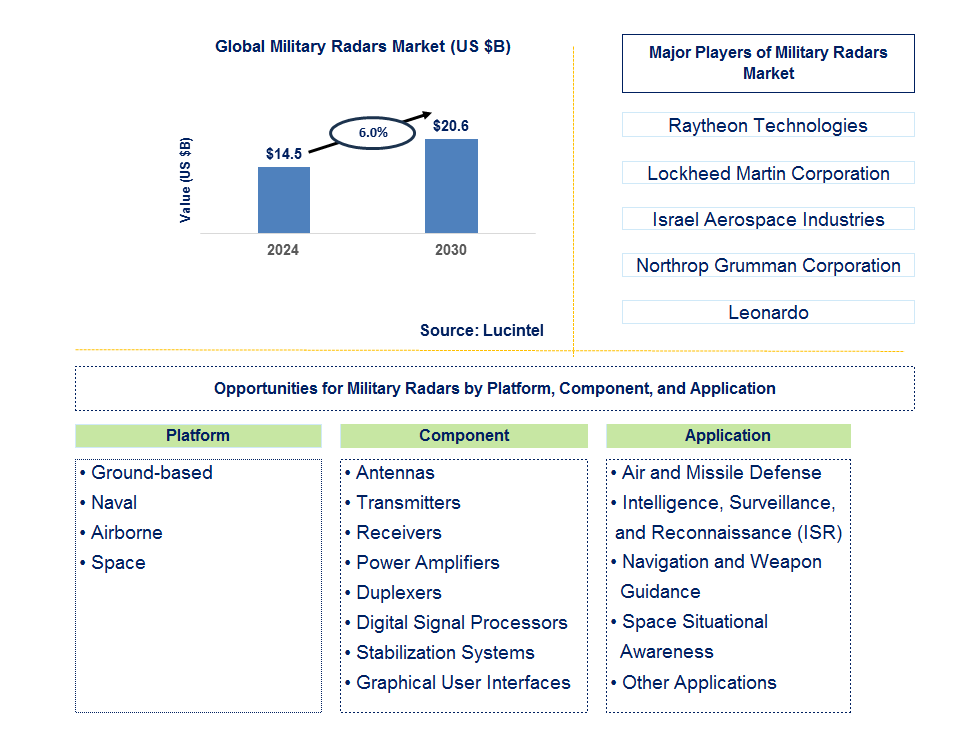
Key data points: The market size in 2030 = $20.6 billion, growth forecast = 6.0% annually next 6 years. Scroll below to get more insights. This market report covers trends, opportunities, and forecast in the global military radars market to 2030 by platform (ground-based, naval, airborne, and space), component (antennas, transmitters, receivers, power amplifiers, duplexers, digital signal processors, stabilization systems, and graphical user interfaces), application (air and missile defense, intelligence, surveillance, and reconnaissance (ISR), navigation and weapon guidance, space situational awareness, and other applications), and region (North America, Europe, Asia Pacific, and the Rest of the World)
We'll send your sample report shortly.
• United States: In the U.S. nearly the significant changes bubbling in the military radar sector is the creation of the advanced radar systems which are AI driven radar threat detection and tracking systems In the air Warfare, the U.S. Air Force is upgrading its AN/APG-83 AESA radar systems in fighter jets which focused on target acquisition in a multi-threat environment. In addition, radar upgrades on ships are being done by the U.S. Navy, so as to improve anti-air and missile defense capabilities. These improvements are in furtherance of the strategic plans to sustain technology leadership in face of increasing threats.
• China: As the People’s Republic continues to grow their military defense in every aspect, they have concentrated on upgrading more of their radar technology systems through local means. More recently, there have been articles about the placement of new solid state Active Electronically Scanned Array AT and missile radars. The People’s Liberation Army has also expressed desire to install radars which will cover the third dimension both land and sea and that will aid in the A2AD strategy of the PLA. The fast enhancement of next generation radar systems is also being driven by partnerships with domestic tech vendors.
• Germany: Germany will be modernizing the militaries radars in certain aspects including that of air arsenal and missile systems. This has seen the country reach out to European allies in the European Midcourse System (EMADS) where there is emphasis on improving interception of aerial threats. Furthermore, Germany seeks to implement some sort of advanced ground radar which is capable of tracking and locating objects that fly at a very low altitude, such as UAV’s. All these measures are in accordance to Germany’s policy of enhancing its defense in light of the security threats in the region.
• India: India is integrating more and more advanced military radar equipment and building it up in conceptual ways to improve self-reliance in defense. More recently, the multi-mode radar systems including and beyond the air force and navy have been put in place which is capable of tracking many targets at a go. Graphic In this context, the Defense Research and Development Organization is developing neoteric radar systems to satisfy the surveillance and reconnaissance needs especially on the international borders of the country. Orders to foreign defense manufacturers are being made as well in the effort to promote technology transfer.
• Japan: Japan does likewise in upgrading and wildlife military radars, due to the situation in the region, mainly due to threats from the south leaving weapons in one’s fire field. Over the past few years, the country has been acquiring new effective Aegis type radars for the navy, adding a new layer of capability for BMDS. Japan has also been advancing its next generation land-based radar systems to better cover the air threats. While these enhancements contribute to Japan’s overall military transformation, they are more as parts of Japan’s efforts to build as Self-Defense Forces and improve joint operations with foreign countries especially the U.S.
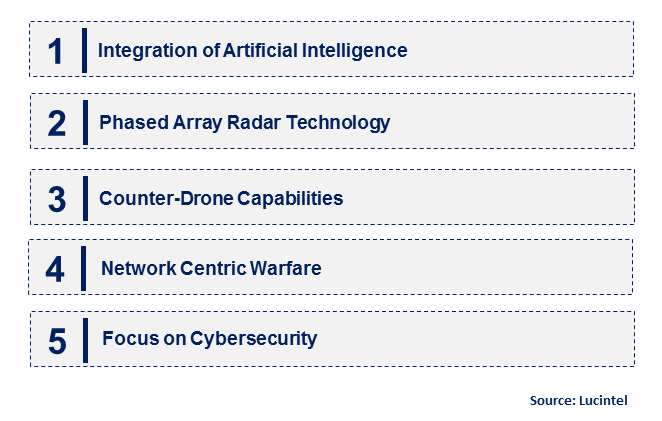
• Integration of Artificial Intelligence: In recent times, the incorporation of AI in radar systems has led to a significant improvement of threat detection and classification. Moreover, owing to the real work done by AI, such AI algorithms are able to process huge amounts of data in the shortest time possible thus more effective in decision making during operations. Thus, apprehensive action is not random rater it is more timely improved and better situational awareness is achieved.
• Phased Array Radar Technology: Phased array radars are rapidly taking over as the radar of choice in the military application scene due to the versatility as well, it is able to simultaneously vector track many targets. More threatening means are developing in form of this technology as it enhances the scanning, tracking and capturing of aerial threats.
• Counter-Drone Capabilities: Since the advent of little birds in area combat a contemporary challenge is posed in the military surveillance radars which include many modules directed at finding UAVs and neutralizing them. This adaptation is imperative so as to defend the assets of the military and the surrounding area as well as maintain operational security.
• Network Centric Warfare: This policy of network centric warfare appears to promote the use of radar systems together with other forces. Improvised by inter communications by persons involved in wide area defense coordinating and as well responding to attacks is made easy.
• Focus on Cybersecurity: Increased connection of military radar systems to other systems or networks has been on the rise thereby security risks and information technology has been made crucial. To wind up, radar networks operational integrity and security of sensitive information are well protected by ensuring radar networks are secure from intrusions of the cyber kind. Economical and technological factors, in such a way, are shifting the military Radar market as improving overall performance, dependability and inclusion of radar systems within wider defense encompassing strategies.
• Advancements in the use of advanced radars: The use of Active Electronically Scanned Array (AESA) radars is gaining roots owing to their impressive target tracking capabilities as well as fine image processing. They are augmenting the performance of fighter aircraft, for ground systems and the general awareness of the battlespace.
• The Use of multi-mode Radar Systems: Development of the new multi-mode radar systems are made to be used for a variety of tasks, such as air defense, ground control and sea control. Such flexibility make it possible to cut down wastage of resources and boost the effectiveness of operations.
• New Trends in Surveillance Upgrades: Military forces are now spending on long range surveillance radars that can reach out to deeper distances for threat detection and initiation of attacks. These systems allow for better preparedness and response activities and strategies.
• Co-operation of Countries and Institutions in Radar technologies: As countries and defense contractors work with one another, they make it easier to access technologies and knowledge on radars. They also serve to speed up progress on future technologies.
• Integration of Next-Gen Signal Processing: The use of new techniques for processing radar signals is being applied in radar systems so as to increase target discrimination, suppression and clutter rejection. This makes it possible to have increased accuracy in tracking as well as improved performance in very complex conditions. These developments are enhancing the Military Radar market; new technologies which are more efficient and effective in operations are being developed, and international collaboration is promoted.
• Air Defense Systems: There are enormous prospects for the manufacturers of radars to suitably address the soaring demand for strong air defense systems. The ultra-modern radars mounted on missile defense systems are vital to dealing with air threats for purpose of homeland protection.
• Maritime Surveillance: With increasing tensions at sea or the oceans, comes the requisition for advancing the existing naval application radars further. Changes in coastal surveillance radar could allow vessels to be tracked and maritime security operations improved.
• Unmanned Aerial Vehicle (UAV) Tracking: As the use of drones continues to grow in both the military and civilian sectors, there lies a great opportunity for the development of drone radius detection radars. This is very important for anti-drone operations.
• Border Control Applications: Nations are purchasing radar systems in order to help in border security and patrol. Ground-based radar systems such as passive and active microwave radar provide proper transportation and monitoring of the boundaries by eradicating illegal entry and dangers.
• Joint Military Drills and Partnership: The focus on union military drills amongst allied nations opens room s of making interoperable radar systems. These systems improve readiness and sharing of information during exercises that involve many nations. The above growth opportunities are changing the radar military market since innovation is increasing and the field of application of the advanced radar system development is up surged.
• Raytheon Technologies Corporation
• Lockheed Martin Corporation
• Israel Aerospace Industries
• Northrop Grumman Corporation
• Leonardo
• Ground-based
• Naval
• Airborne
• Space
• Antennas
• Transmitters
• Receivers
• Power Amplifiers
• Duplexers
• Digital Signal Processors
• Stabilization Systems
• Graphical User Interfaces
• Air and Missile Defense
• Intelligence, Surveillance, and Reconnaissance (ISR)
• Navigation and Weapon Guidance
• Space Situational Awareness
• Other Applications
• North America
• Europe
• Asia Pacific
• The Rest of the World


• Raytheon Technologies Corporation
• Lockheed Martin Corporation
• Israel Aerospace Industries
• Northrop Grumman Corporation
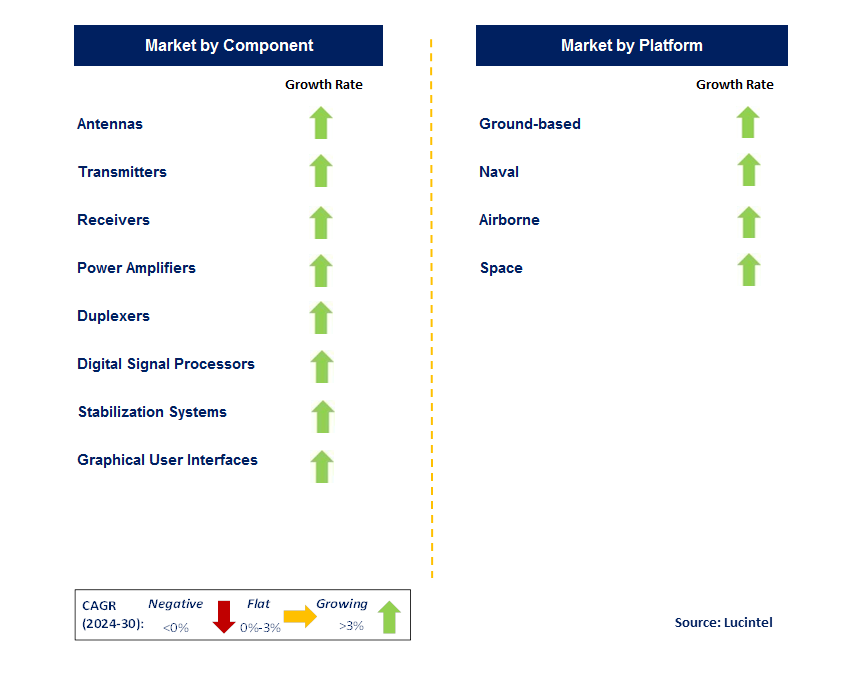
• Leonardo Q6. Which military radars market segment will be the largest in future? Answer: Lucintel forecasts that airborne is expected to witness highest growth over the forecast period. Q7. In military radars market, which region is expected to be the largest in next 6 years? Answer: APAC is expected to witness highest growth over the forecast period. Q.8 Do we receive customization in this report? Answer: Yes, Lucintel provides 10% customization without any additional cost.


Choose a license that fits your team. Instant PDF delivery.
Prices exclude taxes. Instant delivery. Custom licensing available on request.
Market Report · July 31, 2026
Market Report · July 31, 2026
Market Report · July 31, 2026
Trusted partner for strategic intelligence and business growth


Receive a complimentary market analysis tailored to your industry. Our analysts will identify key growth opportunities and competitive dynamics specific to your business.

Market size, growth rate, and key trend analysis for your specific sector.

Top competitor positioning and market share analysis.

Strategic recommendations backed by data-driven insights.
Get curated market intelligence and competitive moves straight to your inbox.
By subscribing, you agree to receive our monthly insights. Unsubscribe anytime.
Receive a complimentary market analysis tailored to your industry. Our analysts will identify key growth opportunities and competitive dynamics specific to your business.
Market size, growth rate, and key trend analysis for your specific sector.
Top competitor positioning and market share analysis.
Strategic recommendations backed by data-driven insights.
Get curated market intelligence, emerging trends, and competitive moves straight to your inbox each month.
By subscribing, you agree to receive our monthly insights. Unsubscribe anytime.
We'll send your sample report shortly.