
Report Feature
Military Helmet and Helmet Mounted Display System Market Trends and Forecast
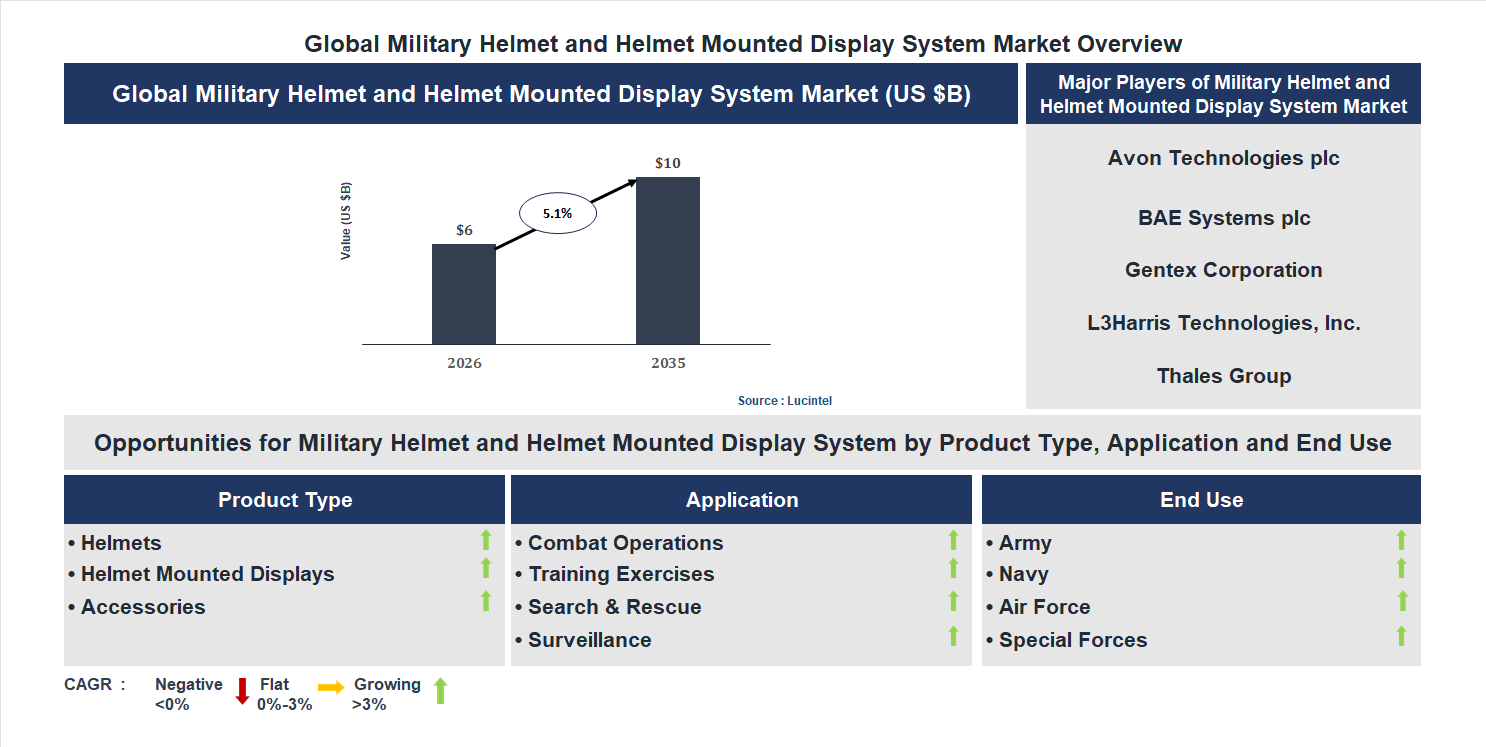
The future of the global military helmet and helmet mounted display system market looks promising with opportunities in the army, navy, air force, and special force markets. The global military helmet and helmet mounted display system market is expected to reach an estimated $10 billion by 2035 with a CAGR of 5.3% from 2026 to 2035. The major drivers for this market are the increasing demand for advanced soldier protection systems, the rising adoption of augmented reality in combat helmets, and the growing investment in next generation military technologies.• Lucintel forecasts that, within the product type category, helmet mounted display is expected to witness the highest growth over the forecast period.
• Within the end use category, special force is expected to witness the highest growth.
• In terms of region, APAC is expected to witness the highest growth over the forecast period. Gain valuable insights for your business decisions with our comprehensive 150+ page report. Sample figures with some insights are shown below.
Emerging Trends in the Military Helmet and Helmet Mounted Display System Market
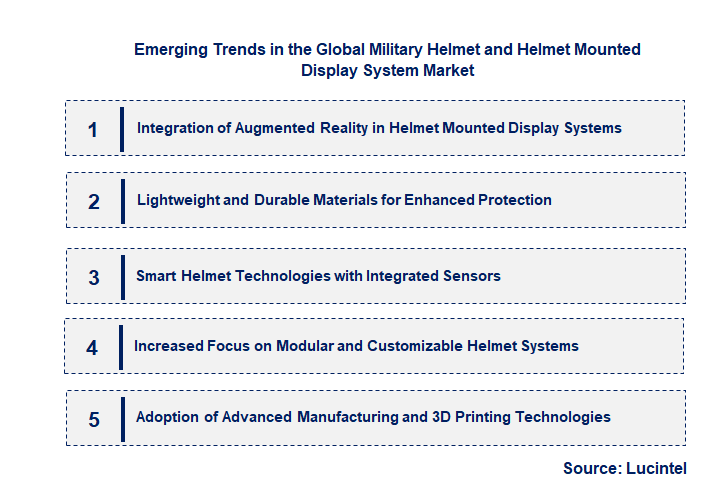
The military helmet and helmet mounted display system market is experiencing rapid evolution driven by technological advancements, changing defense strategies, and increasing demand for enhanced soldier safety and operational efficiency. As militaries worldwide seek to modernize their forces, innovative solutions are emerging to improve situational awareness, communication, and protection. These developments are not only transforming traditional helmet designs but also integrating cutting-edge display systems and materials. The markets growth is further fueled by geopolitical tensions and the need for lightweight, durable, and multifunctional equipment. Understanding these trends is crucial for stakeholders aiming to capitalize on the markets future potential.• Integration of Augmented Reality in Helmet Mounted Display Systems : AR technology is revolutionizing battlefield awareness by overlaying critical data directly onto soldiers visual fields. This allows for real-time information such as maps, target identification, and friendly positions, significantly enhancing decision-making speed and accuracy. The adoption of AR in helmet systems improves operational efficiency and reduces cognitive load, making soldiers more effective in complex combat scenarios. As AR technology advances, its integration into military helmets is expected to become more sophisticated, offering immersive and intuitive user experiences that can be customized for different mission profiles.
• Lightweight and Durable Materials for Enhanced Protection : The demand for lightweight yet robust materials is driving innovation in helmet manufacturing. Advanced composites, such as carbon fiber and Kevlar, are being used to reduce weight without compromising protection levels. These materials improve soldier mobility and reduce fatigue during prolonged operations. Additionally, innovations in impact-absorbing layers and modular designs enhance safety and comfort. The shift towards lighter helmets is particularly significant for special forces and aviation units, where agility and endurance are critical. This trend is expected to continue as material science progresses, leading to more efficient and comfortable protective gear.
• Smart Helmet Technologies with Integrated Sensors : The incorporation of sensors into helmets is creating "smart" systems capable of monitoring physiological parameters, environmental conditions, and situational data. These sensors can detect signs of fatigue, dehydration, or injury, alerting soldiers and command centers in real time. Environmental sensors provide data on temperature, toxic gases, or radiation, enhancing safety in hazardous zones. The integration of communication modules allows seamless data sharing and coordination. Smart helmets improve operational awareness, safety, and health management, making them indispensable in modern warfare where information and safety are paramount.
• Increased Focus on Modular and Customizable Helmet Systems : Modular helmet designs allow for easy attachment of accessories such as night vision devices, communication gear, and cameras. Customization options enable soldiers to tailor their helmets based on specific mission requirements, improving versatility and functionality. This trend supports rapid adaptation to evolving threats and operational environments. Modular systems also facilitate maintenance and upgrades, extending helmet lifespan and reducing costs. The ability to customize enhances user comfort and operational effectiveness, making these helmets more appealing to military forces seeking flexible and future-proof solutions.
• Adoption of Advanced Manufacturing and 3D Printing Technologies : Advanced manufacturing techniques, including 3D printing, are enabling rapid prototyping and production of complex helmet components. This accelerates innovation cycles and reduces costs, allowing for more customized and lightweight designs. 3D printing also facilitates on-demand manufacturing, which is crucial for military logistics and field repairs. The technology supports the development of intricate internal structures for better impact absorption and ventilation. As manufacturing becomes more agile and cost-effective, military helmet systems will become increasingly sophisticated, personalized, and readily available, driving overall market growth. These emerging trends are fundamentally reshaping the military helmet and helmet mounted display system market by enhancing protection, situational awareness, and operational flexibility. The integration of advanced technologies such as AR, smart sensors, and innovative materials is creating more effective, lightweight, and adaptable solutions. These developments are not only improving soldier safety and performance but also enabling militaries to respond more effectively to modern threats, thereby driving the market toward a highly innovative and competitive future.
Recent Development in the Military Helmet and Helmet Mounted Display System Market
The military helmet and helmet mounted display system market is experiencing rapid advancements driven by technological innovation, increasing defense budgets, and evolving combat requirements. These developments are transforming military operations, enhancing soldier safety, and improving battlefield awareness. As nations invest more in defense, the integration of advanced materials, augmented reality, and lightweight designs is creating new opportunities for military forces worldwide. This dynamic landscape is shaping the future of military gear, making it more effective, versatile, and adaptive to modern warfare challenges.• Technological Innovations in Helmet Materials: Enhanced Durability and Comfort: The adoption of advanced composite materials and lightweight polymers is significantly improving helmet durability while reducing weight. These innovations increase soldier comfort and mobility, enabling longer operational periods without fatigue. Improved impact resistance and ballistic protection are also achieved, ensuring better safety in combat scenarios. Such material advancements are expanding the market for high-performance helmets across various military branches, fostering increased procurement and customization options.
• Integration of Augmented Reality in Helmet Mounted Displays: Revolutionizing Battlefield Awareness: The incorporation of augmented reality (AR) into helmet mounted display systems is transforming soldier situational awareness. AR overlays real-time data, maps, and targeting information directly onto the soldier’s view, enhancing decision-making speed and accuracy. This technology is particularly impactful in complex combat environments, enabling better coordination and reducing cognitive load. The growing demand for AR-enabled systems is driving innovation and investment, making battlefield information more accessible and actionable for military personnel.
• Development of Lightweight and Ergonomic Helmet Designs: Improving Soldier Mobility and Endurance: Focused on reducing weight and increasing comfort, new helmet designs incorporate ergonomic features and adjustable fittings. These lightweight helmets improve mobility, reduce neck strain, and allow for better integration of communication and sensor systems. Enhanced ventilation and padding further increase comfort during prolonged use. The market is witnessing a shift toward customizable, modular helmets that cater to specific operational needs, boosting adoption among armed forces seeking to optimize soldier performance.
• Expansion of Helmet Mounted Display System Applications: From Combat to Training: Helmet mounted display systems are expanding beyond combat to include training, simulation, and reconnaissance. These systems provide immersive experiences, real-time data, and enhanced communication capabilities, improving training effectiveness and operational readiness. The versatility of these applications is attracting military budgets worldwide, encouraging the development of multi-functional systems. As a result, the market is diversifying, with increased investments in systems that support both active combat and preparatory training environments.
• Increasing Focus on Cybersecurity and Data Protection: Safeguarding Sensitive Military Information: As helmet mounted systems become more connected and integrated with digital networks, cybersecurity has become a critical concern. Protecting sensitive battlefield data, communication channels, and AR systems from cyber threats is essential to maintain operational integrity. Governments and defense contractors are investing in advanced encryption, secure hardware, and threat detection solutions. This focus on cybersecurity is shaping the market by emphasizing secure, resilient systems that ensure data integrity and operational security in increasingly digital warfare environments. The overall impact of these developments is a more advanced, safer, and versatile military helmet market. Enhanced materials, integrated AR, ergonomic designs, expanded applications, and cybersecurity measures are collectively driving growth, innovation, and operational efficiency. These trends are enabling armed forces to operate more effectively in complex environments, ultimately transforming modern military strategies and capabilities.
Strategic Growth Opportunities in the Military Helmet and Helmet Mounted Display System Market
The military helmet and helmet mounted display system market is experiencing rapid growth driven by technological advancements, increasing defense budgets, and the need for enhanced soldier safety and operational efficiency. Innovations in materials, augmented reality integration, and lightweight designs are expanding application scopes across various military branches. Strategic investments and collaborations are further accelerating market expansion, creating significant opportunities for manufacturers and defense agencies to improve combat readiness and situational awareness.• Enhanced Combat Effectiveness Through Advanced Helmet Technologies: Incorporating lightweight materials, ballistic protection, and integrated communication systems, modern military helmets improve soldier safety and operational efficiency. Helmet mounted display systems provide real-time data, navigation, and targeting information, enabling soldiers to make faster decisions. These innovations support special operations, infantry, and armored units, increasing battlefield survivability and mission success rates. The integration of augmented reality further enhances situational awareness, making helmets a critical component of modern warfare.
• Growing Adoption of Helmet Mounted Display Systems for Situational Awareness: Helmet mounted display systems are increasingly adopted to provide soldiers with real-time battlefield data, including maps, enemy positions, and weapon status. These systems improve coordination and reduce cognitive load during combat. The integration of augmented reality overlays allows for seamless information delivery without diverting attention from the battlefield. As military forces prioritize enhanced situational awareness, demand for advanced helmet mounted displays is expected to rise across land, air, and naval forces.
• Rising Demand for Lightweight and Ergonomic Helmet Designs: The need for comfortable, lightweight helmets that do not compromise protection is driving innovation in materials such as composites and advanced polymers. Ergonomic designs improve soldier mobility and reduce fatigue during prolonged missions. These lightweight helmets are compatible with various mounted systems, including night vision and communication devices. The focus on comfort and functionality is expanding the market for customizable and modular helmet solutions suitable for diverse operational environments.
• Increasing Investment in Augmented Reality and AI Integration: Military organizations are investing heavily in augmented reality (AR) and artificial intelligence (AI) to enhance helmet mounted display capabilities. AR overlays provide real-time tactical information, while AI algorithms assist in target recognition and threat assessment. These integrations improve decision-making speed and accuracy in complex combat scenarios. The development of smart helmets with integrated sensors and data analytics is expected to revolutionize battlefield operations, creating new opportunities for defense contractors and technology providers.
• Expansion of Helmet Market in Non-Combat and Training Applications: Beyond combat, helmets are increasingly used in training, simulation, and non-combat scenarios such as disaster response and peacekeeping missions. Advanced helmet systems facilitate immersive training environments with augmented reality, improving readiness and skill development. The versatility of helmet systems in various operational contexts broadens market potential. Governments and defense agencies are investing in these applications to enhance preparedness, safety, and operational efficiency across multiple military and paramilitary units. The overall market growth is driven by technological innovation, increased defense spending, and the expanding scope of helmet applications, promising significant opportunities for industry stakeholders.
Military Helmet and Helmet Mounted Display System Market Driver and Challenges
The military helmet and helmet mounted display system market is influenced by a range of technological, economic, and regulatory factors. Rapid advancements in defense technology, increasing military budgets worldwide, and evolving threat landscapes drive demand for advanced protective gear and integrated display systems. Regulatory standards for safety and interoperability also shape product development and procurement processes. Additionally, geopolitical tensions and the need for enhanced soldier situational awareness further propel market growth. However, the market faces challenges such as high development costs, stringent regulatory compliance, and rapid technological obsolescence, which can hinder innovation and adoption. Understanding these drivers and challenges is essential for stakeholders aiming to capitalize on market opportunities. The factors responsible for driving the military helmet and helmet mounted display system market include:• Technological Innovation: The continuous evolution of helmet technology, including lightweight materials, enhanced ballistic protection, and integrated display systems, significantly boosts market growth. Advanced materials like carbon fiber reduce weight while maintaining durability, improving soldier comfort and operational efficiency. The integration of augmented reality (AR) and heads-up display (HUD) systems enhances situational awareness, making military operations more effective. Innovations in sensor technology and communication systems further improve helmet capabilities, enabling real-time data sharing and decision-making. As defense agencies prioritize modernization, manufacturers invest heavily in R&D to develop cutting-edge solutions, fueling market expansion.
• Increasing Defense Budgets: Governments worldwide are allocating substantial funds toward modernizing their armed forces, which directly impacts the demand for advanced helmets and display systems. Countries like the U.S., China, and Russia are increasing defense spending to enhance troop safety and operational capabilities. This financial commitment enables procurement of high-tech equipment, including helmet-mounted systems that provide soldiers with critical battlefield information. The rising defense budgets also support research initiatives and the development of customized solutions tailored to specific operational needs, thereby expanding market opportunities and encouraging industry growth.
• Geopolitical Tensions and Security Threats: Ongoing regional conflicts, terrorism, and border disputes heighten the need for advanced military gear. Countries seek to equip their forces with helmets that offer superior protection and integrated display systems for better battlefield awareness. These security threats drive procurement of next-generation helmets capable of supporting communication, navigation, and targeting systems. As military engagements become more complex, the demand for sophisticated helmet-mounted systems increases, prompting manufacturers to innovate and deliver solutions that meet evolving operational requirements, thus expanding the market.
• Focus on Soldier Modernization Programs: Many nations are implementing comprehensive soldier modernization initiatives aimed at enhancing individual soldier capabilities. These programs emphasize lightweight, durable, and technologically advanced helmets with integrated display systems. The goal is to improve situational awareness, communication, and protection simultaneously. Such initiatives often involve public-private partnerships and significant government funding, fostering innovation and accelerating adoption of helmet-mounted display systems. The focus on soldier-centric solutions ensures a steady market growth trajectory driven by modernization priorities.
• Growing Military Conflicts and Asymmetric Warfare: The rise in asymmetric warfare and unconventional threats compels militaries to adopt advanced protective gear and display systems. Helmets equipped with night vision, thermal imaging, and real-time data sharing capabilities are increasingly in demand. These features enable soldiers to operate effectively in complex environments, improving safety and operational success. The need for adaptable, multifunctional helmets to counter diverse threats propels technological development and procurement, thereby expanding the market for helmet-mounted display systems and related equipment. The challenges facing the military helmet and helmet mounted display system market include:
• High Development and Production Costs: Developing advanced helmet systems with integrated display technology involves significant R&D investment, complex manufacturing processes, and high-quality materials. These costs can limit affordability and slow down widespread adoption, especially among smaller defense budgets. Additionally, maintaining technological superiority requires continuous innovation, further escalating expenses. Budget constraints and cost pressures may lead to delays in procurement and limit the deployment of cutting-edge helmet systems, impacting overall market growth.
• Stringent Regulatory and Certification Standards: Military equipment must adhere to strict safety, durability, and interoperability standards, which vary across countries. Meeting these regulatory requirements involves extensive testing, certification, and compliance procedures, often prolonging development timelines and increasing costs. Navigating diverse regulatory landscapes can pose challenges for manufacturers seeking to expand globally. Non-compliance or delays in certification can hinder product launch and market penetration, affecting overall industry growth.
• Rapid Technological Obsolescence: The fast-paced nature of technological advancements in display systems, sensors, and materials can render existing helmet solutions obsolete quickly. This creates a constant pressure for manufacturers to innovate and upgrade products, increasing R&D costs and complicating inventory management. Military procurement cycles are often lengthy, risking the deployment of outdated systems by the time of adoption. This rapid obsolescence can deter investment and slow market expansion, as stakeholders seek solutions with longer lifecycle support. The military helmet and helmet mounted display system market is driven by technological advancements, increased defense spending, geopolitical tensions, modernization initiatives, and the need for adaptable solutions in asymmetric warfare. However, high development costs, regulatory hurdles, and rapid technological obsolescence pose significant challenges. These factors collectively influence market dynamics, requiring stakeholders to balance innovation with cost-efficiency and compliance. Overall, the market is poised for growth, but strategic planning and continuous innovation are essential to overcoming obstacles and capitalizing on emerging opportunities.
List of Military Helmet and Helmet Mounted Display System Companies
Companies in the market compete on the basis of product quality offered. Major players in this market focus on expanding their manufacturing facilities, R&D investments, infrastructural development, and leverage integration opportunities across the value chain. With these strategies military helmet and helmet mounted display system companies cater increasing demand, ensure competitive effectiveness, develop innovative products & technologies, reduce production costs, and expand their customer base. Some of the military helmet and helmet mounted display system companies profiled in this report include-• Avon Technologies plc
• BAE Systems plc
• Gentex Corporation
• L3Harris Technologies, Inc.
• Thales Group
• Safran SA
• Rheinmetall AG
• Honeywell International Inc.
• Elbit Systems Ltd.
• MKU Limited
Military Helmet and Helmet Mounted Display System Market by Segment
The study includes a forecast for the global military helmet and helmet mounted display system market by product type, application, end use, and region.Military Helmet and Helmet Mounted Display System Market by Product Type [Value from 2019 to 2035]:
• Helmets
• Helmet Mounted Displays
• Accessories
Military Helmet and Helmet Mounted Display System Market by Application [Value from 2019 to 2035]:
• Combat Operations
• Training Exercises
• Search & Rescue
• Surveillance
Military Helmet and Helmet Mounted Display System Market by End Use [Value from 2019 to 2035]:
• Army
• Navy
• Air Force
• Special Forces
Military Helmet and Helmet Mounted Display System Market by Region [Value from 2019 to 2035]:
• North America
• Europe
• Asia Pacific
• The Rest of the World
Country Wise Outlook for the Military Helmet and Helmet Mounted Display System Market
The military helmet and helmet mounted display system market has experienced significant technological advancements and increased demand driven by evolving defense strategies worldwide. Countries are investing heavily in modernizing their armed forces, focusing on enhanced protection, situational awareness, and interoperability. Innovations include lightweight materials, integrated communication systems, and augmented reality displays. These developments aim to improve soldier safety, combat effectiveness, and operational efficiency. The markets growth is also influenced by geopolitical tensions and the need for advanced battlefield technologies. As nations prioritize defense modernization, the adoption of cutting-edge helmet systems continues to accelerate, reflecting a global shift toward smarter, more integrated military gear.• United States: The U.S. has led innovations in helmet technology, integrating augmented reality displays and advanced communication systems. The military is focusing on lightweight, durable materials to improve soldier mobility and protection. Recent contracts emphasize interoperability with other battlefield systems, enhancing situational awareness. The U.S. Army is also investing in helmet-mounted sensors for real-time data collection and threat detection, boosting combat effectiveness. Additionally, efforts are underway to develop modular helmet systems adaptable to various mission requirements, reflecting a strategic push toward technological superiority in defense.
• China: China has rapidly advanced its military helmet systems, emphasizing lightweight design and integrated electronic warfare capabilities. The country is investing in helmet-mounted displays that provide real-time battlefield data and targeting information. Chinese defense manufacturers are also focusing on improving helmet comfort and durability to suit diverse operational environments. The government’s increased defense budget supports research into augmented reality and sensor integration, aiming to enhance troop situational awareness and combat readiness. These developments align with China’s broader strategy to modernize its armed forces and achieve technological parity with Western nations.
• Germany: Germany is prioritizing the development of high-performance helmet systems with enhanced ballistic protection and integrated communication features. The country’s defense sector is investing in lightweight composite materials to reduce soldier fatigue during prolonged operations. German innovations include helmet-mounted display systems that facilitate seamless communication and data sharing among units. The focus is also on ergonomic design and modularity, allowing customization for different missions. Germany’s emphasis on research and development reflects its commitment to maintaining a technologically advanced and interoperable military force within NATO frameworks.
• India: India is rapidly modernizing its military helmet systems, emphasizing lightweight construction and integrated communication devices. The country is developing helmet-mounted displays to improve battlefield awareness and coordination among troops. Indian defense agencies are also exploring the integration of sensors for threat detection and environmental monitoring. The focus is on indigenous manufacturing to reduce reliance on imports and foster self-sufficiency. Recent initiatives include collaborations with domestic defense firms to develop advanced helmet systems tailored to India’s operational needs, supporting its broader goal of strategic autonomy and regional security enhancement.
• Japan: Japan is advancing its military helmet technology with a focus on lightweight materials and enhanced protection against ballistic threats. The country is investing in helmet-mounted display systems that support augmented reality features for improved situational awareness. Japan’s defense modernization efforts include integrating communication and sensor systems to facilitate real-time data sharing. The emphasis is on developing versatile helmets suitable for various terrains and operational scenarios. Japan’s technological investments aim to strengthen its self-defense capabilities amid regional security challenges, aligning with its strategic focus on technological innovation and defense resilience.

Features of the Global Military Helmet and Helmet Mounted Display System Market
Market Size Estimates: Military helmet and helmet mounted display system market size estimation in terms of value ($B). Trend and Forecast Analysis: Market trends (2019 to 2025) and forecast (2026 to 2035) by various segments and regions. Segmentation Analysis: Military helmet and helmet mounted display system market size by product type, application, end use, and region in terms of value ($B). Regional Analysis: Military helmet and helmet mounted display system market breakdown by North America, Europe, Asia Pacific, and Rest of the World. Growth Opportunities: Analysis of growth opportunities in different product types, applications, end uses, and regions for the military helmet and helmet mounted display system market. Strategic Analysis: This includes M&A, new product development, and competitive landscape of the military helmet and helmet mounted display system market. Analysis of competitive intensity of the industry based on Porter’s Five Forces model.
FAQ
Q1. What is the military helmet and helmet mounted display system market size? Answer: The global military helmet and helmet mounted display system market is expected to reach an estimated $10 billion by 2035. Q2. What is the growth forecast for military helmet and helmet mounted display system market? Answer: The global military helmet and helmet mounted display system market is expected to grow with a CAGR of 5.3% from 2026 to 2035. Q3. What are the major drivers influencing the growth of the military helmet and helmet mounted display system market? Answer: The major drivers for this market are the increasing demand for advanced soldier protection systems, the rising adoption of augmented reality in combat helmets, and the growing investment in next generation military technologies. Q4. What are the major segments for military helmet and helmet mounted display system market? Answer: The future of the military helmet and helmet mounted display system market looks promising with opportunities in the army, navy, air force, and special force markets. Q5. Who are the key military helmet and helmet mounted display system market companies? Answer: Some of the key military helmet and helmet mounted display system companies are as follows:• Avon Technologies plc
• BAE Systems plc
• Gentex Corporation
• L3Harris Technologies, Inc.
• Thales Group
• Safran SA
• Rheinmetall AG
• Honeywell International Inc.
• Elbit Systems Ltd.
• MKU Limited Q6. Which military helmet and helmet mounted display system market segment will be the largest in future? Answer: Lucintel forecasts that, within the product type category, helmet mounted display is expected to witness the highest growth over the forecast period. Q7. In military helmet and helmet mounted display system market, which region is expected to be the largest in next 8 years? Answer: In terms of region, APAC is expected to witness the highest growth over the forecast period. Q8. Do we receive customization in this report? Answer: Yes, Lucintel provides 10% customization without any additional cost.
Table of Contents
List of Figures
List of Tables
Methodology
- In-depth interviews of the major players in this market
- Detailed secondary research from competitors’ financial statements and published data
- Extensive searches of published works, market, and database information pertaining to industry news, company press releases, and customer intentions
- A compilation of the experiences, judgments, and insights of Lucintel’s professionals, who have analyzed and tracked this market over the years.


Buy Now
Choose a license that fits your team. Instant PDF delivery.
Prices exclude taxes. Instant delivery. Custom licensing available on request.
Key Questions
- • What are some of the most promising, high-growth opportunities for the military helmet and helmet mounted display system market by product type (helmets, helmet mounted displays, and accessories), application (combat operations, training exercises, search & rescue, and surveillance), end use (army, navy, air force, and special forces), and region (North America, Europe, Asia Pacific, and the Rest of the World)?
- • Which segments will grow at a faster pace and why?
- • Which region will grow at a faster pace and why?
- • What are the key factors affecting market dynamics? What are the key challenges and business risks in this market?
- • What are the business risks and competitive threats in this market?
- • What are the emerging trends in this market and the reasons behind them?
- • What are some of the changing demands of customers in the market?
- • What are the new developments in the market? Which companies are leading these developments?
- • Who are the major players in this market? What strategic initiatives are key players pursuing for business growth?
- • What are some of the competing products in this market and how big of a threat do they pose for loss of market share by material or product substitution?
- • What M&A activity has occurred in the last 5 years and what has its impact been on the industry? For any questions related to Military Helmet and Helmet Mounted Display System Market, Military Helmet and Helmet Mounted Display System Market Size, Military Helmet and Helmet Mounted Display System Market Growth, Military Helmet and Helmet Mounted Display System Market Analysis, Military Helmet and Helmet Mounted Display System Market Report, Military Helmet and Helmet Mounted Display System Market Share, Military Helmet and Helmet Mounted Display System Market Trends, Military Helmet and Helmet Mounted Display System Market Forecast, Military Helmet and Helmet Mounted Display System Companies, write Lucintel analyst at email: helpdesk@lucintel.com. We will be glad to get back to you soon.


