
Market Report · July 31, 2026

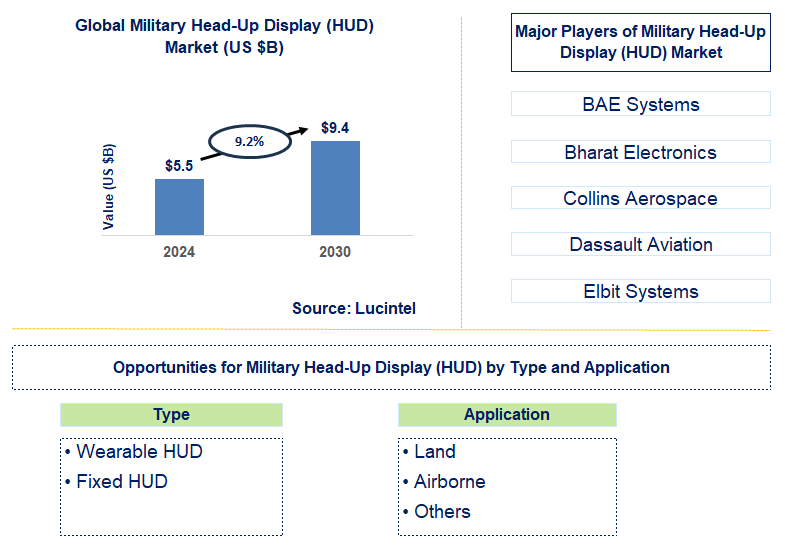
Key data points: The market size in 2030 = $9.4 billion, growth forecast = 9.2% annually for the next 6 years. Scroll below to get more insights. This market report covers trends, opportunities, and forecasts in the global military head-up display (hud) market to 2030 by type (wearable HUD and fixed HUD), application (land , airborne, and others), and region (North America, Europe, Asia Pacific, and the Rest of the World)
We'll send your sample report shortly.
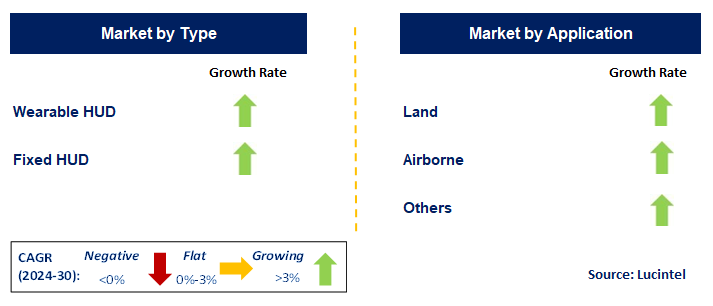
• Lucintel forecasts that, within the type category, wearable HUD is expected to witness the highest growth over the forecast period.
• In terms of regions, APAC is expected to witness the highest growth over the forecast period due to increasing defense spending and modernization of military forces in the region. Gain valuable insights for your business decisions with our comprehensive 150+ page report
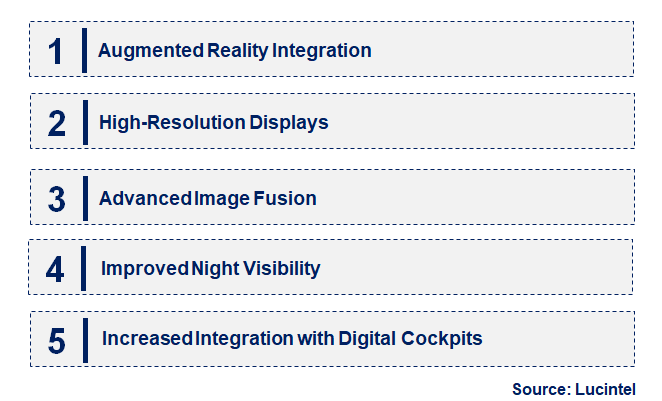
• Augmented Reality Integration: HUDs will integrate with AR technologies to enhance situational awareness by overlaying data in real time. This trend will improve pilots' decision-making and operational efficiency by illustrating critical information directly within the pilot's line of sight.
• High-Resolution Displays: As the resolution of displays improves, HUD displays now show greater clarity and detail. Higher-resolution displays support more precise data presentation and better readability in complex mission situations and high-speed operations.
• Advanced Image Fusion: The integration of image fusion technologies into HUD systems enables the combination of multiple data sources into one logical display. This trend enhances capabilities in target acquisition and tracking by presenting a unified view of critical information.
• Improved Night Visibility: Advances in night vision HUDs aim to dramatically increase visibility and operational effectiveness in low-light conditions. Developments in sensors and displays are making night operations safer and more efficient.
• Increased Integration with Digital Cockpits: HUDs are increasingly integrated with digital cockpit systems to streamline data management and control. This improves coordination and efficiency in operations by consolidating information and controls. These trends are restructuring the military HUD market with advanced technologies like AR, high-resolution displays, image fusion, enhanced night vision, and digital cockpit integration. All of these reflect a wider trend toward ever-more sophisticated, efficient, and user-friendly avionic systems.
• High-Resolution Displays: New high-resolution HUDs boast better clarity and detail. These displays enhance pilot situational awareness by providing clearer and more detailed information, which is essential in complex missions and high-speed operations.
• Integration of Augmented Reality: HUDs are being integrated with augmented reality capabilities that overlay critical information directly onto the pilot's view. This development enhances operational efficiency and increases situational awareness by presenting real-time data and navigation aids.
• Improved Night Vision Systems: Advances in night vision HUD systems offer superior visibility and performance while operating in low-light conditions. These systems feature improved contrast and image quality, enhancing safety and effectiveness during night operations.
• Multi-Function Displays: Modern HUDs now offer multi-function capabilities, enabling pilots to access various types of information simultaneously. This development improves efficiency and reduces the need for multiple displays in the cockpit.
• Advanced Image Fusion Technology: The integration of image fusion technology in HUDs allows the combination of different sensor data onto one display. This provides a broad view of the operational environment and enhances target acquisition and situational awareness. These developments bode well for the military HUD market through improvements in display quality, integration of AR, enhanced night vision, multifunctional capabilities, and integration of image fusion technologies. They reflect ongoing efforts to improve pilot effectiveness and enhance mission success.
• AR-Enabled HUD Development: Investment in AR technologies for HUDs allows for further advancements in pilot situational awareness and mission effectiveness. Integration with AR enables real-time data overlay and improved decision-making capabilities.
• Legacy HUD Systems Upgrade: There are opportunities for upgrading older HUD systems with advanced technologies. These upgrades improve performance, reliability, and integration with current avionics, extending the operational life of existing aircraft.
• Expanded Capability for Night Vision: Advanced night vision HUDs can be developed to effectively meet the demand for nighttime and low-light operations. The development of enhanced night vision technologies holds great potential for improving safety and efficiency during nighttime operations and in adverse weather conditions.
• Better Integration of HUD with Digital Cockpits: New frontiers can be opened by integrating HUD systems with digital cockpit systems for improved data management and user interface. This integration enhances operational efficiency and strengthens the pilot's control and situational awareness.
• Exploring Multi-Functional HUD Design: Investment in multi-functional HUD design allows for diversification of solutions for different aircraft types and mission profiles. This design consolidates both information and controls, thereby enhancing cockpit efficiency. These growth opportunities highlight potential advances in AR, upgrading legacy systems, night vision capabilities, and integration with digital cockpits and multi-functional HUDs. This reflects a growing interest in improving the quality of military flying and the operational effectiveness of pilots in emerging aviation contexts.
• Technological Advancements: Increased use and innovations in display technology and augmented reality contribute to market growth by enhancing HUD capabilities and functionality. This further improves situational awareness and operational effectiveness for pilots.
• Increased Defense Budgets: The growing trend of increased defense budgets encourages investment in advanced technologies for HUDs. Higher expenditures facilitate the development and procurement of advanced systems, further boosting market growth.
• Operational Efficiency: The rising demand for greater operational efficiency and superior functionality drives demand for HUDs that effectively support pilots. Advanced HUDs offer better data integration and situational awareness, which are key components of this demand.
• Integration with Modern Avionics: Integrating HUDs with modern avionics is a key driver of innovative development. Seamless integration enhances the overall functionality of the cockpit, leading to better mission success.
• Safety and Reliability: Safety and reliability are critical concerns for HUD systems. Advances in HUD performance and reliability seek to meet the demand for systems operating under challenging environmental conditions. Challenges in the military HUD market include:
• High Development Costs: The cost of developing advanced HUD technologies is a significant barrier. Unless these costs are managed effectively, maintaining growth through innovation will be challenging.
• Intricate Integration Needs: Integrating new HUD systems into existing aircraft and avionics is complex and costly. Ensuring compatibility and functionality can pose challenges for implementation.
• Meeting Regulations: Stringent military and aviation regulations impact development and deployment. Ensuring compliance with all relevant standards is crucial for gaining approvals and maintaining operational standards. The military HUD market is driven by technological advancements, investment strategies, and compliance matters. Addressing these factors is essential for HUD developments to enhance and secure market competitiveness.
• BAE Systems
• Bharat Electronics
• Collins Aerospace
• Dassault Aviation
• Elbit Systems
• Excelitas Technologies
• Honeywell International
• Wearable HUD
• Fixed HUD
• Land
• Airborne
• Others
• North America
• Europe
• Asia Pacific
• The Rest of the World
• United States: In HUD development, the United States is making significant progress with emerging capabilities in high-resolution displays and augmented reality. Recent advancements include enhanced night vision HUDs and multi-function displays to improve situational awareness in increasingly complex environments.
• Chinese: Recent developments feature high-definition displays integrated with next-generation avionics. Innovations include advanced head-tracking systems and further image fusion to improve pilots' visibility and reaction times.
• Germany: The latest developments include integrating HUDs with advanced digital cockpit systems. Multi-target tracking capabilities are also being developed, expanding HUD applications across both fixed-wing and rotary-wing aircraft.
• Indian: HUD technology is being developed through international cooperation. New developments provide improved display integration and operational reliability to enhance pilot performance and training for combat and transport aircraft.
• Japan: The Japanese are advancing HUD technology with a strong emphasis on precision and integration. Recent developments focus on display brightness and resolution enhancements, along with improved data fusion capabilities that support complex mission requirements and operational scenarios.


• BAE Systems
• Bharat Electronics
• Collins Aerospace
• Dassault Aviation
• Elbit Systems
• Excelitas Technologies
• Honeywell International Q6. Which military head-up display (HUD) market segment will be the largest in future? Answer: Lucintel forecasts that wearableHUD is expected to witness the highest growth over the forecast period. Q7. In military head-up display (HUD) market, which region is expected to be the largest in next 5 years? Answer: APAC is expected to witness the highest growth over the forecast period due to increasing defense spending and modernization of military forces in the region. Q.8 Do we receive customization in this report? Answer: Yes, Lucintel provides 10% customization without any additional cost.


Choose a license that fits your team. Instant PDF delivery.
Prices exclude taxes. Instant delivery. Custom licensing available on request.
Market Report · July 31, 2026
Market Report · July 31, 2026
Market Report · July 31, 2026
Trusted partner for strategic intelligence and business growth


Receive a complimentary market analysis tailored to your industry. Our analysts will identify key growth opportunities and competitive dynamics specific to your business.

Market size, growth rate, and key trend analysis for your specific sector.

Top competitor positioning and market share analysis.

Strategic recommendations backed by data-driven insights.
Get curated market intelligence and competitive moves straight to your inbox.
By subscribing, you agree to receive our monthly insights. Unsubscribe anytime.
Receive a complimentary market analysis tailored to your industry. Our analysts will identify key growth opportunities and competitive dynamics specific to your business.
Market size, growth rate, and key trend analysis for your specific sector.
Top competitor positioning and market share analysis.
Strategic recommendations backed by data-driven insights.
Get curated market intelligence, emerging trends, and competitive moves straight to your inbox each month.
By subscribing, you agree to receive our monthly insights. Unsubscribe anytime.
We'll send your sample report shortly.