
Market Report · July 31, 2026

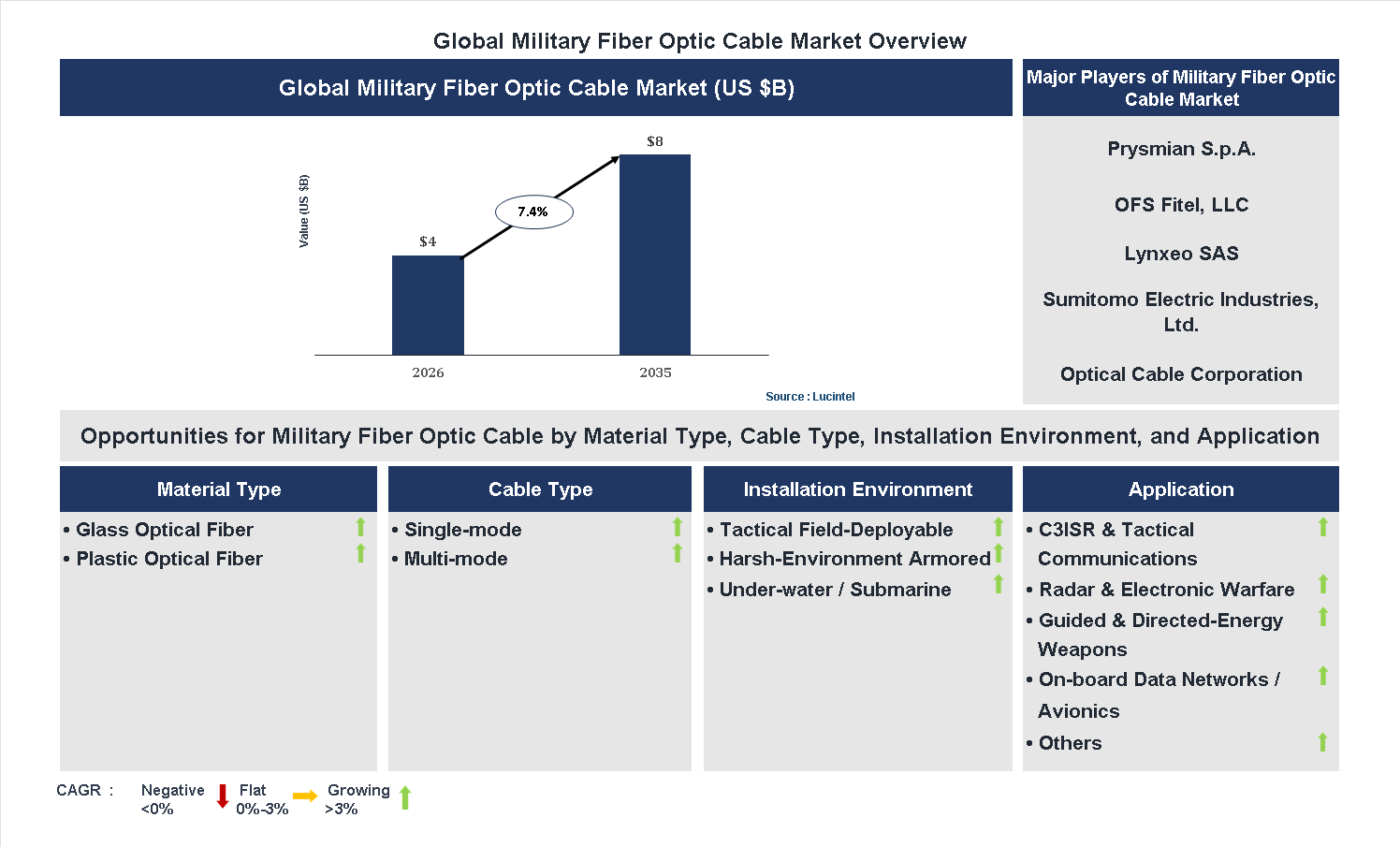
Key data points: The market size in 2035 = $19 billion, growth forecast = 11.1% annually for the next 8 years. Scroll below to get more insights. This market report covers trends, opportunities and forecasts in military fiber optic cable market to 2035 by type (single mode and multi-mode), material (glass and plastic), platform (civil, military, and space), application (cabin interior, weapons systems, ISR systems, communication systems, navigation & sensing, avionics, and others), and region (North America, Europe, Asia Pacific, and the Rest of the World)
We'll send your sample report shortly.
• Lucintel forecasts that, within the type category, single mode is expected to witness higher growth over the forecast period.
• Within the application category, communication system is expected to witness the highest growth.
• In terms of region, APAC is expected to witness the highest growth over the forecast period. Gain valuable insights for your business decisions with our comprehensive 150+ page report. Sample figures with some insights are shown below.
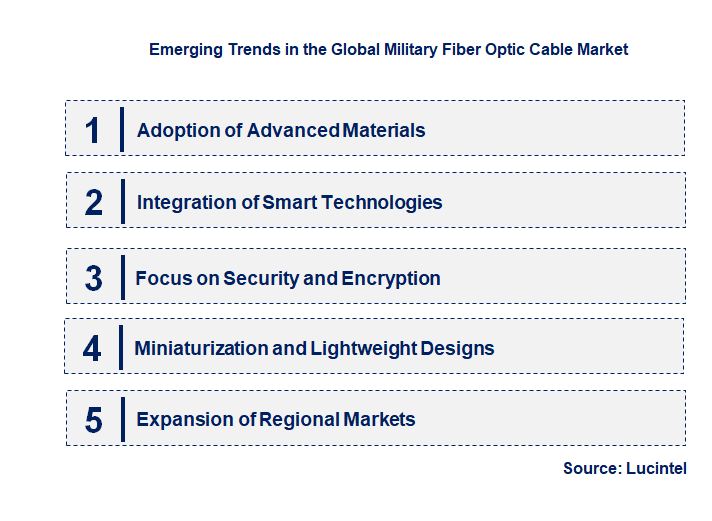
• Adoption of Advanced Materials: The market is witnessing a shift towards using high-performance materials such as aramid fibers and specialized coatings. These materials enhance durability, flexibility, and resistance to harsh environmental conditions like extreme temperatures, moisture, and mechanical stress. This trend improves the reliability and lifespan of military fiber optic cables, making them suitable for diverse operational scenarios. As a result, defense agencies can deploy these cables in more challenging environments, ensuring uninterrupted communication and data transfer during critical missions.
• Integration of Smart Technologies: The incorporation of smart features such as embedded sensors and real-time monitoring systems is transforming military fiber optic cables. These sensors can detect physical damage, temperature fluctuations, and other environmental factors, providing real-time data to maintenance teams. This proactive approach reduces downtime and maintenance costs while increasing operational readiness. The integration of IoT-enabled solutions is also facilitating better network management and security, making these cables more adaptable to evolving battlefield requirements.
• Focus on Security and Encryption: With increasing cyber threats and the need for secure communication channels, the market is emphasizing advanced encryption techniques and secure fiber optic solutions. Military-grade encryption ensures data confidentiality and integrity during transmission, preventing interception or tampering by adversaries. This trend is critical for safeguarding sensitive information and maintaining strategic advantages. As cyber warfare intensifies, the demand for highly secure fiber optic cables is expected to grow significantly across all defense sectors.
• Miniaturization and Lightweight Designs: The trend towards developing smaller, lighter fiber optic cables is driven by the need for mobility and ease of deployment in various military operations. Miniaturized cables reduce logistical burdens and enable integration into compact platforms such as drones, submarines, and portable communication devices. This innovation enhances operational flexibility and reduces transportation costs. The lightweight design also contributes to improved maneuverability and faster deployment in complex terrains, making it a crucial factor in modern military strategies.
• Expansion of Regional Markets: While North America and Europe currently dominate the market due to advanced defense infrastructure, emerging regions such as Asia-Pacific and the Middle East are experiencing rapid growth. Increased defense spending, regional conflicts, and modernization initiatives are fueling demand in these areas. Local manufacturers are also investing in R&D to develop region-specific solutions, fostering regional market expansion. This geographic diversification is creating new opportunities for global players and encouraging innovation tailored to diverse operational needs. These emerging trends are significantly reshaping the military fiber optic cable market by enhancing performance, security, and adaptability. The focus on advanced materials, smart technology integration, security, miniaturization, and regional expansion is driving innovation and market growth. As these trends continue to evolve, they will enable military forces worldwide to achieve more secure, reliable, and efficient communication networks, ultimately transforming modern defense strategies and operational capabilities.
• Growing Defense Budgets: Increased military spending worldwide is fueling demand for advanced communication systems, including fiber optic cables, to support modern warfare needs and secure data transmission.
• Technological Innovations: Developments in high-capacity, durable, and secure fiber optic cables are enabling military forces to improve battlefield communication, surveillance, and data sharing capabilities.
• Emphasis on Secure Communications: The need for encrypted, interference-free communication channels is driving the adoption of fiber optic cables, which offer enhanced security and resistance to hacking.
• Integration with Emerging Technologies: The incorporation of fiber optics into drone, satellite, and autonomous vehicle systems is expanding their operational range and data handling capacity.
• Regional Market Expansion: Growing military modernization programs in Asia-Pacific and the Middle East are creating significant opportunities for fiber optic cable manufacturers to expand their market presence. These developments are significantly transforming the military fiber optic cable market by enhancing communication security, operational efficiency, and technological integration. Increased defense investments and innovation are driving market growth, creating opportunities for industry players to develop advanced, reliable, and secure fiber optic solutions tailored to modern military needs.
• Enhanced Secure Communication Networks: Military fiber optic cables enable highly secure, encrypted communication channels essential for battlefield operations, command centers, and intelligence sharing. The demand for advanced encryption and anti-interception features drives innovation in fiber optic technology, ensuring data integrity and confidentiality. Growing geopolitical tensions and the need for resilient communication infrastructure further accelerate adoption across defense agencies worldwide.
• Adoption of Lightweight and Flexible Cables for Mobile Operations: The need for portable, lightweight, and flexible fiber optic cables is increasing in mobile military units, UAVs, and naval vessels. These cables improve maneuverability and ease of installation in confined or rapidly changing environments. Advances in material science and miniaturization are enabling the development of durable, high-performance cables that meet the rigorous demands of field operations, expanding their use in tactical scenarios.
• Integration with Advanced Defense Systems and Platforms: Fiber optic cables are increasingly integrated into sophisticated defense systems such as missile guidance, radar, and surveillance platforms. Their high bandwidth and immunity to electromagnetic interference enhance system performance and reliability. The trend toward network-centric warfare and smart weapon systems necessitates robust fiber optic infrastructure, creating opportunities for suppliers to develop specialized solutions tailored to military specifications.
• Growing Demand for Underwater and Submarine Fiber Optic Cables: Underwater military communication networks are critical for secure naval operations and submarine communication. The need for long-distance, high-capacity, and resilient underwater cables is rising due to increased submarine patrols and underwater surveillance activities. Innovations in waterproofing, pressure resistance, and signal integrity are expanding the deployment of submarine fiber optic cables, supporting strategic maritime security initiatives.
• Development of Next-Generation High-Speed Data Transmission Solutions: The increasing volume of data generated by military sensors, drones, and satellite systems necessitates high-speed fiber optic solutions. Next-generation cables with higher bandwidth, lower latency, and enhanced durability are being developed to support real-time data processing and decision-making. These advancements enable military forces to operate more efficiently in complex, data-intensive environments, fostering innovation in command and control systems. The overall growth of the military fiber optic cable market is driven by technological innovation, strategic military needs, and geopolitical factors. These opportunities are expected to significantly enhance defense communication capabilities, ensuring more secure, reliable, and efficient military operations globally. As the market evolves, stakeholders will benefit from investing in advanced, specialized fiber optic solutions tailored to emerging defense requirements.
• Technological Advancements: The rapid evolution of fiber optic technology enhances data transmission speed, security, and reliability, which are crucial for military applications. Innovations such as flexible fiber optics and improved shielding enable deployment in diverse environments, supporting modern warfare needs. These advancements facilitate real-time communication, surveillance, and secure data sharing across military networks, thereby increasing demand for sophisticated fiber optic cables. As military operations become more digitized, the need for cutting-edge fiber optic solutions continues to grow, fueling market expansion.
• Increasing Defense Budgets: Governments worldwide are allocating more funds toward modernizing their military infrastructure, including communication systems. Rising defense budgets enable procurement of advanced fiber optic cables for secure and high-capacity communication networks. This financial commitment supports the development of integrated battlefield communication systems, enhancing operational efficiency and security. The sustained increase in defense spending directly correlates with market growth, as military organizations seek reliable, high-speed data transmission solutions to maintain strategic advantages.
• Geopolitical Tensions and Security Concerns: Heightened geopolitical conflicts and regional tensions drive the demand for secure and resilient communication infrastructure. Fiber optic cables offer enhanced security features, such as encryption and immunity to electromagnetic interference, making them ideal for military use. Countries invest in robust fiber optic networks to safeguard sensitive information and ensure uninterrupted communication during conflicts. These security imperatives propel market growth, as militaries prioritize reliable and tamper-proof communication channels to support national defense strategies.
• Growing Adoption of Network-Centric Warfare: The shift towards network-centric warfare emphasizes interconnected systems and real-time data sharing among military units. Fiber optic cables are fundamental to establishing high-speed, secure communication networks necessary for this paradigm. The integration of sensors, drones, and command centers relies heavily on fiber optic infrastructure, enabling faster decision-making and coordinated operations. This trend significantly boosts demand for advanced fiber optic cables, fostering innovation and expansion within the market.
• Expansion of Military Bases and Infrastructure Modernization: The modernization of military bases and infrastructure worldwide necessitates upgraded communication networks. Fiber optic cables are essential for supporting high-bandwidth applications such as surveillance, command and control, and data storage. As countries invest in new military facilities and upgrade existing ones, the demand for durable, high-performance fiber optic cables increases. This infrastructure development ensures enhanced operational capabilities and long-term strategic advantages, further propelling market growth. The challenges facing the military fiber optic cable market include:
• Supply Chain Disruptions: The global supply chain for fiber optic components faces disruptions due to geopolitical tensions, trade restrictions, and the COVID-19 pandemic. These disruptions lead to delays in manufacturing and delivery, increasing costs and affecting project timelines. Limited availability of raw materials and specialized components hampers the ability of manufacturers to meet rising demand, creating bottlenecks in the supply chain. Overcoming these challenges requires diversification of suppliers and strategic inventory management to ensure consistent market supply.
• Regulatory and Export Restrictions: Stringent government regulations and export controls on military technology impact the availability and transfer of fiber optic cables across borders. These restrictions aim to prevent technology proliferation but can hinder international collaboration and procurement processes. Compliance with varying regulatory standards adds complexity and costs for manufacturers and buyers. Navigating these legal frameworks is essential to avoid penalties and ensure smooth market operations, but it remains a significant hurdle for global market expansion.
• High Costs and Technological Complexity: The development and deployment of advanced military fiber optic cables involve substantial costs due to sophisticated manufacturing processes and materials. Additionally, integrating these cables into existing military systems requires specialized expertise and infrastructure, increasing complexity. The high costs can limit adoption, especially for smaller or budget-constrained defense agencies. Overcoming technological and financial barriers is crucial for broader market penetration and ensuring that cutting-edge solutions are accessible to a wider range of military forces. In summary, the military fiber optic cable market is driven by technological innovation, increased defense spending, security needs, and infrastructure modernization. However, it faces challenges such as supply chain issues, regulatory restrictions, and high costs. These factors collectively influence market dynamics, requiring stakeholders to innovate and adapt strategically. The ongoing technological advancements and geopolitical developments will continue to shape the markets future, emphasizing the importance of resilience and agility in this sector.
• Amphenol Fsi
• Carlisle Interconnect Technologies
• Radiall
• Te Connectivity
• Corning Optical Communications Llc
• Single Mode
• Multi-Mode
• Glass
• Plastic
• Civil
• Military
• Space
• Cabin Interior
• Weapons Systems
• ISR Systems
• Communication Systems
• Navigation & Sensing
• Avionics
• Others
• North America
• Europe
• Asia Pacific
• The Rest of the World
• United States: The US military has focused on deploying next-generation fiber optic cables with enhanced bandwidth and security features. Recent investments include integrating fiber optics into drone and satellite communication systems, emphasizing resilience against cyber threats. The US is also exploring flexible, lightweight cables suitable for rapid deployment in diverse terrains, boosting operational agility.
• China: China has accelerated its military modernization efforts by developing high-capacity, durable fiber optic cables for its navy and land forces. The country is investing in indigenous technology to reduce reliance on foreign suppliers, emphasizing secure, encrypted communication channels. Recent projects include deploying fiber optics in missile defense systems and advanced surveillance networks.
• Germany: Germanys defense sector is upgrading its communication infrastructure with cutting-edge fiber optic cables that support high data transfer rates and enhanced security. The focus is on integrating these cables into NATO operations and joint European defense initiatives. Germany is also investing in ruggedized cables suitable for harsh environments, ensuring reliable military communications.
• India: India is rapidly expanding its military communication capabilities by deploying fiber optic cables across border regions and strategic locations. Recent developments include the deployment of secure, high-capacity cables to support border security and counter-terrorism operations. The country is also investing in indigenous manufacturing to boost self-reliance and reduce dependency on imports.
• Japan: Japan has prioritized the modernization of its military communication networks with advanced fiber optic cables that offer high-speed data transfer and resistance to environmental factors. Recent initiatives include integrating fiber optics into missile defense systems and naval communication networks. Japan is also focusing on developing resilient cables capable of withstanding natural disasters, ensuring continuous operational capability.


• Amphenol Fsi
• Carlisle Interconnect Technologies
• Radiall
• Te Connectivity
• Corning Optical Communications Llc Q6. Which military fiber optic cable market segment will be the largest in future? Answer: Lucintel forecasts that, within the type category, single mode is expected to witness higher growth over the forecast period. Q7. In military fiber optic cable market, which region is expected to be the largest in next 8 years? Answer: In terms of region, APAC is expected to witness the highest growth over the forecast period. Q8. Do we receive customization in this report? Answer: Yes, Lucintel provides 10% customization without any additional cost.


Choose a license that fits your team. Instant PDF delivery.
Prices exclude taxes. Instant delivery. Custom licensing available on request.
Market Report · July 31, 2026
Market Report · July 31, 2026
Market Report · July 31, 2026
Trusted partner for strategic intelligence and business growth


Receive a complimentary market analysis tailored to your industry. Our analysts will identify key growth opportunities and competitive dynamics specific to your business.

Market size, growth rate, and key trend analysis for your specific sector.

Top competitor positioning and market share analysis.

Strategic recommendations backed by data-driven insights.
Get curated market intelligence and competitive moves straight to your inbox.
By subscribing, you agree to receive our monthly insights. Unsubscribe anytime.
Receive a complimentary market analysis tailored to your industry. Our analysts will identify key growth opportunities and competitive dynamics specific to your business.
Market size, growth rate, and key trend analysis for your specific sector.
Top competitor positioning and market share analysis.
Strategic recommendations backed by data-driven insights.
Get curated market intelligence, emerging trends, and competitive moves straight to your inbox each month.
By subscribing, you agree to receive our monthly insights. Unsubscribe anytime.
We'll send your sample report shortly.