
Market Report · July 22, 2026

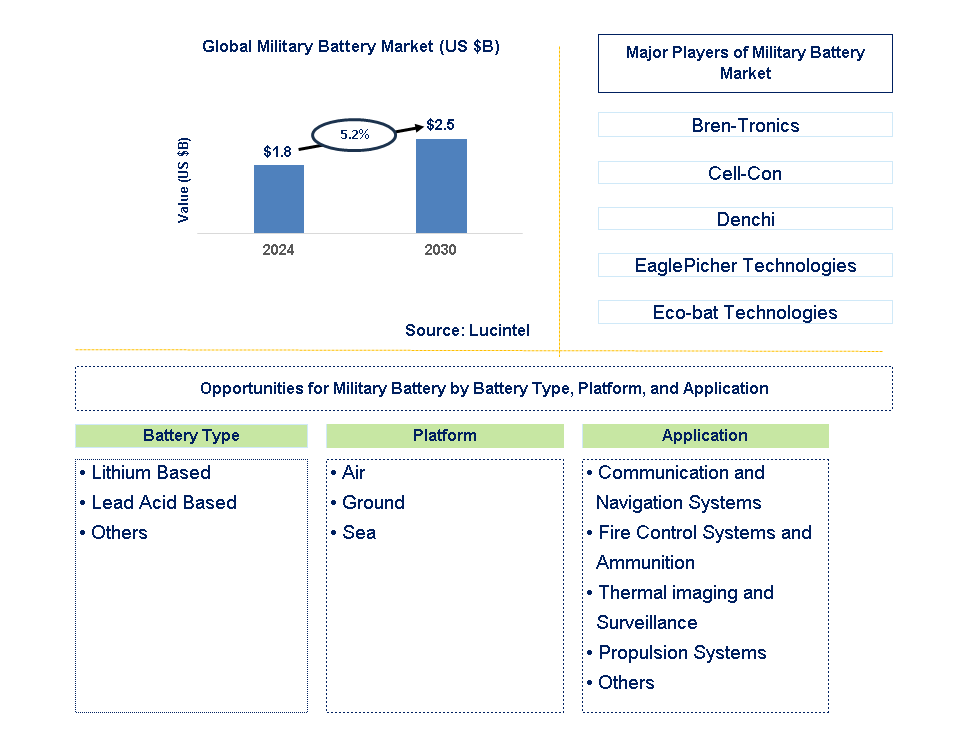
Key data points: The market size in 2030 = $2.5 billion, growth forecasts = 5.2% annually for the next 6 years. Scroll below to get more insights. This market report covers trends, opportunities, and forecasts in the global military battery market to 2030 by battery type (lithium based, lead acid based, and others), platform (air, ground, and sea), application (communication and navigation systems, fire control systems and ammunition, thermal imaging and surveillance, propulsion systems, and others), and region (North America, Europe, Asia Pacific, and the Rest of the World)
We'll send your sample report shortly.
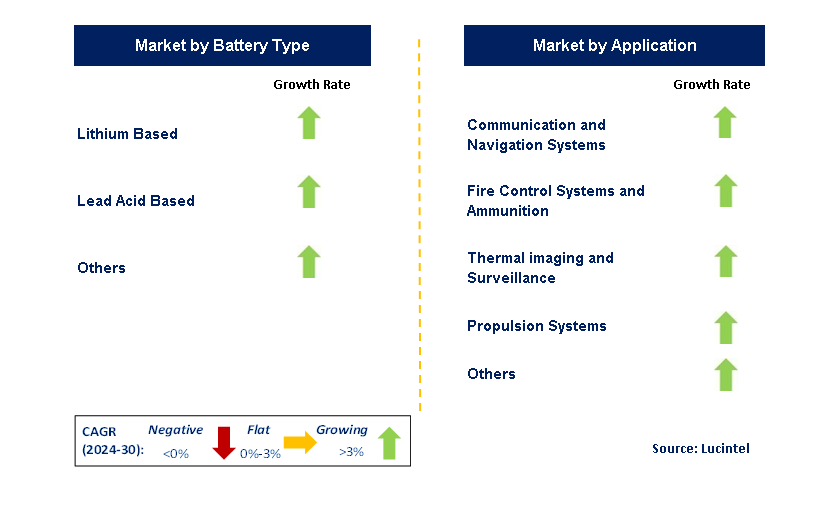
• Lucintel forecasts that, within the battery type category, lithium-based is expected to witness the highest growth over the forecast period due to its various advantages, such as fast charging, longer life cycles, and high energy density.
• Within the application category, the communication and navigation system is expected to witness the highest growth over the forecast period.
• In terms of regions, North America is expected to witness the highest growth over the forecast period due to rising supportive government expenditure in the military sector and the presence of major military powers in this region. Gain valuable insights for your business decisions with our comprehensive 150+ page report.
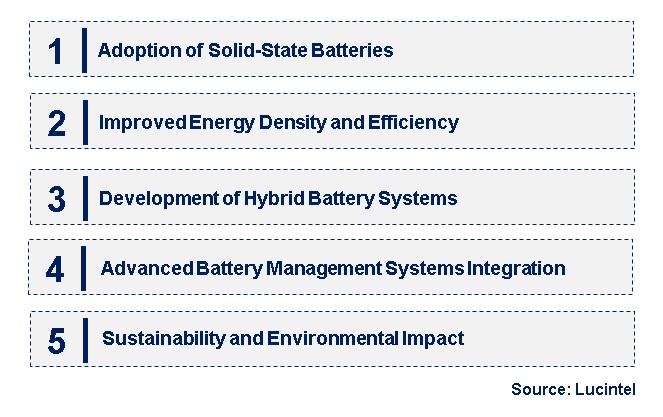
• Adoption of Solid-State Batteries: Currently, solid-state batteries represent an option offering higher levels of safety and greater energy density compared to traditional lithium-ion batteries. They have less risk of thermal runaway and offer a longer life, making them the best option for demanding military applications.
• Improved Energy Density and Efficiency: There has been a continuing drive for military batteries to achieve better energy density and efficiency. The introduction of new battery chemistries and better materials continue to make higher-capacity and longer-life power sources practical.
• Development of Hybrid Battery Systems: Various hybrid battery systems are currently under construction that can combine a range of different battery chemistries to achieve certain optimal performance or safety criteria. The systems allow for tailored solutions for military applications, such as lithium-ion plus supercapacitors, for improved power delivery.
• Advanced Battery Management Systems Integration: Indeed, the integration of advanced BMS into such systems is now becoming a trend. Active BMS technologies further enhance safety, monitoring, and efficiency with real-time data to extend battery life in support of critical military operations.
• Sustainability and Environmental Impact: There is greater emphasis now on developing battery technologies in an environmentally friendly way. Battery production and disposal are being made more environmentally benign through the use of recyclable materials and green manufacturing processes. These emerging trends are the reformation pressure on the military battery market for innovation in safety, performance, and sustainability. Therefore, these emerging technologies will continue to play an important role in modernizing military power sources and their reliability in the future.
• Advancements in Lithium-Ion Technologies: Advances are being made regarding lithium-ion batteries on many fronts: energy density, thermal management, and safety features. This study enables several military applications that range from portable electronics all the way to vehicle power systems to have reliable and long-lasting sources of energy.
• Solid-State Batteries: Entering the Market: While this is so, solid-state batteries have been heralded as the principal development due to their higher energy density and safety than conventional lithium-ion batteries. There can be provided more compact and efficient sources of power for different military usages based on this technology, hence answering certain particular questions about stability and performance that are being pointed at batteries.
• Production Capability Expansion: This has also correspondingly increased the production capacity for military batteries to meet such rising demands. New manufacturing plants are being opened with state-of-the-art technologies for ramping up supply and supporting the scaling up of advanced battery solutions for defense needs.
• Integration of Advanced Battery Management Systems: Advanced BMS integration will continue to be one factor that drives military battery performance, further enhancing its safety. These systems offer a set of features like real-time monitoring and predictive maintenance that improve the life of a battery. As such, advanced BMS has become an indispensable feature in ensuring reliability and efficiency in power management for military applications.
• Hybrid Battery Solutions End: The development of hybrid battery solutions with varied chemistries that offer optimal performance is developed, which would be essential in helping various military applications. This includes increasing power density and operational life, hence meeting the set of diverse requirements across different defense applications.
• Expansion into electric military vehicles: The growth of electric military vehicles is a huge opportunity for advanced battery solutions. The electric tactical and combat vehicles will need batteries with higher performance, offering greater energy density and durability for more widespread adoption and integration into military fleets.
• Portable Power Solution Development: It is very important to have portable power solutions during field operations and at remote sites. LiFePO4 and solid-state batteries are reliable light sources of power for portable equipment, communication devices, and soldier power systems that enable better efficiency and effectiveness in operations.
• Energy Storage Systems Advancement: Energy storage systems are heavily deployed for military bases and installations. Advanced batteries have the potential to provide reliable backup power, allow for greater integration of renewable energy sources, and offer enhanced energy resilience and sustainability of the defense infrastructure.
• Integration with Unmanned Systems: Integration of high-capacity batteries in unmanned systems, such as drones and driverless vehicles, is a key growth segment. High-energy-density batteries are making flying times longer and operational duration, thus supporting different mission types for both defense and surveillance.
• Improved Emergency Power Supplies: Emergency power supplies will be critical to sustaining operational readiness under lost power or field conditions. Advanced military batteries with high reliability and rapid deployment can support critical systems in continued operation in difficult environments. Other strategic growth opportunities for military batteries are in electric military vehicles, portable power solutions, energy storage systems, unmanned systems, and emergency power supplies. Such opportunities drive innovation and advancements within battery technologies to meet ever-evolving defense needs.
• Technological Advancements: The military battery market is developing because of technological advancements related to chemistry, materials, and systems that manage batteries. The invention of solid-state batteries and advanced lithium-ion technologies introduces better performance, safety, and efficiency, hence meeting the high demand in military applications.
• Rising Defense Spending: These markets are increasingly being driven by rising defense budgets and investments in the modernization of military equipment, significantly driving up demand for better battery solutions. Governments and defense contractors, therefore, attach a high priority to developing high-performance batteries for enhancing military systems' capability and reliability.
• Portable and Reliable Power-Demand Rising: Advanced batteries are needed for military operations, so a growing need for portable and reliable sources of power exists. Examples include portable power solutions such as field equipment and communication device batteries that are important in maintaining effectiveness in diverse environments.
• Energy Efficiency and Sustainability: In general, energy efficiency and sustainability in defense systems are given more emphasis. Advanced battery technologies offering higher energy density and longer life cycles contribute to a reduction in operation costs and lower environmental impact, contributing to broader sustainability goals.
• Advancements in Energy Storage Solutions: High-performance batteries are needed for advanced energy storage in military bases and installations. Energy resiliency with mission-critical operations, mostly needed for austere or remote environments, is well-supported. Challenges in the military battery market are:
• High Development and Production Costs: The high costs associated with the development and production of advanced military batteries pose a great challenge. The investment in research, development, and manufacturing infrastructure needs to be such that the kind of performance and safety required can be achieved.
• Raw Material Supply Chain Issues: The availability of raw materials and their prices will determine how batteries are produced. Supply chain disruption and unstable material prices may affect the production schedule and cost of the batteries, which could challenge the manufacturers.
• Regulatory and Compliance Requirements: Military equipment and technologies stand under stringent regulatory and compliance requirements. Ensuring that the batteries meet rigorous criteria for safety, performance, and the environment is a major prerequisite for market acceptability and deployment. Some of the growth drivers for the military battery market include technological advancement, increase in defense expenditure, demand for portable power, emphasis on energy efficiency, and energy storage developments. On the other hand, some of the contrasting features are high development costs, raw material supply constraints, and regulatory compliances. These are some of the critical growth drivers and challenges for sustained growth and innovation in the market.
• Bren-Tronics
• Cell-Con
• Denchi
• EaglePicher Technologies
• Eco-bat Technologies
• Lithium Based
• Lead Acid Based
• Others
• Air
• Ground
• Sea
• Communication and Navigation Systems
• Fire Control Systems and Ammunition
• Thermal imaging and Surveillance
• Propulsion Systems
• Others
• North America
• Europe
• Asia Pacific
• The Rest of the World
• United States: The United States military battery market has recorded developments in lithium-ion and solid-state batteries. Development has targeted increasing the energy density, making them safer and more durable to support a wide variety of defense platforms such as portable electronics and vehicle power supplies. The United States military has invested in research targeting next-generation batteries with improved performance in extreme conditions and for extended life.
• China: Compared to military battery technology development, noticeable steps are being taken by China, emphasizing the increase of production capacities and the improvement of batteries' performance. That would include recent developments in LiFePO4 batteries, where new chemistries have been adopted to allow for better energy density and operational reliability. China is integrating advanced battery management systems into the batteries to ensure increased efficiency and longevity in military applications.
• Germany: Germany has been one of the forerunners in integrating advanced battery technologies within military applications, including high-energy-density lithium-ion batteries. Recent developments have now included thermal stability and safety improvements to meet high military operation standards. Emphasizing energy efficiency and sustainability in Germany allows for innovation in the fields of battery design and materials capable of meeting tactical and strategic defense needs.
• India: The Indian military battery market is coming up with a development of local production levels to consequently enhance local import dependence. For example, lithium-ion and lead-acid batteries have been developed lately that are fit for defense applications. India is also working in research and development on the performance enhancement of batteries besides improving their safety profile all while ensuring compatibility with different military applications, such as communications devices and combat vehicles.
• Japan: Japan also continues to advance in the military battery market on aspects relating to high-performance lithium-ion and solid-state batteries. The paper tracks the improvement in energy density, safety, and thermal management of batteries. Emphasizing technology innovation, together with strategic partnerships with defense contractors, Japan is giving greater emphasis to the development of batteries that can keep up with extreme conditions and reliably perform in service for military systems.


• Bren-Tronics
• Cell-Con
• Denchi
• EaglePicher Technologies
• Eco-bat Technologies Q6. Which military battery market segment will be the largest in future? Answer: Lucintel forecasts that lithium based is expected to witness the highest growth over the forecast period due to its various advantages, such as fast charging, longer life cycle and high energy density. Q7. In military battery market, which region is expected to be the largest in next 5 years? Answer: North America is expected to witness the highest growth over the forecast period due to rising supportive government expenditure in military sector and presence of major military powers in this region. Q.8 Do we receive customization in this report? Answer: Yes, Lucintel provides 10% customization without any additional cost.


Choose a license that fits your team. Instant PDF delivery.
Prices exclude taxes. Instant delivery. Custom licensing available on request.
Market Report · July 22, 2026
Market Report · July 22, 2026
Market Report · July 17, 2026
Trusted partner for strategic intelligence and business growth


Receive a complimentary market analysis tailored to your industry. Our analysts will identify key growth opportunities and competitive dynamics specific to your business.

Market size, growth rate, and key trend analysis for your specific sector.

Top competitor positioning and market share analysis.

Strategic recommendations backed by data-driven insights.
Get curated market intelligence and competitive moves straight to your inbox.
By subscribing, you agree to receive our monthly insights. Unsubscribe anytime.
Receive a complimentary market analysis tailored to your industry. Our analysts will identify key growth opportunities and competitive dynamics specific to your business.
Market size, growth rate, and key trend analysis for your specific sector.
Top competitor positioning and market share analysis.
Strategic recommendations backed by data-driven insights.
Get curated market intelligence, emerging trends, and competitive moves straight to your inbox each month.
By subscribing, you agree to receive our monthly insights. Unsubscribe anytime.
We'll send your sample report shortly.