
Market Report · July 31, 2026

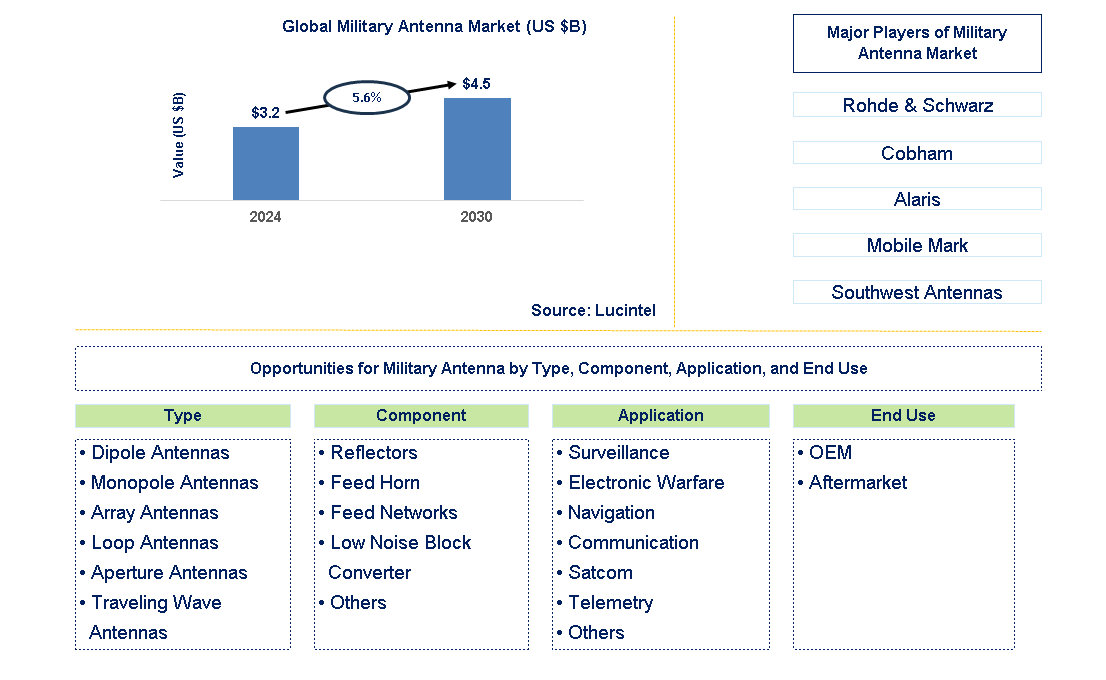
Key data points: The market size in 2030 = $4.5 billion, growth forecast = 5.6% annually for the next 6 years. Scroll below to get more insights. This market report covers trends, opportunities, and forecasts in the global military antenna market to 2030 by type (dipole antennas, monopole antennas, array antennas, loop antennas, aperture antennas, and traveling wave antennas), component (reflectors, feed horn, feed networks, low noise block converter, and others), application (surveillance, electronic warfare, navigation, communication, satcom, telemetry, and others), end use (OEM and aftermarket), and region (North America, Europe, Asia Pacific, and the Rest of the World)
We'll send your sample report shortly.
• Lucintel forecasts that, within the type category, electronic warfare is expected to witness the highest growth over the forecast period due to integration of efficient radio frequency technologies into military-grade electronic devices.
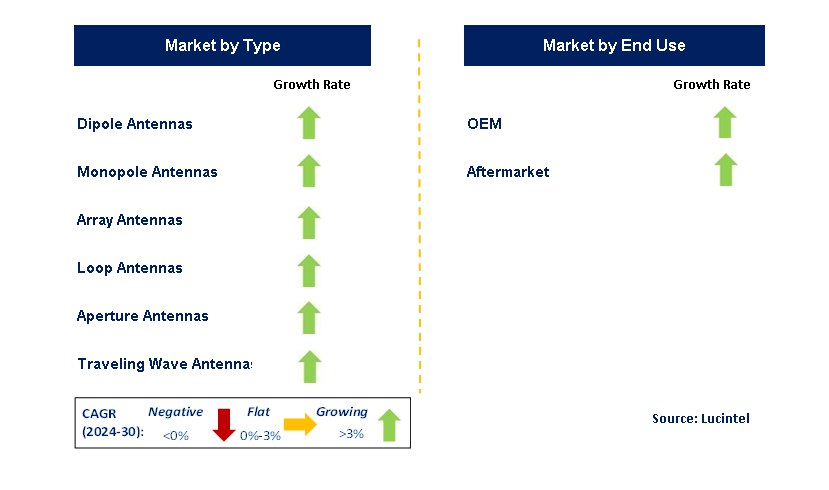
• Within the end use category, OEM will remain the larger segment due to rising military antenna upgradation and military vehicle procurement.
• In terms of regions, APAC will remain the largest region over the forecast period due to the growth in terror acts in the region has prompted governments in the area to strengthen their surveillance and anti-terrorism capacities. A more than 150-page report is developed to help in your business decisions.
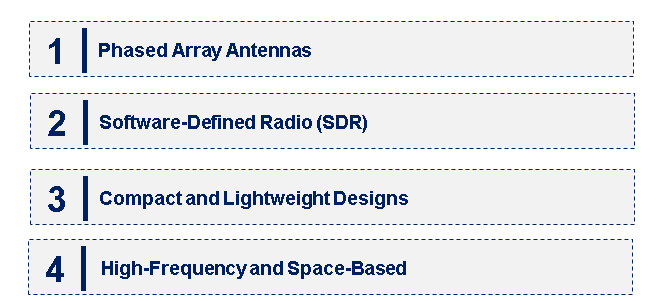
• Phased Array Antennas: These types are becoming more prominent due to their ability to offer rapid beam steering and better tracking capabilities. They support advanced radar systems and communication system, which increases performance for terrestrial as well as airborne military platforms.
• Software-Defined Radio (SDR) Integration: The adoption of SDR technology in military antennas is a major trend towards boosting flexibility coupled with adaptability. There can be frequency adjustments on dynamic basis for SDR-aided antennas which aids signal processing leading to effective channel management among other operational requirements.
• Compact and Lightweight Designs; Many compact and lightweight antennas have been made specifically for use with mobile or aerial platforms by many countries including India. This makes them more versatile while operating more effectively even in space-limited scenarios where smaller sizes become an advantage.
• High-Frequency and Space-Based Antennas; Developments in high-frequency antennae designed for the satellite-based communications are raising satellite communication capabilities. This allows better transmission of data for defense operations improving its robustness across various platforms through constant dependable network connections of communication channels within them. These changes are transforming the military antenna market through innovation of technology and enhancing communication capabilities. Advances in antenna technology are boosting performance, versatility and operational efficiency, meeting changing defense requirements and strategy needs.
• Advanced Phased Array Antennas: Sophisticated phased array antennas that enable fast beam steering and precise tracking are now being deployed. These serve to enhance radar and communications systems, thereby improving situational awareness as well as real-time data transmission during military operations.
• Incorporation of Software Defined Radio (SDR): Integration of SDR technology with military antennas allows greater flexibility and adaptability. Underneath it all, SDR enabled antennas can dynamically change frequencies while enhancing signal processing thus resulting into diverse communication channels and supportable operational requirements.
• Compact and Lightweight Antennas have Been Developed: Designers focus on creating compact lightweight antennas that are used in mobile and airborne platforms. This development meets space and weight constraints thereby improving the deployment of the antennas’ effectiveness across various military environments.
• High Frequency & Space Based Antenna Technology: Advancements in high-frequency bands, as well as space-based antennas are helping improve satellite communication capabilities. Such technologies facilitate better transmission of information amongst other supportive moves which strengthen defense operations while at the same time strategic communication networks. These developments towards improved performance, adaptability, and operational efficiency combined with various sophisticated technologies makes a new trend on military antenna market suitable for evolving defense needs.
• Several attractive application areas exist for the military antenna market. As defense requirements change, new technologies and applications are emerging to improve communications and radar systems. Below are five key growth opportunities in the military antenna market.
• Expanding Phased Array Systems: A key opportunity in this area is expanding the use of phased array systems for advanced radar and communication applications. Unlike their alternative traditional counterparts, these provide superior beamforming as well as tracking capabilities which enhance situational awareness and most importantly operational effectiveness.
• Adoption of SDR Technology: Growth opportunities can be identified through adoption of software-defined radio (SDR) technology on military antennas. These provide flexibility, adaptability, support many types of operations as well as improve overall network performance
• Development of Mobile & Airborne Antennas; As a result of increased demands associated with mobile and airborne platforms there is a possibility to develop compact lightweight antennas for them thereby creating room for space and weight limitations hence improved deployment plus efficiency towards diverse environments within armed forces context among others These prospects have shaped the military antenna market, by stimulating innovation and meeting dynamic defense requirements. Technological strides and applications are being utilized to upgrade communication and radar systems that further strategic growth and operational efficiency.
• Rohde & Schwarz
• Cobham
• Alaris
• Mobile Mark
• Southwest Antennas
• L3 Harris
• Hascall-Denke
• Barker & Williamson
• Antenna Products
• Antcom
• Dipole Antennas
• Monopole Antennas
• Array Antennas
• Loop Antennas
• Aperture Antennas
• Traveling Wave Antennas
• Reflectors
• Feed Horn
• Feed Networks
• Low Noise Block Converter
• Others
• Surveillance
• Electronic Warfare
• Navigation
• Communication
• Satcom
• Telemetry
• OEM
• Aftermarket
• North America
• Europe
• Asia Pacific
• The Rest of the World
• United States: U.S has witnessed advances in military antennas with phased array antennas providing enhanced beamforming and tracking capabilities. These types of antennas are very important for advanced radar systems, improved situational awareness and real-time information transmission over military networks.
• China: For space-based communications systems, China is leveraging high-frequency antennas for its military. This helps to improve their satellite communication capabilities by making it possible to send better data for coordinating defensive actions or even strategic communications.
• Germany: To improve flexibility and adaptability of military antennas, Germany has emphasized software-defined radio (SDR) technology integration. SDR enabled antennas offer improved signal processing as well as operational versatility to manage various communication channels for different tactical requirements.
• India: Compactness and light weightiness characterize Indian’s latest innovations towards development of aerial or mobile platform capable miniature antennae used in various aspects of defense operations. These help in boosting performance levels where it is most difficult while also enhancing India’s overall defense communication system particularly along its borders as well as at sea fronts.
• Japan: Japan is making remarkable progress towards creating high-gain submarine and naval application antennae. It focuses on underwater communications while enhancing its navy’s intelligence gathering abilities that contribute much to the country’s self-defense arms modernization process.


• Rohde & Schwarz
• Cobham
• Alaris
• Mobile Mark
• Southwest Antennas
• L3 Harris
• Hascall-Denke
• Barker & Williamson
• Antenna Products
• Antcom Q6. Which military antenna market segment will be the largest in future? Answer: Lucintel forecasts that electronic warfare is expected to witness the highest growth over the forecast period due to integration of efficient radio frequency technologies into military-grade electronic devices. Q7. In military antenna market, which region is expected to be the largest in next 5 years? Answer: APAC will remain the largest region over the forecast period due to the growth in terror acts in the region has prompted governments in the area to strengthen their surveillance and anti-terrorism capacities. Q.8 Do we receive customization in this report? Answer: Yes, Lucintel provides 10% customization without any additional cost.


Choose a license that fits your team. Instant PDF delivery.
Prices exclude taxes. Instant delivery. Custom licensing available on request.
Market Report · July 31, 2026
Market Report · July 31, 2026
Market Report · July 31, 2026
Trusted partner for strategic intelligence and business growth


Receive a complimentary market analysis tailored to your industry. Our analysts will identify key growth opportunities and competitive dynamics specific to your business.

Market size, growth rate, and key trend analysis for your specific sector.

Top competitor positioning and market share analysis.

Strategic recommendations backed by data-driven insights.
Get curated market intelligence and competitive moves straight to your inbox.
By subscribing, you agree to receive our monthly insights. Unsubscribe anytime.
Receive a complimentary market analysis tailored to your industry. Our analysts will identify key growth opportunities and competitive dynamics specific to your business.
Market size, growth rate, and key trend analysis for your specific sector.
Top competitor positioning and market share analysis.
Strategic recommendations backed by data-driven insights.
Get curated market intelligence, emerging trends, and competitive moves straight to your inbox each month.
By subscribing, you agree to receive our monthly insights. Unsubscribe anytime.
We'll send your sample report shortly.