
'
...

The Impact of COVID-19 is included in Military and Aerospace Fiber Optic Market Report. Buy it today to get an advantage.

Request the impact of COVID-19 on your product or industry


Military and Aerospace Fiber Optic Market Trends and Forecast

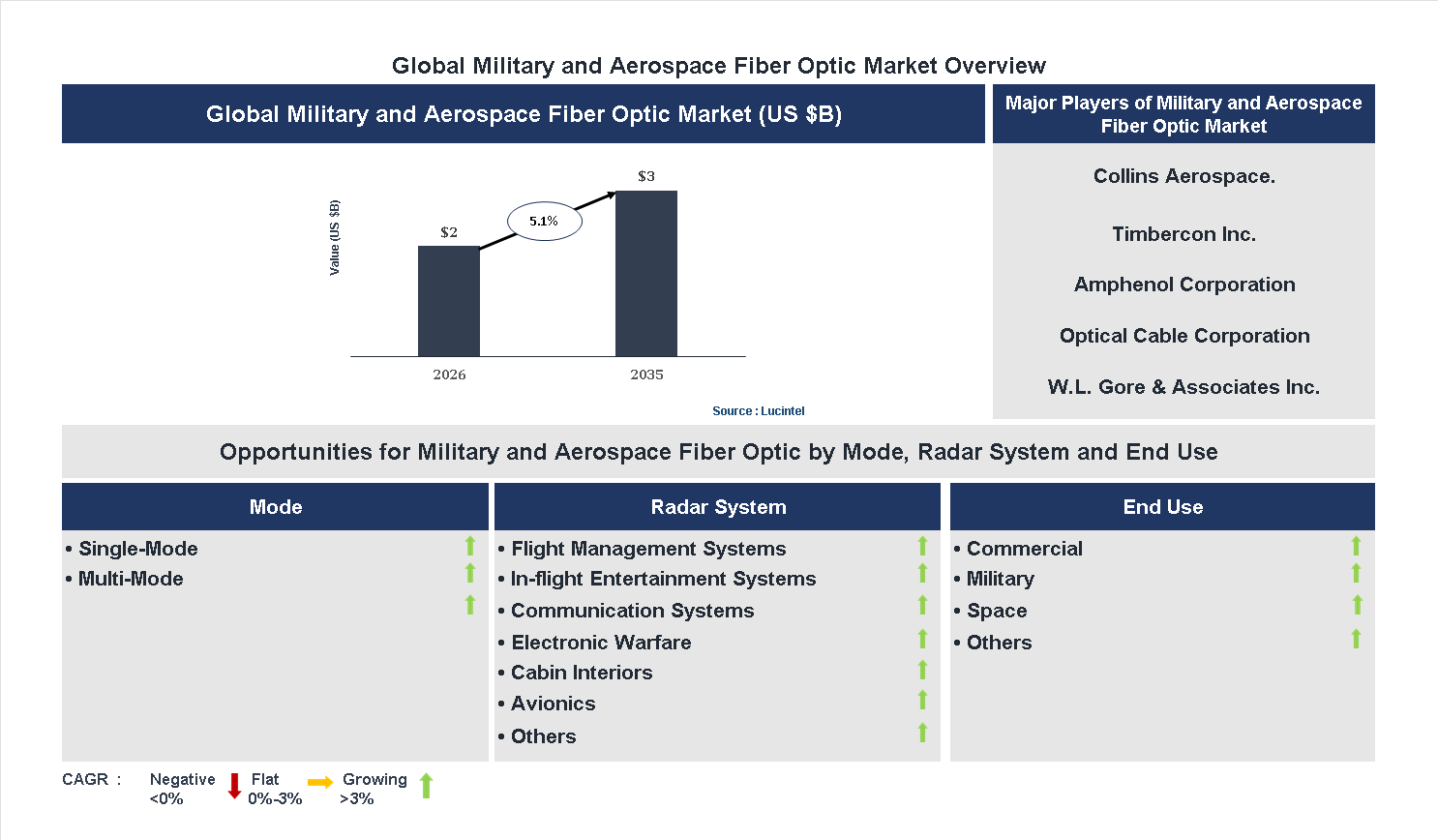
The future of the global military and aerospace fiber optic market looks promising with opportunities in the commercial, military, and space markets. The global military and aerospace fiber optic market is expected to reach an estimated $3 billion by 2035 with a CAGR of 5.1% from 2026 to 2035. The major drivers for this market are the increasing demand advanced communication systems, the rising defense modernization aerospace applications, and the growing investment secure fiber networks.

• Lucintel forecasts that, within the mode category, single-mode is expected to witness the highest growth over the forecast period.
• Within the end use category, military is expected to witness the highest growth.
• In terms of region, APAC is expected to witness the highest growth over the forecast period.
Gain valuable insights for your business decisions with our comprehensive 150+ page report. Sample figures with some insights are shown below.
Military and Aerospace Fiber Optic Market Trends and Forecast

Emerging Trends in the Military and Aerospace Fiber Optic Market

The evolution of military and aerospace fiber optic market is currently shaped by the demand for miniaturization, extreme durability, and immense data throughput. As platforms become more autonomous and networked, fiber optics serve as the essential backbone for real-time intelligence. These trends reflect a broader move toward digitized battlefields where optical communication outperforms traditional systems.

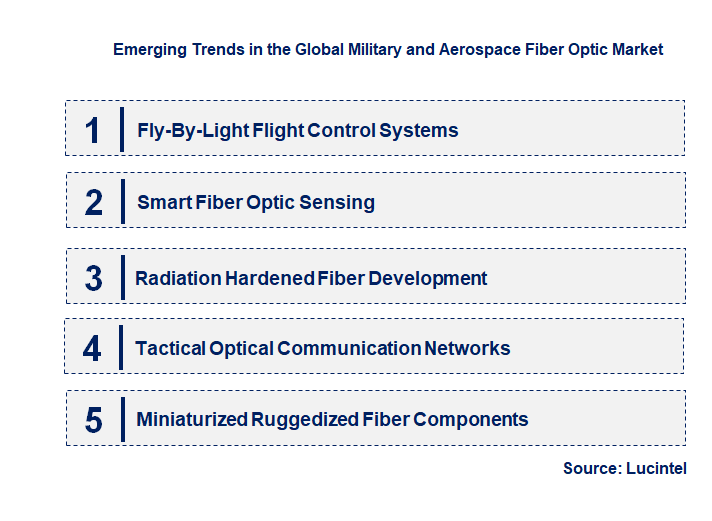
• Fly-by-Light Flight Control Systems: Optical fibers are replacing electrical wiring in flight control systems to improve signal reliability and eliminate electromagnetic interference risks. This transition supports enhanced system stability and ensures accurate data transmission in complex operational environments where electronic disruption is a concern.
• Smart Fiber Optic Sensing: Distributed sensing enables a single fiber to monitor multiple parameters such as strain, temperature, and pressure. This technology is being embedded into aerospace structures and defense platforms to enable continuous monitoring and early detection of structural anomalies.
• Radiation Hardened Fiber Development: Specialized fiber materials are being engineered to withstand high-radiation environments encountered in space operations. These fibers maintain signal integrity under extreme conditions, supporting reliable communication and sensing in satellite and space-based defense systems.
• Tactical Optical Communication Networks: Increasing deployment of advanced communication networks requires fiber optics to handle high data loads from sensors and connected systems. These networks support real-time information exchange across defense platforms operating in dynamic and distributed environments.
• Miniaturized Ruggedized Fiber Components: Development of compact and durable connectors and cables is enabling integration into space-constrained systems. These components are designed to perform under vibration, shock, and extreme conditions, supporting deployment across diverse military and aerospace applications.

These emerging trends are collectively shifting the market toward a more resilient, high-capacity, and intelligent infrastructure. By prioritizing lightweight materials and advanced sensing capabilities, the industry is overcoming traditional limitations. This evolution ensures fiber optic technology remains central to modern defense systems, enabling secure, efficient, and scalable operations.
Emerging Trends in the Military and Aerospace Fiber Optic Market

Recent Developments in the Military and Aerospace Fiber Optic Market

The military and aerospace fiber optic sector is undergoing a period of rapid technical refinement to meet modern operational requirements. Developments focus on enhancing reliability, adaptability, and performance in complex environments. These advancements ensure that communication systems remain robust and efficient across increasingly sophisticated defense and aerospace platforms.

• Integrated Modular Avionics Growth: Transition toward centralized architectures interconnected by fiber optics is enabling efficient data sharing across aircraft systems. This approach reduces system complexity and enhances coordination between avionics functions within advanced aerospace platforms.
• Directed Energy System Integration: Fiber-based technologies are being incorporated into high-energy systems designed for defense applications. These systems rely on precision optical transmission to support advanced targeting and energy delivery mechanisms.
• Enhanced Underwater Fiber Systems: Development of durable fiber cables for underwater applications is supporting advanced naval communication and sensing systems. These solutions are designed to operate under high pressure and challenging marine environments.
• Secure Optical Communication Networks: Integration of advanced security protocols within fiber optic networks is strengthening protection of sensitive military data. These networks support secure communication across critical defense infrastructure.
• Advanced Multi-Mode Fiber Capabilities: Improvements in multi-mode fiber design are enhancing data transmission efficiency in short-range applications. These fibers support reliable communication within confined environments such as vehicles and aircraft systems.

These developments are strengthening the performance and reliability of military and aerospace systems. Continuous innovation in fiber optic technologies is enabling enhanced communication, improved system integration, and greater operational efficiency across modern defense platforms.

Strategic Growth Opportunities in the Military and Aerospace Fiber Optic Market

Growth in the military and aerospace fiber optic market is increasingly aligned with advancements in defense technologies and expansion of high-speed communication systems. Opportunities are emerging across applications that require secure, reliable, and efficient data transmission. These areas are attracting attention from stakeholders seeking to expand capabilities and address evolving operational requirements.

• Unmanned Systems Communication: Increasing adoption of unmanned platforms is driving demand for reliable communication infrastructure. Fiber optics are being integrated to support data transmission within and between systems, enabling advanced operational capabilities in surveillance and mission execution.
• Space-Based Communication Systems: Expansion of satellite networks is creating demand for high-performance fiber optic technologies. These systems support communication between ground infrastructure and space platforms, enhancing connectivity across defense operations.
• Electronic Warfare Systems Integration: Fiber optics are being utilized in systems designed to operate in complex electromagnetic environments. These technologies support secure signal transmission and enable efficient functioning of advanced defense systems.
• Medical Support Infrastructure Deployment: Fiber-based communication systems are being integrated into defense medical facilities to support advanced diagnostics and communication capabilities in remote environments. These systems enhance operational support in field conditions.
• Naval Platform Communication Upgrades: Modernization of naval fleets is creating opportunities for integration of fiber optic communication systems. These upgrades support improved connectivity and operational coordination within maritime defense platforms.

Strategic growth opportunities are expanding the application scope of fiber optics across defense and aerospace sectors. Continued focus on advanced communication and system integration is enabling broader adoption and supporting evolving operational needs.

Military and Aerospace Fiber Optic Market Driver and Challenges

The military and aerospace fiber optic market is influenced by a combination of technological advancements, economic priorities, and regulatory frameworks. These factors shape adoption patterns and create both opportunities and constraints for market participants operating in complex defense environments.

The factors responsible for driving the military and aerospace fiber optic market include:
• High Bandwidth Communication Needs: Increasing reliance on advanced sensors and communication systems is driving demand for high-capacity data transmission. Fiber optics support efficient handling of large volumes of information across defense platforms.
• Electromagnetic Interference Resistance: Fiber optic systems provide reliable performance in environments with high electromagnetic activity. This capability supports secure and stable communication in complex operational scenarios.
• Lightweight System Requirements: Demand for reduced system weight in aerospace and defense platforms is encouraging adoption of fiber optics. These solutions support efficient system design and improved operational performance.
• Defense Infrastructure Modernization: Ongoing upgrades to military systems are driving integration of advanced communication technologies. Fiber optics play a key role in enhancing connectivity across modern defense infrastructure.
• Expansion of Space Communication Networks: Growth in space-based operations is increasing demand for reliable communication technologies. Fiber optics support connectivity between ground systems and space platforms.

The challenges facing the military and aerospace fiber optic market include:
• High Deployment Costs: Implementation of advanced fiber optic systems requires significant investment in materials and infrastructure. This can limit adoption across certain applications.
• Regulatory Compliance Complexity: Strict standards governing defense technologies create challenges in development and deployment. Compliance requirements can extend timelines and increase costs.
• Technical Integration Difficulties: Integrating fiber optics with existing systems presents challenges due to compatibility issues. This requires careful planning and adaptation within defense infrastructure.

The military and aerospace fiber optic market is shaped by strong demand for advanced communication technologies alongside operational and regulatory constraints. While adoption continues to expand across defense systems, addressing cost, compliance, and integration challenges remains essential for sustained growth and technological advancement.

List of Military and Aerospace Fiber Optic Companies

Companies in the market compete on the basis of product quality offered. Major players in this market focus on expanding their manufacturing facilities, R&D investments, infrastructural development, and leverage integration opportunities across the value chain. With these strategies military and aerospace fiber optic companies cater increasing demand, ensure competitive effectiveness, develop innovative products & technologies, reduce production costs, and expand their customer base. Some of the military and aerospace fiber optic companies profiled in this report include-
• Collins Aerospace.
• Timbercon Inc.
• Amphenol Corporation
• Optical Cable Corporation
• W.L. Gore & Associates Inc.
• Carlisle Companies Inc.
• AFL
• TE Connectivity
• Prysmian Group
• Corning

Military and Aerospace Fiber Optic Market by Segment

The study includes a forecast for the global military and aerospace fiber optic market by mode, radar system, end use, and region.

Military and Aerospace Fiber Optic Market by Mode [Value from 2019 to 2035]:


• Single-Mode
• Multi-Mode

Military and Aerospace Fiber Optic Market by Radar System [Value from 2019 to 2035]:


• Flight Management Systems
• In-flight Entertainment Systems
• Communication Systems
• Electronic Warfare
• Cabin Interiors
• Avionics
• Others

Military and Aerospace Fiber Optic Market by End Use [Value from 2019 to 2035]:


• Commercial
• Military
• Space
• Others

Military and Aerospace Fiber Optic Market by Region [Value from 2019 to 2035]:


• North America
• Europe
• Asia Pacific
• The Rest of the World

Country Wise Outlook for the Military and Aerospace Fiber Optic Market

The military and aerospace military and aerospace fiber optic market is experiencing transformative growth as global powers modernize their defense infrastructures. The shift toward data-centric warfare and high-speed satellite communications necessitates robust, EMI-immune connectivity solutions. Nations are prioritizing domestic manufacturing and advanced sensing technologies to enhance situational awareness, ensuring operational superiority in increasingly contested electronic environments across land, air, and space domains.

• United States: The nation continues to lead global innovation through extensive investments in next-generation fighter jets and satellite constellations. Developments emphasize high-bandwidth and radiation-resistant fibers for deep-space missions and advanced avionics. Integration into directed-energy systems and naval platforms is strengthening capabilities in modular electronics and secure multi-domain communication architectures.
• China: Rapid expansion of domestic aerospace capabilities has fueled strong adoption of fiber optics across military platforms. The country is investing in indigenous fiber production to reduce reliance on foreign technologies. Advancements in fiber-guided weapon systems and secure communication networks highlight a strategic focus on electronic warfare and self-sufficient defense ecosystems.
• Germany: A strong emphasis on advanced aerospace engineering is driving adoption of fiber-based systems in aircraft and defense electronics. Developments center on structural monitoring through embedded optical sensors and improved signal integrity. Collaborative European initiatives are supporting standardization of rugged fiber components for interoperable defense communication networks.
• India: Government-led initiatives are accelerating domestic production of military-grade fiber optic components for surveillance and communication. Developments include deployment of fiber-based navigation systems in indigenous defense platforms and expansion of smart sensing solutions for border security. Focus on self-reliance is strengthening local capabilities and reducing dependency on imports.
• Japan: Technological progress is focused on high-precision fiber optic sensing and lightweight solutions for aerospace systems. Developments include integration into maritime defense platforms and advanced aircraft systems. Collaboration with allied nations is supporting the creation of resilient optical communication networks for secure and efficient multi-domain operations.

Lucintel Analytics Dashboard

Features of the Global Military and Aerospace Fiber Optic Market

Market Size Estimates: Military and aerospace fiber optic market size estimation in terms of value ($B).
Trend and Forecast Analysis: Market trends (2019 to 2025) and forecast (2026 to 2035) by various segments and regions.
Segmentation Analysis: Military and aerospace fiber optic market size by mode, radar system, end use, and region in terms of value ($B).
Regional Analysis: Military and aerospace fiber optic market breakdown by North America, Europe, Asia Pacific, and Rest of the World.
Growth Opportunities: Analysis of growth opportunities in different modes, radar systems, end uses, and regions for the military and aerospace fiber optic market.
Strategic Analysis: This includes M&A, new product development, and competitive landscape of the military and aerospace fiber optic market.
Analysis of competitive intensity of the industry based on Porter’s Five Forces model.

Lucintel Consulting Services

FAQ

Q1. What is the military and aerospace fiber optic market size?
Answer: The global military and aerospace fiber optic market is expected to reach an estimated $3 billion by 2035.
Q2. What is the growth forecast for military and aerospace fiber optic market?
Answer: The global military and aerospace fiber optic market is expected to grow with a CAGR of 5.1% from 2026 to 2035.
Q3. What are the major drivers influencing the growth of the military and aerospace fiber optic market?
Answer: The major drivers for this market are the increasing demand advanced communication systems, the rising defense modernization aerospace applications, and the growing investment secure fiber networks.
Q4. What are the major segments for military and aerospace fiber optic market?
Answer: The future of the military and aerospace fiber optic market looks promising with opportunities in the commercial, military, and space markets.
Q5. Who are the key military and aerospace fiber optic market companies?
Answer: Some of the key military and aerospace fiber optic companies are as follows:
• Collins Aerospace.
• Timbercon Inc.
• Amphenol Corporation
• Optical Cable Corporation
• W.L. Gore & Associates Inc.
• Carlisle Companies Inc.
• AFL
• TE Connectivity
• Prysmian Group
• Corning
Q6. Which military and aerospace fiber optic market segment will be the largest in future?
Answer: Lucintel forecasts that, within the mode category, single-mode is expected to witness the highest growth over the forecast period.
Q7. In military and aerospace fiber optic market, which region is expected to be the largest in next 8 years?
Answer: In terms of region, APAC is expected to witness the highest growth over the forecast period.
Q8. Do we receive customization in this report?
Answer: Yes, Lucintel provides 10% customization without any additional cost.

This report answers following 11 key questions:

Q.1. What are some of the most promising, high-growth opportunities for the military and aerospace fiber optic market by mode (single-mode and multi-mode), radar system (flight management systems, in-flight entertainment systems, communication systems, electronic warfare, cabin interiors, avionics, and others), end use (commercial, military, space, and others), and region (North America, Europe, Asia Pacific, and the Rest of the World)?
Q.2. Which segments will grow at a faster pace and why?
Q.3. Which region will grow at a faster pace and why?
Q.4. What are the key factors affecting market dynamics? What are the key challenges and business risks in this market?
Q.5. What are the business risks and competitive threats in this market?
Q.6. What are the emerging trends in this market and the reasons behind them?
Q.7. What are some of the changing demands of customers in the market?
Q.8. What are the new developments in the market? Which companies are leading these developments?
Q.9. Who are the major players in this market? What strategic initiatives are key players pursuing for business growth?
Q.10. What are some of the competing products in this market and how big of a threat do they pose for loss of market share by material or product substitution?
Q.11. What M&A activity has occurred in the last 5 years and what has its impact been on the industry?

For any questions related to Military and Aerospace Fiber Optic Market, Military and Aerospace Fiber Optic Market Size, Military and Aerospace Fiber Optic Market Growth, Military and Aerospace Fiber Optic Market Analysis, Military and Aerospace Fiber Optic Market Report, Military and Aerospace Fiber Optic Market Share, Military and Aerospace Fiber Optic Market Trends, Military and Aerospace Fiber Optic Market Forecast, Military and Aerospace Fiber Optic Companies, write Lucintel analyst at email: helpdesk@lucintel.com. We will be glad to get back to you soon.
                                           Table of Contents

            1. Executive Summary

            2. Market Overview

                        2.1 Background and Classifications
                        2.2 Supply Chain

            3. Market Trends & Forecast Analysis

                        3.1 Macroeconomic Trends and Forecasts
                        3.2 Industry Drivers and Challenges
                        3.3 PESTLE Analysis
                        3.4 Patent Analysis
                        3.5 Regulatory Environment
                        3.6 Global Military and Aerospace Fiber Optic Market Trends and Forecast

            4. Global Military and Aerospace Fiber Optic Market by Mode

                        4.1 Overview
                        4.2 Attractiveness Analysis by Mode
                        4.3 Single-Mode : Trends and Forecast (2019 to 2035)
                        4.4 Multi-Mode : Trends and Forecast (2019 to 2035)

            5. Global Military and Aerospace Fiber Optic Market by Radar System

                        5.1 Overview
                        5.2 Attractiveness Analysis by Radar System
                        5.3 Flight Management Systems : Trends and Forecast (2019 to 2035)
                        5.4 In-flight Entertainment Systems : Trends and Forecast (2019 to 2035)
                        5.5 Communication Systems : Trends and Forecast (2019 to 2035)
                        5.6 Electronic Warfare : Trends and Forecast (2019 to 2035)
                        5.7 Cabin Interiors : Trends and Forecast (2019 to 2035)
                        5.8 Avionics : Trends and Forecast (2019 to 2035)
                        5.9 Others : Trends and Forecast (2019 to 2035)

            6. Global Military and Aerospace Fiber Optic Market by End Use

                        6.1 Overview
                        6.2 Attractiveness Analysis by End Use
                        6.3 Commercial : Trends and Forecast (2019 to 2035)
                        6.4 Military : Trends and Forecast (2019 to 2035)
                        6.5 Space : Trends and Forecast (2019 to 2035)
                        6.6 Others : Trends and Forecast (2019 to 2035)

            7. Regional Analysis

                        7.1 Overview
                        7.2 Global Military and Aerospace Fiber Optic Market by Region

            8. North American Military and Aerospace Fiber Optic Market

                        8.1 Overview
                        8.2 North American Military and Aerospace Fiber Optic Market by Mode
                        8.3 North American Military and Aerospace Fiber Optic Market by End Use
                        8.4 The United States Military and Aerospace Fiber Optic Market
                        8.5 Canadian Military and Aerospace Fiber Optic Market
                        8.6 Mexican Military and Aerospace Fiber Optic Market

            9. European Military and Aerospace Fiber Optic Market

                        9.1 Overview
                        9.2 European Military and Aerospace Fiber Optic Market by Mode
                        9.3 European Military and Aerospace Fiber Optic Market by End Use
                        9.4 German Military and Aerospace Fiber Optic Market
                        9.5 French Military and Aerospace Fiber Optic Market
                        9.6 Italian Military and Aerospace Fiber Optic Market
                        9.7 Spanish Military and Aerospace Fiber Optic Market
                        9.8 The United Kingdom Military and Aerospace Fiber Optic Market

            10. APAC Military and Aerospace Fiber Optic Market

                        10.1 Overview
                        10.2 APAC Military and Aerospace Fiber Optic Market by Mode
                        10.3 APAC Military and Aerospace Fiber Optic Market by End Use
                        10.4 Chinese Military and Aerospace Fiber Optic Market
                        10.5 Indian Military and Aerospace Fiber Optic Market
                        10.6 Japanese Military and Aerospace Fiber Optic Market
                        10.7 South Korean Military and Aerospace Fiber Optic Market
                        10.8 Indonesian Military and Aerospace Fiber Optic Market

            11. ROW Military and Aerospace Fiber Optic Market

                        11.1 Overview
                        11.2 ROW Military and Aerospace Fiber Optic Market by Mode
                        11.3 ROW Military and Aerospace Fiber Optic Market by End Use
                        11.4 Middle Eastern Military and Aerospace Fiber Optic Market
                        11.5 South American Military and Aerospace Fiber Optic Market
                        11.6 African Military and Aerospace Fiber Optic Market

            12. Competitor Analysis

                        12.1 Product Portfolio Analysis
                        12.2 Operational Integration
                        12.3 Porter’s Five Forces Analysis
                                    • Competitive Rivalry
                                    • Bargaining Power of Buyers
                                    • Bargaining Power of Suppliers
                                    • Threat of Substitutes
                                    • Threat of New Entrants
                        12.4 Market Share Analysis

            13. Opportunities & Strategic Analysis

                        13.1 Value Chain Analysis
                        13.2 Growth Opportunity Analysis
                                    13.2.1 Growth Opportunity by Mode
                                    13.2.2 Growth Opportunity by Radar System
                                    13.2.3 Growth Opportunity by End Use
                                    13.2.4 Growth Opportunity by Region
                        13.3 Emerging Trends in the Global Military and Aerospace Fiber Optic Market
                        13.4 Strategic Analysis
                                    13.4.1 New Product Development
                                    13.4.2 Certification and Licensing
                                    13.4.3 Mergers, Acquisitions, Agreements, Collaborations, and Joint Ventures

            14. Company Profiles of the Leading Players Across the Value Chain

                        14.1 Competitive Analysis Overview
                        14.2 Collins Aerospace.
                                    • Company Overview
                                    • Military and Aerospace Fiber Optic Market Business Overview
                                    • New Product Development
                                    • Merger, Acquisition, and Collaboration
                                    • Certification and Licensing
                        14.3 Timbercon Inc.
                                    • Company Overview
                                    • Military and Aerospace Fiber Optic Market Business Overview
                                    • New Product Development
                                    • Merger, Acquisition, and Collaboration
                                    • Certification and Licensing
                        14.4 Amphenol Corporation
                                    • Company Overview
                                    • Military and Aerospace Fiber Optic Market Business Overview
                                    • New Product Development
                                    • Merger, Acquisition, and Collaboration
                                    • Certification and Licensing
                        14.5 Optical Cable Corporation
                                    • Company Overview
                                    • Military and Aerospace Fiber Optic Market Business Overview
                                    • New Product Development
                                    • Merger, Acquisition, and Collaboration
                                    • Certification and Licensing
                        14.6 W.L. Gore & Associates Inc.
                                    • Company Overview
                                    • Military and Aerospace Fiber Optic Market Business Overview
                                    • New Product Development
                                    • Merger, Acquisition, and Collaboration
                                    • Certification and Licensing
                        14.7 Carlisle Companies Inc.
                                    • Company Overview
                                    • Military and Aerospace Fiber Optic Market Business Overview
                                    • New Product Development
                                    • Merger, Acquisition, and Collaboration
                                    • Certification and Licensing
                        14.8 AFL
                                    • Company Overview
                                    • Military and Aerospace Fiber Optic Market Business Overview
                                    • New Product Development
                                    • Merger, Acquisition, and Collaboration
                                    • Certification and Licensing
                        14.9 TE Connectivity
                                    • Company Overview
                                    • Military and Aerospace Fiber Optic Market Business Overview
                                    • New Product Development
                                    • Merger, Acquisition, and Collaboration
                                    • Certification and Licensing
                        14.10 Prysmian Group
                                    • Company Overview
                                    • Military and Aerospace Fiber Optic Market Business Overview
                                    • New Product Development
                                    • Merger, Acquisition, and Collaboration
                                    • Certification and Licensing
                        14.11 Corning
                                    • Company Overview
                                    • Military and Aerospace Fiber Optic Market Business Overview
                                    • New Product Development
                                    • Merger, Acquisition, and Collaboration
                                    • Certification and Licensing

            15. Appendix

                        15.1 List of Figures
                        15.2 List of Tables
                        15.3 Research Methodology
                        15.4 Disclaimer
                        15.5 Copyright
                        15.6 Abbreviations and Technical Units
                        15.7 About Us
                        15.8 Contact Us

                                               List of Figures


            Chapter 1

                        Figure 1.1: Trends and Forecast for the Global Military and Aerospace Fiber Optic Market

            Chapter 2

                        Figure 2.1: Usage of Military and Aerospace Fiber Optic Market
                        Figure 2.2: Classification of the Global Military and Aerospace Fiber Optic Market
                        Figure 2.3: Supply Chain of the Global Military and Aerospace Fiber Optic Market

            Chapter 3

                        Figure 3.1: Trends of the Global GDP Growth Rate
                        Figure 3.2: Trends of the Global Population Growth Rate
                        Figure 3.3: Trends of the Global Inflation Rate
                        Figure 3.4: Trends of the Global Unemployment Rate
                        Figure 3.5: Trends of the Regional GDP Growth Rate
                        Figure 3.6: Trends of the Regional Population Growth Rate
                        Figure 3.7: Trends of the Regional Inflation Rate
                        Figure 3.8: Trends of the Regional Unemployment Rate
                        Figure 3.9: Trends of Regional Per Capita Income
                        Figure 3.10: Forecast for the Global GDP Growth Rate
                        Figure 3.11: Forecast for the Global Population Growth Rate
                        Figure 3.12: Forecast for the Global Inflation Rate
                        Figure 3.13: Forecast for the Global Unemployment Rate
                        Figure 3.14: Forecast for the Regional GDP Growth Rate
                        Figure 3.15: Forecast for the Regional Population Growth Rate
                        Figure 3.16: Forecast for the Regional Inflation Rate
                        Figure 3.17: Forecast for the Regional Unemployment Rate
                        Figure 3.18: Forecast for Regional Per Capita Income
                        Figure 3.19: Driver and Challenges of the Military and Aerospace Fiber Optic Market

            Chapter 4

                        Figure 4.1: Global Military and Aerospace Fiber Optic Market by Mode in 2019, 2025, and 2035
                        Figure 4.2: Trends of the Global Military and Aerospace Fiber Optic Market ($B) by Mode
                        Figure 4.3: Forecast for the Global Military and Aerospace Fiber Optic Market ($B) by Mode
                        Figure 4.4: Trends and Forecast for Single-Mode in the Global Military and Aerospace Fiber Optic Market (2019-2035)
                        Figure 4.5: Trends and Forecast for Multi-Mode in the Global Military and Aerospace Fiber Optic Market (2019-2035)

            Chapter 5

                        Figure 5.1: Global Military and Aerospace Fiber Optic Market by Radar System in 2019, 2025, and 2035
                        Figure 5.2: Trends of the Global Military and Aerospace Fiber Optic Market ($B) by Radar System
                        Figure 5.3: Forecast for the Global Military and Aerospace Fiber Optic Market ($B) by Radar System
                        Figure 5.4: Trends and Forecast for Flight Management Systems in the Global Military and Aerospace Fiber Optic Market (2019-2035)
                        Figure 5.5: Trends and Forecast for In-flight Entertainment Systems in the Global Military and Aerospace Fiber Optic Market (2019-2035)
                        Figure 5.6: Trends and Forecast for Communication Systems in the Global Military and Aerospace Fiber Optic Market (2019-2035)
                        Figure 5.7: Trends and Forecast for Electronic Warfare in the Global Military and Aerospace Fiber Optic Market (2019-2035)
                        Figure 5.8: Trends and Forecast for Cabin Interiors in the Global Military and Aerospace Fiber Optic Market (2019-2035)
                        Figure 5.9: Trends and Forecast for Avionics in the Global Military and Aerospace Fiber Optic Market (2019-2035)
                        Figure 5.10: Trends and Forecast for Others in the Global Military and Aerospace Fiber Optic Market (2019-2035)

            Chapter 6

                        Figure 6.1: Global Military and Aerospace Fiber Optic Market by End Use in 2019, 2025, and 2035
                        Figure 6.2: Trends of the Global Military and Aerospace Fiber Optic Market ($B) by End Use
                        Figure 6.3: Forecast for the Global Military and Aerospace Fiber Optic Market ($B) by End Use
                        Figure 6.4: Trends and Forecast for Commercial in the Global Military and Aerospace Fiber Optic Market (2019-2035)
                        Figure 6.5: Trends and Forecast for Military in the Global Military and Aerospace Fiber Optic Market (2019-2035)
                        Figure 6.6: Trends and Forecast for Space in the Global Military and Aerospace Fiber Optic Market (2019-2035)
                        Figure 6.7: Trends and Forecast for Others in the Global Military and Aerospace Fiber Optic Market (2019-2035)

            Chapter 7

                        Figure 7.1: Trends of the Global Military and Aerospace Fiber Optic Market ($B) by Region (2019-2025)
                        Figure 7.2: Forecast for the Global Military and Aerospace Fiber Optic Market ($B) by Region (2026-2035)

            Chapter 8

                        Figure 8.1: Trends and Forecast for the North American Military and Aerospace Fiber Optic Market (2019-2035)
                        Figure 8.2: North American Military and Aerospace Fiber Optic Market by Mode in 2019, 2025, and 2035
                        Figure 8.3: Trends of the North American Military and Aerospace Fiber Optic Market ($B) by Mode (2019-2025)
                        Figure 8.4: Forecast for the North American Military and Aerospace Fiber Optic Market ($B) by Mode (2026-2035)
                        Figure 8.5: North American Military and Aerospace Fiber Optic Market by Radar System in 2019, 2025, and 2035
                        Figure 8.6: Trends of the North American Military and Aerospace Fiber Optic Market ($B) by Radar System (2019-2025)
                        Figure 8.7: Forecast for the North American Military and Aerospace Fiber Optic Market ($B) by Radar System (2026-2035)
                        Figure 8.8: Trends and Forecast for the United States Military and Aerospace Fiber Optic Market ($B) (2019-2035)
                        Figure 8.9: Trends and Forecast for the Mexican Military and Aerospace Fiber Optic Market ($B) (2019-2035)
                        Figure 8.10: Trends and Forecast for the Canadian Military and Aerospace Fiber Optic Market ($B) (2019-2035)

            Chapter 9

                        Figure 9.1: Trends and Forecast for the European Military and Aerospace Fiber Optic Market (2019-2035)
                        Figure 9.2: European Military and Aerospace Fiber Optic Market by Mode in 2019, 2025, and 2035
                        Figure 9.3: Trends of the European Military and Aerospace Fiber Optic Market ($B) by Mode (2019-2025)
                        Figure 9.4: Forecast for the European Military and Aerospace Fiber Optic Market ($B) by Mode (2026-2035)
                        Figure 9.5: European Military and Aerospace Fiber Optic Market by Radar System in 2019, 2025, and 2035
                        Figure 9.6: Trends of the European Military and Aerospace Fiber Optic Market ($B) by Radar System (2019-2025)
                        Figure 9.7: Forecast for the European Military and Aerospace Fiber Optic Market ($B) by Radar System (2026-2035)
                        Figure 9.8: Trends and Forecast for the German Military and Aerospace Fiber Optic Market ($B) (2019-2035)
                        Figure 9.9: Trends and Forecast for the French Military and Aerospace Fiber Optic Market ($B) (2019-2035)
                        Figure 9.10: Trends and Forecast for the Spanish Military and Aerospace Fiber Optic Market ($B) (2019-2035)
                        Figure 9.11: Trends and Forecast for the Italian Military and Aerospace Fiber Optic Market ($B) (2019-2035)
                        Figure 9.12: Trends and Forecast for the United Kingdom Military and Aerospace Fiber Optic Market ($B) (2019-2035)

            Chapter 10

                        Figure 10.1: Trends and Forecast for the APAC Military and Aerospace Fiber Optic Market (2019-2035)
                        Figure 10.2: APAC Military and Aerospace Fiber Optic Market by Mode in 2019, 2025, and 2035
                        Figure 10.3: Trends of the APAC Military and Aerospace Fiber Optic Market ($B) by Mode (2019-2025)
                        Figure 10.4: Forecast for the APAC Military and Aerospace Fiber Optic Market ($B) by Mode (2026-2035)
                        Figure 10.5: APAC Military and Aerospace Fiber Optic Market by Radar System in 2019, 2025, and 2035
                        Figure 10.6: Trends of the APAC Military and Aerospace Fiber Optic Market ($B) by Radar System (2019-2025)
                        Figure 10.7: Forecast for the APAC Military and Aerospace Fiber Optic Market ($B) by Radar System (2026-2035)
                        Figure 10.8: Trends and Forecast for the Japanese Military and Aerospace Fiber Optic Market ($B) (2019-2035)
                        Figure 10.9: Trends and Forecast for the Indian Military and Aerospace Fiber Optic Market ($B) (2019-2035)
                        Figure 10.10: Trends and Forecast for the Chinese Military and Aerospace Fiber Optic Market ($B) (2019-2035)
                        Figure 10.11: Trends and Forecast for the South Korean Military and Aerospace Fiber Optic Market ($B) (2019-2035)
                        Figure 10.12: Trends and Forecast for the Indonesian Military and Aerospace Fiber Optic Market ($B) (2019-2035)

            Chapter 11

                        Figure 11.1: Trends and Forecast for the ROW Military and Aerospace Fiber Optic Market (2019-2035)
                        Figure 11.2: ROW Military and Aerospace Fiber Optic Market by Mode in 2019, 2025, and 2035
                        Figure 11.3: Trends of the ROW Military and Aerospace Fiber Optic Market ($B) by Mode (2019-2025)
                        Figure 11.4: Forecast for the ROW Military and Aerospace Fiber Optic Market ($B) by Mode (2026-2035)
                        Figure 11.5: ROW Military and Aerospace Fiber Optic Market by Radar System in 2019, 2025, and 2035
                        Figure 11.6: Trends of the ROW Military and Aerospace Fiber Optic Market ($B) by Radar System (2019-2025)
                        Figure 11.7: Forecast for the ROW Military and Aerospace Fiber Optic Market ($B) by Radar System (2026-2035)
                        Figure 11.8: Trends and Forecast for the Middle Eastern Military and Aerospace Fiber Optic Market ($B) (2019-2035)
                        Figure 11.9: Trends and Forecast for the South American Military and Aerospace Fiber Optic Market ($B) (2019-2035)
                        Figure 11.10: Trends and Forecast for the African Military and Aerospace Fiber Optic Market ($B) (2019-2035)

            Chapter 12

                        Figure 12.1: Porter’s Five Forces Analysis of the Global Military and Aerospace Fiber Optic Market
                        Figure 12.2: Market Share (%) of Top Players in the Global Military and Aerospace Fiber Optic Market (2025)

            Chapter 13

                        Figure 13.1: Growth Opportunities for the Global Military and Aerospace Fiber Optic Market by Mode
                        Figure 13.2: Growth Opportunities for the Global Military and Aerospace Fiber Optic Market by Radar System
                        Figure 13.3: Growth Opportunities for the Global Military and Aerospace Fiber Optic Market by End Use
                        Figure 13.4: Growth Opportunities for the Global Military and Aerospace Fiber Optic Market by Region
                        Figure 13.5: Emerging Trends in the Global Military and Aerospace Fiber Optic Market

                                               List of Tables


            Chapter 1

                        Table 1.1: Growth Rate (%, 2024-2025) and CAGR (%, 2026-2035) of the Military and Aerospace Fiber Optic Market by Mode, Radar System, and End Use
                        Table 1.2: Attractiveness Analysis for the Military and Aerospace Fiber Optic Market by Region
                        Table 1.3: Global Military and Aerospace Fiber Optic Market Parameters and Attributes

            Chapter 3

                        Table 3.1: Trends of the Global Military and Aerospace Fiber Optic Market (2019-2025)
                        Table 3.2: Forecast for the Global Military and Aerospace Fiber Optic Market (2026-2035)

            Chapter 4

                        Table 4.1: Attractiveness Analysis for the Global Military and Aerospace Fiber Optic Market by Mode
                        Table 4.2: Market Size and CAGR of Various Mode in the Global Military and Aerospace Fiber Optic Market (2019-2025)
                        Table 4.3: Market Size and CAGR of Various Mode in the Global Military and Aerospace Fiber Optic Market (2026-2035)
                        Table 4.4: Trends of Single-Mode in the Global Military and Aerospace Fiber Optic Market (2019-2025)
                        Table 4.5: Forecast for Single-Mode in the Global Military and Aerospace Fiber Optic Market (2026-2035)
                        Table 4.6: Trends of Multi-Mode in the Global Military and Aerospace Fiber Optic Market (2019-2025)
                        Table 4.7: Forecast for Multi-Mode in the Global Military and Aerospace Fiber Optic Market (2026-2035)

            Chapter 5

                        Table 5.1: Attractiveness Analysis for the Global Military and Aerospace Fiber Optic Market by Radar System
                        Table 5.2: Market Size and CAGR of Various Radar System in the Global Military and Aerospace Fiber Optic Market (2019-2025)
                        Table 5.3: Market Size and CAGR of Various Radar System in the Global Military and Aerospace Fiber Optic Market (2026-2035)
                        Table 5.4: Trends of Flight Management Systems in the Global Military and Aerospace Fiber Optic Market (2019-2025)
                        Table 5.5: Forecast for Flight Management Systems in the Global Military and Aerospace Fiber Optic Market (2026-2035)
                        Table 5.6: Trends of In-flight Entertainment Systems in the Global Military and Aerospace Fiber Optic Market (2019-2025)
                        Table 5.7: Forecast for In-flight Entertainment Systems in the Global Military and Aerospace Fiber Optic Market (2026-2035)
                        Table 5.8: Trends of Communication Systems in the Global Military and Aerospace Fiber Optic Market (2019-2025)
                        Table 5.9: Forecast for Communication Systems in the Global Military and Aerospace Fiber Optic Market (2026-2035)
                        Table 5.10: Trends of Electronic Warfare in the Global Military and Aerospace Fiber Optic Market (2019-2025)
                        Table 5.11: Forecast for Electronic Warfare in the Global Military and Aerospace Fiber Optic Market (2026-2035)
                        Table 5.12: Trends of Cabin Interiors in the Global Military and Aerospace Fiber Optic Market (2019-2025)
                        Table 5.13: Forecast for Cabin Interiors in the Global Military and Aerospace Fiber Optic Market (2026-2035)
                        Table 5.14: Trends of Avionics in the Global Military and Aerospace Fiber Optic Market (2019-2025)
                        Table 5.15: Forecast for Avionics in the Global Military and Aerospace Fiber Optic Market (2026-2035)
                        Table 5.16: Trends of Others in the Global Military and Aerospace Fiber Optic Market (2019-2025)
                        Table 5.17: Forecast for Others in the Global Military and Aerospace Fiber Optic Market (2026-2035)"

            Chapter 6

                        Table 6.1: Attractiveness Analysis for the Global Military and Aerospace Fiber Optic Market by End Use
                        Table 6.2: Market Size and CAGR of Various End Use in the Global Military and Aerospace Fiber Optic Market (2019-2025)
                        Table 6.3: Market Size and CAGR of Various End Use in the Global Military and Aerospace Fiber Optic Market (2026-2035)
                        Table 6.4: Trends of Commercial in the Global Military and Aerospace Fiber Optic Market (2019-2025)
                        Table 6.5: Forecast for Commercial in the Global Military and Aerospace Fiber Optic Market (2026-2035)
                        Table 6.6: Trends of Military in the Global Military and Aerospace Fiber Optic Market (2019-2025)
                        Table 6.7: Forecast for Military in the Global Military and Aerospace Fiber Optic Market (2026-2035)
                        Table 6.8: Trends of Space in the Global Military and Aerospace Fiber Optic Market (2019-2025)
                        Table 6.9: Forecast for Space in the Global Military and Aerospace Fiber Optic Market (2026-2035)
                        Table 6.10: Trends of Others in the Global Military and Aerospace Fiber Optic Market (2019-2025)
                        Table 6.11: Forecast for Others in the Global Military and Aerospace Fiber Optic Market (2026-2035)

            Chapter 7

                        Table 7.1: Market Size and CAGR of Various Regions in the Global Military and Aerospace Fiber Optic Market (2019-2025)
                        Table 7.2: Market Size and CAGR of Various Regions in the Global Military and Aerospace Fiber Optic Market (2026-2035)

            Chapter 8

                        Table 8.1: Trends of the North American Military and Aerospace Fiber Optic Market (2019-2025)
                        Table 8.2: Forecast for the North American Military and Aerospace Fiber Optic Market (2026-2035)
                        Table 8.3: Market Size and CAGR of Various Mode in the North American Military and Aerospace Fiber Optic Market (2019-2025)
                        Table 8.4: Market Size and CAGR of Various Mode in the North American Military and Aerospace Fiber Optic Market (2026-2035)
                        Table 8.5: Market Size and CAGR of Various Radar System in the North American Military and Aerospace Fiber Optic Market (2019-2025)
                        Table 8.6: Market Size and CAGR of Various Radar System in the North American Military and Aerospace Fiber Optic Market (2026-2035)
                        Table 8.7: Trends and Forecast for the United States Military and Aerospace Fiber Optic Market (2019-2035)
                        Table 8.8: Trends and Forecast for the Mexican Military and Aerospace Fiber Optic Market (2019-2035)
                        Table 8.9: Trends and Forecast for the Canadian Military and Aerospace Fiber Optic Market (2019-2035)

            Chapter 9

                        Table 9.1: Trends of the European Military and Aerospace Fiber Optic Market (2019-2025)
                        Table 9.2: Forecast for the European Military and Aerospace Fiber Optic Market (2026-2035)
                        Table 9.3: Market Size and CAGR of Various Mode in the European Military and Aerospace Fiber Optic Market (2019-2025)
                        Table 9.4: Market Size and CAGR of Various Mode in the European Military and Aerospace Fiber Optic Market (2026-2035)
                        Table 9.5: Market Size and CAGR of Various Radar System in the European Military and Aerospace Fiber Optic Market (2019-2025)
                        Table 9.6: Market Size and CAGR of Various Radar System in the European Military and Aerospace Fiber Optic Market (2026-2035)
                        Table 9.7: Trends and Forecast for the German Military and Aerospace Fiber Optic Market (2019-2035)
                        Table 9.8: Trends and Forecast for the French Military and Aerospace Fiber Optic Market (2019-2035)
                        Table 9.9: Trends and Forecast for the Spanish Military and Aerospace Fiber Optic Market (2019-2035)
                        Table 9.10: Trends and Forecast for the Italian Military and Aerospace Fiber Optic Market (2019-2035)
                        Table 9.11: Trends and Forecast for the United Kingdom Military and Aerospace Fiber Optic Market (2019-2035)

            Chapter 10

                        Table 10.1: Trends of the APAC Military and Aerospace Fiber Optic Market (2019-2025)
                        Table 10.2: Forecast for the APAC Military and Aerospace Fiber Optic Market (2026-2035)
                        Table 10.3: Market Size and CAGR of Various Mode in the APAC Military and Aerospace Fiber Optic Market (2019-2025)
                        Table 10.4: Market Size and CAGR of Various Mode in the APAC Military and Aerospace Fiber Optic Market (2026-2035)
                        Table 10.5: Market Size and CAGR of Various Radar System in the APAC Military and Aerospace Fiber Optic Market (2019-2025)
                        Table 10.6: Market Size and CAGR of Various Radar System in the APAC Military and Aerospace Fiber Optic Market (2026-2035)
                        Table 10.7: Trends and Forecast for the Japanese Military and Aerospace Fiber Optic Market (2019-2035)
                        Table 10.8: Trends and Forecast for the Indian Military and Aerospace Fiber Optic Market (2019-2035)
                        Table 10.9: Trends and Forecast for the Chinese Military and Aerospace Fiber Optic Market (2019-2035)
                        Table 10.10: Trends and Forecast for the South Korean Military and Aerospace Fiber Optic Market (2019-2035)
                        Table 10.11: Trends and Forecast for the Indonesian Military and Aerospace Fiber Optic Market (2019-2035)

            Chapter 11

                        Table 11.1: Trends of the ROW Military and Aerospace Fiber Optic Market (2019-2025)
                        Table 11.2: Forecast for the ROW Military and Aerospace Fiber Optic Market (2026-2035)
                        Table 11.3: Market Size and CAGR of Various Mode in the ROW Military and Aerospace Fiber Optic Market (2019-2025)
                        Table 11.4: Market Size and CAGR of Various Mode in the ROW Military and Aerospace Fiber Optic Market (2026-2035)
                        Table 11.5: Market Size and CAGR of Various Radar System in the ROW Military and Aerospace Fiber Optic Market (2019-2025)
                        Table 11.6: Market Size and CAGR of Various Radar System in the ROW Military and Aerospace Fiber Optic Market (2026-2035)
                        Table 11.7: Trends and Forecast for the Middle Eastern Military and Aerospace Fiber Optic Market (2019-2035)
                        Table 11.8: Trends and Forecast for the South American Military and Aerospace Fiber Optic Market (2019-2035)
                        Table 11.9: Trends and Forecast for the African Military and Aerospace Fiber Optic Market (2019-2035)

            Chapter 12

                        Table 12.1: Product Mapping of Military and Aerospace Fiber Optic Suppliers Based on Segments
                        Table 12.2: Operational Integration of Military and Aerospace Fiber Optic Manufacturers
                        Table 12.3: Rankings of Suppliers Based on Military and Aerospace Fiber Optic Revenue

            Chapter 13

                        Table 13.1: New Product Launches by Major Military and Aerospace Fiber Optic Producers (2019-2025)
                        Table 13.2: Certification Acquired by Major Competitor in the Global Military and Aerospace Fiber Optic Market

.

Buy full report or by chapter as follows

Price by License Type:
[-] Hide Chapter Details
[Chapter Number] [Chapter Name] [Chapter Number Of Pages] [Chapter Price]
Title/Chapter Name Pages Price
Full Report: Military and Aerospace Fiber Optic Market Report: Trends, Forecast and Competitive Analysis to 2035 Full Report $ 4,850
A 150 Page Report
Lucintel has been in the business of market research and management consulting since 2000 and has published over 1000 market intelligence reports in various markets / applications and served over 1,000 clients worldwide. This study is a culmination of four months of full-time effort performed by Lucintel's analyst team. The analysts used the following sources for the creation and completion of this valuable report:
  • In-depth interviews of the major players in this market
  • Detailed secondary research from competitors’ financial statements and published data 
  • Extensive searches of published works, market, and database information pertaining to industry news, company press releases, and customer intentions
  • A compilation of the experiences, judgments, and insights of Lucintel’s professionals, who have analyzed and tracked this market over the years.
Extensive research and interviews are conducted across the supply chain of this market to estimate market share, market size, trends, drivers, challenges, and forecasts. Below is a brief summary of the primary interviews that were conducted by job function for this report.
 
Thus, Lucintel compiles vast amounts of data from numerous sources, validates the integrity of that data, and performs a comprehensive analysis. Lucintel then organizes the data, its findings, and insights into a concise report designed to support the strategic decision-making process. The figure below is a graphical representation of Lucintel’s research process. 
 

Please sign in below to get report brochure - Military and Aerospace Fiber Optic Market Report.

At Lucintel, we respect your privacy and maintain the confidentiality of information / data provided by you
(Please enter your corporate email. * These fields are mandatory )

Follow us on