
Market Report · July 31, 2026

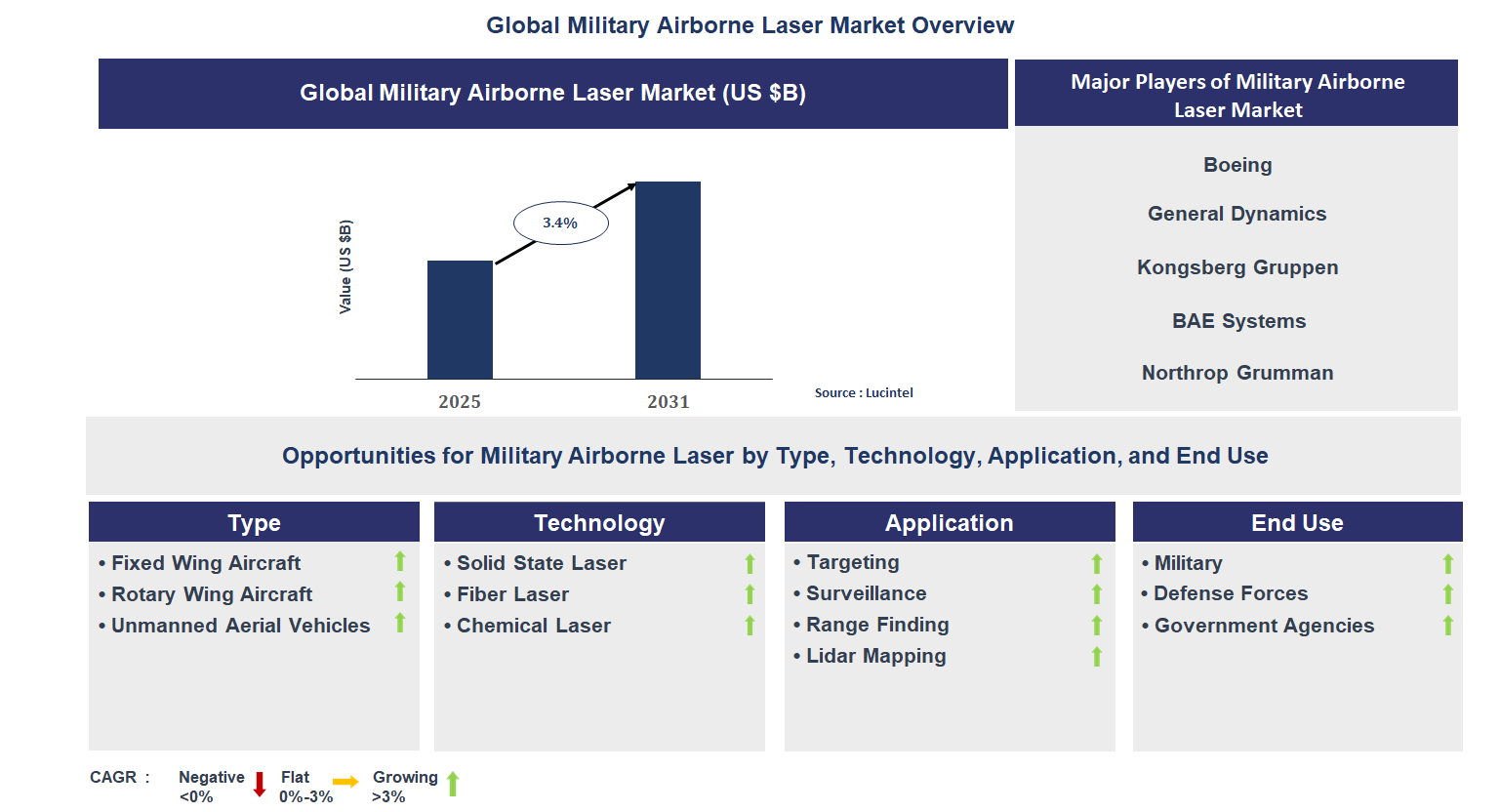
Key data points: The growth forecast = 3.4% annually for the next 7 years. Scroll below to get more insights. This market report covers trends, opportunities and forecasts in military airborne laser market to 2031 by type (fixed wing aircraft, rotary wing aircraft, and unmanned aerial vehicles), technology (solid state laser, fiber laser, and chemical laser), application (targeting, surveillance, range finding, and lidar mapping), end use (military, defense forces, and government agencies), and region (North America, Europe, Asia Pacific, and the Rest of the World)
We'll send your sample report shortly.
• Lucintel forecasts that, within the type category, fixed wing aircraft is expected to witness the highest growth over the forecast period.
• Within the end use category, military is expected to witness the highest growth.
• In terms of region, APAC is expected to witness the highest growth over the forecast period. Gain valuable insights for your business decisions with our comprehensive 150+ page report. Sample figures with some insights are shown below.
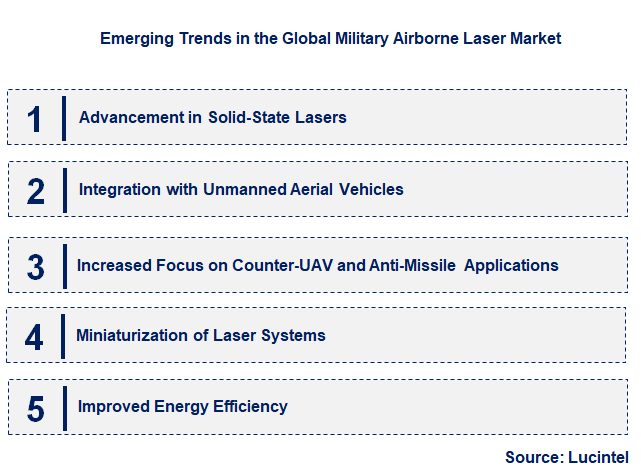
• Advancement in Solid-State Lasers: Solid-state lasers are gaining traction due to their high efficiency, durability, and compact size. This technology is becoming more effective for airborne applications as it allows for higher power output in smaller, more portable systems. Their potential for long-range engagements and precision targeting is increasing interest in military airborne laser systems.
• Integration with Unmanned Aerial Vehicles: The integration of airborne lasers with UAVs is a growing trend, as drones provide a cost-effective platform for laser systems. UAVs can be deployed for a variety of defense applications, including surveillance, anti-drone operations, and precision strikes. This combination enhances operational flexibility and reduces risks to manned aircraft.
• Increased Focus on Counter-UAV and Anti-Missile Applications: The need for effective countermeasures against drones and missile threats is propelling the development of airborne lasers. These systems are increasingly being designed to neutralize incoming threats at long ranges, offering a significant advantage in modern warfare, especially in high-intensity conflicts where missile defense is a priority.
• Miniaturization of Laser Systems: The miniaturization of laser systems for airborne applications is enabling their integration into smaller platforms, including tactical aircraft and helicopters. This trend is making laser systems more versatile and accessible for various military operations, improving the agility and operational readiness of air forces around the world.
• Improved Energy Efficiency: Energy efficiency is becoming a critical factor in the development of military airborne laser systems. Advances in energy generation and storage technologies are allowing lasers to be used more effectively, with longer operational durations and greater power output. This trend is expected to enhance the overall capabilities and sustainability of directed energy weapons. The emerging trends in the military airborne laser market, including advancements in solid-state lasers, UAV integration, counter-UAV applications, miniaturization, and improved energy efficiency, are reshaping defense strategies worldwide. These trends are driving innovation in laser technologies and expanding their applications in modern warfare, enhancing both offensive and defensive capabilities.
• Successful Testing of High-Powered Lasers: The successful testing of high-powered lasers by the U.S. military and China has marked a major milestone in the development of airborne laser technology. These lasers are now capable of disabling or destroying missiles and drones in mid-flight, demonstrating their effectiveness in real-world combat scenarios. This development is bolstering the credibility of directed energy weapons.
• Deployment of Lasers for Anti-Missile Defense: The U.S. and China have developed airborne laser systems capable of intercepting and destroying missiles during their flight phases. These systems are designed to protect aircraft, naval vessels, and ground installations from ballistic and cruise missile threats. The implementation of such technology provides a significant advantage in missile defense.
• Integration of Directed Energy with UAVs: The integration of laser systems with unmanned aerial vehicles (UAVs) is advancing rapidly. Drones equipped with laser weapons are being tested for use in counter-drone operations, allowing for quick and efficient neutralization of adversary drones. This development is crucial for military operations in congested airspaces and against small, agile threats.
• Collaboration Between Defense Contractors: There has been an increase in collaboration between defense contractors, research institutions, and governments to advance military airborne laser technology. These partnerships are crucial for pooling resources, knowledge, and expertise in developing high-performance lasers that can be deployed on various military platforms.
• Research into Compact Laser Systems: Research into smaller, more efficient laser systems is gaining momentum. These compact systems are being developed to fit on smaller platforms such as helicopters, tactical aircraft, and naval vessels. This development is enhancing the versatility and scalability of laser systems, making them more adaptable for different operational scenarios. Recent developments in the military airborne laser market are driving significant advances in missile defense, counter-drone operations, and laser integration with UAVs. These developments enhance the operational capabilities of military forces, ensuring greater precision and flexibility in modern defense strategies.
• Expansion of Counter-Drone Capabilities: With the increasing proliferation of drones in military operations, there is a significant opportunity for the development of airborne lasers specifically designed for counter-drone defense. This application is gaining momentum, as lasers offer precise, rapid responses to small, agile threats, making them ideal for intercepting enemy UAVs in real-time.
• Missile Defense Systems: The integration of airborne laser systems into missile defense platforms represents a major growth opportunity. As missile threats evolve, high-powered lasers provide a cost-effective, scalable solution for intercepting ballistic and cruise missiles. Expanding these capabilities across various defense sectors offers significant market potential.
• Collaborative Defense Partnerships: Strategic collaborations between defense contractors and governments can create growth opportunities in the market. Joint research and development programs can help accelerate advancements in military airborne laser technology, providing more efficient, powerful, and reliable systems. These partnerships can lead to quicker adoption and deployment of laser systems.
• Naval and Maritime Defense: Lasers mounted on naval vessels are a growing area of interest, providing effective defense against missile and drone threats at sea. The versatility and precision of laser systems make them ideal for naval defense, creating opportunities for expansion within this sector, especially for countries with advanced maritime capabilities.
• Integration with Airborne Platforms: The integration of lasers with a variety of aircraft platforms, including fighter jets, bombers, and reconnaissance planes, offers substantial growth potential. As laser technology becomes more miniaturized and efficient, its application in air combat and surveillance operations is expected to increase, boosting the market for airborne laser systems. Strategic growth opportunities in the military airborne laser market, including counter-drone capabilities, missile defense, collaborative partnerships, naval defense, and airborne platform integration, are reshaping defense capabilities globally. These opportunities are poised to drive the widespread adoption and deployment of laser technologies in military operations.
• Boeing
• General Dynamics
• Kongsberg Gruppen
• BAE Systems
• Northrop Grumman
• Israel Aerospace Industries
• Textron
• SAAB
• Leonardo
• Hewlett Packard Enterprise
• Fixed Wing Aircraft
• Rotary Wing Aircraft
• Unmanned Aerial Vehicles
• Solid State Laser
• Fiber Laser
• Chemical Laser
• Targeting
• Surveillance
• Range Finding
• Lidar Mapping
• Military
• Defense Forces
• Government Agencies
• North America
• Europe
• Asia Pacific
• The Rest of the World
• United States: The U.S. is a global leader in military airborne laser technology, with the ongoing development of high-powered laser systems for various defense applications. The U.S. Air Forces Airborne Laser Test Bed (ALTB) program has seen advancements in directed energy weaponry, including laser systems mounted on aircraft for missile defense. The U.S. is also expanding research into solid-state lasers, improving energy efficiency and operational capabilities.
• China: China is rapidly advancing its military airborne laser capabilities, focusing on developing high-powered lasers for both defensive and offensive purposes. Recent reports indicate that China has successfully tested laser systems mounted on aircraft for anti-drone and missile defense. The country’s military modernization efforts emphasize the integration of laser technologies into a wide range of platforms, including UAVs and fighter jets.
• Germany: Germany has made significant strides in integrating airborne laser systems into its defense strategy. The German military is exploring directed energy weaponry as a potential countermeasure for missile and drone defense. Collaboration with defense contractors and research institutions is enhancing Germany’s capabilities in high-powered laser technology, particularly for aircraft-mounted systems aimed at neutralizing threats at long ranges.
• India: India has shown growing interest in military airborne laser technology, with a focus on strengthening its defense capabilities. The Indian government has been investing in research and development of directed energy weapons for applications such as missile interception and drone defense. India is also exploring collaborations with global defense firms to enhance its indigenous capabilities in this advanced technology.
• Japan: Japan is enhancing its military capabilities with a focus on laser technology for both defense and surveillance purposes. Japanese defense agencies are exploring airborne laser systems to combat missile threats and protect key infrastructure. Research is underway to develop compact, high-efficiency lasers that can be mounted on aircraft, offering a strategic advantage in missile defense and maritime security operations.


• Boeing
• General Dynamics
• Kongsberg Gruppen
• BAE Systems
• Northrop Grumman
• Israel Aerospace Industries
• Textron
• SAAB
• Leonardo
• Hewlett Packard Enterprise Q5. Which military airborne laser market segment will be the largest in future? Answer: Lucintel forecasts that, within the type category, fixed wing aircraft is expected to witness the highest growth over the forecast period. Q6. In military airborne laser market, which region is expected to be the largest in next 5 years? Answer: In terms of region, APAC is expected to witness the highest growth over the forecast period. Q7. Do we receive customization in this report? Answer: Yes, Lucintel provides 10% customization without any additional cost.


Choose a license that fits your team. Instant PDF delivery.
Prices exclude taxes. Instant delivery. Custom licensing available on request.
Market Report · July 31, 2026
Market Report · July 31, 2026
Market Report · July 31, 2026
Trusted partner for strategic intelligence and business growth


Receive a complimentary market analysis tailored to your industry. Our analysts will identify key growth opportunities and competitive dynamics specific to your business.

Market size, growth rate, and key trend analysis for your specific sector.

Top competitor positioning and market share analysis.

Strategic recommendations backed by data-driven insights.
Get curated market intelligence and competitive moves straight to your inbox.
By subscribing, you agree to receive our monthly insights. Unsubscribe anytime.
Receive a complimentary market analysis tailored to your industry. Our analysts will identify key growth opportunities and competitive dynamics specific to your business.
Market size, growth rate, and key trend analysis for your specific sector.
Top competitor positioning and market share analysis.
Strategic recommendations backed by data-driven insights.
Get curated market intelligence, emerging trends, and competitive moves straight to your inbox each month.
By subscribing, you agree to receive our monthly insights. Unsubscribe anytime.
We'll send your sample report shortly.