
Market Report · May 18, 2026

This market report covers trends, opportunities, and forecasts in the global military aerospace pcb market to 2031 by product technology (single-sided pcb, double-sided pcb, and multi-layered pcb), application (radar installations, power supplies, power conversion, radio communication, lighting, engine control systems, and others), and region (North America, Europe, Asia Pacific, and the Rest of the World)
We'll send your sample report shortly.
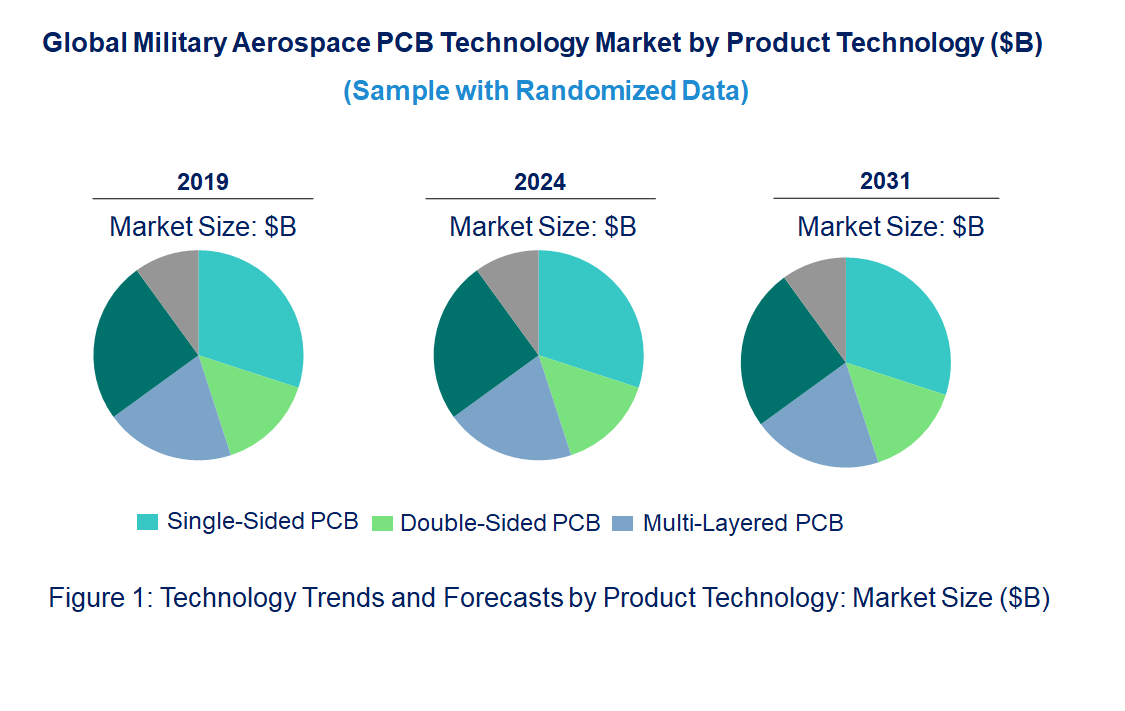
![Military Aerospace PCB Market Trend and Forecast by Application [Value from 2019 to 2031]:](https://lucintel.com/images/Military-Aerospace-PCB-Technology-Market-Segment.png "Military Aerospace PCB Market Trend and Forecast by Application [Value from 2019 to 2031]:")
• Adoption of Flexible and Rigid-Flex PCBs: Flexible and rigid-flex PCBs replace traditional rigid boards more often. These designs present lightweight, compact solutions as critical elements for modern aerospace systems. Their ability to bend and accommodate irregular shapes has improved their integration into complex equipment while providing a reduction in total system weight.
• Integration of High-Density Interconnect (HDI) Technology: Military aerospace HDI PCBs have started appearing with finer lines, vias, and connections of higher density. They improve performance and miniaturize, thus becoming vital elements for the development of newer avionics, improved radar systems, and much more.
• Advanced Thermal Management Using Materials: High-performance materials like polyimide, ceramic-filled laminates, and metal cores are used to improve heat dissipation and reliability. These materials ensure the stability of operations in high-temperature environments, which is the usual problem in aerospace applications.
• Emphasis on Electromagnetic Interference (EMI) Shielding: The PCB design integrates enhanced EMI shielding techniques, such as using special coatings and ground planes. These protect sensitive military aerospace systems from electromagnetic interference, ensuring signal integrity and operational reliability.
• Use of Embedded Components: There is an increasing trend to directly embed passive and active components into PCBs. It minimizes size, increases performance, and enhances reliability due to reduced interconnection points. It is an ideal trend for mission-critical aerospace systems. These emerging trends bring out the transformative changes that are taking place in military aerospace PCB technology. As it embraces these advancements like flexible designs, HDI technology, and better materials, the industry is well prepared to face the rising demands for performance, durability, and efficiency. Such innovations redefine the capability of military aerospace systems, opening new possibilities for defense and aviation applications.
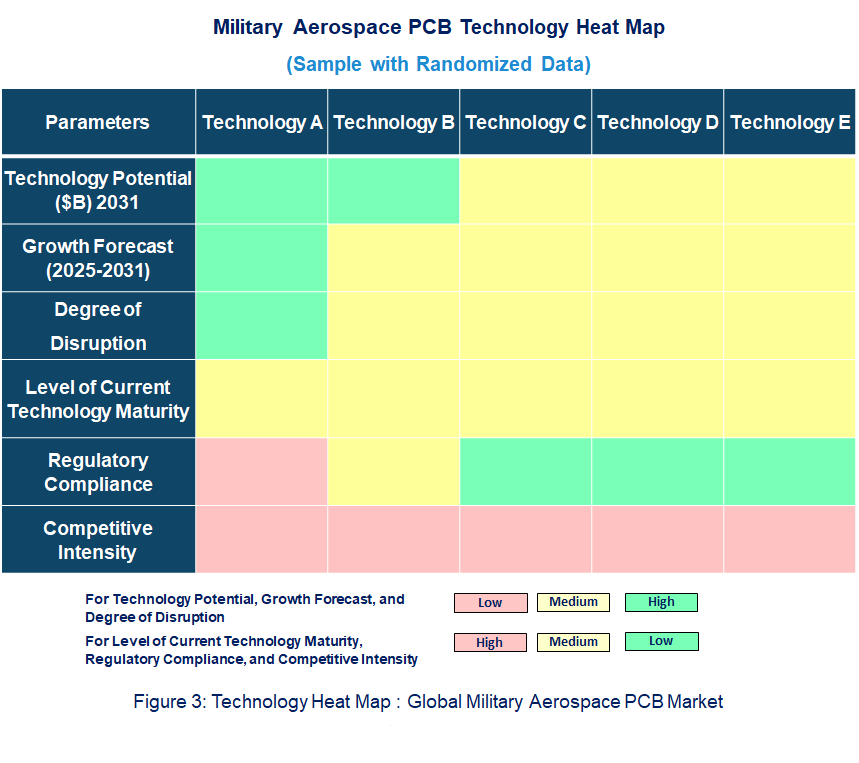
• Technology Potential: Military aerospace PCB technology is full of promise to change the face of defense and aviation systems. With developments in flexible and rigid-flex PCBs, HDI technology, and embedded components, these innovations allow for lightweight designs, enhanced performance, and improved integration in complex systems.
• Degree of Disruption: The shift towards advanced materials, such as ceramic-filled laminates and metal cores, along with EMI shield innovations. This represents a significant disruption to traditional PCB manufacturing. Such technologies are completely redefining system reliability and operational efficiency in mission-critical environments.
• Level of Current Technology Maturity: Though mature for traditional rigid PCBs, the adoption of new emerging technologies like flexible PCBs and embedded components varies at different levels. Integration into aerospace systems indicates steady progress toward broader application and reliability.
• Regulatory Compliance: Military Aerospace PCB technology is very strict about regulatory compliance. It is safety, reliability, and environmental standards. Strict guidelines must be followed, including ITAR (International Traffic in Arms Regulations) and RoHS (Restriction of Hazardous Substances), to ensure global applicability and adherence to defense requirements.
• Amitron: Amitron has developed advanced thermal management solutions in their PCB designs with metal-core PCBs and specialized laminates. This ensures reliability in high-temperature environments, which is a critical requirement for aerospace applications.
• Corintech: Corintech uses flexible and rigid-flex PCB technologies to achieve lightweight and compact designs. Their recent developments cater to avionics and unmanned aerial vehicles (UAVs), thus enhancing system integration and reducing overall weight.
• Delta Circuits: NexLogic has invested in HDI (High-Density Interconnect) PCB technology, which has enabled miniaturization and increased performance for complex military electronics. Their developments support leading-edge communication systems and advanced radar technologies.
• Excello Circuits: The Excello Circuits has recently released PCBs with added EMI shielding and also embedded components. Such designs address the modern need for signal integrity and compactness in military aerospace equipment for assured performance in sensitive environments. These developments by market leaders are reflective of continuous innovation in Military Aerospace PCB technology. Advanced materials, design techniques, and manufacturing processes adopted in these developments are changing the industry and making possible superior performance in critical defense and aerospace applications.
• Advancements in Military Aircraft and Systems: Advances in military aircraft, drones, and satellite systems are fueling the demand for higher-end PCB technologies. Such developments increase operational capabilities, improve communication systems, and ensure performance under harsh conditions.
• Increasing Military Budgets and Defense Spending: Major global players’ increased defense spending has increased demand for high-performance PCBs. Military spending is primarily focused on modernization and new technologies, which require upgraded and more reliable electronic systems.
• Advanced Electronic Warfare (EW) Systems Integration: The rising electronic warfare, which extensively relies on advanced electronics to intercept signals, jam, and provide countermeasures, calls for the need to have robust and high-frequency PCBs that can withstand tough operational environments.
• Modular and Scalable Systems: Military aerospace applications have modular and scalable designs, which call for PCBs that can be easily adapted to a variety of configurations and upgradable, thereby increasing demand for innovative PCB technologies. Challenges
• Stringent Military and Regulatory Standards:Manufacturers face the challenges of adhering to strict military specifications, including various standards for quality, safety, and environmental factors. These requirements can increase production costs and development timelines.
• Supply Chain Disruptions: Raw materials and components can sometimes cause disruptions in the supply chain and geopolitical climate, potentially slowing down production and adding cost.
• Technological Complexity and R&D Costs: The advancement of PCB technology to meet the requirements of modern aerospace and military demands involves large R&D investment. Increased design complexity and the demand for high-reliability solutions also become economic and logistical burdens.
• Cybersecurity Concerns: As connected and networked military systems continue to grow, the cybersecurity of PCBs is of utmost importance. This, in turn, complicates the manufacturing process and elevates the cost because extra layers of protection are necessary. Military aerospace PCB technology is a field heavily influenced by advancements in military systems and increased defense spending, which drives demand for high-performance PCBs. However, challenges such as regulatory standards, supply chain disruptions, and cybersecurity concerns require industry players to innovate continuously. The combined drivers and challenges shape a dynamic market that must balance technological evolution with operational and economic hurdles.
• Amitron
• Corintech
• Delta Circuits
• Nexlogic
• Excello Circuits
• Technology Readiness by Technology Type: The most mature and most widely adopted are single-sided PCBs. These are easy to design and cost-efficient. Therefore, they can be applied in basic consumer electronics, appliances, and simple automotive applications. Double-sided PCBs are also very established. They are meant for mid-level electronics like industrial equipment, communication devices, and more complex consumer products. Multi-layered PCBs are the most advanced and suitable for high-performance applications, such as military aerospace systems, advanced medical equipment, and high-speed communication devices, where space, signal integrity, and thermal management are paramount. These PCBs support multi-functional, compact designs, enabling rapid technological innovations. The readiness of multi-layered PCBs is driven by continuous R&D efforts, pushing forward the capabilities in miniaturization and complex circuit integration.
• Competitive Intensity and Regulatory Compliance: The competitive intensity in the military aerospace PCB market differs according to the technology type. Single-sided PCBs have low competition since they are usually basic components with less customization. The wider application of double-sided PCBs, together with their flexibility, makes a more competitive environment; however, multi-layered PCBs are the ones that face the highest intensity in competition, given the high-end and unique solutions that such a technology commands. The regulatory compliance continues to be a tightrope for more complex technologies. Single-sided PCBs meet rather relaxed standards. Double and multi-layered PCBs have to adhere to more strenuous military and industrial specifications to ensure that the components are reliable, safe, and environmentally friendly. For multilayer PCBs in high-performance applications and sectors, such as aerospace and defense, they need even more rigid specifications.
• Disruption Potential by Technology Type: Single-side PCBs, although simplistic, are essential for relatively simple applications and low-cost solutions, but not very disruption potential due to simplicity. In double-sided PCBs, there is greater design freedom, and they can handle moderate complexities, thus better suited to a wide range of applications in electronics. Multi-layer PCBs are highly disruptive due to their ability to support complex, compact designs with very high component density and functions. These PCBs are driving innovation in aerospace, telecommunications, and military technology toward better performance and miniaturization. Multi-layered PCBs ensure greater signal integrity and thermal management than single-layer PCBs and are critical in applications with high frequency and high reliability. They have a feature of integration that puts them as transformational in application sectors where technology needs to be more complex. Multi-layered PCBs are scalable and robust to meet the requirements of future technological advancements and higher performance standards.
• Single-Sided PCB
• Double-Sided PCB
• Multi-Layered PCB
• Radar Installations
• Power Supplies
• Power Conversion
• Radio Communication
• Lighting
• Engine Control Systems
• Others
• North America
• Europe
• Asia Pacific
• The Rest of the World
• Latest Developments and Innovations in the Military Aerospace PCB Technologies
• Companies / Ecosystems
• Strategic Opportunities by Technology Type


Choose a license that fits your team. Instant PDF delivery.
Prices exclude taxes. Instant delivery. Custom licensing available on request.
Market Report · May 18, 2026
Market Report · May 18, 2026
Market Report · May 18, 2026
Trusted partner for strategic intelligence and business growth


Receive a complimentary market analysis tailored to your industry. Our analysts will identify key growth opportunities and competitive dynamics specific to your business.

Market size, growth rate, and key trend analysis for your specific sector.

Top competitor positioning and market share analysis.

Strategic recommendations backed by data-driven insights.
Get curated market intelligence and competitive moves straight to your inbox.
By subscribing, you agree to receive our monthly insights. Unsubscribe anytime.
Receive a complimentary market analysis tailored to your industry. Our analysts will identify key growth opportunities and competitive dynamics specific to your business.
Market size, growth rate, and key trend analysis for your specific sector.
Top competitor positioning and market share analysis.
Strategic recommendations backed by data-driven insights.
Get curated market intelligence, emerging trends, and competitive moves straight to your inbox each month.
By subscribing, you agree to receive our monthly insights. Unsubscribe anytime.
We'll send your sample report shortly.