
Market Report · July 16, 2026

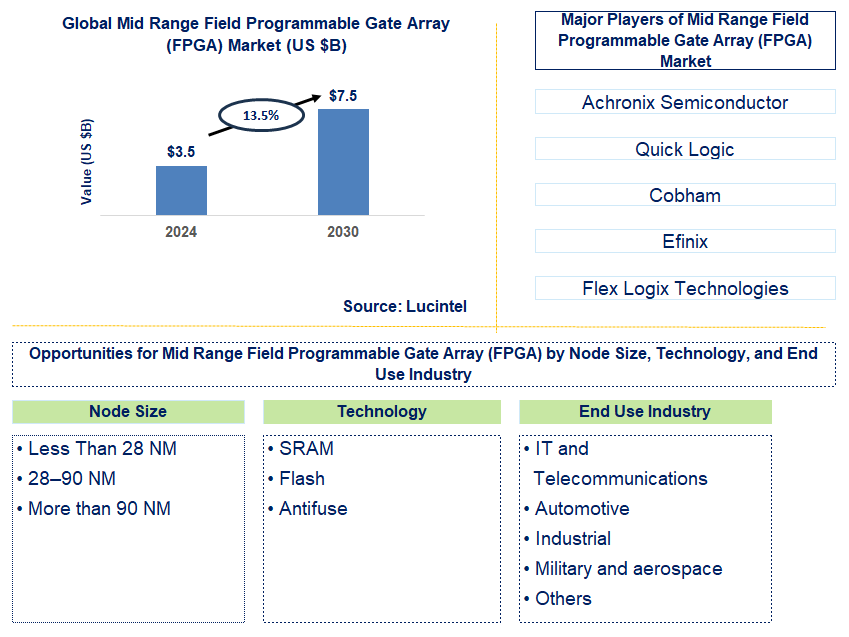
Key data points: The market size in 2030 = $7.5 billion, growth forecast = 13.5% annually for the next 6 years. Scroll below to get more insights. This market report covers trends, opportunities, and forecasts in the global mid range field programmable gate array (fpga) market to 2030 by node size (less than 28 NM, 28–90 NM, and more than 90 NM), technology (SRAM, flash, and antifuse), end use industry ( IT and telecommunications, Automotive, Industrial, Military and aerospace, and others), and region (North America, Europe, Asia Pacific, and the Rest of the World)
We'll send your sample report shortly.
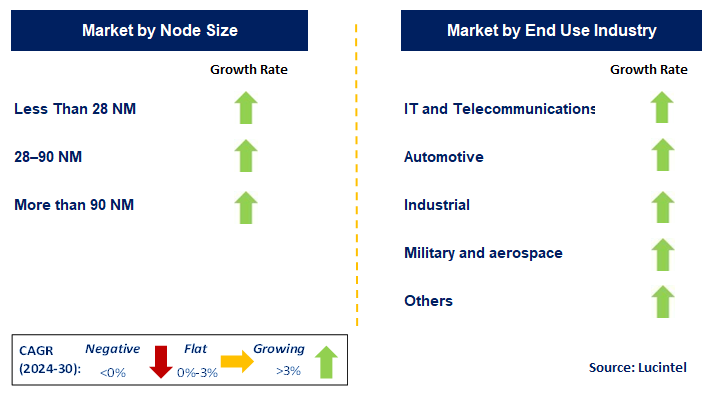
• Lucintel forecast that within the node size category, 28–90 NM is expected to witness the highest growth over the forecast period due to growing demand for FPGAs in high-performance computing applications and advantages like a good balance of performance, flexibility, and cost.
• Within the end use industry category, IT and telecommunications will remain the largest segment due to the variety of networking applications, such as routers, switches, and firewalls, and its utility in the development of 5G networks.
• In terms of regions, APAC is expected to witness the highest growth over the forecast period due to the increasing adoption of cloud computing and big data analytics and rising demand for 5G networks in this region. Gain valuable insights for your business decisions with our 150+ page report.
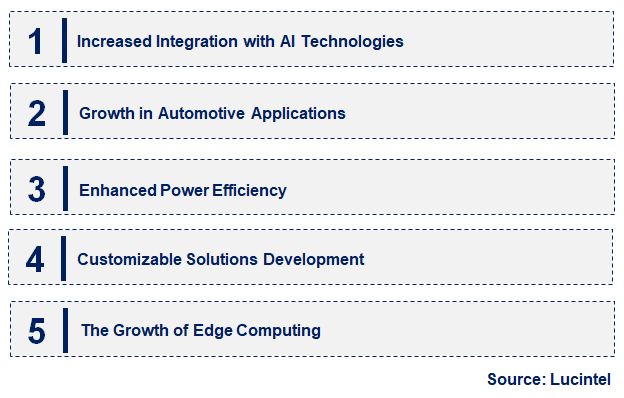
• Increased Integration with AI Technologies: Mid-range FPGAs are increasingly integrated with artificial intelligence (AI) and machine learning capabilities, improving applications requiring real-time data processing and decision-making, such as in the automotive industry and data centers.
• Growth in Automotive Applications: Increased demand for Advanced Driver Assistance Systems (ADAS) and autonomous vehicles has driven growth in automotive applications. Mid-range FPGAs optimized for high-speed data processing and real-time control are increasingly important in automotive electronics.
• Enhanced Power Efficiency: Advances in power management technology are leading to higher energy efficiency in mid-range FPGAs. This trend is critical in areas such as portable devices and environments that require low power consumption without significantly affecting performance.
• Customizable Solutions Development: There is a growing market for application-specific customizable FPGA solutions, addressing diverse areas such as telecom, industrial automation, and consumer electronics, allowing for greater flexibility and optimization.
• Growth of Edge Computing: Edge computing environments increasingly rely on mid-range FPGAs. This local processing capability enhances real-time data processing, enabling faster response rates and reduced latency. These developments are transforming the mid-range FPGA industry by fostering innovations that boost performance, efficiency, and application-specific functionalities. Continued development will significantly impact the FPGA market's direction and growth.
• Increasing Performance Capabilities: Recent modifications to increase the performance speed of mid-range FPGAs focus on boosting computational complexity and data-handling capabilities for advanced AI-based applications and telecommunications.
• Cost-Cutting Measures: Production and design process optimizations implemented by manufacturers are making mid-range FPGAs more affordable and widely used across different areas.
• Progress in Security Features: Security features embedded in mid-range FPGAs address concerns over data integrity and protection. These steps are essential for applications in financial services, healthcare, and critical infrastructure.
• Compatibility with New Technologies: Combining mid-range FPGAs with IoT devices and edge computing enables more efficient data processing and connectivity in smart devices and industrial systems.
• Focus on Customization and Flexibility: A growing focus on customization allows users to tailor mid-range FPGAs to meet specific requirements. This adaptability is a major driver in sectors such as automotive, aerospace, and consumer electronics. These developments improve mid-range FPGA performance, reduce costs, and broaden application capabilities. As advancements continue, they will shape the future direction of FPGA technology across various industries.
• Industrial Automation: The integration rate of mid-range FPGAs into industrial automation systems that promote flexibility, scalability, and real-time processing is increasing. Demand for tailored automation solutions and efficient data management is driving growth.
• Automotive Electronics: This sector rapidly adopts mid-range FPGAs for advanced driver assistance systems (ADAS), infotainment units, and electric vehicle control devices. Their capability to handle complex algorithms and adapt to new requirements supports this growth.
• Communications Infrastructure: Mid-range FPGAs are essential in next-generation communication networks, including 5G infrastructure. Their reconfigurability allows for fast, adaptable, and scalable network designs with high-speed processing.
• Artificial Intelligence and Machine Learning: The rise in AI and ML applications has fueled demand for mid-range FPGAs, which enable efficient hardware acceleration for faster processing and reduced power consumption.
• Internet of Things (IoT): The increase in IoT devices drives the need for edge computing solutions, where mid-range FPGAs support local data processing and analysis, reducing latency and improving system efficiency. The mid-range FPGA market is expanding rapidly due to technological advancements, growing demand, and the need for flexible and scalable solutions. These opportunities shape the market's future and foster innovation across sectors.
• Technological Advancements: Innovations in FPGA technology, such as larger sizes, higher speeds, and improved energy efficiency, drive market growth.
• Increased Demand for Customization: Growing interest in tailored solutions for specific applications increases demand for mid-range FPGAs.
• Cost Reductions: Mid-range FPGAs are becoming more affordable as manufacturing costs decrease and supply chains improve efficiency.
• Emerging Applications: New applications, such as virtual and augmented reality, expand opportunities for mid-range FPGAs.
• Government Initiatives: Government support for technological development and industrial expansion promotes FPGA market growth. Challenges:
• Design Complexity: Increasing complexity in FPGA designs poses challenges for developers and extends development cycles.
• Supply Chain Constraints: Limited supplies of essential components and potential disruptions may hinder market growth.
• Competition from Other Technologies: Mid-range FPGAs face competition from other technologies, such as application-specific integrated circuits (ASICs). The mid-range FPGA market is driven by technological developments, demand for customization, and cost-saving initiatives. However, challenges such as design complexity, supply chain constraints, and competition must be addressed for sustained growth.
• Achronix Semiconductor
• Quick Logic
• Cobham
• Efinix
• Flex Logix Technologies
• Intel
• Xilinx
• Aldec
• Gowin Semiconductor
• Lattice Semiconductor
• Less Than 28 NM
• 28–90 NM
• More than 90 NM
• SRAM
• Flash
• Antifuse
• IT and Telecommunications
• Automotive
• Industrial
• Military and aerospace
• Others
• North America
• Europe
• Asia Pacific
• The Rest of the World
• United States: In the US, AI and machine learning applications drive advancements in FPGA technology. Companies integrate high-performance computing capabilities into mid-range FPGAs, leading to innovations in data centers and edge computing.
• China: China focuses on producing affordable, dense mid-range FPGAs to support its expanding telecommunications and automotive sectors. Domestic manufacturers are increasing production capacity to meet local and international demand.
• Germany: Industrial automation and automotive applications drive the development of mid-range FPGAs in Germany. Widespread adoption in smart manufacturing is increasing due to improved security features and real-time processing capabilities.
• India: India's FPGA market growth centers around low-power, high-performance devices, supported by expanding infrastructure projects and a growing tech sector.
• Japan: Japan's mid-range FPGAs benefit from advanced power management and miniaturization technologies, improving performance in consumer electronics, robotics, and automotive sectors where precision and efficiency are crucial.


• Achronix Semiconductor
• Quick Logic
• Cobham
• Efinix
• Flex Logix Technologies
• Intel
• Xilinx
• Aldec
• GOWIN Semiconductor
• Lattice Semiconductor Q6. Which mid range field programmable gate array (FPGA) market segment will be the largest in future? Answer: Lucintel forecast that 28–90 NM is expected to witness the highest growth over the forecast period due to growing demand for FPGAs in high-performance computing applications and advantages like a good balance of performance, flexibility, and cost. Q7. In mid range field programmable gate array (FPGA) market, which region is expected to be the largest in next 5 years? Answer: APAC is expected to witness highest growth over the forecast period due to increasing adoption of cloud computing and big data analytics and rising demand for 5G networks in this region. Q.8 Do we receive customization in this report? Answer: Yes, Lucintel provides 10% customization without any additional cost.


Choose a license that fits your team. Instant PDF delivery.
Prices exclude taxes. Instant delivery. Custom licensing available on request.
Market Report · July 16, 2026
Market Report · May 18, 2026
Market Report · May 18, 2026
Trusted partner for strategic intelligence and business growth


Receive a complimentary market analysis tailored to your industry. Our analysts will identify key growth opportunities and competitive dynamics specific to your business.

Market size, growth rate, and key trend analysis for your specific sector.

Top competitor positioning and market share analysis.

Strategic recommendations backed by data-driven insights.
Get curated market intelligence and competitive moves straight to your inbox.
By subscribing, you agree to receive our monthly insights. Unsubscribe anytime.
Receive a complimentary market analysis tailored to your industry. Our analysts will identify key growth opportunities and competitive dynamics specific to your business.
Market size, growth rate, and key trend analysis for your specific sector.
Top competitor positioning and market share analysis.
Strategic recommendations backed by data-driven insights.
Get curated market intelligence, emerging trends, and competitive moves straight to your inbox each month.
By subscribing, you agree to receive our monthly insights. Unsubscribe anytime.
We'll send your sample report shortly.