
Market Report · July 31, 2026

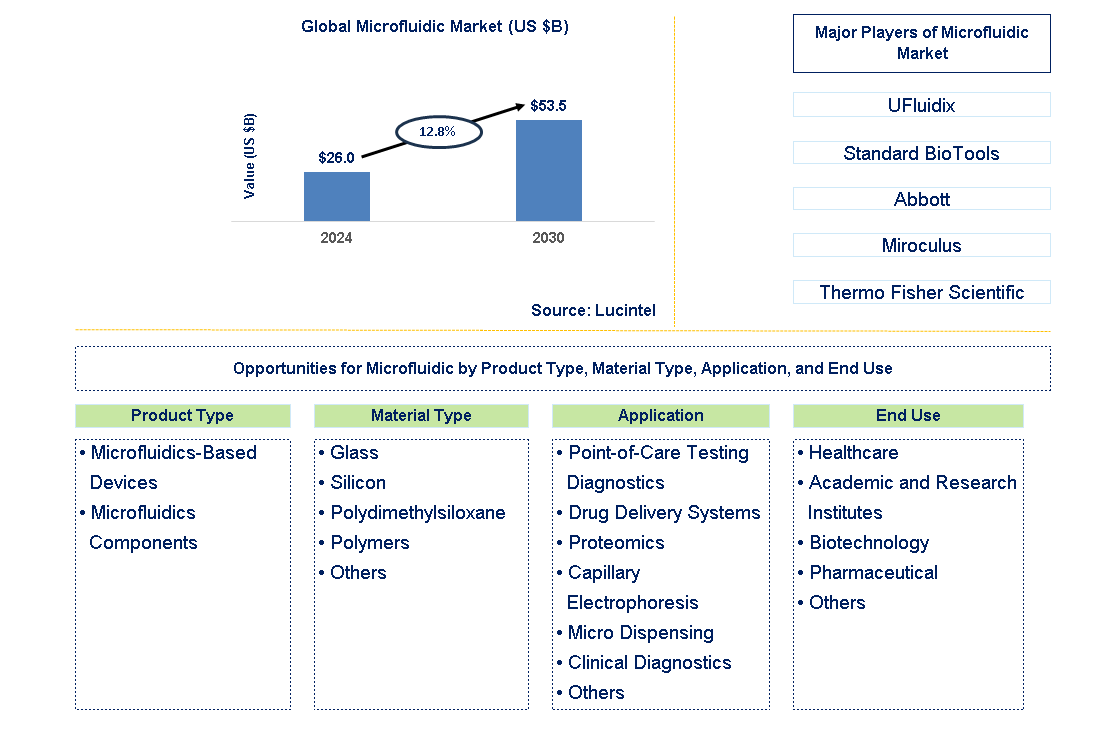
Key data points: The market size in 2030 = $53.5 billion, growth forecast = 12.8% annually next 6 years. Scroll below to get more insights. This market report covers trends, opportunities, and forecast in the global microfluidic market to 2030 by product type (microfluidics-based devices and microfluidics components), material type (glass, silicon, polydimethylsiloxane (PDMS), polymers, and others), application (point-of-care testing diagnostics, drug delivery systems, proteomics, capillary electrophoresis, micro dispensing, clinical diagnostics, and others), end use (healthcare, academic and research institutes, biotechnology, pharmaceutical, and others), and region (North America, Europe, Asia Pacific, and the Rest of the World)
We'll send your sample report shortly.
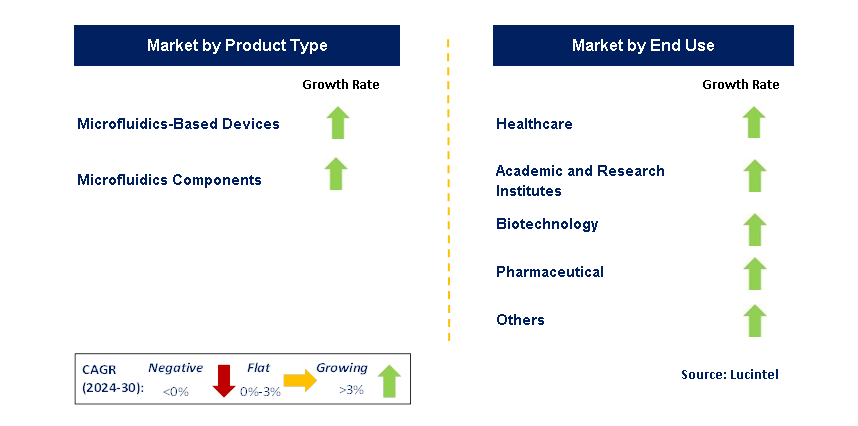
• Lucintel forecasts that microfluidics component is expected to witness the higher growth over the forecast period.
• Within this market, healthcare is expected to witness the highest growth over the forecast period.
• North America will remain the largest region over the forecast period.
• United States: Substantial investment in research and development has been a significant driver of the growth of microfluidics in the U.S. Some key developments include the incorporation of artificial intelligence and machine learning into microfluidic devices to improve diagnostics, both detection as well as identification. Regulations on approval have also made it relatively easier to get point-of-care testing devices approved by the FDA. Academia-industry collaborations are also on the rise to develop novel applications of diagnostics and therapeutics.
• China: China is enhancing healthcare outlays from its government and urging advanced diagnostic solutions, thereby propelling their microfluidics market at an incredible rate. The country of China is looking to enhance manufacturing for microfluidic devices, making them more affordable and accessible. Innovative platforms regarding detection and monitoring of infectious diseases are helping companies win the game. Speedy testing solutions will also be valuable according to global health trends.
• Germany: Another country well known for strong thrust on R&D in microfluidics is Germany. New developments include enhanced lab-on-a-chip technologies along with testing platforms that can automate the testing process. Demand for microfluidic devices also is coming from the precision medicine focus of German healthcare. The innovation here is closely tied with the initiative of university collaboration with biotech firms, especially where the applications are for diagnostics as well as environmental monitoring, and Germany's presence remains strong in the world market.
• India: India Microfluidics market is on a roll due to increased awareness of healthcare innovations. Affordability for diagnostic solutions will keep propelling the local manufacturers to develop low cost microfluidic devices. Research and development are increasing through government initiatives toward healthcare infrastructure improvements. There will be a focus on personalized medicine, which will increase adoption in clinical settings for the application of microfluidic technologies.
• Japan: Advancement in nanotechnology and precision engineering characterizes the Japan microfluidics market. Drug delivery system and biomarker analysis are some of the areas where the market is growing. The government of Japan, through R&D of healthcare technologies, has furthered applications in diagnostics and pharmaceuticals with innovative applications. Corporate and academic collaboration to develop niche medical devices has contributed to the advancement of cutting-edge microfluidics.
• Expansion of Point-of-Care Testing: Point-of-care testing is increasingly being sought after, in a thrust towards rapid diagnostic solutions. Microfluidic devices, in particular, make external testing quick and accurate, thus equipping clinical environments with instant decision-making capabilities. This trend reduces the wait times of patients and enhances patient care through enhanced access to critical diagnostic information.
• Integration of AI and Machine Learning: In microfluidics, artificial intelligence and machine learning can provide improved data analysis and interpretation. These further enhance the accuracy of diagnostics and enable the development of predictive models-a stepping stone toward personalized medicine approaches. This is, in fact, transforming the management of patients to accommodate timely interventions based on these highly accurate data analyses.
• Emerging Lab-on-a-Chip Technologies: LOC technologies are gaining popularity, where multiple laboratory functions can be performed on one device. This trend means increased efficiency and also reduces the demand for large infrastructure in the laboratory. It is handy in resource-poor settings, making advanced diagnostics more available and accessible.
• Focus on Personalized Medicine: Demand for microfluidic technologies is driven by changes in medicine to personalized care. Tailored diagnostics and therapy plans enhance outcomes of therapies that come to be tailored to genetic and biological profiles. This is thereby changing and establishing microfluidics as an important component in modern care.
• Sustainable Microfluidic Solutions: There is more recent focus on the development of eco-friendly microfluidic devices with environmentally friendly materials and processes. This aligns with worldwide goals of sustainability towards health solutions that are environment-friendly.
All this consideration of sustainability and environmentally friendly care solutions made its high diagnostic potential, new applications, and better patient results become some of the main drivers and forcers of innovation and growth in the market.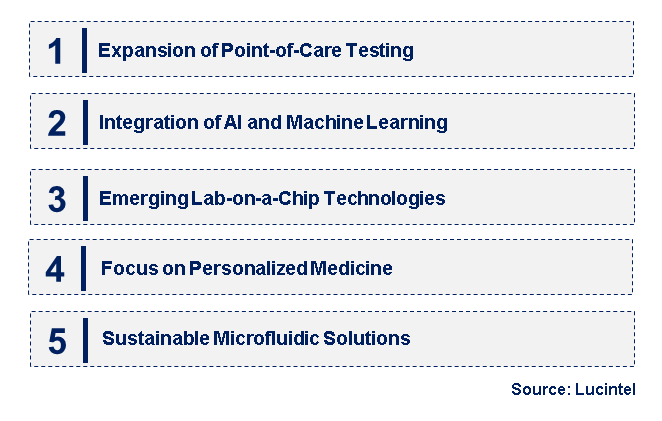
• New Advances in Microfluidic Devices: New materials and designs in microfluidic devices have improved both performances and functionalities in recent developments. From rapid diagnostics, novel drug delivery devices, and other advanced applications, new devices are at the fore, moving device functionalities and efficiencies in clinical practice forward.
• FDA Approvals for New Technologies: Regulatory Support: The FDA has fast-tracked the approval for microfluidic technologies, especially for testing devices at the point of care. Therefore, regulatory support sends innovation solutions to faster market entry, healthy competition, and further strengthening technological advancements in the field.
• Collaborative Research: Research collaborations between universities and industry players provide the next front for unleashing innovation in microfluidics. Novel applications or improvement upon existing technology through these collaborative researches are leading to breakthroughs in diagnostics and therapeutics.
• Commercialization of Lab-on-a-Chip Platforms: The commercialization of lab-on-a-chip platforms is currently being developed and allows multiples tests to be run simultaneously. It will then become more efficient in diagnostics, yet still at low costs, especially for resource-poor environments.
• Rise of Startups: Startups focused on microfluidic technologies abound, changing the game. Such firms will be developing novel devices, but also applications, which can take the impetus for innovation, and competition within marketplaces to a very high level.
These advances are driving the microfluidics market forward by providing better diagnostics accuracy, increases efficiencies as well as expanding applications toward the delivery of better patient care and health outcomes.• In Vitro Diagnostics (IVD) Applications: The IVD segment also boasts of bright prospects due to the growing need for speedy diagnosis with accuracy. Microfluidics enhances streamlined processing and analysis of samples and thus remains an essential technology in laboratories and point-of-care.
• Drug Delivery Systems: Microfluidics is increasingly being utilized in drug delivery systems in applications where strong regulation over dosage delivery and release rate is needed. Utilization of microfluidics in drug delivery systems increases the efficiency of treatment and minimizes side effects, hence encouraging the pharmaceutical industry and personalized medicine.
• Environmental Monitoring: Microfluidics is the next giant opportunity for environmental monitoring. Devices made specifically to detect pollutants and toxins can be used in real time monitoring, improving public health and safety, and thus market potential for innovations.
• Biotechnology Research: Microfluidics is another area in biotechnology that has emerged to involve rapid development in cell culture and analysis. Research into it accelerates more efficient laboratory experiments for faster life science innovation, which in turn leads to quicker development of various therapeutic solutions.
• Home Diagnostics: Development of microfluidic devices for home diagnostics is a unique opportunity for growth. With portable and more friendly testing kits, it would enable patients to watch themselves from their homes, thus greater accessibility and patient-level health management will be witnessed.
Growth opportunities are redefining the microfluidics market by expanding its applications as well as access to innovative diagnostic technologies to better enhance patient care and drive market growth.• UFluidix
• Standard BioTools
• Abbott
• Miroculus
• Thermo Fisher Scientific
• Danaher Corporation
• Bio-Rad Laboratories
• PerkinElmer
• Dolomite Microfluidics
• Qiagen
• Microfluidics-Based Devices
• Microfluidics Components
• Glass
• Silicon
• Polydimethylsiloxane
• Polymers
• Others
• Point-of-Care Testing Diagnostics
• Drug Delivery Systems
• Proteomics
• Capillary Electrophoresis
• Micro Dispensing
• Clinical Diagnostics
• Healthcare
• Academic and Research Institutes
• Biotechnology
• Pharmaceutical
• Others
• North America
• Europe
• Asia Pacific
• The Rest of the World
• Lucintel forecasts that microfluidics component is expected to witness the higher growth over the forecast period.
• Within this market, healthcare is expected to witness the highest growth over the forecast period.
• North America will remain the largest region over the forecast period.


• UFluidix
• Standard BioTools
• Abbott
• Miroculus
• Thermo Fisher Scientific
• Danaher Corporation
• Bio-Rad Laboratories
• PerkinElmer
• Dolomite Microfluidics
• Qiagen
Q6. Which microfluidic market segment will be the largest in future?

Choose a license that fits your team. Instant PDF delivery.
Prices exclude taxes. Instant delivery. Custom licensing available on request.
Market Report · July 31, 2026
Market Report · July 31, 2026
Market Report · July 31, 2026
Trusted partner for strategic intelligence and business growth


Receive a complimentary market analysis tailored to your industry. Our analysts will identify key growth opportunities and competitive dynamics specific to your business.

Market size, growth rate, and key trend analysis for your specific sector.

Top competitor positioning and market share analysis.

Strategic recommendations backed by data-driven insights.
Get curated market intelligence and competitive moves straight to your inbox.
By subscribing, you agree to receive our monthly insights. Unsubscribe anytime.
Receive a complimentary market analysis tailored to your industry. Our analysts will identify key growth opportunities and competitive dynamics specific to your business.
Market size, growth rate, and key trend analysis for your specific sector.
Top competitor positioning and market share analysis.
Strategic recommendations backed by data-driven insights.
Get curated market intelligence, emerging trends, and competitive moves straight to your inbox each month.
By subscribing, you agree to receive our monthly insights. Unsubscribe anytime.
We'll send your sample report shortly.