
Report Feature
Microdisplay Plane Market Trends and Forecast
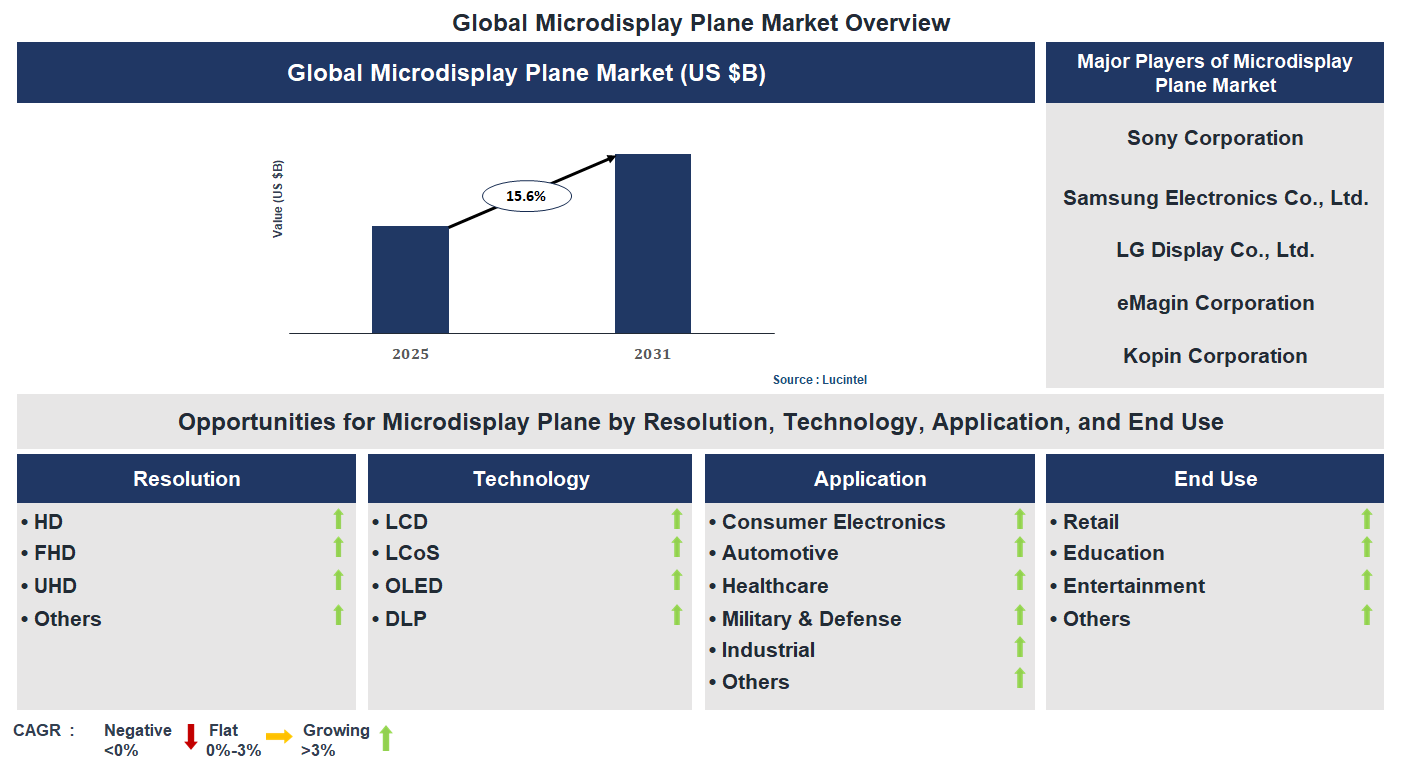
The future of the global microdisplay plane market looks promising with opportunities in the retail, education, and entertainment markets. The global microdisplay plane market is expected to grow with a CAGR of 15.6% from 2025 to 2031. The major drivers for this market are the increasing demand for portable devices, the rising adoption of augmented reality technology, and the growing preference for high-resolution displays.• Lucintel forecasts that, within the technology category, LCD is expected to witness the highest growth over the forecast period.
• Within the end use category, retail is expected to witness the highest growth.
• In terms of region, North America is expected to witness the highest growth over the forecast period. Gain valuable insights for your business decisions with our comprehensive 150+ page report. Sample figures with some insights are shown below.
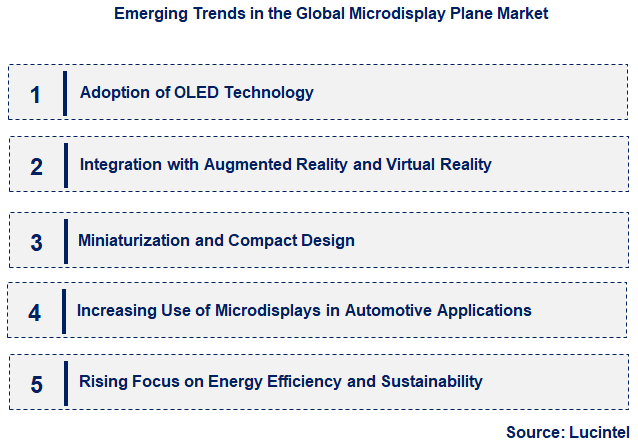
Emerging Trends in the Microdisplay Plane Market
The microdisplay plane market is experiencing rapid evolution driven by technological advancements, increasing demand for compact display solutions, and expanding applications across various industries such as consumer electronics, healthcare, and automotive sectors. As the need for high-resolution, energy-efficient, and versatile display technologies grows, market players are innovating to meet these demands. Emerging trends are shaping the future landscape, influencing product development, market strategies, and consumer preferences. These developments are not only expanding the market size but also redefining the competitive dynamics, making it crucial for stakeholders to stay informed about the latest trends to capitalize on new opportunities.• Adoption of OLED Technology: OLED microdisplays are gaining popularity due to their superior contrast ratios, faster response times, and flexibility. This trend enhances display quality in applications like augmented reality (AR) and virtual reality (VR), providing more immersive experiences. The lightweight and thin profile of OLEDs also contributes to the miniaturization of devices, making them ideal for wearable tech and head-up displays. As OLED manufacturing becomes more cost-effective, its adoption is expected to accelerate, driving innovation and expanding market reach.
• Integration with Augmented Reality and Virtual Reality: Microdisplays are increasingly being integrated into AR and VR devices, offering high-resolution visuals in compact form factors. This trend is transforming gaming, training, healthcare, and industrial applications by providing more realistic and interactive experiences. The demand for lightweight, high-quality displays is pushing manufacturers to develop advanced microdisplays with higher pixel densities and wider fields of view. As AR and VR markets grow, the microdisplay segment is poised to benefit significantly, fueling further technological advancements and new product launches.
• Miniaturization and Compact Design: The push for smaller, more portable devices is driving innovation in microdisplay technology. Manufacturers are focusing on reducing the size and power consumption of microdisplays without compromising performance. This trend is critical for applications like smart glasses, head-up displays, and compact medical devices. The miniaturization trend enhances user comfort, device aesthetics, and functionality, opening new avenues for wearable and embedded systems. As a result, the market is witnessing a surge in demand for ultra-thin, energy-efficient microdisplays tailored for diverse applications.
• Increasing Use of Microdisplays in Automotive Applications: The automotive industry is adopting microdisplays for heads-up displays (HUDs), instrument clusters, and infotainment systems. These displays improve driver safety by providing real-time information without diverting attention from the road. The trend towards autonomous vehicles and connected cars further accelerates demand for high-resolution, durable microdisplays capable of operating under harsh conditions. This integration is transforming vehicle interfaces, making them more intuitive and informative, and opening new revenue streams for microdisplay manufacturers.
• Rising Focus on Energy Efficiency and Sustainability: As environmental concerns grow, the market is shifting towards energy-efficient microdisplays that consume less power and have a lower carbon footprint. Innovations include the development of low-power OLEDs and microLEDs, which offer brighter displays with less energy consumption. This trend aligns with the broader push for sustainable technology solutions across industries. Manufacturers are investing in eco-friendly materials and manufacturing processes to meet regulatory standards and consumer expectations, ultimately leading to more sustainable and cost-effective display solutions. In summary, these emerging trends are significantly reshaping the microdisplay plane market by enhancing display quality, enabling new applications, and promoting sustainability. The focus on advanced technologies like OLED and microLED, along with the integration into AR, VR, and automotive sectors, is driving growth and innovation. Miniaturization and energy efficiency are further supporting the development of versatile, eco-friendly products. Collectively, these trends are creating a dynamic market landscape that offers exciting opportunities for manufacturers, developers, and consumers alike.
Recent Development in the Microdisplay Plane Market
The microdisplay plane market is experiencing rapid innovation driven by advancements in display technology, increasing demand for immersive visual experiences, and expanding applications across consumer electronics, automotive, and healthcare sectors. These developments are shaping the future landscape, offering new growth opportunities and competitive advantages. As industries seek more compact, high-resolution, and energy-efficient displays, market players are investing heavily in research and development to meet evolving consumer and industrial needs. The following key developments highlight the current trajectory of this dynamic market.• Technological Advancements in Microdisplay Resolution: The focus on higher resolution microdisplays is enabling sharper, more detailed images, which significantly enhance user experience in virtual reality (VR), augmented reality (AR), and head-up displays (HUDs). These improvements are driven by innovations in OLED and LCD technologies, leading to better contrast, color accuracy, and energy efficiency. As a result, manufacturers can deliver more immersive and realistic visual experiences, expanding the adoption of microdisplays in various high-end applications and increasing market competitiveness.
• Integration of Microdisplays in Automotive HUDs: The automotive industry is increasingly adopting microdisplays for head-up displays, providing drivers with real-time information without distraction. This integration improves safety, navigation, and driver assistance systems, making vehicles smarter and more connected. The development of compact, durable, and high-brightness microdisplays tailored for automotive environments is accelerating market growth. This trend is expected to boost demand, especially as autonomous and semi-autonomous vehicles become more prevalent, transforming in-car user interfaces.
• Growth of Wearable and Augmented Reality Devices: The rising popularity of wearable devices and AR applications is fueling demand for lightweight, high-resolution microdisplays. These displays are critical for delivering clear visuals in compact form factors, enhancing user engagement in gaming, training, and industrial applications. Innovations in microdisplay technology are enabling longer battery life and improved comfort, which are essential for mass adoption. This growth is expanding the market beyond traditional sectors, opening new avenues for manufacturers and increasing competition.
• Expansion into Healthcare and Medical Imaging: Microdisplays are increasingly used in medical imaging devices, surgical displays, and diagnostic tools, offering high precision and real-time visualization. These displays improve accuracy in procedures and diagnostics, leading to better patient outcomes. Advances in biocompatible materials and miniaturization are making microdisplays more suitable for medical applications. The healthcare sectors adoption is expected to grow significantly, driving innovation and creating new market segments focused on medical-grade display solutions.
• Development of Flexible and Transparent Microdisplays: The emergence of flexible and transparent microdisplays is opening new possibilities for innovative product designs, including foldable devices, heads-up displays, and smart windows. These displays offer enhanced durability, aesthetic appeal, and integration capabilities. Technological breakthroughs in flexible substrates and transparent materials are reducing costs and improving performance. This trend is set to revolutionize consumer electronics, automotive, and architectural applications, broadening the scope and versatility of microdisplay technology in the market. These developments are significantly transforming the microdisplay plane market by enhancing display quality, expanding application areas, and enabling innovative product designs. The integration of high-resolution, flexible, and specialized displays across industries is driving market growth and competitiveness. As technological advancements continue, the market is poised for substantial expansion, offering new opportunities for manufacturers and stakeholders. Overall, these trends are fostering a more dynamic, versatile, and high-performance microdisplay ecosystem.
Strategic Growth Opportunities in the Microdisplay Plane Market
The microdisplay plane market is experiencing rapid expansion driven by technological advancements and increasing demand across various industries. Innovations in display quality, miniaturization, and integration with emerging technologies are creating new growth opportunities. Key applications such as augmented reality, virtual reality, automotive displays, and consumer electronics are fueling market development. Companies are investing heavily in R&D to enhance performance, reduce costs, and expand applications, positioning the market for sustained growth over the coming years.• Expansion in Augmented Reality and Virtual Reality Devices: The rising adoption of AR and VR devices is a significant growth driver for microdisplay planes. These displays offer high resolution, low latency, and compact form factors essential for immersive experiences. As consumer and enterprise applications grow, demand for advanced microdisplays with better brightness, contrast, and power efficiency increases. This creates opportunities for manufacturers to develop tailored solutions that meet the specific needs of AR/VR headsets, gaming, and training applications, fueling overall market expansion.
• Integration of Microdisplays in Automotive Heads-Up Displays (HUDs): The automotive industry is increasingly adopting microdisplays for HUDs to enhance driver safety and experience. Microdisplays enable clear, real-time information projection directly onto windshields, reducing driver distraction. The demand for high-resolution, durable, and energy-efficient displays is rising with the growth of connected and autonomous vehicles. Automakers seek innovative microdisplay solutions that can withstand harsh conditions while providing seamless integration with vehicle systems, opening new avenues for market growth.
• Growth in Consumer Electronics and Wearable Devices: Consumer electronics, including smartwatches, AR glasses, and compact cameras, are driving demand for microdisplays. These devices require small, lightweight, and high-quality displays to improve user experience. As wearable technology becomes more sophisticated, microdisplays with enhanced resolution, brightness, and power efficiency are increasingly sought after. Manufacturers are focusing on miniaturization and cost reduction, which will expand the application scope and accelerate market growth in this segment.
• Advancements in Microdisplay Technology for Medical and Industrial Applications: Microdisplays are gaining traction in medical imaging, diagnostics, and industrial inspection due to their precision and compact size. In medical devices, they enable high-resolution visualization for surgeries and diagnostics. Industrial applications benefit from microdisplays in quality control, machine vision, and augmented maintenance. Continuous technological improvements, such as higher contrast ratios and better durability, are expanding their use cases, creating new growth opportunities in these specialized sectors.
• Increasing Demand for Microdisplays in Military and Aerospace Sectors: Military and aerospace applications require rugged, high-performance microdisplays for heads-up displays, pilot helmets, and simulation systems. These displays must operate reliably under extreme conditions, with high brightness and low latency. Growing defense budgets and technological modernization initiatives are boosting demand. Innovations in microdisplay durability, energy efficiency, and integration with advanced sensors are further expanding their use in these sectors, contributing significantly to overall market growth. The overall impact of these opportunities is set to significantly accelerate the microdisplay plane market, fostering innovation and expanding its application landscape. As industries adopt more advanced, miniaturized display solutions, market players will benefit from increased demand and new revenue streams. This growth will also drive technological advancements, making microdisplays more versatile, affordable, and accessible across multiple sectors, ensuring sustained market development in the coming years.
Microdisplay Plane Market Driver and Challenges
The microdisplay plane market is influenced by a variety of technological, economic, and regulatory factors that shape its growth trajectory. Rapid advancements in display technology, increasing demand for augmented reality (AR) and virtual reality (VR) applications, and the need for compact, high-resolution displays are key drivers. Additionally, economic factors such as rising consumer spending on electronics and government initiatives supporting innovation play significant roles. Regulatory standards concerning safety, environmental impact, and intellectual property rights also impact market dynamics. Navigating these complex factors is essential for stakeholders aiming to capitalize on emerging opportunities while addressing potential hurdles. The factors responsible for driving the microdisplay plane market include:• Technological Innovation: The continuous development of microdisplay technologies such as OLED, LCD, and microLED has significantly enhanced display resolution, brightness, and energy efficiency. These innovations enable the creation of smaller, more powerful displays suitable for AR/VR devices, head-up displays, and wearable technology. As technology advances, manufacturers can offer higher-quality products that meet consumer and industrial demands, fueling market growth. Moreover, integration with AI and IoT further expands application possibilities, making microdisplays more versatile and essential in modern electronics.
• Growing AR and VR Market: The increasing adoption of augmented reality and virtual reality across sectors like gaming, healthcare, education, and military is a major growth driver. Microdisplays are critical components in AR/VR headsets, providing immersive visual experiences with high resolution and low latency. As these applications become mainstream, demand for compact, high-performance microdisplays rises. The proliferation of AR glasses and VR devices is expected to significantly boost market revenues, driven by consumer interest and enterprise adoption for training, simulation, and remote assistance.
• Rising Consumer Electronics Demand: The surge in consumer electronics sales, including smartphones, smart glasses, and wearable devices, directly impacts the microdisplay market. Consumers seek devices with enhanced visual quality, compact design, and longer battery life, all of which microdisplays can deliver. The increasing affordability and availability of these displays make them attractive for manufacturers aiming to differentiate their products. As consumer preferences shift towards more interactive and visually rich devices, the market for microdisplays is poised for substantial expansion.
• Industry Collaboration and Investment: Strategic partnerships between display manufacturers, technology firms, and end-user industries are accelerating innovation and commercialization. Investments in research and development enable the creation of advanced microdisplay solutions tailored for specific applications. Collaborations also facilitate the integration of microdisplays into diverse products, expanding market reach. Government grants and funding initiatives further support technological breakthroughs, fostering a competitive environment that drives market growth and diversification.
• Regulatory and Standards Development: The establishment of regulatory frameworks concerning safety, environmental impact, and intellectual property rights influences market operations. Compliance with standards related to electromagnetic emissions, hazardous materials, and product safety ensures market acceptance and consumer trust. Additionally, intellectual property protections encourage innovation by safeguarding technological advancements. Navigating these regulatory landscapes is crucial for market participants to avoid legal issues and to ensure the smooth commercialization of microdisplay products. The challenges facing this microdisplay plane market include:
• Technological Complexity and Cost: Developing microdisplays with high resolution, brightness, and low power consumption involves complex manufacturing processes, which can be costly. Achieving consistent quality at scale remains a challenge, often resulting in higher product prices. This cost barrier can limit adoption, especially in price-sensitive markets. Additionally, integrating microdisplays into various devices requires sophisticated engineering, which can increase development time and expenses, potentially slowing market growth and limiting accessibility for smaller players.
• Short Product Lifecycles and Rapid Obsolescence: The fast-paced nature of display technology leads to short product lifecycles, with frequent updates and innovations rendering existing products obsolete quickly. This rapid obsolescence pressures manufacturers to continuously invest in R&D and inventory management, increasing operational costs. Consumers and industries may also hesitate to invest heavily in microdisplay-based products due to concerns over rapid technological changes, which can hinder long-term market stability and growth.
• Regulatory and Environmental Challenges: Stringent regulations related to environmental sustainability, such as restrictions on hazardous materials and waste disposal, pose compliance challenges for manufacturers. Meeting these standards often requires redesigning products and supply chains, increasing costs. Additionally, concerns over electromagnetic interference and safety standards can delay product launches. Navigating diverse regulatory environments across regions complicates international expansion and may limit market penetration, especially for smaller firms lacking resources to meet complex compliance requirements. In summary, the microdisplay plane market is driven by technological advancements, expanding AR/VR applications, rising consumer electronics demand, strategic collaborations, and evolving regulatory standards. However, it faces challenges such as high development costs, rapid product obsolescence, and complex regulatory compliance. These factors collectively influence market growth, requiring stakeholders to innovate continuously while managing costs and regulatory risks. Overall, the markets future depends on balancing technological progress with effective regulatory navigation and cost management strategies, ensuring sustainable growth and competitive advantage.
List of Microdisplay Plane Companies
Companies in the market compete on the basis of product quality offered. Major players in this market focus on expanding their manufacturing facilities, R&D investments, infrastructural development, and leverage integration opportunities across the value chain. With these strategies microdisplay plane companies cater increasing demand, ensure competitive effectiveness, develop innovative products & technologies, reduce production costs, and expand their customer base. Some of the microdisplay plane companies profiled in this report include-• Sony Corporation
• Samsung Electronics Co., Ltd.
• LG Display Co., Ltd.
• eMagin Corporation
• Kopin Corporation
• Himax Technologies, Inc.
• AU Optronics Corp.
• Jasper Display Corp.
• MicroVision, Inc.
• Syndiant Inc.
Microdisplay Plane Market by Segment
The study includes a forecast for the global microdisplay plane market by resolution, technology, application, end use, and region.Microdisplay Plane Market by Resolution [Value from 2019 to 2031]:
• HD
• FHD
• UHD
• Others
Microdisplay Plane Market by Technology [Value from 2019 to 2031]:
• LCD
• LCoS
• OLED
• DLP
Microdisplay Plane Market by Application [Value from 2019 to 2031]:
• Consumer Electronics
• Automotive
• Healthcare
• Military & Defense
• Industrial
• Others
Microdisplay Plane Market by End Use [Value from 2019 to 2031]:
• Retail
• Education
• Entertainment
• Others
Microdisplay Plane Market by Region [Value from 2019 to 2031]:
• North America
• Europe
• Asia Pacific
• The Rest of the World
Country Wise Outlook for the Microdisplay Plane Market
The microdisplay plane market has experienced significant growth driven by technological advancements and increasing demand across various sectors such as consumer electronics, automotive, healthcare, and military applications. Innovations in display resolution, size, and power efficiency have propelled market expansion globally. Countries are investing heavily in research and development to enhance display quality and integrate new functionalities. The competitive landscape is evolving with new entrants and collaborations, fostering rapid innovation. As the market matures, regulatory and supply chain factors also influence development trajectories. Here is a country-specific overview of recent developments in this dynamic market.• United States: The US market has seen substantial advancements with major tech companies investing in microdisplay technology for augmented reality (AR) and virtual reality (VR) devices. Innovations in OLED and microLED displays have improved image quality and energy efficiency. The government’s focus on defense applications has also spurred research into high-resolution microdisplays for military headsets and heads-up displays. Startups and established firms are collaborating to develop lightweight, high-performance displays, boosting the overall market growth.
• China: China has emerged as a key player, with significant investments in microdisplay manufacturing and R&D. Domestic companies are focusing on integrating microdisplays into consumer electronics, such as smartphones and smart glasses. The government’s support for semiconductor and display technology development has accelerated innovation. Chinese firms are also expanding into the automotive and healthcare sectors, developing microdisplays for heads-up displays and medical imaging, respectively, which enhances their global competitiveness.
• Germany: Germany’s market development is characterized by a focus on industrial and automotive applications. Leading automotive manufacturers are adopting microdisplays for advanced driver-assistance systems (ADAS) and augmented reality dashboards. German research institutions are pioneering in microLED technology, aiming to improve display brightness and lifespan. The country’s emphasis on precision engineering and innovation has fostered the development of high-quality, durable microdisplays suitable for demanding industrial environments.
• India: India is witnessing growing interest in microdisplay technology primarily for consumer electronics and healthcare applications. Startups and research institutions are exploring cost-effective microdisplay solutions to cater to the expanding domestic market. The government’s initiatives to promote electronics manufacturing and innovation are facilitating the development of indigenous microdisplay technologies. Additionally, collaborations with international firms are helping Indian companies access advanced manufacturing processes and design expertise.
• Japan: Japan continues to lead in microdisplay innovation, especially in the fields of consumer electronics, gaming, and medical devices. Major corporations are investing in microLED and OLED microdisplays to enhance product performance. Japan’s focus on miniaturization and energy efficiency has resulted in high-resolution, compact displays used in wearable devices and AR glasses. The country’s strong R&D ecosystem and strategic partnerships are driving continuous improvements and new applications in the microdisplay plane market.

Features of the Global Microdisplay Plane Market
Market Size Estimates: Microdisplay plane market size estimation in terms of value ($B). Trend and Forecast Analysis: Market trends (2019 to 2024) and forecast (2025 to 2031) by various segments and regions. Segmentation Analysis: Microdisplay plane market size by various segments, such as by resolution, technology, application, end use, and region in terms of value ($B). Regional Analysis: Microdisplay plane market breakdown by North America, Europe, Asia Pacific, and Rest of the World. Growth Opportunities: Analysis of growth opportunities in different resolutions, technologies, applications, end uses, and regions for the microdisplay plane market. Strategic Analysis: This includes M&A, new product development, and competitive landscape of the microdisplay plane market. Analysis of competitive intensity of the industry based on Porter’s Five Forces model.
FAQ
Q1. What is the growth forecast for microdisplay plane market? Answer: The global microdisplay plane market is expected to grow with a CAGR of 15.6% from 2025 to 2031. Q2. What are the major drivers influencing the growth of the microdisplay plane market? Answer: The major drivers for this market are the increasing demand for portable devices, the rising adoption of augmented reality technology, and the growing preference for high-resolution displays. Q3. What are the major segments for microdisplay plane market? Answer: The future of the microdisplay plane market looks promising with opportunities in the retail, education, and entertainment markets. Q4. Who are the key microdisplay plane market companies? Answer: Some of the key microdisplay plane companies are as follows:• Sony Corporation
• Samsung Electronics Co., Ltd.
• LG Display Co., Ltd.
• eMagin Corporation
• Kopin Corporation
• Himax Technologies, Inc.
• AU Optronics Corp.
• Jasper Display Corp.
• MicroVision, Inc.
• Syndiant Inc. Q5. Which microdisplay plane market segment will be the largest in future? Answer: Lucintel forecasts that, within the technology category, LCD is expected to witness the highest growth over the forecast period. Q6. In microdisplay plane market, which region is expected to be the largest in next 5 years? Answer: In terms of region, North America is expected to witness the highest growth over the forecast period. Q7. Do we receive customization in this report? Answer: Yes, Lucintel provides 10% customization without any additional cost.
Table of Contents
List of Figures
List of Tables
Methodology
- In-depth interviews of the major players in this market
- Detailed secondary research from competitors’ financial statements and published data
- Extensive searches of published works, market, and database information pertaining to industry news, company press releases, and customer intentions
- A compilation of the experiences, judgments, and insights of Lucintel’s professionals, who have analyzed and tracked this market over the years.


Buy Now
Choose a license that fits your team. Instant PDF delivery.
Prices exclude taxes. Instant delivery. Custom licensing available on request.
Key Questions
- • What are some of the most promising, high-growth opportunities for the microdisplay plane market by resolution (HD, FHD, UHD, and others), technology (LCD, LCoS, OLED, and DLP), application (consumer electronics, automotive, healthcare, military & defense, industrial, and others), end use (retail, education, entertainment, and others), and region (North America, Europe, Asia Pacific, and the Rest of the World)?
- • Which segments will grow at a faster pace and why?
- • Which region will grow at a faster pace and why?
- • What are the key factors affecting market dynamics? What are the key challenges and business risks in this market?
- • What are the business risks and competitive threats in this market?
- • What are the emerging trends in this market and the reasons behind them?
- • What are some of the changing demands of customers in the market?
- • What are the new developments in the market? Which companies are leading these developments?
- • Who are the major players in this market? What strategic initiatives are key players pursuing for business growth?
- • What are some of the competing products in this market and how big of a threat do they pose for loss of market share by material or product substitution?
- • What M&A activity has occurred in the last 6 years and what has its impact been on the industry? For any questions related to Microdisplay Plane Market, Microdisplay Plane Market Size, Microdisplay Plane Market Growth, Microdisplay Plane Market Analysis, Microdisplay Plane Market Report, Microdisplay Plane Market Share, Microdisplay Plane Market Trends, Microdisplay Plane Market Forecast, Microdisplay Plane Companies, write Lucintel analyst at email: helpdesk@lucintel.com. We will be glad to get back to you soon.


