
Report Feature
Microcarrier Separation System Market Trends and Forecast
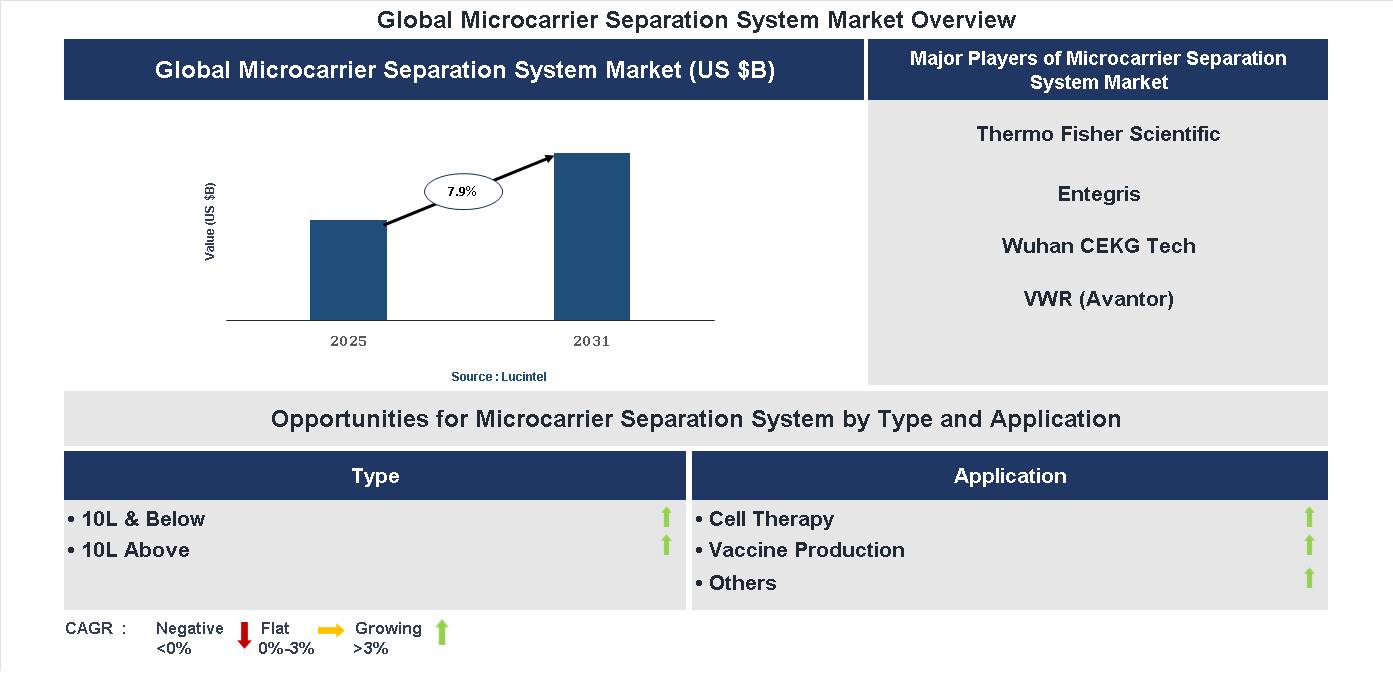
The future of the global microcarrier separation system market looks promising with opportunities in the cell therapy and vaccine production markets. The global microcarrier separation system market is expected to grow with a CAGR of 7.9% from 2025 to 2031. The major drivers for this market are the increasing demand for advanced cell therapies, the rising use of biopharmaceutical production techniques, and the growing need for scalable cell culture systems.• Lucintel forecasts that, within the type category, 10l & below is expected to witness higher growth over the forecast period.
• Within the application category, cell therapy is expected to witness higher growth.
• In terms of region, APAC is expected to witness the highest growth over the forecast period. Gain valuable insights for your business decisions with our comprehensive 150+ page report. Sample figures with some insights are shown below.
Emerging Trends in the Microcarrier Separation System Market
The microcarrier separation system market is experiencing rapid evolution driven by technological advancements, increasing demand for biopharmaceuticals, and a focus on improving process efficiency. As bioprocessing becomes more sophisticated, the need for precise, scalable, and cost-effective separation systems is growing. Innovations in automation, material science, and system integration are shaping the future landscape of this market. These developments are not only enhancing product yields and purity but also reducing operational costs and processing times. The following key trends highlight the major shifts influencing the market's trajectory and how companies are adapting to meet emerging industry needs.• Adoption of Automation and Digital Technologies: Increasing integration of automation and digital tools in separation systems enhances process control, reduces human error, and improves reproducibility. Automated systems enable real-time monitoring and adjustments, leading to higher efficiency and consistency in bioprocessing. Digital technologies such as AI and machine learning optimize separation parameters, predict system performance, and facilitate troubleshooting. This trend is driven by the need for scalable, reliable, and compliant manufacturing processes, especially in large-scale biopharmaceutical production. The impact includes faster turnaround times, reduced labor costs, and improved product quality.
• Development of Advanced Materials and Membranes: Innovation in materials used for microcarriers and separation membranes is a significant trend. New materials offer enhanced biocompatibility, durability, and selectivity, which improve separation efficiency and the lifespan of equipment. These advanced materials reduce fouling and facilitate easier cleaning, thereby decreasing downtime and operational costs. The adoption of novel membrane technologies also enables better separation of cells and proteins, leading to higher yields. This trend supports the market's shift toward more sustainable and cost-effective solutions, ultimately improving overall process performance.
• Growing Demand for Single-Use Systems: The market is witnessing a surge in single-use separation systems due to their flexibility, reduced contamination risk, and lower capital investment. Single-use systems eliminate the need for cleaning and sterilization, enabling faster changeovers and increased production agility. They are particularly advantageous for small to medium batch sizes and personalized medicine applications. This trend is driven by the biopharmaceutical industry's focus on rapid development cycles and cost efficiency. The impact includes minimized cross-contamination risks, simplified logistics, and enhanced scalability, making single-use systems a preferred choice for many manufacturers.
• Focus on Process Intensification and Scalability: There is a strong emphasis on developing scalable and process-intensive separation systems that can handle higher cell densities and product titers. Innovations aim to streamline workflows, reduce process steps, and increase throughput without compromising quality. This trend supports the industry's move toward continuous processing and integrated bioprocessing. The impact is a significant reduction in manufacturing costs, shorter production timelines, and improved flexibility to meet market demands. It also enables companies to efficiently scale up from laboratory to commercial production, ensuring consistent product quality.
• Emphasis on Sustainability and Eco-Friendly Solutions: Environmental concerns are prompting the adoption of greener separation technologies. This includes the use of recyclable materials, energy-efficient systems, and waste reduction strategies. Companies are investing in sustainable designs that minimize water and chemical usage, aligning with global environmental standards. This trend not only reduces the environmental footprint but also appeals to eco-conscious consumers and regulators. The impact is a market shift toward sustainable bioprocessing solutions, fostering innovation in eco-friendly materials and processes that support long-term industry growth. In summary, these trends are collectively transforming the microcarrier separation system market by enhancing efficiency, sustainability, and scalability. They are enabling biopharmaceutical manufacturers to meet increasing global demand for high-quality biologics while reducing costs and environmental impact. As these developments continue, the market is poised for significant growth, driven by technological innovation and evolving industry requirements.

Recent Development in the Microcarrier Separation System Market
The microcarrier separation system market has experienced significant advancements driven by technological innovations, increasing demand in biopharmaceuticals, and evolving regulatory standards. These developments aim to improve efficiency, reduce costs, and enhance product quality, thereby supporting the growth of bioprocessing industries worldwide. As the market continues to expand, key innovations are shaping its future trajectory, influencing manufacturers, researchers, and end-users alike. The following are five recent key developments that are transforming this market landscape.• Technological Innovation in Separation Techniques: New separation technologies have been developed, such as advanced filtration and centrifugation methods, which increase efficiency and reduce processing time. These innovations enable higher throughput and better separation quality, leading to improved productivity in bioprocessing facilities. The impact is a more streamlined workflow, lower operational costs, and enhanced scalability for biopharmaceutical companies.
• Integration of Automation and Digitalization: Automation systems and digital monitoring tools are increasingly integrated into microcarrier separation processes. These advancements allow real-time data collection, process control, and reduced manual intervention. The impact includes increased precision, reproducibility, and reduced human error, which ultimately enhances product consistency and regulatory compliance.
• Growing Adoption in Cell Therapy and Regenerative Medicine: The rising use of microcarriers in cell therapy and regenerative medicine has driven demand for specialized separation systems. These systems facilitate the efficient isolation of cells, improving yield and purity. The impact is a broader application scope, opening new revenue streams for market players and accelerating clinical research and commercialization.
• Regulatory and Quality Standards Enhancement: Stricter regulatory standards and quality requirements have prompted the development of more robust separation systems. These systems incorporate features for validation, traceability, and compliance with Good Manufacturing Practices (GMP). The impact is increased trust and acceptance among pharmaceutical companies, fostering market growth and ensuring patient safety.
• Sustainability and Eco-Friendly Innovations: Companies are focusing on developing environmentally sustainable separation systems, such as energy-efficient equipment and recyclable materials. These innovations aim to reduce the environmental footprint of bioprocessing operations. The impact includes cost savings, improved corporate social responsibility, and alignment with global sustainability goals, which are increasingly influencing purchasing decisions. In summary, these developments are significantly impacting the microcarrier separation system market by enhancing efficiency, expanding application areas, ensuring regulatory compliance, and promoting sustainability. Collectively, they are driving market growth, fostering innovation, and supporting the evolving needs of the biopharmaceutical industry.
Strategic Growth Opportunities in the Microcarrier Separation System Market
The microcarrier separation system market is experiencing rapid growth driven by advancements in bioprocessing, increasing demand for biologics, and technological innovations. As the biopharmaceutical industry expands, the need for efficient separation systems becomes critical to improve productivity, reduce costs, and ensure product quality. Key applications such as cell therapy, vaccine production, monoclonal antibody manufacturing, regenerative medicine, and gene therapy are fueling this growth. Companies are investing in developing more sophisticated, scalable, and cost-effective systems to meet the evolving needs of these sectors. These developments are creating significant opportunities for market players to innovate and capture new revenue streams, ultimately transforming the landscape of bioprocessing technologies.• Enhanced Separation Efficiency: The adoption of microcarrier separation systems in cell therapy is improving cell yield and purity, which is vital for therapeutic efficacy. These systems enable gentle, scalable separation processes that preserve cell viability, thus supporting the production of high-quality cell therapies. As cell-based treatments gain regulatory approval and commercial interest, demand for advanced separation solutions is rising. This growth is expected to streamline manufacturing workflows, reduce processing times, and lower costs, making cell therapies more accessible. The impact is a more robust supply chain for personalized medicine, fostering innovation and expanding market reach.
• Increased Scalability and Throughput: Microcarrier separation systems are crucial in vaccine manufacturing, especially for large-scale production of viral vectors and protein-based vaccines. These systems facilitate high-throughput processing, ensuring rapid and efficient separation of cells and viral particles. As global vaccination efforts expand, the need for scalable, reliable separation technologies intensifies. Innovations in automation and process control are further enhancing productivity and consistency. This growth opportunity supports faster vaccine development cycles, reduces manufacturing costs, and improves product quality, ultimately strengthening global health initiatives and market stability.
• Improved Purity and Yield: The demand for monoclonal antibodies (mAbs) is surging across various therapeutic areas. Microcarrier separation systems contribute to higher purity and yield by enabling precise separation of cell cultures from culture media. These systems help in reducing impurities and contaminants, ensuring compliance with stringent regulatory standards. The ability to process large volumes efficiently supports increased production capacity. This growth enhances the competitiveness of mAb manufacturers by lowering costs and improving product quality. Consequently, it accelerates the availability of life-saving biologics, boosting market growth and patient access.
• Support for Scalable Tissue Engineering: Microcarrier separation systems are vital in regenerative medicine for harvesting and purifying cells used in tissue engineering. They enable scalable, gentle separation processes that preserve cell functionality and viability. As regenerative therapies become more prevalent, the demand for efficient separation systems increases to support large-scale production. Innovations in system design are facilitating better process control and automation, reducing labor and operational costs. This growth opportunity accelerates the development of personalized tissue constructs and organ regeneration, opening new avenues for treatment and expanding the market footprint of regenerative medicine.
• Facilitating Efficient Vector Purification: Gene therapy relies heavily on the production of viral vectors, which require precise separation and purification. Microcarrier separation systems are increasingly employed to streamline these processes, ensuring high purity and yield of vectors. The ability to handle large volumes with minimal contamination risk is critical for clinical and commercial applications. As gene therapies gain regulatory approval and market acceptance, the demand for advanced separation technologies rises. This growth supports faster development timelines, reduces manufacturing costs, and enhances product safety, thereby accelerating the adoption of gene therapies and expanding market opportunities. In summary, these key growth opportunities across applications are significantly transforming the microcarrier separation system market. They are driving technological innovation, improving manufacturing efficiency, and enabling the production of high-quality biologics. As a result, market players are poised to capitalize on expanding biopharmaceutical and regenerative medicine sectors, fostering sustained growth and competitive advantage.
Microcarrier Separation System Market Driver and Challenges
The microcarrier separation system market is influenced by a variety of technological, economic, and regulatory factors that shape its growth trajectory. Advances in bioprocessing technologies, increasing demand for biologics, and stringent regulatory standards are key drivers. Simultaneously, challenges such as high operational costs, complex process optimization, and regulatory hurdles pose significant obstacles. Understanding these drivers and challenges is essential for stakeholders to navigate the evolving landscape effectively and capitalize on emerging opportunities. The factors responsible for driving the microcarrier separation system market include:-• Technological Advancements: The continuous development of innovative separation technologies enhances efficiency and scalability, enabling biopharmaceutical companies to process larger volumes with higher purity. Automation and integration of advanced sensors improve process control, reduce errors, and lower operational costs. These innovations facilitate faster product development cycles and meet increasing demand for biologics, thereby fueling market growth.
• Rising Biopharmaceutical Demand: The global surge in biologics, vaccines, and cell therapies drives the need for efficient separation systems. Microcarriers enable high-density cell cultures, which are essential for large-scale production. As healthcare systems prioritize personalized medicine and regenerative therapies, the demand for reliable separation systems increases, expanding market opportunities.
• Regulatory Support and Standards: Stringent regulatory frameworks for biologics manufacturing necessitate high-quality separation processes. Compliance with standards such as GMP (Good Manufacturing Practice) encourages the adoption of advanced separation systems that ensure product safety and efficacy. Regulatory approvals and guidelines also promote innovation and investment in this sector.
• Increasing R&D Investments: Significant investments in research and development by pharmaceutical and biotech companies foster innovation in microcarrier technologies. Enhanced focus on process optimization, cost reduction, and product quality leads to the development of more efficient separation systems, thereby expanding market potential. The challenges in the microcarrier separation system market are:
• High Operational and Capital Costs: The deployment of advanced separation systems involves substantial capital investment and operational expenses. Maintenance, skilled labor, and consumables add to the overall costs, which can hinder adoption, especially among small and medium-sized enterprises seeking cost-effective solutions.
• Process Complexity and Optimization: Microcarrier separation processes are complex, requiring precise control and optimization to ensure high yield and purity. Variability in cell types and process parameters complicates standardization, leading to longer development times and increased risk of process failure.
• Regulatory and Quality Challenges: Navigating complex regulatory landscapes and ensuring compliance with evolving standards pose significant hurdles. Delays in approval processes and the need for extensive validation can slow down product development and market entry, impacting overall growth. In summary, the microcarrier separation system market is driven by technological innovations, increasing biologics demand, supportive regulatory frameworks, and ongoing R&D investments. However, high costs, process complexities, and regulatory challenges present notable barriers. These factors collectively influence market dynamics, requiring stakeholders to balance innovation with cost-efficiency and compliance. Successful navigation of these drivers and challenges will determine the pace and sustainability of growth in this evolving sector.
List of Microcarrier Separation System Companies
Companies in the market compete on the basis of product quality offered. Major players in this market focus on expanding their manufacturing facilities, R&D investments, infrastructural development, and leverage integration opportunities across the value chain. With these strategies microcarrier separation system companies cater increasing demand, ensure competitive effectiveness, develop innovative products & technologies, reduce production costs, and expand their customer base. Some of the microcarrier separation system companies profiled in this report include-• Thermo Fisher Scientific
• Entegris
• Wuhan CEKG Tech
• VWR (Avantor)
Microcarrier Separation System Market by Segment
The study includes a forecast for the global microcarrier separation system market by type, application, and region.Microcarrier Separation System Market by Type [Value from 2019 to 2031]:
• 10L & Below
• 10L Above
Microcarrier Separation System Market by Application [Value from 2019 to 2031]:
• Cell Therapy
• Vaccine Production
• Others
Microcarrier Separation System Market by Region [Value from 2019 to 2031]:
• North America
• Europe
• Asia Pacific
• The Rest of the World
Country Wise Outlook for the Microcarrier Separation System Market
The microcarrier separation system market is experiencing rapid growth driven by advancements in biopharmaceutical manufacturing, regenerative medicine, and cell therapy. As the demand for efficient cell separation techniques increases, countries are investing in innovative technologies to enhance productivity, reduce costs, and improve product quality. Regulatory approvals and technological innovations are shaping the competitive landscape, with key players focusing on developing scalable and automated systems. The market's evolution reflects broader trends in personalized medicine and bioprocessing, emphasizing the importance of efficient separation systems for various applications across the globe.• United States: The U.S. market is leading in technological innovation and adoption, driven by extensive research and development activities. Major biotech companies are investing heavily in automated and scalable microcarrier separation systems to meet increasing demand for cell therapies and biologics. Regulatory agencies like the FDA are supporting advancements through clear guidelines, fostering market growth. The presence of numerous biotech hubs and collaborations with academic institutions further accelerates innovation. Additionally, the U.S. government’s funding initiatives for regenerative medicine are propelling the adoption of advanced separation technologies, making it a dominant player in this market.
• China: China is witnessing rapid growth in the microcarrier separation system market, fueled by expanding biopharmaceutical manufacturing capabilities and government initiatives supporting biotech innovation. The country is focusing on developing cost-effective and efficient separation systems to cater to its growing domestic demand. Local companies are increasingly investing in R&D to improve system performance and scalability. The Chinese government’s strategic plans, such as the "Made in China 2025" initiative, aim to boost bioprocessing technologies, including microcarrier separation systems. This environment fosters a competitive landscape with emerging players gaining market share alongside established international firms.
• Germany: Germany remains a key player in the European bioprocessing sector, with a strong emphasis on quality, innovation, and regulatory compliance. The country’s advanced manufacturing infrastructure and research institutions contribute to the development of high-performance microcarrier separation systems. German companies are focusing on integrating automation and digitalization to enhance efficiency and reduce operational costs. The European Union’s regulatory framework supports innovation, encouraging the adoption of new technologies. Germany’s strategic collaborations with biotech firms and research organizations further strengthen its position in the market, making it a hub for cutting-edge microcarrier separation solutions.
• India: India’s biopharmaceutical sector is rapidly expanding, with increasing investments in bioprocessing technologies, including microcarrier separation systems. The country’s focus on affordable healthcare and generic biologics drives demand for cost-effective and scalable solutions. Local manufacturers are enhancing their R&D capabilities to develop innovative systems tailored to regional needs. Government initiatives like Make in India and the Biotechnology Industry Research Assistance Council (BIRAC) are promoting innovation and manufacturing excellence. The growing presence of global players and collaborations with Indian firms are further boosting market growth, positioning India as an emerging market for microcarrier separation systems.
• Japan: Japan is known for its advanced technological landscape and strong emphasis on quality and precision in bioprocessing. The country is investing in next-generation microcarrier separation systems that incorporate automation and real-time monitoring. Japanese firms are focusing on developing compact, energy-efficient, and highly reliable systems to meet the stringent regulatory standards. The government’s support for biotech innovation and collaborations with international companies fosters a conducive environment for market growth. Japan’s aging population and increasing prevalence of chronic diseases also drive demand for regenerative medicine and cell therapies, further propelling the adoption of advanced separation systems in the country.

Features of the Global Microcarrier Separation System Market
Market Size Estimates: Microcarrier separation system market size estimation in terms of value ($B). Trend and Forecast Analysis: Market trends (2019 to 2024) and forecast (2025 to 2031) by various segments and regions. Segmentation Analysis: Microcarrier separation system market size by type, application, and region in terms of value ($B). Regional Analysis: Microcarrier separation system market breakdown by North America, Europe, Asia Pacific, and Rest of the World. Growth Opportunities: Analysis of growth opportunities in different types, applications, and regions for the microcarrier separation system market. Strategic Analysis: This includes M&A, new product development, and competitive landscape of the microcarrier separation system market. Analysis of competitive intensity of the industry based on Porter’s Five Forces model.
FAQ
Q1. What is the growth forecast for microcarrier separation system market? Answer: The global microcarrier separation system market is expected to grow with a CAGR of 7.9% from 2025 to 2031. Q2. What are the major drivers influencing the growth of the microcarrier separation system market? Answer: The major drivers for this market are the increasing demand for advanced cell therapies, the rising use of biopharmaceutical production techniques, and the growing need for scalable cell culture systems. Q3. What are the major segments for microcarrier separation system market? Answer: The future of the microcarrier separation system market looks promising with opportunities in the cell therapy and vaccine production markets. Q4. Who are the key microcarrier separation system market companies? Answer: Some of the key microcarrier separation system companies are as follows:• Thermo Fisher Scientific
• Entegris
• Wuhan CEKG Tech
• VWR (Avantor) Q5. Which microcarrier separation system market segment will be the largest in future? Answer: Lucintel forecasts that, within the type category, 10l & below is expected to witness higher growth over the forecast period. Q6. In microcarrier separation system market, which region is expected to be the largest in next 5 years? Answer: In terms of region, APAC is expected to witness the highest growth over the forecast period. Q7. Do we receive customization in this report? Answer: Yes, Lucintel provides 10% customization without any additional cost.
Table of Contents
List of Figures
List of Tables
Methodology
- In-depth interviews of the major players in this market
- Detailed secondary research from competitors’ financial statements and published data
- Extensive searches of published works, market, and database information pertaining to industry news, company press releases, and customer intentions
- A compilation of the experiences, judgments, and insights of Lucintel’s professionals, who have analyzed and tracked this market over the years.


Buy Now
Choose a license that fits your team. Instant PDF delivery.
Prices exclude taxes. Instant delivery. Custom licensing available on request.
Key Questions
- • What are some of the most promising, high-growth opportunities for the microcarrier separation system market by type (10l & below and 10l above), application (cell therapy, vaccine production, and others), and region (North America, Europe, Asia Pacific, and the Rest of the World)?
- • Which segments will grow at a faster pace and why?
- • Which region will grow at a faster pace and why?
- • What are the key factors affecting market dynamics? What are the key challenges and business risks in this market?
- • What are the business risks and competitive threats in this market?
- • What are the emerging trends in this market and the reasons behind them?
- • What are some of the changing demands of customers in the market?
- • What are the new developments in the market? Which companies are leading these developments?
- • Who are the major players in this market? What strategic initiatives are key players pursuing for business growth?
- • What are some of the competing products in this market and how big of a threat do they pose for loss of market share by material or product substitution?
- • What M&A activity has occurred in the last 5 years and what has its impact been on the industry? For any questions related to Microcarrier Separation System Market, Microcarrier Separation System Market Size, Microcarrier Separation System Market Growth, Microcarrier Separation System Market Analysis, Microcarrier Separation System Market Report, Microcarrier Separation System Market Share, Microcarrier Separation System Market Trends, Microcarrier Separation System Market Forecast, Microcarrier Separation System Companies, write Lucintel analyst at email: helpdesk@lucintel.com. We will be glad to get back to you soon.


