
Market Report · July 15, 2026

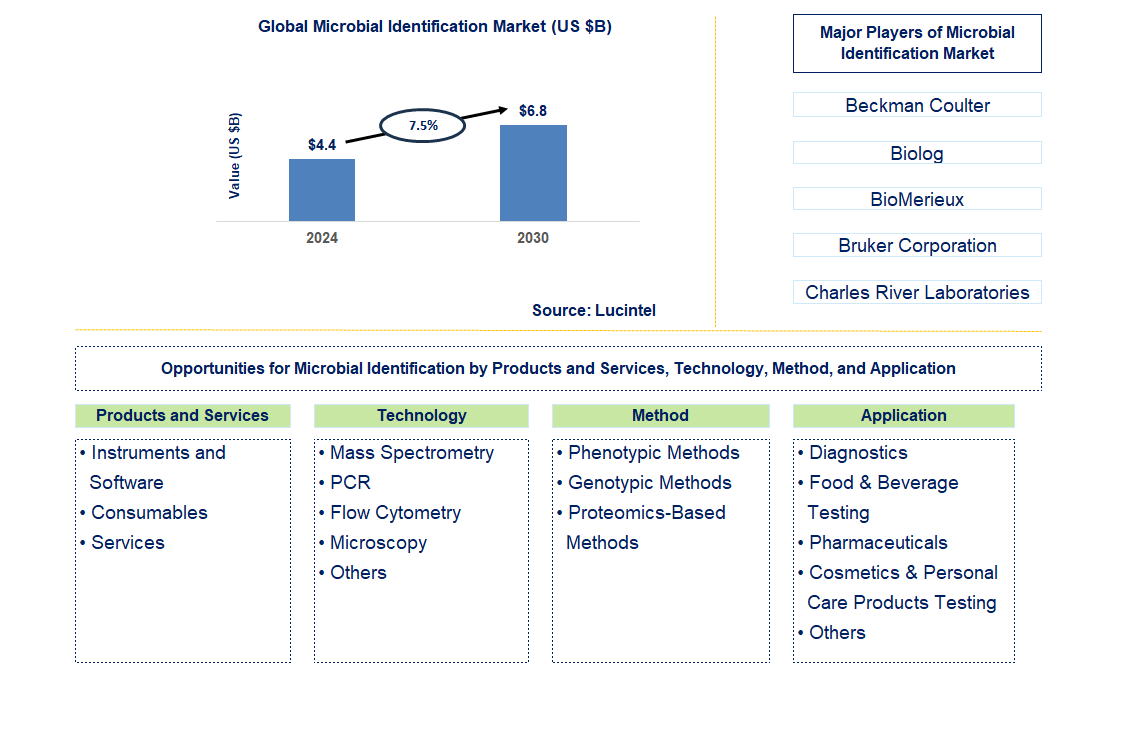
Key data points: The market size in 2030 = $6.8 billion, growth forecast = 7.5% annually for the next 6 years. Scroll below to get more insights. This market report covers trends, opportunities, and forecasts in the global microbial identification market to 2030 by products and services (instruments and software, consumables, and services), technology (mass spectrometry, PCR, flow cytometry, microscopy, and others), method (phenotypic methods, genotypic methods, and proteomics-based methods), application (diagnostics, food & beverage testing, pharmaceuticals, cosmetics & personal care products testing, and others), and region (North America, Europe, Asia Pacific, and the Rest of the World)
We'll send your sample report shortly.
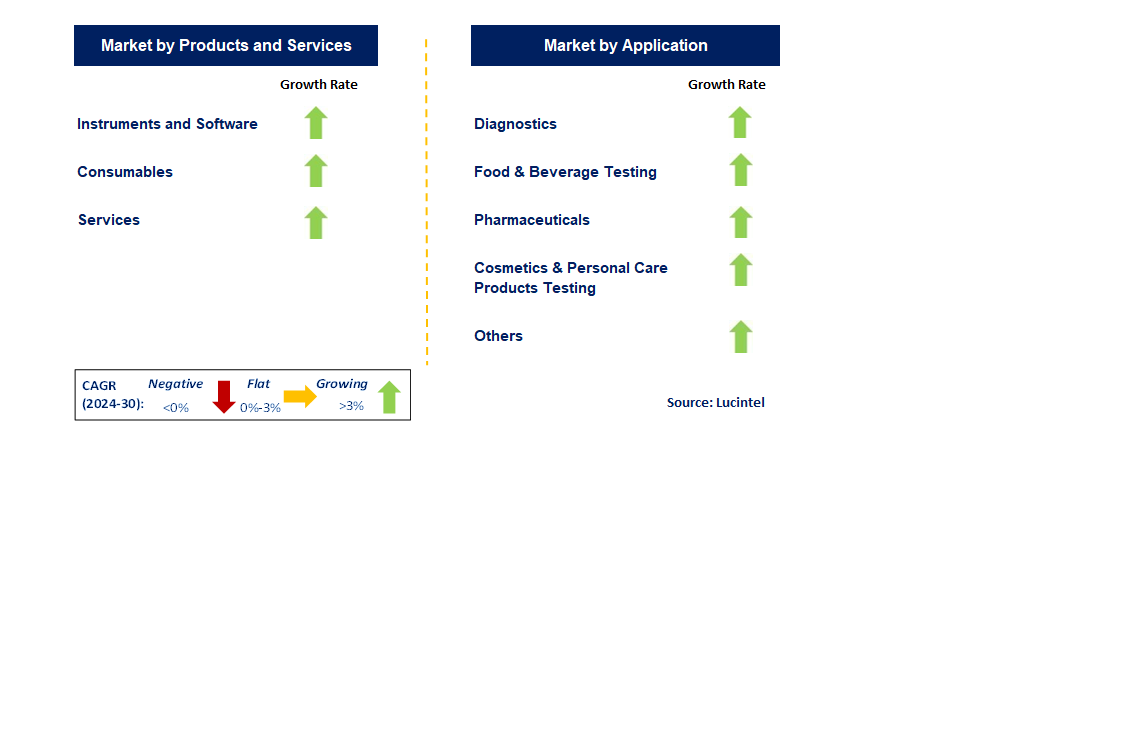
• Lucintel forecasts that, within the products and services category, instruments and software will witness highest growth over the forecast period due to the increasing awareness towards microbial testing and growing burden of infectious diseases.
• Within the application category, diagnostics will remain the largest segment due to growing prevalence of acute and chronic infections and food-borne diseases along with outbreak of pandemic.
• In terms of regions, North America will remain the largest region over the forecast period due to the increasing burden of infectious diseases, rising concerns about food safety, and the presence of key players in the region. Gain valuable insights for your business decisions with our comprehensive 150+ page report.
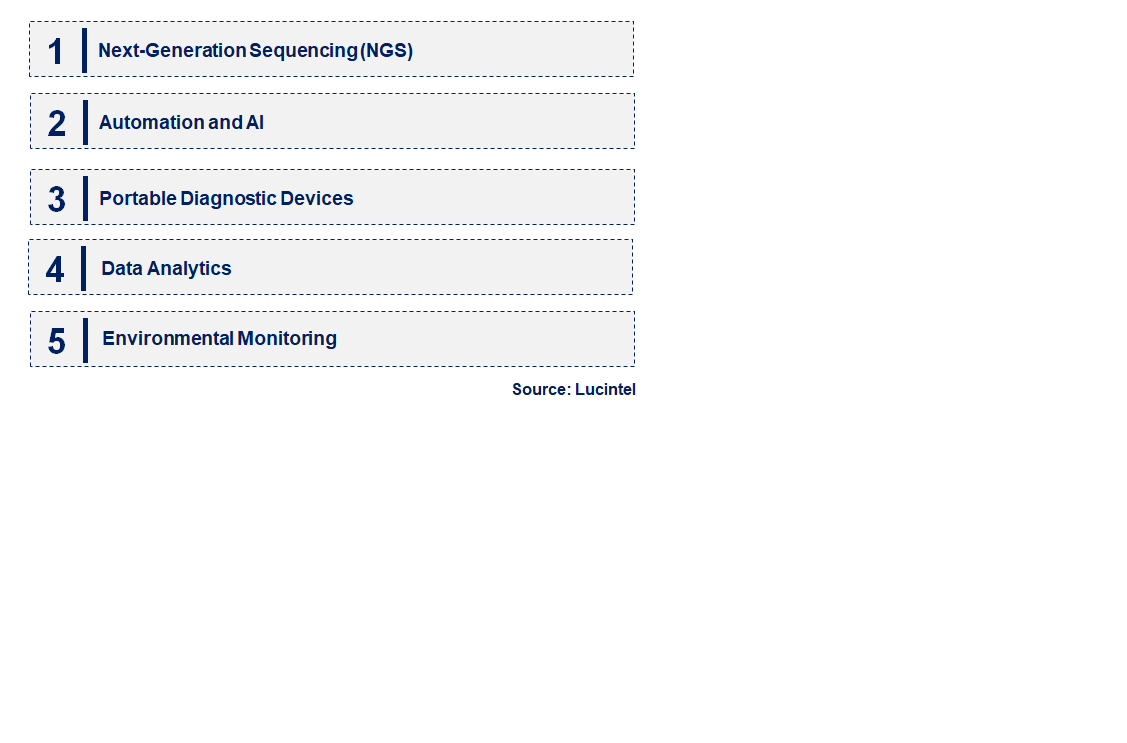
• Next-Generation Sequencing (NGS): NGS technologies are becoming increasingly prevalent, providing high-throughput and precise identification of microbial species. This trend supports more detailed and rapid microbial analysis, enhancing both research and clinical diagnostics.
• Automation and AI: The integration of automation with artificial intelligence streamlines microbial identification processes. AI-driven systems enhance accuracy and speed while minimizing manual intervention, expediting the overall process.
• Portable Diagnostic Devices: There is growing interest in portable or point-of-care devices within the microbial identification field. These devices enable on-site testing and yield immediate results, improving access to diagnostics in remote or field settings.
• Data Analytics: Advanced data analytics and machine learning applied to microbial identification enhance data interpretation and trend analysis. This trend facilitates the identification of patterns and forecasting of microbial behavior.
• Environmental Monitoring: Increasingly, microbial identification technologies are being used for environmental monitoring. This trend aids in tracking and managing microbial contamination in various environments, such as water and food sources. These innovative trends expand microbial identification technologies into new application areas, further enhancing diagnostics, research, and environmental monitoring.
• Next-Generation Sequencing: Advanced sequencing technologies are improving accuracy and speed for microbial identification, facilitating in-depth genomic analysis and rapid pathogen detection.
• Automation in Labs: The broader use of automated microbial identification systems enhances laboratory workflows. Automation reduces manual errors and accelerates identification processes, improving overall efficiency in microbial analysis.
• AI Integration: The integration of artificial intelligence into microbial identification systems extends data analysis capabilities. AI algorithms enhance diagnostic precision and help identify complex microbial patterns.
• Cost-Effective Solutions: Innovations in cost-effective microbial identification technologies are making advanced diagnostics more accessible, particularly in developing regions, thus facilitating wider implementation of microbial testing.
• Multi-Omics Approaches: Employing multi-omics approaches—genomics, proteomics, and metabolomics—provides a holistic view of microbial communities and interactions, enhancing diagnostic and research outcomes. These developments are enhancing the speed and precision of microbial identification, improving access and diagnostic capabilities.
• Clinical Diagnostics: Significant growth is observed in clinical diagnostics due to the expanding applications of microbial identification. Improved technologies enhance pathogen detection and treatment monitoring, addressing critical needs in healthcare.
• Pharmaceutical Industry: Microbial identification technologies are applied in the pharmaceutical industry for drug development and quality control. Accurate microbial analysis supports new drug development and ensures product safety.
• Environmental Monitoring: There are increasing opportunities for growth in environmental monitoring applications. Microbial identification helps monitor contamination levels in water, soil, and air, promoting environmental protection and public health.
• Food Safety: Microbial identification is crucial for detecting contaminants and pathogens in food safety, supporting regulatory compliance and enhancing consumer protection within the food industry.
• Agriculture: Growth opportunities also exist in agriculture, where microbial identification technologies can monitor soil health and plant pathogens, leading to better crop management and improved yields. These growth opportunities create new avenues for microbial identification technologies across various industries, propelling market development.
• Technological Advancements: Developments in NGS and automation enhance the capability to identify microbes, driving the market through increased speed and precision.
• Rising Incidence of Infectious Diseases: The increasing prevalence of infectious diseases boosts the demand for advanced microbial identification solutions, vital for effective diagnosis and treatment.
• Need for Rapid Diagnostics: The demand for timely diagnostic tools across various sectors encourages the adoption of advanced microbial identification technologies.
• Regulatory Support: Favorable regulatory environments boost the development and adoption of new microbial identification technologies, fostering market growth. Challenges in the microbial identification market are:
• Complexity of Technologies: Advanced microbial identification technologies can be challenging to implement, as integrating them into existing workflows requires training and expertise.
• Regulatory Challenges: Complex regulatory requirements for new technologies can delay product development and market entry. These drivers and challenges interact to shape the microbial identification market, affecting its growth trajectory and influencing stakeholders' strategic decisions.
• Beckman Coulter
• Biolog
• BioMérieux
• Bruker Corporation
• Charles River Laboratories
• Eurofins Scientific
• Liofilchem S.r.l
• Merck
• Shimadzu Corporation
• Thermo Fisher Scientific
• Instruments and Software
• Consumables
• Services
• Mass Spectrometry
• PCR
• Flow Cytometry
• Microscopy
• Others
• Phenotypic Methods
• Genotypic Methods
• Proteomics-Based Methods
• Diagnostics
• Food & Beverage Testing
• Pharmaceuticals
• Cosmetics & Personal Care Products Testing
• Others
• North America
• Europe
• Asia Pacific
• The Rest of the World
• United States: The U.S. leads in adopting next-generation sequencing technologies for microbial identification, allowing for high-resolution data collection and rapid diagnostic capabilities in clinical and research settings.
• China: Significant investments in automation and AI-driven microbial identification systems are enhancing speed and accuracy for microbial detection, supporting large-scale public health and research initiatives.
• Germany: Germany is at the forefront of developing advanced biochemical and molecular methods for microbial identification. Innovations are improving pathogen detection precision and expanding applications in environmental monitoring.
• India: The growth of affordable microbial identification technologies is on the rise in India, focusing on solutions that ensure access to proper diagnostics in clinical and research practices, particularly in resource-limited settings.
• Japan: In Japan, microbial identification systems are increasingly integrated with advanced data analytics and machine learning, enhancing the identification and tracking of microbial threats with greater accuracy and efficiency.


• Beckman Coulter
• Biolog
• BioMérieux
• Bruker Corporation
• Charles River Laboratories
• Eurofins Scientific
• Liofilchem S.r.l
• Merck
• Shimadzu Corporation
• Thermo Fisher Scientific Q6. Which microbial identification market segment will be the largest in future? Answer: Lucintel forecasts that instruments and software will witness highest growth over the forecast period due to the increasing awareness towards microbial testing and growing burden of infectious diseases. Q7. In microbial identification market, which region is expected to be the largest in next 5 years? Answer: North America will remain the largest region over the forecast period due to the increasing burden of infectious diseases, rising concerns about food safety, and the presence of key players in the region. Q.8 Do we receive customization in this report? Answer: Yes, Lucintel provides 10% customization without any additional cost.


Choose a license that fits your team. Instant PDF delivery.
Prices exclude taxes. Instant delivery. Custom licensing available on request.
Market Report · July 15, 2026
Market Report · May 18, 2026
Market Report · May 18, 2026
Trusted partner for strategic intelligence and business growth


Receive a complimentary market analysis tailored to your industry. Our analysts will identify key growth opportunities and competitive dynamics specific to your business.

Market size, growth rate, and key trend analysis for your specific sector.

Top competitor positioning and market share analysis.

Strategic recommendations backed by data-driven insights.
Get curated market intelligence and competitive moves straight to your inbox.
By subscribing, you agree to receive our monthly insights. Unsubscribe anytime.
Receive a complimentary market analysis tailored to your industry. Our analysts will identify key growth opportunities and competitive dynamics specific to your business.
Market size, growth rate, and key trend analysis for your specific sector.
Top competitor positioning and market share analysis.
Strategic recommendations backed by data-driven insights.
Get curated market intelligence, emerging trends, and competitive moves straight to your inbox each month.
By subscribing, you agree to receive our monthly insights. Unsubscribe anytime.
We'll send your sample report shortly.