
Market Report · July 31, 2026

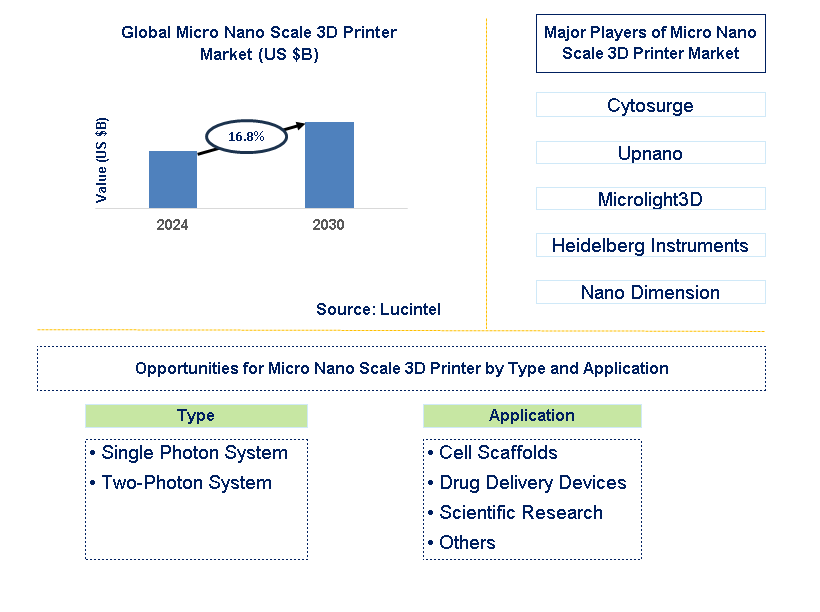
Key data points: The growth forecast = 16.8% annually for the next 6 years. Scroll below to get more insights. This market report covers trends, opportunities, and forecasts in the global micro nano scale 3D printer market to 2030 by type (single photon system and two-photon system), application (cell scaffolds, drug delivery devices, scientific research, and others), and region (North America, Europe, Asia Pacific, and the Rest of the World)
We'll send your sample report shortly.
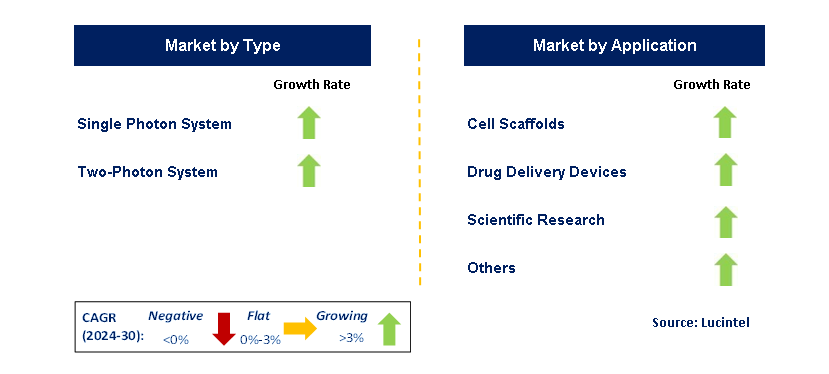
• Lucintel forecasts that, within the type category, the single photon system is expected to witness a higher growth over the forecast period.
• Within the application category, cell scaffold is expected to witness the highest growth.
• In terms of regions, APAC is expected to witness the highest growth over the forecast period. Gain valuable insights for your business decisions with our comprehensive 150+ page report.
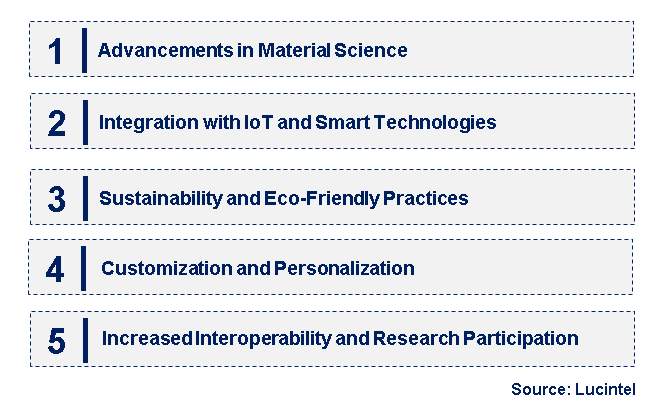
• Advancements in Material Science: Innovations in materials enhance the capabilities of 3D printing at micro and nano-scale levels. New polymers and composites emerge as experimental breakthroughs to enhance strength, flexibility, and biocompatibility. The scope of applications is significantly enhanced in healthcare and electronics, making 3D printing a viable means of creating complex, high-performance parts.
• Integration with IoT and Smart Technologies: Micro and nano-scale 3D printers integrate with IoT technologies, streamlining production processes. This trend helps track outputs and run analytics in real-time, increasing efficiency and reducing waste. Research suggests that smart manufacturing systems that integrate 3D printing allow systems to adapt to varying demands and increase productivity.
• Sustainability and Eco-Friendly Practices: The sustainability aspect of 3D printing is growing. Today, manufacturers are concerned with making materials and processes as eco-friendly as possible. This cuts waste and energy usage. Hence, the industry is getting closer to meeting global sustainability goals, making 3D printing more desirable for environmentally conscious users and businesses in terms of consumption and supply chain.
• Customization and Personalization: Highly customized products are a core trend in micro and nano-scale 3D printing, where manufacturing can be done according to specific requirements of consumers. The healthcare and consumer goods industries take great advantage of this feature to create solutions accurately tailored to certain user requirements. This trend increases customer satisfaction and consequently spurs demand for more advanced 3D printing technologies.
• Increased Interoperability and Research Participation: Advances in micro and nano-scale 3D printing gather momentum through collaborative efforts by industry, academia, and government. Increasing investment in research creates new techniques, materials, and applications that develop from such funding. This trend supports a much more dynamic ecosystem for progress in technology and growth of the market. These new trends reshape the Micro Nano Scale 3D Printers market, pushing innovations to scale up and become more sustainable while boosting customization capabilities, thereby expanding applicative scopes in different sectors.
• High Resolution Printing Techniques: Advanced printing techniques like two-photon polymerization can create the most detailed structures on the micro-scale. These high-resolution properties are important when applied in microelectronics and biomedical fields because precision matters.
• Development of Bioprinting Technologies: With the power to print complex tissue architectures and organ models, bioprinting revolutionizes the health sector. Advances in both bioinks and printing processes further enable the functionality and viability of printed biological material, thus improving the field of regenerative medicine.
• Increased Automation and Workflow Integration: Increased automation enhances the productivity and efficiency of workflows in 3D printing. New systems are developed that include printing, post-processing, and quality control, streamlining the manufacturing process and lowering lead times for production.
• Moving into Aerospace Applications: Emerging demand in aerospace, where components are becoming lighter and geometries are more intricate, drives the demand for micro and nano-scale 3D printing. Parts made from newly developed high-performance materials must comply with strict regulatory requirements, making them even lighter for better fuel consumption.
• User-friendly Solutions in Software: Micro and nano-scale 3D printers feature user-friendly software solutions that simplify the design process, thus increasing the accessibility of 3D printing technologies to various sectors. Current developments significantly boost capabilities, expand applications for products, and optimize efficiency during the manufacturing process for the Micro Nano Scale 3D Printers market.
• Healthcare and Medical Devices: The healthcare sector presents interesting growth opportunities, particularly in bioprinting and personalized medical devices. As customized solutions grow in demand, companies can rapidly use 3D printing to create and manufacture customized implants and prosthetics optimized for patient care.
• Consumer Electronics: Increased adoption of 3D printing for consumer electronics is expected to align with the production of complex components with high precision. Manufacturers will thrive on innovation, reducing time to market, while consumers increasingly demand customization and higher functionality.
• Aerospace and Defense: Increased application of micro and nano-scale 3D printing in aerospace and defense industries involves components that are lightweight and high strength. This trend creates opportunities for producing specialized parts that improve fuel efficiency and performance for critical applications.
• Automobile Lightweight Customized: The automobile sector for growth focuses on producing lightweight and customized parts. The potential to accelerate prototyping and save on manufacturing costs through 3D printing smooths development cycles and enables imaginative designs.
• Education and Research Applications: There is significant interest in integrating 3D printing into schools and scientific research centers. The availability of micro and nano-scale 3D printers will improve workforce skills and innovation, creating an effective workforce for future developments. These growth avenues transform the Micro Nano Scale 3D Printers market by driving innovation and encouraging investment in new technologies as well as their varied applications across industries.
• Technological Advancements: Significant advancements in material and printing technology propel rapid growth in 3D printing. Such innovations in production result in the creation of complex and precision parts, which have varied applications across different industries.
• Growing Demand for Customization: The ability to create customized products strongly drives micro and nano-scale 3D printing. Companies leverage this capability to deliver tailored solutions, improving customer satisfaction and loyalty.
• Cost-effective Manufacturing Solutions: Another advantage of 3D printing is the ability to print low quantities of complex geometries effectively. Such advantages attract businesses keen on saving production costs and increasing efficiency in competitive markets. Challenges in the micro nano scale 3D printer market include:
• Legal Compliance Problems: Adapting to new requirements in materials and applications poses a challenge. Given the importance of safety and environmental regulations, failing to meet standards may delay market entry for new products.
• High Cost of Initial Investment: The initial investment in state-of-the-art micro and nano-scale 3D printers is significantly high. This could deter small businesses and startups from participation, leading to lower overall growth potential.
• Rigorous Competition: The micro and nano-scale 3D printing market is becoming increasingly competitive as it matures. Companies must continue innovating while ensuring that their products differ from others in the market. These drivers and challenges deeply influence the Micro Nano Scale 3D Printers market in terms of its growth trajectory and serve as key influencers in strategic decisions made by industry players. Success in this dynamic field depends critically on addressing these factors effectively.
• Cytosurge
• Upnano
• Microlight3D
• Heidelberg Instruments
• Nano Dimension
• Exaddon
• Old World Labs
• Single Photon System
• Two-Photon System
• Cell Scaffolds
• Drug Delivery Devices
• Scientific Research
• Others
• North America
• Europe
• Asia Pacific
• The Rest of the World
• United States: In the United States, there is enormous investment in micro and nano-scale 3D printing technologies, particularly in healthcare. Companies develop biocompatible materials for producing complex tissue structures and prosthetics. Improvements in digital light processing techniques enhance resolution and enable more precise designs. Interdisciplinary research between universities and industrial partners drives improvements in printer capabilities and applications, positioning the U.S. as a leader in this field.
• China: China is poised to become a global leader in mass production and cost-effective micro and nano-scale 3D printing. The government heavily invests in research and development, encouraging tech firms to collaborate with academic institutions. Recent developments include improvements in speed and quality of prints based on nano-materials. Applications also arise from the electronics and automotive industries, boosting productivity and competitive advantages.
• Germany: Germany continues to lead in precision engineering and manufacturing, furthering its position in the micro and nano-scale 3D printers market. Technology now emphasizes harmonizing with traditional manufacturing processes, enhancing customization possibilities and increasing product efficiency. German companies demonstrate innovation not only through the creation of new materials and methods but also through eco-friendly printing materials and practices.
• India: India is increasingly popular for micro and nano-scale 3D printing, focusing on affordability. The technology is sought by startups in fields ranging from healthcare to education and product design. Government initiatives to stimulate innovation and technology adoption are expected to boost growth. Research now focuses on new polymers and composites to improve the performance of 3D printed parts, enhancing applicability in other industries.
• Japan: Japan leads technological advancements in 3D printing micro and nano-scale models with applications in robotics and electronics. Companies are developing highly accurate printing techniques that meet advanced manufacturing sector requirements. There is a strong focus on integrating these printers into smart manufacturing operations to enhance automation and efficiency. Industry and academic collaborations pioneer new material research for expanding 3D printing capabilities.


• Cytosurge
• Upnano
• Microlight3D
• Heidelberg Instruments
• Nano Dimension
• Exaddon
• Old World Labs Q5. Which micro nano scale 3D printer market segment will be the largest in future? Answer: Lucintel forecasts that single photon system is expected to witness a higher growth over the forecast period. Q6. In micro nano scale 3D printer market, which region is expected to be the largest in next 5 years? Answer: APAC is expected to witness the highest growth over the forecast period. Q.7 Do we receive customization in this report? Answer: Yes, Lucintel provides 10% customization without any additional cost.


Choose a license that fits your team. Instant PDF delivery.
Prices exclude taxes. Instant delivery. Custom licensing available on request.
Market Report · July 31, 2026
Market Report · July 22, 2026
Market Report · July 20, 2026
Trusted partner for strategic intelligence and business growth


Receive a complimentary market analysis tailored to your industry. Our analysts will identify key growth opportunities and competitive dynamics specific to your business.

Market size, growth rate, and key trend analysis for your specific sector.

Top competitor positioning and market share analysis.

Strategic recommendations backed by data-driven insights.
Get curated market intelligence and competitive moves straight to your inbox.
By subscribing, you agree to receive our monthly insights. Unsubscribe anytime.
Receive a complimentary market analysis tailored to your industry. Our analysts will identify key growth opportunities and competitive dynamics specific to your business.
Market size, growth rate, and key trend analysis for your specific sector.
Top competitor positioning and market share analysis.
Strategic recommendations backed by data-driven insights.
Get curated market intelligence, emerging trends, and competitive moves straight to your inbox each month.
By subscribing, you agree to receive our monthly insights. Unsubscribe anytime.
We'll send your sample report shortly.