
Market Report · September 3, 2026

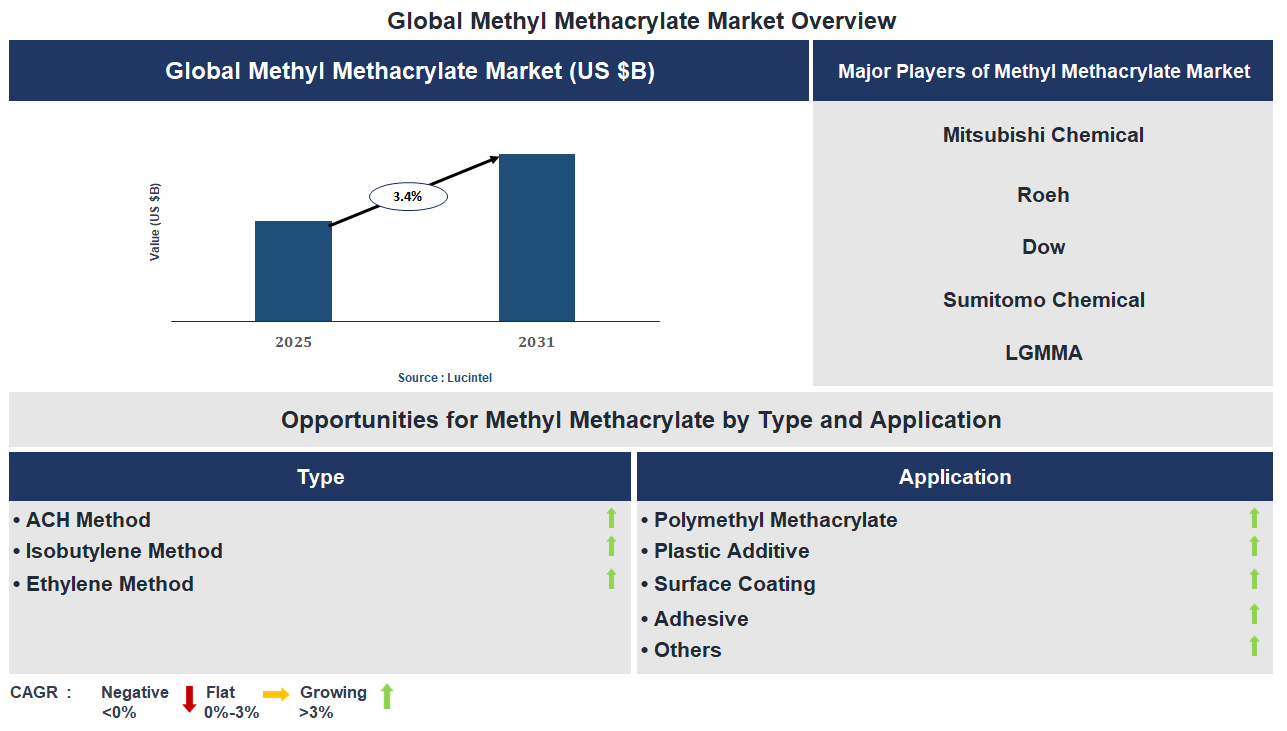
Key data points: The growth forecast = 3.4% annually for the next 7 years. Scroll below to get more insights. This market report covers trends, opportunities and forecasts in methyl methacrylate market to 2031 by type (ACH method, isobutylene method, and ethylene method), application (polymethyl methacrylate, plastic additive, surface coating, adhesive, and others), and region (North America, Europe, Asia Pacific, and the Rest of the World)
We'll send your sample report shortly.
• Lucintel forecasts that, within the type category, ethylene method is expected to witness the highest growth over the forecast period.
• Within the application category, polymethyl methacrylate is expected to witness the highest growth.
• In terms of region, APAC is expected to witness the highest growth over the forecast period. Gain valuable insights for your business decisions with our comprehensive 150+ page report. Sample figures with some insights are shown below.
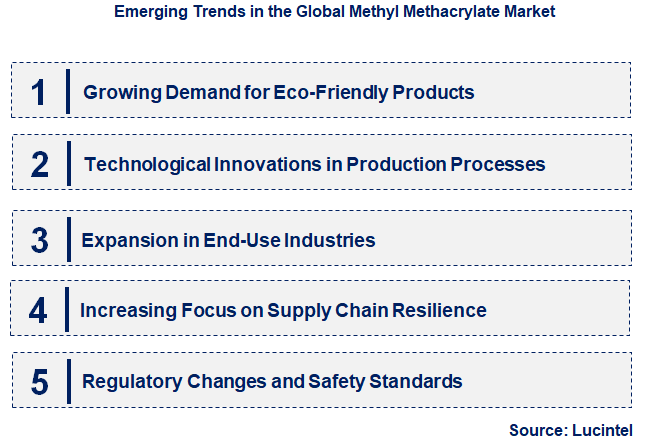
• Growing Demand for Eco-Friendly Products: The market is witnessing a shift towards sustainable MMA formulations due to environmental regulations and consumer awareness. Companies are investing in bio-based raw materials and recyclable products to reduce carbon footprints. This trend enhances brand reputation and aligns with global sustainability goals, encouraging innovation in green chemistry. As a result, eco-friendly MMA products are gaining market share, prompting manufacturers to adopt cleaner production processes and develop environmentally responsible offerings.
• Technological Innovations in Production Processes: Advances in manufacturing technologies, such as continuous flow reactors and catalyst improvements, are increasing efficiency and reducing costs. These innovations enable higher purity levels and better control over product quality, which are critical for high-performance applications. Enhanced production methods also minimize waste and energy consumption, supporting sustainability efforts. This trend allows companies to meet rising demand more effectively while maintaining competitive pricing and quality standards.
• Expansion in End-Use Industries: The growth of sectors like automotive, electronics, and construction is driving increased MMA consumption. In automotive, MMA is used in lightweight composites and coatings; in electronics, for adhesives and sealants; and in construction, for acrylic sheets and paints. The rising demand for durable, lightweight, and aesthetically appealing materials is fueling market expansion. This diversification of applications ensures steady growth and opens new opportunities for manufacturers to innovate and tailor products to specific industry needs.
• Increasing Focus on Supply Chain Resilience: Recent disruptions, such as global pandemics and geopolitical tensions, have highlighted the importance of supply chain stability. Companies are diversifying sourcing strategies, investing in local production facilities, and building strategic inventories to mitigate risks. Strengthening supply chain resilience ensures consistent product availability and reduces vulnerability to external shocks. This trend is reshaping procurement strategies and fostering closer collaboration among suppliers, manufacturers, and distributors.
• Regulatory Changes and Safety Standards: Stricter regulations concerning emissions, worker safety, and product standards are influencing MMA production and usage. Compliance requires adopting safer chemicals, improving handling procedures, and reducing hazardous waste. Companies are proactively updating their processes to meet evolving standards, which can involve significant investment but ultimately lead to safer, more sustainable products. Navigating these regulatory landscapes is crucial for market players to maintain legal compliance and competitive advantage. In summary, these emerging trends are fundamentally reshaping the methyl methacrylate market by promoting sustainability, technological advancement, diversified applications, resilient supply chains, and regulatory compliance. Collectively, they foster innovation, enhance competitiveness, and ensure the markets sustainable growth in a rapidly changing global environment.
• Technological Innovations: New manufacturing processes have improved MMA production efficiency and reduced environmental impact, leading to cost savings and higher product quality. These innovations enable manufacturers to meet stricter regulatory standards and expand their market reach, fostering industry growth and competitiveness.
• Sustainability Initiatives: Increasing emphasis on eco-friendly practices has prompted companies to develop bio-based MMA alternatives and adopt greener production methods. This shift enhances market appeal among environmentally conscious consumers and aligns with global sustainability goals, potentially opening new market segments.
• Regulatory Changes: Governments worldwide are implementing stricter environmental regulations and safety standards for chemical manufacturing. These policies compel companies to upgrade facilities and adopt cleaner technologies, which may increase operational costs but also drive innovation and safer product development.
• Expanding Applications: The use of MMA in emerging sectors such as automotive, electronics, and healthcare is growing rapidly. This diversification broadens market opportunities, stimulates demand, and encourages R&D investments to develop specialized formulations tailored to these industries.
• Supply Chain Dynamics: The COVID-19 pandemic and geopolitical tensions have disrupted supply chains, causing volatility in raw material availability and pricing. Companies are now focusing on supply chain resilience, diversifying sources, and optimizing logistics to ensure steady production and meet rising demand. In summary, recent developments in the MMA market—spanning technological advancements, sustainability efforts, regulatory shifts, application expansion, and supply chain resilience—are collectively driving growth and transformation. These changes are fostering innovation, encouraging sustainable practices, and expanding market opportunities, ultimately shaping a more resilient and competitive industry landscape.
• Enhanced Building Materials : The demand for lightweight, durable, and weather-resistant materials is boosting MMA use in construction, especially in coatings, adhesives, and sealants, leading to improved building longevity and energy efficiency.
• Lightweight Components : MMAs excellent optical clarity and toughness are driving its adoption in automotive headlamps, interior trims, and adhesives, contributing to vehicle weight reduction and safety enhancements.
• Advanced Encapsulation Materials : The electronics industry is leveraging MMA for encapsulating and protecting sensitive components, which improves device performance, reliability, and lifespan.
• Biocompatible Polymers : MMA-based materials are increasingly used in medical applications such as denture bases, bone cements, and intraocular lenses, expanding healthcare solutions with improved biocompatibility and durability.
• Innovative Packaging and Displays : The consumer goods industry is utilizing MMA in manufacturing clear, impact-resistant packaging, display units, and household items, enhancing product appeal and consumer experience. In summary, these growth opportunities across key applications are significantly impacting the MMA market by driving innovation, expanding application scope, and increasing demand. This evolution is fostering competitive advantages for market players and supporting sustainable industry growth.
• Technological Innovations: The development of advanced manufacturing techniques, such as continuous production processes and catalyst improvements, has significantly enhanced MMA production efficiency. These innovations reduce costs, improve product quality, and enable the creation of specialized grades for specific applications like automotive, construction, and electronics. As technology continues to evolve, manufacturers can meet increasing demand with more sustainable and cost-effective solutions, fostering market expansion.
• Growing Construction and Automotive Industries: The rising demand for lightweight, durable, and high-performance materials in construction and automotive sectors is a major growth driver. MMA-based products like acrylic sheets, adhesives, and coatings are preferred for their clarity, weather resistance, and versatility. Urbanization and infrastructure development in emerging economies further boost demand, making these industries pivotal in propelling the MMA market forward.
• Increasing Use in Medical and Healthcare Applications: The healthcare sectors expanding use of MMA in dental prosthetics, bone cements, and medical adhesives is a significant driver. The biocompatibility, transparency, and adhesive properties of MMA make it ideal for medical applications. As healthcare infrastructure develops globally, the demand for MMA in medical devices and treatments is expected to grow, opening new avenues for market growth.
• Environmental Regulations and Sustainability Initiatives: Stricter environmental standards aimed at reducing volatile organic compound (VOC) emissions and promoting sustainable manufacturing practices influence the MMA market. Companies investing in eco-friendly production methods, such as bio-based raw materials and recycling technologies, can gain competitive advantages. These regulatory pressures also encourage innovation toward greener MMA products, shaping future market trends. The challenges facing this methyl methacrylate market include:-
• Fluctuating Raw Material Prices: The MMA industry heavily depends on raw materials like acetone and benzene, whose prices are volatile due to geopolitical tensions, supply chain disruptions, and fluctuating crude oil prices. These fluctuations directly impact production costs and profit margins, creating uncertainty for manufacturers and investors. Managing raw material procurement and cost stability remains a critical challenge for sustaining growth.
• Stringent Environmental Regulations: Increasingly strict regulations aimed at reducing VOC emissions and promoting sustainable practices pose compliance challenges for MMA producers. Implementing cleaner production technologies often requires significant capital investment and process modifications. Non-compliance can lead to penalties, legal issues, and damage to reputation, making regulatory adherence a complex aspect of market operations.
• Geopolitical and Trade Uncertainties: Trade tensions, tariffs, and geopolitical conflicts can disrupt supply chains and limit market access, especially in key regions like Asia-Pacific, North America, and Europe. These uncertainties hinder long-term planning and investment, potentially leading to market volatility. Companies must navigate complex international policies to maintain stable operations and supply networks. In summary, the methyl methacrylate market is driven by technological advancements, expanding end-use industries, and environmental initiatives, which collectively foster growth opportunities. However, challenges such as raw material price volatility, strict regulations, and geopolitical uncertainties pose risks that could hinder progress. The interplay of these factors will shape the markets evolution, requiring stakeholders to innovate, adapt, and strategize effectively to capitalize on emerging trends while mitigating potential setbacks. Overall, the markets future hinges on balancing technological progress with sustainable and compliant practices amidst a dynamic global landscape.
• Mitsubishi Chemical
• Roeh
• Dow
• Sumitomo Chemical
• LGMMA
• Trinseo
• Kuraray
• Formosa Plastics
• Jilin Petrochemical
• Longxin Chemical
• ACH Method
• Isobutylene Method
• Ethylene Method
• Polymethyl Methacrylate
• Plastic Additive
• Surface Coating
• Adhesive
• Others
• North America
• Europe
• Asia Pacific
• The Rest of the World
• United States: The U.S. market has seen increased investment in sustainable production processes, including bio-based MMA. Major companies are expanding capacity and adopting energy-efficient technologies. Regulatory pressures are encouraging greener manufacturing practices, and demand from the automotive and construction sectors remains strong. Innovations in polymer applications are also driving growth, with a focus on high-performance materials.
• China: China continues to dominate the global MMA market with rapid capacity expansion and technological upgrades. The country is investing heavily in modernizing production facilities to reduce environmental impact. Domestic demand is driven by booming construction, automotive, and electronics industries. Additionally, China is increasing its focus on sustainable and eco-friendly MMA production methods to meet stricter environmental regulations.
• Germany: Germany remains a key player in the European MMA market, emphasizing high-quality production and sustainable practices. The country is investing in research and development to improve product performance and reduce environmental footprint. The automotive sectors demand for lightweight, durable materials is fueling innovation. Germany also benefits from strong regulatory frameworks promoting eco-friendly manufacturing.
• India: The Indian MMA market is witnessing rapid growth due to expanding construction, automotive, and infrastructure projects. Local manufacturers are adopting advanced technologies to improve product quality and efficiency. The government’s focus on sustainable development and environmental regulations is encouraging the adoption of greener production methods. Market players are also exploring new applications in electronics and healthcare.
• Japan: Japans MMA market is characterized by technological innovation and a focus on high-performance materials. Companies are investing in research to develop advanced polymer solutions for electronics, automotive, and industrial applications. Japan is also emphasizing sustainable manufacturing practices, including energy-efficient processes and eco-friendly raw materials, to meet global environmental standards. The market remains competitive with a focus on quality and innovation.


• Mitsubishi Chemical
• Roeh
• Dow
• Sumitomo Chemical
• LGMMA
• Trinseo
• Kuraray
• Formosa Plastics
• Jilin Petrochemical
• Longxin Chemical Q5. Which methyl methacrylate market segment will be the largest in future? Answer: Lucintel forecasts that, within the type category, ethylene method is expected to witness the highest growth over the forecast period. Q6. In methyl methacrylate market, which region is expected to be the largest in next 5 years? Answer: In terms of region, APAC is expected to witness the highest growth over the forecast period. Q7. Do we receive customization in this report? Answer: Yes, Lucintel provides 10% customization without any additional cost.


Choose a license that fits your team. Instant PDF delivery.
Prices exclude taxes. Instant delivery. Custom licensing available on request.
Market Report · September 3, 2026
Market Report · July 22, 2026
Market Report · July 22, 2026
Trusted partner for strategic intelligence and business growth


Receive a complimentary market analysis tailored to your industry. Our analysts will identify key growth opportunities and competitive dynamics specific to your business.

Market size, growth rate, and key trend analysis for your specific sector.

Top competitor positioning and market share analysis.

Strategic recommendations backed by data-driven insights.
Get curated market intelligence and competitive moves straight to your inbox.
By subscribing, you agree to receive our monthly insights. Unsubscribe anytime.
Receive a complimentary market analysis tailored to your industry. Our analysts will identify key growth opportunities and competitive dynamics specific to your business.
Market size, growth rate, and key trend analysis for your specific sector.
Top competitor positioning and market share analysis.
Strategic recommendations backed by data-driven insights.
Get curated market intelligence, emerging trends, and competitive moves straight to your inbox each month.
By subscribing, you agree to receive our monthly insights. Unsubscribe anytime.
We'll send your sample report shortly.