
Market Report · May 18, 2026

This market report covers trends, opportunities, and forecasts in the global methane monitor market to 2031 by technology (non-dispersive infrared (ndir) technology, catalytic bead technology, electrochemical sensor technology, photoionization detector (pid) technology, and others), application (metallurgy, power plant, chemical industry, mine, tunnel, and others), and region (North America, Europe, Asia Pacific, and the Rest of the World)
We'll send your sample report shortly.
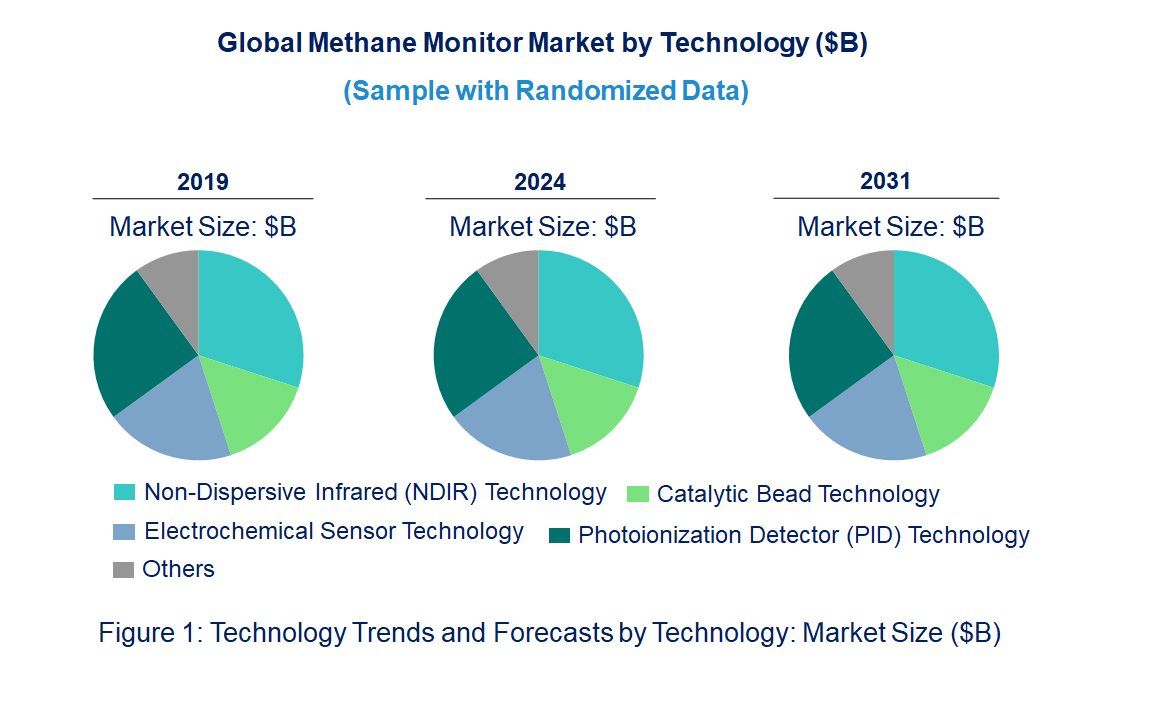
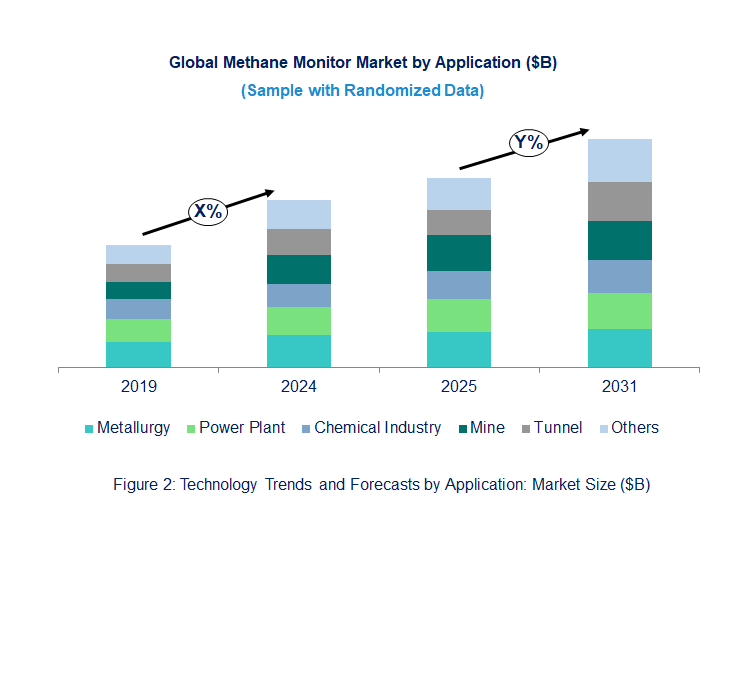
• Advancements in Sensor Technology: technologies like non-dispersive infrared (NDIR) sensors are gaining popularity because of their higher precision, reliability, and longer operational life compared to traditional sensors like catalytic bead sensors. These advancements enable more accurate monitoring of methane concentrations in a wide range of environments, from industrial plants to mining operations.
• Wireless and Remote Monitoring Solutions: Increasingly popular are wireless and IoT-enabled methane monitoring systems. It is possible to collect data in real time and monitor the location from afar to provide quicker response times when methane leaks occur and for safety protocols. This will be particularly important in areas such as mining and oil & gas, where areas not easily accessible must be monitored.
• Integration with AI and Data Analytics: The integration of AI and data analytics into methane monitoring systems enables predictive maintenance and smarter monitoring. These technologies process a large volume of data for the prediction of potential leakages and offer possible corrective actions, resulting in more efficient and proactive systems in detecting methane emissions.
• Regulatory and Environmental Compliance: As governments and regulatory bodies implement more severe environmental regulations in terms of methane emissions, companies are increasingly moving toward methane monitoring solutions. More precise and reliable monitoring solutions are moving the market towards reducing greenhouse gas emissions and the prevention of environmental disasters.
• Miniaturization and Portability: The demand for methane detection in remote or hazardous areas brings about the trend toward miniaturizing methane monitors. It allows for easier on-site monitoring for workers since portable and compact devices facilitate applications like tunneling, chemical plants, and mining. Emerging trends such as advancements in sensor technology, wireless monitoring, AI integration, stricter regulatory compliance, and miniaturization are shaping the methane monitor market. All these innovations help to better enhance the capability of methane detection systems for industries and propel market growth while keeping it safer and more environmentally responsible.
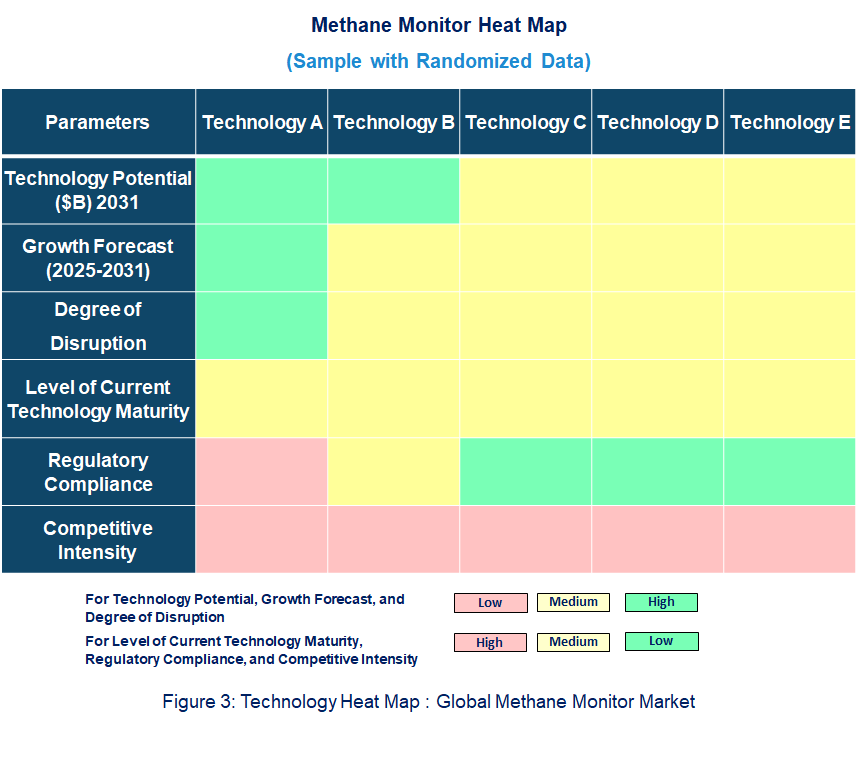
• Technology Potential: Non-dispersive infrared sensors are leaders in the methane monitor market, with superior accuracy and longer life. It has newer technologies like IoT-enabled wireless systems and AI-based monitoring, which enhance data gathering, make forecasts, and provide real-time methane-emission measurement via remote monitoring.
• Degree of Disruption: The current disruptions caused by NDIR and PID detectors are immense, as these offer higher sensitivity, precision, and longer lifetimes of sensors. The above technologies are changing the scenario in terms of methane detection, especially for the industries in mining, power plants, and the chemical industry sectors. The shift from the old way to newer automatic systems changes the entire approach toward methane monitoring.
• Level of Current Technology Maturity: Currently, NDIR and catalytic bead technologies are well accepted, and NDIR is the more advanced of the two. AI integration and wireless monitoring are still in the development and early adoption phases. They are rapidly maturing from being in early-stage innovation to being applied more commercially.
• Regulatory Compliance: Rising global regulatory standards on methane emissions are compelling market players to invest in cutting-edge methane monitoring technologies. Such systems provide real-time monitoring and thus ensure compliance with environmental standards, especially in industries such as oil and gas, chemical manufacturing, or mining, where the regulatory standards are highly stringent.
• Fireboy-Xintex: Fireboy-Xintex has enhanced the company's methane detection product offerings through catalytic and infrared sensors that enhance the technological advancements. This company mainly concentrates on being robust, reliable, and cost-effective, mainly to the industries of mining, oil & gas, and manufacturing. Such improvements boost safety and regulatory compliance.
• CSE Corporation: CSE Corporation has produced many innovative methane detection products, such as portable monitors and continuous monitoring systems for high-risk applications. Their focus on real-time data delivery and rugged, portable devices ensures industries, such as chemical manufacturing and mining, can maintain constant, near-continuous monitoring with very minimal downtime.
• Applied Techno System: Applied Techno System recently integrated IoT connectivity and wireless technologies into its methane monitoring systems. This improves real-time access to data and predictive analytics, offering more integrated and proactive approaches for methane detection in power plants, metallurgy, and other industries.
• Teledyne Gas & Flame Detection: Teledyne, on the other hand, has enhanced methane detection technology with a focus on incorporating AI and machine learning into its monitoring system. This technology promotes predictive maintenance, reduces false alarms, and ensures more efficient monitoring of industries that depend on continuous and accurate methane detection, such as oil & gas.
• Oizom: Oizom has designed a new generation of methane detection systems that rely on the most advanced environmental sensors and analytics software. Their innovations have a focus on cloud-based monitoring and real-time alerts, which have been very effective for large-scale industrial applications in helping organizations meet regulatory requirements and enhance operational safety. These developments by key players are shaping the methane monitor market, making it more technologically advanced, efficient, and compliant with emerging environmental standards.
• The increasing environmental consciousness: There has been increasing awareness of climate change and the role that methane plays in global warming, which has increased the demand for methane-monitoring systems. These technologies help businesses comply with environmental regulations, reduce emissions, and mitigate their carbon footprint, contributing to a greener future.
• Stringent Government Regulations: Such measures comprise tighter restrictions on methane emissions around the world, especially in the oil and gas and agriculture sectors, as well as waste management. Firms are now pushed to incorporate methane detection technologies because of compliance and the threat of penalties.
• Technological Advancement: Innovations in sensor technology, including better accuracy, real-time monitoring, and economical solutions, are driving the adoption of methane monitoring systems. Improved performance coupled with greater effectiveness in monitoring methane emissions economically enhances the market's potential for growth. Challenges
• High initial investment: There is a significant cost imposed by installing and maintaining methane monitoring systems; this remains a major barrier, especially for small and medium enterprises. This constraint prevents its adoption on a large scale in industries that operate cost-sensitive activities.
• Limited Technological Integration: The technologies are under development; however, there are issues with the compatibility of methane monitoring systems with the already existing infrastructure. Integration becomes challenging due to compatibility problems in older systems and a lack of standardization across platforms for most industries.
• Intractable Regulatory Compliance: The regulatory environment is complex and dynamic, making it challenging for organizations to navigate the same. The differences in regulations between countries and industries might make it uncertain for firms to adopt methane monitoring systems, thereby complicating the decision-making process. Growing environmental concerns, regulatory pressures, and technological advancements boost the methane monitor market. Still, high costs and complexity in regulations may hinder it from reaching its full potential. Growth opportunities include expansion in emerging markets, IoT integration, government subsidies, and portable solutions, which would propel the market forward and help businesses better manage methane emissions and maintain compliance standards. All of these factors together ensure continued market growth, with a focus on environmental sustainability and efficiency in operations.
• Fireboy-Xintex
• Cse Corporation
• Applied Techno System
• Teledyne Gas & Flame Detection
• Oizom
• Technology Readiness by Technology Type: NDIR technology is the most mature and widespread, with a readiness level of readiness for meeting regulatory compliance and diverse industrial applications like oil and gas. Catalytic Bead is ready to use in basic detection of gases, but may not be stringent enough to meet high emission standards in some cases. Electrochemical Sensors have reached an advanced level as far as portable, on-site monitoring is concerned. However, they are relatively less applied in continuous systems. Because PID technology has limited sensitivity to methane, it is less prepared for widespread methane monitoring, but still useful in specific applications of VOC detection. Competitive levels of each technology depend on its ability to be adapted toward regulatory standards and the precise needs of such industries as environmental monitoring and oil and gas.
• Competitive Intensity and Regulatory Compliance: The competitive intensity in the market for methane monitors is shaped by the different requirements for complying with regulations and maturity in each technology. NDIR is highly competitive, based on its wide applicability in industries that have the most stringent emission regulations. Other technologies, Catalytic Bead and Electrochemical Sensor, compete in the price-sensitive applications but face significant challenges related to longevity and sensitivity. It's less competitive when it comes to methane monitoring, but its niche is well-positioned in VOC applications. For regulatory compliance, NDIR leads the market in abating emissions while others are forced to meet increasingly restrictive laws on the environment through adaptation, such as PID and Catalytic Bead technologies.
• Relative Disruption Potential of Different Technologies: In the methane monitor market, different technologies offer varying levels of disruption. Non-Dispersive Infrared (NDIR) technology provides high sensitivity and precision, making it widely used for continuous monitoring. Catalytic Bead technology is cost-effective and commonly used in combustible gas detection, although it has limited specificity for methane. Electrochemical Sensor technology offers excellent sensitivity and is favored for portable solutions, but it has a shorter lifespan than other options. PID technology excels in detecting volatile organic compounds but is not as good for methane. Other new technologies, like laser-based systems, provide higher accuracy but are still in development regarding cost-effectiveness and practical application.
• Non-Dispersive Infrared (NDIR) Technology
• Catalytic Bead Technology
• Electrochemical Sensor Technology
• Photoionization Detector (PID) Technology
• Others
• Metallurgy
• Power Plant
• Chemical Industry
• Mine
• Tunnel
• Others
• North America
• Europe
• Asia Pacific
• The Rest of the World
• Latest Developments and Innovations in the Methane Monitor Technologies
• Companies / Ecosystems
• Strategic Opportunities by Technology Type


Choose a license that fits your team. Instant PDF delivery.
Prices exclude taxes. Instant delivery. Custom licensing available on request.
Market Report · May 18, 2026
Market Report · May 18, 2026
Market Report · May 18, 2026
Trusted partner for strategic intelligence and business growth


Receive a complimentary market analysis tailored to your industry. Our analysts will identify key growth opportunities and competitive dynamics specific to your business.

Market size, growth rate, and key trend analysis for your specific sector.

Top competitor positioning and market share analysis.

Strategic recommendations backed by data-driven insights.
Get curated market intelligence and competitive moves straight to your inbox.
By subscribing, you agree to receive our monthly insights. Unsubscribe anytime.
Receive a complimentary market analysis tailored to your industry. Our analysts will identify key growth opportunities and competitive dynamics specific to your business.
Market size, growth rate, and key trend analysis for your specific sector.
Top competitor positioning and market share analysis.
Strategic recommendations backed by data-driven insights.
Get curated market intelligence, emerging trends, and competitive moves straight to your inbox each month.
By subscribing, you agree to receive our monthly insights. Unsubscribe anytime.
We'll send your sample report shortly.