
Report Feature
Metalens Solution Market Trends and Forecast
The future of the global metalens solution market looks promising with opportunities in the consumer electronics, automotive electronics, industrial, and medical markets. The global metalens solution market is expected to grow with a CAGR of 76.5% from 2026 to 2032. The major drivers for this market are the increasing demand for compact optical devices, the rising adoption of metalens in imaging systems, and the growing need for advanced light manipulation techniques.
• Lucintel forecasts that, within the type category, foundry service will remain the largest segment over the forecast period.
• Within the application category, consumer electronics will remain the largest segment.
• In terms of region, APAC is expected to witness the highest growth over the forecast period.
Gain valuable insights for your business decisions with our comprehensive 150+ page report. Sample figures with some insights are shown below.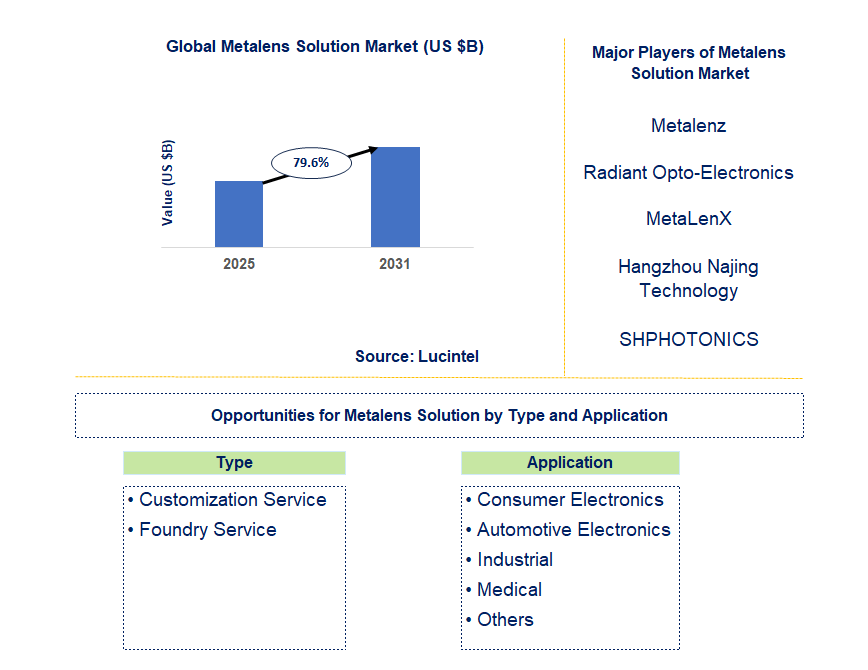
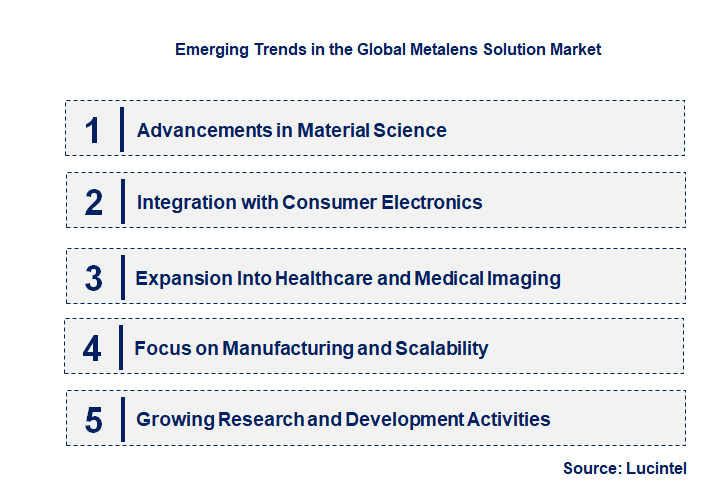
Emerging Trends in the Metalens Solution Market
The metalens solution market is experiencing rapid growth driven by technological advancements and increasing demand for miniaturized, high-performance optical components across various industries. As industries such as consumer electronics, healthcare, and telecommunications seek innovative solutions, metalenses are emerging as a promising alternative to traditional lenses. These developments are reshaping the landscape by offering enhanced optical capabilities, reduced device size, and improved energy efficiency. The market's evolution is also influenced by ongoing research, material innovations, and expanding application areas, making it a dynamic and competitive space. Understanding these key trends is essential for stakeholders aiming to capitalize on the market's potential.
• Advancements in Material Science: Development of novel nanomaterials and metasurfaces is enabling more efficient, tunable, and versatile metalenses. These innovations improve optical performance, such as higher resolution and broader spectral range, while reducing manufacturing costs. The integration of new materials like dielectric and phase-change materials enhances the functionality of metalenses, making them suitable for diverse applications. This trend is driving the market toward more customizable and high-performance solutions, expanding their use in imaging, sensing, and display technologies.
• Integration with Consumer Electronics: Metalenses are increasingly being integrated into smartphones, cameras, and augmented reality devices. Their compact size and superior focusing capabilities allow for thinner, lighter devices with enhanced imaging quality. This trend is significantly impacting the consumer electronics market by enabling innovative product designs and improved user experiences. As manufacturers seek to differentiate their products, metalenses offer a competitive edge through improved optical performance and device miniaturization, fueling market growth.
• Expansion into Healthcare and Medical Imaging: The healthcare sector is adopting metalenses for applications such as endoscopy, microscopy, and optical coherence tomography. Their ability to provide high-resolution imaging in a compact form factor improves diagnostic accuracy and patient outcomes. This trend is opening new avenues for non-invasive, portable, and cost-effective medical devices. The integration of metalenses in medical imaging systems is expected to revolutionize diagnostics, making advanced imaging more accessible and efficient.
• Focus on Manufacturing and Scalability: Innovations in fabrication techniques, including nanoimprint lithography and roll-to-roll processing, are making large-scale production of metalenses feasible and cost-effective. This trend addresses the challenge of mass manufacturing, enabling widespread adoption across industries. Improved scalability is crucial for meeting the growing demand in consumer electronics, automotive, and aerospace sectors, thereby accelerating market penetration and reducing costs.
• Growing Research and Development Activities: Increased R&D efforts are driving the discovery of new designs, materials, and applications for metalenses. Collaborations between academia and industry are fostering innovation, leading to improved performance and new functionalities such as tunability and multi-wavelength operation. This trend ensures continuous technological evolution, expanding the potential use cases and market size. It also attracts investments and accelerates commercialization, positioning metalenses as a key component in future optical systems.
In summary, these emerging trends are collectively transforming the metalens solution market by enhancing performance, enabling new applications, and improving manufacturing processes. They are fostering innovation, reducing costs, and expanding the market reach, ultimately reshaping the future of optical technologies across multiple industries.
Recent Development in the Metalens Solution Market
The metalens solution market has experienced significant growth driven by advancements in nanotechnology, optical engineering, and increasing demand for miniaturized optical devices across various industries. As the technology matures, key developments are shaping the future landscape, influencing product innovation, manufacturing processes, and application scope. These developments are enabling more efficient, cost-effective, and versatile metalens solutions, which are transforming sectors such as consumer electronics, healthcare, and telecommunications. The market's evolution reflects a shift towards integrated, high-performance optical components that meet the rising demands for compactness and enhanced functionality in modern devices.
• Technological Innovation: Development of multi-functional metalenses has enhanced their ability to focus, steer, and manipulate light simultaneously, leading to more versatile applications and improved device performance.
• Manufacturing Advancements: Introduction of scalable nanofabrication techniques, such as nanoimprint lithography, has reduced production costs and increased the feasibility of mass manufacturing metalenses.
• Material Improvements: Use of novel materials like titanium dioxide and silicon has improved metalens durability, efficiency, and operational wavelength range, expanding their application scope.
• Integration with Existing Technologies: Integration of metalenses with semiconductor devices and sensors has facilitated the development of compact, high-performance optical systems for smartphones, AR/VR devices, and medical imaging.
• Regulatory and Standardization Efforts: Establishment of industry standards and safety regulations has accelerated market adoption by ensuring quality, reliability, and compatibility across different applications.
These developments are collectively driving the metalens solution market towards greater adoption, enhanced performance, and broader application horizons. The market is becoming more competitive and innovative, with increased opportunities for new entrants and established players alike. Overall, these advancements are positioning metalenses as critical components in next-generation optical and photonic devices, fostering sustained growth and technological progress.
Strategic Growth Opportunities in the Metalens Solution Market
The metalens solution market is experiencing rapid growth driven by technological advancements and increasing demand across various industries. As applications expand, companies are exploring innovative ways to leverage metalenses for improved performance, miniaturization, and cost efficiency. These developments are opening new avenues for market expansion and competitive advantage. The following five key growth opportunities highlight the most promising areas for development within this market, each offering significant impact on industry dynamics and technological progress.
• Consumer Electronics: Enhanced Camera Technologies : Metalenses enable ultra-thin, high-quality imaging components, leading to improved smartphone cameras and wearable devices. This innovation allows for slimmer devices with superior imaging capabilities, attracting consumers seeking advanced features and portability. The integration of metalenses in consumer electronics is expected to revolutionize device design and user experience.
• Medical Imaging: Miniaturized Diagnostic Devices : Metalenses facilitate the development of compact, high-resolution imaging systems for medical diagnostics. These miniaturized solutions improve portability and accessibility of medical devices, enabling point-of-care testing and real-time imaging. This growth enhances healthcare delivery and broadens the application scope of medical imaging technologies.
• Augmented Reality (AR) and Virtual Reality (VR): Compact Optical Components : Metalenses offer lightweight, flat optical elements that significantly reduce the size and weight of AR/VR headsets. This advancement improves user comfort and device aesthetics, fostering wider adoption of immersive technologies. The ability to produce high-quality, miniaturized lenses is a key driver in AR/VR market expansion.
• Automotive Industry: Advanced Driver Assistance Systems (ADAS) : Metalenses are used in automotive sensors and cameras to improve object detection and environmental perception. Their compact form factor and high efficiency contribute to safer, more reliable autonomous driving systems. This application accelerates the integration of metalenses into next-generation vehicles.
• Scientific Research and Space Exploration: High-Precision Optical Instruments : Metalenses enable the creation of lightweight, high-performance optical systems for telescopes and scientific instruments. Their durability and precision support advanced research in astronomy and space exploration, expanding the capabilities of observational tools and data collection.
In summary, these growth opportunities are significantly impacting the metalens solution market by driving innovation, enabling miniaturization, and enhancing performance across diverse applications. As industries adopt these advanced optical solutions, market growth is expected to accelerate, fostering new technological breakthroughs and expanding market reach globally.
Metalens Solution Market Driver and Challenges
The metalens solution market is influenced by a variety of technological, economic, and regulatory factors that shape its growth trajectory. Advances in nanofabrication and optical engineering are enabling the development of highly efficient and miniaturized metalenses, driving innovation in imaging, sensing, and communication applications. Economic factors such as increasing demand for compact optical devices and the rising adoption of metalenses in consumer electronics further propel market expansion. Regulatory standards related to manufacturing and environmental safety also impact product development and deployment. Navigating these complex drivers and challenges is essential for stakeholders aiming to capitalize on emerging opportunities within this dynamic industry.
The factors responsible for driving the metalens solution market include:-
• Technological Innovation: The rapid evolution of nanofabrication techniques and materials science has enabled the creation of highly efficient, ultra-thin metalenses. These innovations allow for improved optical performance, such as better focusing capabilities and reduced aberrations, which are critical for applications in imaging, augmented reality, and biomedical devices. As research progresses, the cost of manufacturing is decreasing, making metalenses more accessible for commercial use. The integration of metalenses into existing optical systems enhances device miniaturization and performance, fostering new product development and expanding market reach.
• Growing Demand for Miniaturized Optical Devices: The increasing need for compact, lightweight optical components across various sectors, including consumer electronics, healthcare, and aerospace, is a significant driver. Metalenses offer a promising solution by replacing bulky traditional lenses with thin, lightweight alternatives without compromising performance. This trend is particularly evident in smartphones, wearable devices, and medical imaging equipment, where space constraints are critical. The demand for portable, high-performance optical systems is expected to continue fueling market growth as manufacturers seek innovative solutions to meet consumer and industry needs.
• Expansion in Consumer Electronics and Augmented Reality: The proliferation of smartphones, tablets, and AR/VR devices is a major catalyst for the metalens solution market. Metalenses enable the development of thinner, more efficient optical components that enhance device aesthetics and functionality. In augmented reality, metalenses facilitate improved image quality and immersive experiences by enabling compact, high-performance optical systems. As consumer preferences shift toward sleek, multifunctional devices, the integration of metalenses is becoming increasingly vital, driving manufacturers to invest in research and development to meet these evolving demands.
• Increasing Investment in R&D and Strategic Collaborations: Significant investments by technology companies, research institutions, and startups are accelerating the development of advanced metalens technologies. Strategic collaborations facilitate knowledge sharing, resource pooling, and commercialization of innovative solutions. Funding initiatives and government grants further support research activities, leading to the discovery of new materials and fabrication methods. These efforts are crucial for overcoming current technical limitations and scaling production processes, ultimately expanding the application scope and market penetration of metalenses across various industries.
• Rising Adoption in Medical and Optical Imaging: Metalenses are increasingly being adopted in medical imaging devices due to their ability to improve image resolution and reduce device size. They enable the development of compact endoscopes, microscopes, and diagnostic tools that are more portable and easier to operate. The enhanced optical performance of metalenses allows for better visualization of biological tissues, aiding in early diagnosis and treatment. The growing emphasis on minimally invasive procedures and point-of-care diagnostics is expected to further boost demand, making medical applications a key growth driver for the market.
The challenges facing this metalens solution market include:-
• Technical Limitations and Manufacturing Complexities: Despite significant advancements, fabricating high-quality metalenses at scale remains challenging. Precise nanofabrication techniques are required, which are often expensive and time-consuming. Achieving consistent performance across large production volumes is difficult, leading to higher costs and potential quality issues. Additionally, issues such as chromatic aberration and limited bandwidth pose technical hurdles that need to be addressed to ensure reliable, versatile applications. Overcoming these manufacturing complexities is essential for widespread commercialization and cost competitiveness.
• High Production Costs and Scalability Issues: The current manufacturing processes for metalenses involve sophisticated equipment and materials, resulting in high production costs. Scaling these processes for mass production without compromising quality is a significant challenge. This cost barrier limits the adoption of metalenses in cost-sensitive markets such as consumer electronics. Moreover, the lack of standardized manufacturing protocols hampers the ability to produce metalenses at a competitive price point, restricting market growth and limiting widespread deployment.
• Regulatory and Environmental Concerns: The deployment of metalenses, especially in medical and consumer applications, faces regulatory scrutiny related to safety, environmental impact, and manufacturing standards. The use of certain nanomaterials may raise concerns about toxicity and environmental sustainability. Compliance with evolving regulations can delay product launches and increase costs. Additionally, environmental considerations regarding the disposal and recyclability of nanomaterials used in metalenses are gaining importance, posing further challenges for manufacturers aiming for sustainable development and market acceptance.
In summary, the metalens solution market is driven by technological innovations, increasing demand for miniaturized optical devices, and expanding applications in consumer electronics and healthcare. However, technical challenges, high production costs, and regulatory hurdles pose significant obstacles. The interplay of these drivers and challenges will shape the market’s evolution, requiring strategic investments and technological breakthroughs to unlock its full potential. Overall, the market is poised for growth, provided stakeholders effectively address these technical and regulatory issues to foster innovation and scalability.
List of Metalens Solution Companies
Companies in the market compete on the basis of product quality offered. Major players in this market focus on expanding their manufacturing facilities, R&D investments, infrastructural development, and leverage integration opportunities across the value chain. With these strategies metalens solution companies cater increasing demand, ensure competitive effectiveness, develop innovative products & technologies, reduce production costs, and expand their customer base. Some of the metalens solution companies profiled in this report include-
• Metalenz
• MetalenX
• Moxtec
• Sintec Optronics
• Radiant Opto-Electronics (NIL Technology)
• EV Group
Metalens Solution Market by Segment
The study includes a forecast for the global metalens solution market by type, application, and region.
Metalens Solution Market by Type [Value from 2020 to 2032]:
• Customization Service
• Foundry Service
Metalens Solution Market by Application [Value from 2020 to 2032]:
• Consumer Electronics
• Automotive Electronics
• Industrial
• Medical
• Others
Metalens Solution Market by Region [Value from 2020 to 2032]:
• North America
• Europe
• Asia Pacific
• The Rest of the World
Country Wise Outlook for the Metalens Solution Market
The metalens solution market has experienced significant growth driven by advancements in optical technologies, increasing demand for miniaturized and high-performance imaging systems, and expanding applications across industries such as healthcare, consumer electronics, and telecommunications. Innovations in material science and manufacturing processes have enabled the development of more efficient, versatile, and cost-effective metalenses. As the market evolves, key players are focusing on enhancing functionality, scalability, and integration with existing systems. The following summaries highlight recent developments in the metalens solution market across the United States, China, Germany, India, and Japan, reflecting regional trends and technological progress.
• United States: The US market has seen rapid innovation with major tech companies investing heavily in metalens research. Recent advancements include the development of ultra-thin, high-efficiency metalenses for smartphone cameras and augmented reality devices. Several startups are pioneering scalable manufacturing techniques, and collaborations between academia and industry are accelerating commercialization. The US also leads in integrating metalenses into medical imaging and defense applications, expanding their functional scope and market reach.
• China: China has emerged as a key player in metalens technology, focusing on mass production and cost reduction. Recent developments include the deployment of metalenses in consumer electronics, such as smartphones and wearable devices, to improve imaging quality. Chinese research institutions have made breakthroughs in tunable and multifunctional metalenses, enhancing adaptability for various applications. Government initiatives support the growth of the industry, fostering innovation and expanding the domestic supply chain.
• Germany: Germany's market is characterized by a strong emphasis on precision engineering and optical component integration. Recent advancements involve the development of high-performance metalenses for industrial and scientific applications, including microscopy and laser systems. German companies are also exploring the use of metalenses in automotive lidar systems for autonomous vehicles. The focus remains on improving durability, efficiency, and integration with existing optical systems, supported by robust research and development efforts.
• India: India is witnessing growing interest in metalens technology, primarily driven by startups and research institutions. Recent developments include the creation of affordable, compact metalenses for mobile devices and medical diagnostics. Efforts are underway to develop scalable manufacturing processes suitable for local markets. The government’s push for innovation and digital healthcare is expected to boost the adoption of metalenses in various sectors, fostering a burgeoning ecosystem of research and commercialization.
• Japan: Japan continues to lead in optical innovation with recent progress in high-precision metalenses for scientific instrumentation and consumer electronics. Japanese researchers have developed metalenses with enhanced chromatic correction and broadband capabilities. The focus is on miniaturization and integration into existing optical systems, such as cameras and sensors. Industry collaborations are advancing the commercialization of these technologies, with an emphasis on improving performance and reducing costs for broader market adoption.

Features of the Global Metalens Solution Market
Market Size Estimates: Metalens solution market size estimation in terms of value ($M).
Trend and Forecast Analysis: Market trends (2020 to 2024) and forecast (2026 to 2032) by various segments and regions.Segmentation Analysis: Metalens solution market size by type, application, and region in terms of value ($M).
Regional Analysis: Metalens solution market breakdown by North America, Europe, Asia Pacific, and Rest of the World.
Growth Opportunities: Analysis of growth opportunities in different type, application, and regions for the metalens solution market.
Strategic Analysis: This includes M&A, new product development, and competitive landscape of the metalens solution market.
Analysis of competitive intensity of the industry based on Porter’s Five Forces model.

FAQ
Q1. What is the growth forecast for metalens solution market?
Answer: The global metalens solution market is expected to grow with a CAGR of 76.5% from 2026 to 2032.
Q2. What are the major drivers influencing the growth of the metalens solution market?
Answer: The major drivers for this market are the increasing demand for compact optical devices, the rising adoption of metalens in imaging systems, and the growing need for advanced light manipulation techniques.
Q3. What are the major segments for metalens solution market?
Answer: The future of the metalens solution market looks promising with opportunities in the consumer electronics, automotive electronics, industrial, and medical markets.
Q4. Who are the key metalens solution market companies?
Answer: Some of the key metalens solution companies are as follows:
• Metalenz
• MetalenX
• Moxtec
• Sintec Optronics
• Radiant Opto-Electronics (NIL Technology)
• EV Group
Q5. Which metalens solution market segment will be the largest in future?Answer: Lucintel forecasts that, within the type category, foundry service will remain the largest segment over the forecast period.
Q6. In metalens solution market, which region is expected to be the largest in next 5 years?
Answer: In terms of region, APAC is expected to witness the highest growth over the forecast period.
Q7. Do we receive customization in this report?
Answer: Yes, Lucintel provides 10% customization without any additional cost.
Table of Contents
List of Figures
List of Tables
Methodology
- In-depth interviews of the major players in this market
- Detailed secondary research from competitors’ financial statements and published data
- Extensive searches of published works, market, and database information pertaining to industry news, company press releases, and customer intentions
- A compilation of the experiences, judgments, and insights of Lucintel’s professionals, who have analyzed and tracked this market over the years.


Buy Now
Choose a license that fits your team. Instant PDF delivery.
Prices exclude taxes. Instant delivery. Custom licensing available on request.
Key Questions
- • What are some of the most promising, high-growth opportunities for the metalens solution market by type (customization service and foundry service), application (consumer electronics, automotive electronics, industrial, medical, and others), and region (North America, Europe, Asia Pacific, and the Rest of the World)?
- • Which segments will grow at a faster pace and why?
- • Which region will grow at a faster pace and why?
- • What are the key factors affecting market dynamics? What are the key challenges and business risks in this market?
- • What are the business risks and competitive threats in this market?
- • What are the emerging trends in this market and the reasons behind them?
- • What are some of the changing demands of customers in the market?
- • What are the new developments in the market? Which companies are leading these developments?
- • Who are the major players in this market? What strategic initiatives are key players pursuing for business growth?
- • What are some of the competing products in this market and how big of a threat do they pose for loss of market share by material or product substitution?
- • What M&A activity has occurred in the last 5 years and what has its impact been on the industry? For any questions related to Metalens Solution Market, Metalens Solution Market Size, Metalens Solution Market Growth, Metalens Solution Market Analysis, Metalens Solution Market Report, Metalens Solution Market Share, Metalens Solution Market Trends, Metalens Solution Market Forecast, Metalens Solution Companies, write Lucintel analyst at email: helpdesk@lucintel.com. We will be glad to get back to you soon.


