
Market Report · July 29, 2026

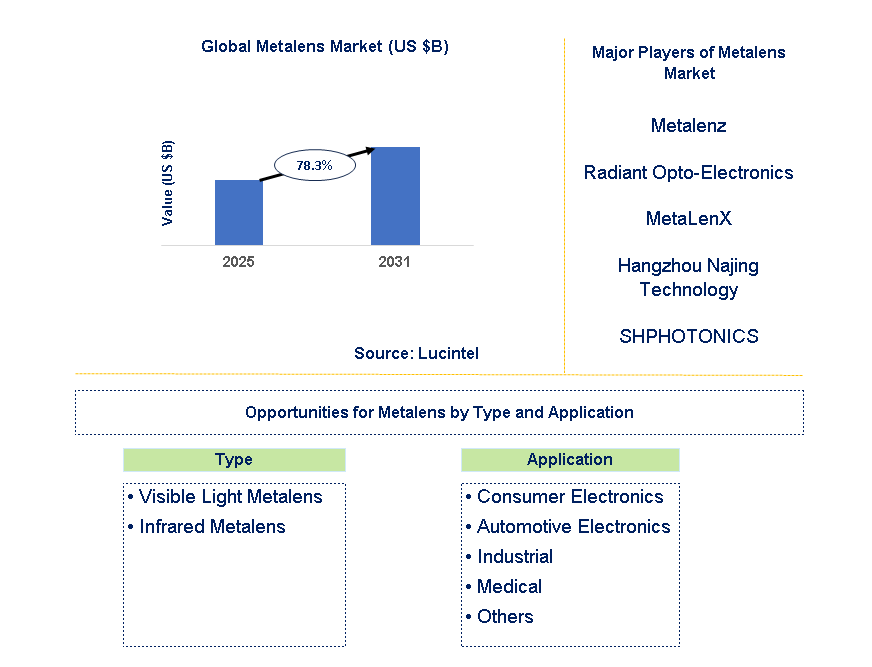
Key data points: The growth forecast = 78.3% annually for the next 7 years. Scroll below to get more insights. This market report covers Trends, opportunities and forecasts in metalens market to 2031 by type (visible light metalens and infrared metalens), application (consumer electronics, automotive electronics, industrial, medical, and others), and region (North America, Europe, Asia Pacific, and the Rest of the World)
We'll send your sample report shortly.
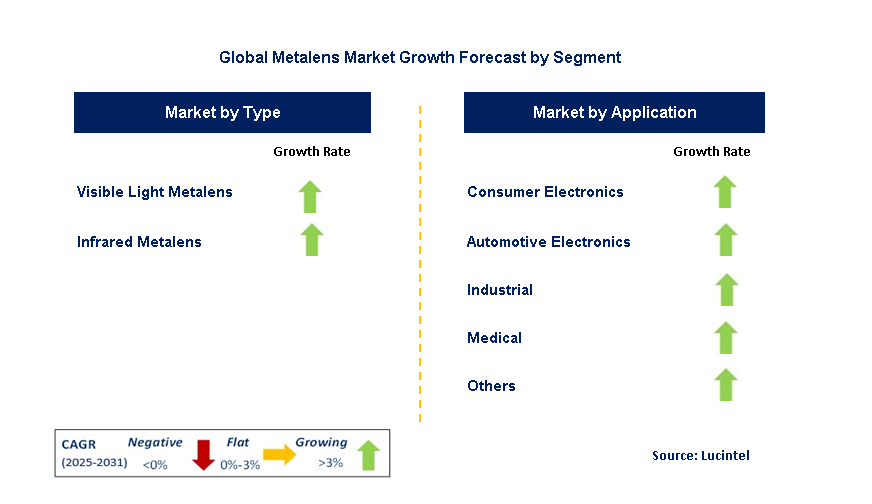
• Lucintel forecasts that, within the type category, visible light metalens is expected to witness higher growth over the forecast period due to the rising demand for advanced imaging system.
• Within the application category, consumer electronics is expected to witness the highest growth due to the growing demand for miniaturized electronics.
• In terms of region, North America is expected to witness the highest growth over the forecast period due to the increasing investments in optical technology.
• The Shift Towards Smaller Lenses: The new leads to a demand for metalenses replace traditional and bulky lenses. Now, phones, portable devices, and wearable tech can utilize metalenses which are lightweight and slim compared to older lenses. This new trend is allowing industries to improve and maintain size as well as weightage while augmenting the optical performance.
• New Production Methods: The use of nanofabrication and 3D printing are enhancing expansion metalens production can scale to. Because these methods allow for high precision mass production, costs can be cut, and quality control can be enhanced. These are known to as advanced manufacturing techniques, and as refinement of these methods are garnered, the metalens production gets easier, cheaper, and more efficient which will enable faster market acceptance.
• Integrating Optical metalenses with Electronic Gadgets: Integrating metalenses with electronic gadgets is on the rise with time particularly in cameras and other optical sensors. As smartphones and tablets, as well as AR and VR devices continue to mature, there is growing demand for compact yet powerful optics. metalenses improve the image quality while reducing the size of optical components which makes them suitable for the new generation of consumer products.
• Enhancement of Medical Imaging with metalenses: In medicine, metalenses are becoming widely popular as these lenses are believed to be very useful in improving imaging systems. With the ability to design metalenses with an array of specialized features like higher resolution and lower optical distortions, they very useful in medical devices like endoscopes, microscopes, and other imaging tools. These advances will facilitate better diagnosis and treatment in healthcare.
• Use in Self-driving Cars: Self-driving cars depend on optical systems like cameras and LiDAR for navigation. metalenses tents to increase the efficiency of detecting an object as well as imaging the objects in various environmental conditions. The precision and miniaturization features of metalenses combine well with the needs of autonomous driving technology, making these devices a crucial component in the future of transportation.
These growing trends point to a gradual development in the metalens market as new technologies and applications emerge. The focus is on miniaturization processes, advanced manufacturing techniques, integration with consumer electronics, improvements in medical imaging, and self-driving vehicles. These technologies are preparing the ground for increased industry innovations and adoption.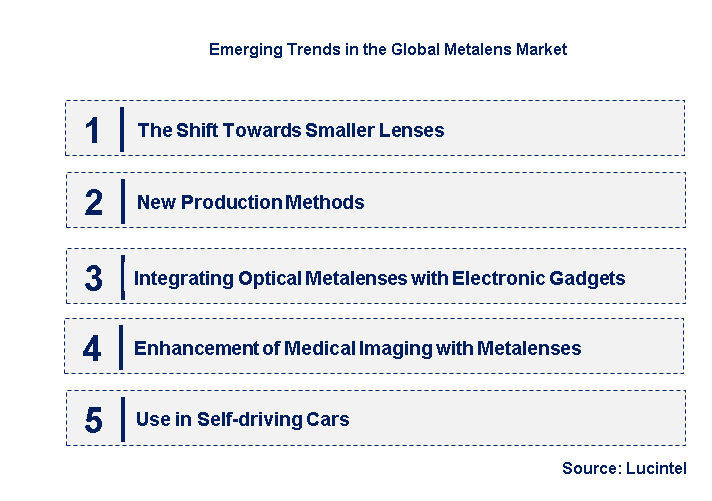
• Advancements in Materials for Metalenses: The use of metasurfaces and nano-structured materials has improved the performance of metalenses. Recent breakthroughs in materials such as these have greatly aided the development of metalenses. Exceptional optical power like improved focal length and aberration-free vision can now be used with metalenses. Better material properties enable metalens systems to function better with higher reliability supporting great metalens adoption.
• Capabilities for Mass Production: The advancement of cost-effective mass production techniques has made a massive impact on the metalens market. Nanofabrication techniques like photolithography and nano-imprint lithography are improving, allowing manufacturers to fabricate lenses on a larger scale. This improvement in scaling production metalens technology is making it cheaper and easier to access, leading to growth in the market domain.
• Merged with Wearables: The most promising development is the incorporation of metalenses in the wearable technology. Firms are embedding metalens structures within smart glasses and augmented reality (AR) headsets. These small and powerful lenses increase packaging efficiency while ensuring that the lenses are lightweight, which is a critical factor for the market acceptability of head-worn devices.
• Use In Optical Communication: metalenses are being researched for a variety of uses in optical communications where the ability to control and manipulate light at small scales is needed to enhance data transmission and reduce energy use. In particular, metalenses are being applied on integrated optical devices using optical waveguides and photonic systems to enable the next generation of communication technologies.
• Achievements in Adaptive Optics: Another domain that metalenses are making progress in is that of adaptive optics metalenses which tries to compensate for optical blinds in real time. Other areas where these systems could be utilized include astronomy and medical imaging. The new advancements in nano fabrication and optics are fundamentally changing the performance of adaptive optics.
New changes in the development and mass production of metalenses, as well as wearables, optical communications and adaptive optics are rapidly growing the metalens market. These changes improve the versatility and extend the scope of the metalenses which will enable them to be widely used in industry.• Self Driving Cars: The self driving cars market is another sector that is rapidly growing for metalenses. Their reliance on cameras and LiDAR systems for navigation means metalenses can help improve the performance of these systems. As a result, autonomous vehicle technology is a valuable component to metalenses, as they increase imaging accuracy, reduce size, and decrease weight.
• Defence, Aerospace and Security: metalenses can be applied for satellites imaging, observation, communication, and even surveillance systems, which are weight sensitive. These industries have a great demand for high performance compact optical systems because having better imaging while reducing size is an advantage. While as metalenses providing space for improved imaging, they are way more suitable for these applications.
• AR and VR: The demand for AR and VR makes the performance of these devices improved with more metalenses strapping to them. With the enhancement of clarity provided by metalenses, AR glasses and VR headsets much easier to wear as no longer do bulkier lenses need to be used. With the ever growing need for immersion in both consumer and industrial expers, this is undoubtedly a big opportunity.
The metalens market is expected to grow across various sectors such as consumer electronics, medical equipment, autonomous automobiles, aerospace, and AR & VR. This shows the flexibility of the metalenses as they are able to capture the opportunities available while ensuring a change in different sectors which enables them to be one of the most important technologies in the world.• Metalenz
• Radiant Opto-Electronics
• MetaLenX
• Hangzhou Najing Technology
• SHPHOTONICS
• Visible Light Metalens
• Infrared Metalens
• Consumer Electronics
• Automotive Electronics
• Industrial
• Medical
• Others
• North America
• Europe
• Asia Pacific
• The Rest of the World
• United States: A large chunk of research towards innovation in metalens solutions is formulated in the United States. Additionally, tech companies that have an affinity for metalenses have started working with universities for consumer electronics, autonomous cars, and medicare devices, as an example, for cross-industry collaboration to reap shared benefits. The American government on the other end is pushing for progress towards nanotechnology so that it can be harnessed for metalense implementations. These initiatives alongside many other notable companies in the US that are focusing on improving production and efficiency of metalens systems has led to an increase of market growth.
• China: Along with the private sector, the government funding has rapidly assisted China’s growth in the metalens market. The country’s investment in its manufacturing and research facilities is positively impacting the growth of metalens technology. China is particularly focused on mobile devices, optics for cameras, and other wearable gadgets to apply them on. On top of that, the government’s support for research in nanotechnology greatly enhances thecountry’s ability to be a leader in metalens production.
• Germany: Germany is currently making great progress in the metalens market due to its growing precise optics industry. The government tends to focus on quality manufacturing and engineering, which is incredibly beneficial in the case of developing a metalens. German firms are looking for new uses for metalenses in the automotive, healthcare, and aerospace sectors. Within Germany, industrial and research institutions are working more closely to otain better production efficiency, reigniting the country’s participation in the global value chain for metalens supply.
• India: metalenses have a very promising future in Indian research and even start-ups are investing in nanotechnology and optical engineering. The never ending growth in India’s tech industry, especially mobile and telecommunications, creates a very strong demand for metalenses. Indian researchers are looking into how increase the production of metalenses without compromising on their cost. Looking into the future, as the country strengthens its position in the global tech ecosystem, metalenses are adopted in medical imaging and solar industries across the country.
• Japan: Japan has the strongest base for metalens developments because of their experience with optics and the growing technology base. The industrial leaders in Japan, especially those in robotics and electronics, are very bullish on metal lenses and their uses for AR VR applications. Also, the Japanese focus on miniaturization and precision manufacturing makes them increase the value of metalens technology. Besides, there is a need for further work to remove mass production barriers which will help make metalenses widely available.


• Metalenz
• Radiant Opto-Electronics
• MetaLenX
• Hangzhou Najing Technology
• SHPHOTONICS
Q5. Which metalens market segment will be the largest in future?

Choose a license that fits your team. Instant PDF delivery.
Prices exclude taxes. Instant delivery. Custom licensing available on request.
Market Report · July 29, 2026
Market Report · July 20, 2026
Market Report · July 20, 2026
Trusted partner for strategic intelligence and business growth


Receive a complimentary market analysis tailored to your industry. Our analysts will identify key growth opportunities and competitive dynamics specific to your business.

Market size, growth rate, and key trend analysis for your specific sector.

Top competitor positioning and market share analysis.

Strategic recommendations backed by data-driven insights.
Get curated market intelligence and competitive moves straight to your inbox.
By subscribing, you agree to receive our monthly insights. Unsubscribe anytime.
Receive a complimentary market analysis tailored to your industry. Our analysts will identify key growth opportunities and competitive dynamics specific to your business.
Market size, growth rate, and key trend analysis for your specific sector.
Top competitor positioning and market share analysis.
Strategic recommendations backed by data-driven insights.
Get curated market intelligence, emerging trends, and competitive moves straight to your inbox each month.
By subscribing, you agree to receive our monthly insights. Unsubscribe anytime.
We'll send your sample report shortly.