
Market Report · July 22, 2026

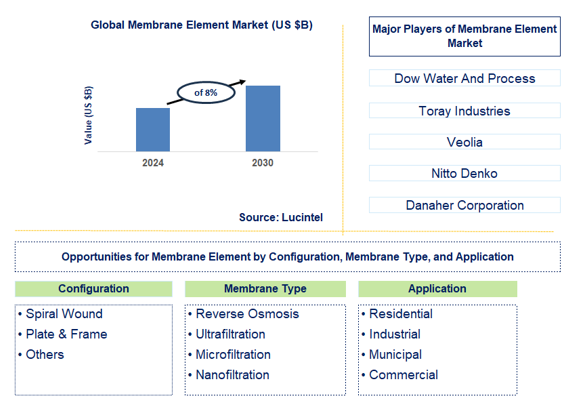
Key data points: The growth forecast = of 8% annually for the next 6 years. Scroll below to get more insights. This market report covers trends, opportunities, and forecasts in the global membrane element market to 2030 by configuration (spiral wound, plate & frame, and others), membrane type (reverse osmosis, ultrafiltration, microfiltration, and nanofiltration), application (residential, industrial, municipal, and commercial), and region (North America, Europe, Asia Pacific, and the Rest of the World)
We'll send your sample report shortly.
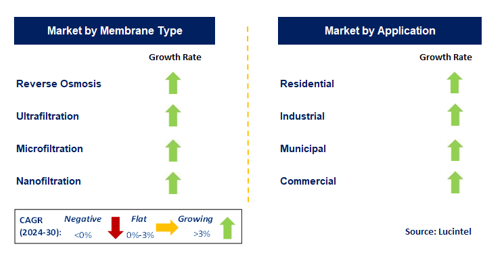
• Lucintel forecasts that, within the membrane type category, reverse osmosis will remain the largest segment over the forecast period due to its wide application like desalination and industrial water treatment.
• Within the application category, residential will remain the largest segment.
• APAC is expected to witness the highest growth over the forecast period due to increasing government initiatives to improve water infrastructure and rising awareness among people towards water scarcity issue in the region. Gain valuable insights for your business decisions with our comprehensive 150+ page report.
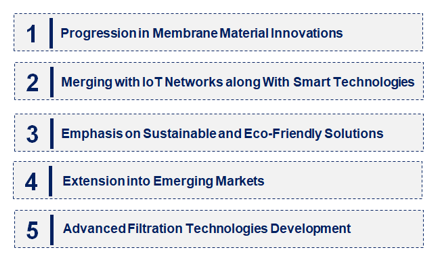
• Progression in Membrane Material Innovations: Advancements in areas such as high-flux and fouling-resistant membranes have resulted in increased demand for products associated with this market because they improve their functions. In particular, these new materials help decrease maintenance costs by increasing membrane performance and the durability of water treatments or other industrial applications.
• Merging with IoT Networks Along with Smart Technologies: Increasingly, membrane systems are being incorporated into Internet of Things (IoT)-based networks with smart technologies on board. By doing so, it allows real-time monitoring and control, which optimizes the operations associated with membranes, thereby extending their life span as well. As such, smart technologies have improved the efficiency and dependability of membrane systems.
• Emphasis on Sustainable and Eco-Friendly Solutions: The focus is shifting toward sustainable and eco-friendly membrane solutions. Manufacturers are creating membranes that have less environmental impact and improved energy efficiency. This trend aligns with global sustainability objectives, which foster the use of green technologies in water treatment and other industrial applications.
• Extension into Emerging Markets: Significant growth prospects exist as membrane technology expands into emerging markets such as India and Southeast Asia. Demand for advanced membranes arises from the industrialization process taking place in these regions, along with water scarcity, which has led to market expansion and the discovery of new areas of application.
• Advanced Filtration Technologies Development: The development of advanced filtration technologies, like hybrid or multistage filtration systems, enhances membrane performance. Such technologies combine several filtering techniques to handle the complex demands of water and wastewater treatment, offering complete solutions for different applications. Emerging trends, like advancements in membrane materials, IoT integration and smart technology, focus on sustainability, expansion into emerging markets, and the development of advanced filtration technologies, are reshaping the membrane element market. These trends promote technological innovation, broader market coverage, and evolving environmental and industrial requirements.
• Better Membrane Materials: The use of more complex membrane materials, such as those with improved fouling properties and higher flux rates, represents a major breakthrough. These materials increase the performance and lifespan of membranes, reducing maintenance needs and operating costs across various applications.
• Intelligent Membrane Systems: The integration of intelligent systems into membrane architectures allows real-time monitoring and automated control. This improvement enhances system effectiveness, efficiency, and maintenance by providing actionable insights, enabling membrane systems to be managed proactively.
• Innovations for Cost Reduction: Innovation aimed at finding cheaper ways of producing and implementing membranes is expanding the market. Advanced manufacturing and material sourcing have made high-performance membranes more affordable, driving their wider acceptance in both developed and emerging markets.
• Green Membrane Solutions: The push for more sustainable membrane solutions is gaining momentum. New membranes are being developed to achieve low environmental impact by using eco-friendly materials and reducing energy consumption, which aligns with global sustainability goals and regulatory requirements.
• More Industrial Process Applications: Membranes are increasingly being used in diverse industrial processes beyond traditional water treatment. These applications include food processing, chemical industries, and pharmaceuticals, where enhanced filtration and separation techniques result in better product quality. Advancements such as improved membrane materials, smart systems, cost-reduction innovations, sustainable solutions, and expanded industrial applications are recent developments that fuel growth in the membrane element market. These improvements make membranes better in performance while lowering costs and enabling them to serve a wider range of applications, thereby contributing to both market expansion and technological advancement.
• Membrane Technologies Expansion Is a Great Opportunity for Growth: Advanced membrane solutions have the capacity to meet the increasing global demand for clean water in desalination, wastewater treatment, and potable water production.
• Industrial Process Optimization: Efficiency and quality improvement in industrial processes are achieved through the increased use of membranes. In sectors like food and beverage, pharmaceuticals, and chemicals, process performance can be enhanced by the application of advanced filtration and separation techniques.
• Development of Energy-Efficient Membranes: There is an increasing demand for energy-efficient membrane technologies. Developing membranes that require less energy for operation aligns with sustainability goals and reduces operational costs, presenting a growth opportunity for manufacturers focused on eco-friendly solutions.
• Emerging Market Penetration: New market opportunities arise when advanced membrane solutions are offered in emerging markets like India or Southeast Asia. Water scarcity, rising industrialization levels, and infrastructure development contribute to the need for advancing membrane technology, creating new market opportunities.
• Integration with Advanced Technologies: Growth opportunities arise from integrating membrane technologies into IoT and smart systems. The use of better monitoring and control methods to enhance the performance of membranes will encourage adoption and innovation in this market. Strategic growth opportunities in the membrane element market include water treatment expansion, industrial process optimization, development of energy-efficient membranes, emerging market penetration, and integration with advanced technologies. Their use drives efficiency to address global needs at all times while enhancing the outlook of these markets over time.
• Technological Advancements: Technological advancements act as a driver for change in the membrane element market. Innovations in membrane materials, manufacturing processes, and filtration technologies improve performance, durability, and efficiency. Water treatment and industrial processes are some of the various applications where these developments have influenced adoption.
• Increasing Demand for Water Purification: The global demand for clean and safe water has boosted the membrane element market. As global water scarcity and pollution issues escalate, advanced membrane technologies offer effective solutions for water purification, desalination, and wastewater treatment.
• Regulatory Pressures: Market growth is driven by stringent environmental and water quality regulations. Governments are enacting regulations that require innovative products to meet safety standards, thus necessitating manufacturers to adopt membranes.
• Industrial Growth: The need for membrane technologies arises from industrial growth, which calls for efficient separation and filtration processes. Sectors such as food and beverage, pharmaceuticals, and chemicals require advanced membranes that can enhance product quality and process efficiency.
• Sustainability and Energy Efficiency: Within the membrane element market, sustainability and energy efficiency are increasingly becoming important concerns. Innovations aimed at reducing environmental impact and operational energy consumption are driving market growth while aligning with global sustainability goals. Challenges in the membrane element market include:
• High Initial Costs: Despite long-term benefits, the high initial costs of membrane technologies may hinder their adoption, especially in price-sensitive markets. Moreover, the high cost of sophisticated materials and systems can discourage certain buyers, thereby hindering further development in this market.
• Membrane Fouling: The accumulation of contaminants causes fouling of membranes, which is a significant issue. This fouling influences how long membranes remain effective and the way they function, leading to higher costs for service support and maintenance. Tackling this issue through new ideas is crucial for market growth.
• Regulatory Compliance: It can be difficult for membrane manufacturers to deal with differing and rapidly changing regulatory standards. The varying regulations across regions make market entry and expansion more complex and expensive. Technological advancements, increased demand for water purification, environmental protection regulations, expanding industrial activities, and a drive toward sustainable manufacturing are some of the factors driving growth in the membrane element market. However, challenges such as high setup costs, membrane fouling, and meeting regulatory compliance demands must also be overcome. Achieving a balance between these drivers and obstacles is essential for success in the market and achieving growth.
• Dow Water and Process Solutions
• Toray Industries
• Veolia
• Nitto Denko
• Danaher Corporation
• Alfa Laval
• Applied Membrane
• Spiral Wound
• Plate & Frame
• Others
• Reverse Osmosis
• Ultrafiltration
• Microfiltration
• Nanofiltration
• Residential
• Industrial
• Municipal
• Commercial
• North America
• Europe
• Asia Pacific
• The Rest of the World
• United States: In the US, advancements in reverse osmosis (RO) and nanofiltration (NF) technologies are expanding the membrane element market. Notable developments include new types of membranes that could make water purification systems even more durable and efficient. Innovations aimed at environmental sustainability, along with stringent environmental standards, have driven the development of advanced membrane technologies for industrial processes and municipal water treatment.
• China: China’s membrane element market has experienced tremendous growth due to rapid industrialization and increasing water scarcity concerns. The goal is to improve membrane performance and make them affordable for use in wastewater treatment and desalination. Chinese firms have invested heavily in research and development to produce high-performance membranes that meet both local and international standards. Additionally, government support for water infrastructure projects is contributing to further market acceleration.
• Germany: Germany remains a leading force in innovative membrane technology, with a particular focus on high-performance membranes for both industrial and municipal water treatments. To enhance the longevity and efficiency of membranes used by German companies, they are concentrating on advanced materials and production processes. This demand aligns with Germany’s sustainable water management approaches, which integrate societal objectives under strong environmental policies driving the adoption of modern technologies available through the sale of advanced membranes.
• India: The Indian membrane element market is developing significantly as the country works toward improving its water infrastructure and addressing issues related to water scarcity. Recent developments include cost-effective membrane technologies suitable for multiple sources of water supply, including diversified options that cater to different conditions and cost variations. All these initiatives undertaken by the Indian government to improve water quality and treatment facilities are increasing the use of membranes in both the municipal and industrial sectors.
• Japan: The Japanese membrane element market has seen technological advancements in highly efficient membranes for water treatment and industrial applications. The country is leading the world in the development of membrane materials and processes that enhance performance while ensuring sustainability. Technological excellence and environmental protection define Japan’s preference for cutting-edge membrane solutions, which continuously evolve.


• Dow Water and Process Solutions
• Toray Industries
• Veolia
• Nitto Denko
• Danaher Corporation
• Alfa Laval
• Applied Membrane Q5. Which membrane element market segment will be the largest in future? Answer: Lucintel forecasts that reverse osmosis will remain the largest segment over the forecast period due to its wide application like desalination and industrial water treatment. Q6. In membrane element market, which region is expected to be the largest in next 5 years? Answer: APAC is expected to witness highest growth over the forecast period due to increasing government initiatives to improve water infrastructure and rising awareness among people towards water scarcity issue in the region. Q7. Do we receive customization in this report? Answer: Yes, Lucintel provides 10% customization without any additional cost.


Choose a license that fits your team. Instant PDF delivery.
Prices exclude taxes. Instant delivery. Custom licensing available on request.
Market Report · July 22, 2026
Market Report · July 22, 2026
Market Report · July 22, 2026
Trusted partner for strategic intelligence and business growth


Receive a complimentary market analysis tailored to your industry. Our analysts will identify key growth opportunities and competitive dynamics specific to your business.

Market size, growth rate, and key trend analysis for your specific sector.

Top competitor positioning and market share analysis.

Strategic recommendations backed by data-driven insights.
Get curated market intelligence and competitive moves straight to your inbox.
By subscribing, you agree to receive our monthly insights. Unsubscribe anytime.
Receive a complimentary market analysis tailored to your industry. Our analysts will identify key growth opportunities and competitive dynamics specific to your business.
Market size, growth rate, and key trend analysis for your specific sector.
Top competitor positioning and market share analysis.
Strategic recommendations backed by data-driven insights.
Get curated market intelligence, emerging trends, and competitive moves straight to your inbox each month.
By subscribing, you agree to receive our monthly insights. Unsubscribe anytime.
We'll send your sample report shortly.