
Report Feature
Medical Smart Textile Market Trends and Forecast
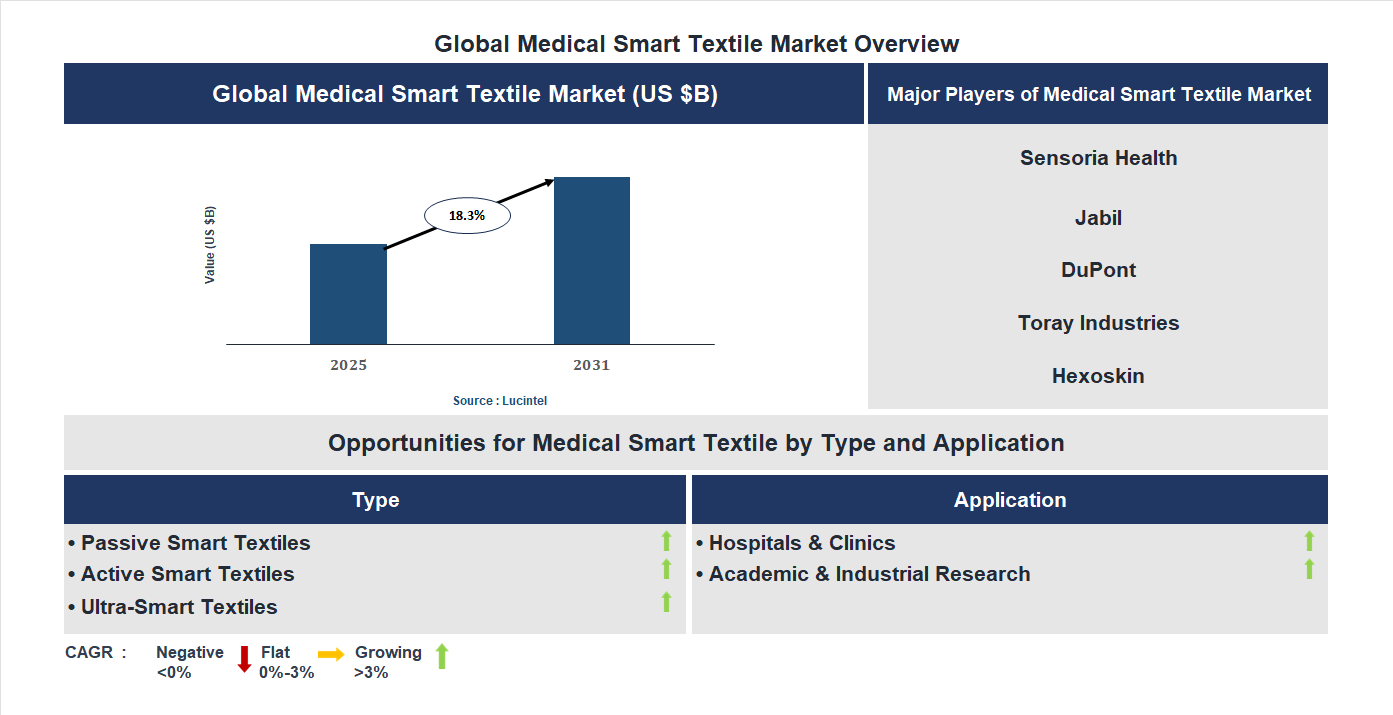
The future of the global medical smart textile market looks promising with opportunities in the hospital & clinic and academic & industrial research markets. The global medical smart textile market is expected to grow with a CAGR of 18.3% from 2025 to 2031. The major drivers for this market are the increasing demand for patient monitoring textiles, the rising adoption of wearable healthcare technologies, and the growing focus on preventive healthcare solutions.• Lucintel forecasts that, within the type category, active smart textile is expected to witness the highest growth over the forecast period.
• Within the application category, hospital & clinic is expected to witness higher growth.
• In terms of region, APAC is expected to witness the highest growth over the forecast period. Gain valuable insights for your business decisions with our comprehensive 150+ page report. Sample figures with some insights are shown below.
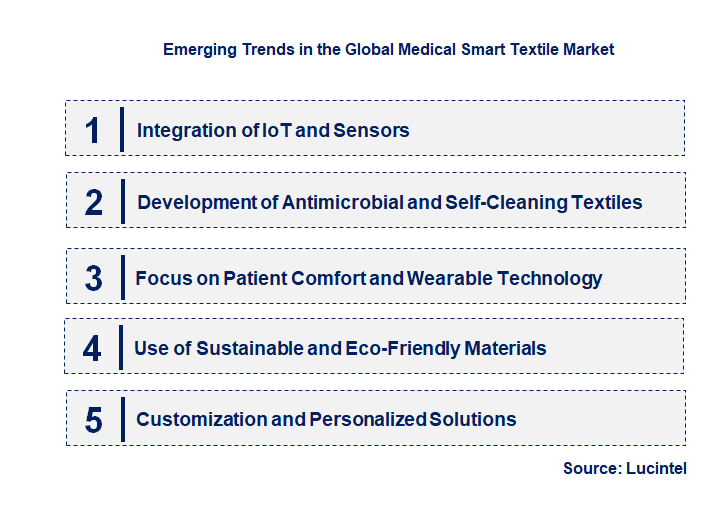
Emerging Trends in the Medical Smart Textile Market
The medical smart textile market is experiencing rapid growth driven by technological advancements, increasing healthcare needs, and a rising focus on patient comfort and safety. Innovations in textile materials integrated with sensors, data collection, and responsive features are transforming traditional medical textiles into intelligent solutions. These developments are not only improving patient outcomes but also enhancing healthcare provider efficiency. As the market evolves, key trends are emerging that are shaping its future landscape. These trends reflect a shift towards more personalized, connected, and sustainable medical textile products, ultimately redefining how healthcare services are delivered and experienced.• Integration of IoT and sensors: The incorporation of Internet of Things (IoT) technology and sensors into medical textiles allows real-time monitoring of vital signs, movement, and environmental conditions. This connectivity enhances patient care by providing continuous data to healthcare providers, enabling early detection of health issues and personalized treatment plans. It also facilitates remote patient monitoring, reducing hospital visits and improving overall healthcare efficiency. As sensor technology becomes more affordable and miniaturized, its adoption in smart textiles is expected to accelerate, making healthcare more proactive and data-driven.
• Development of antimicrobial and self-cleaning textiles: The demand for hygienic and infection-resistant medical textiles is driving innovation in antimicrobial and self-cleaning fabrics. These textiles incorporate antimicrobial agents or nanomaterials that inhibit bacterial growth, reducing infection risks for patients and healthcare workers. Self-cleaning textiles, which repel dirt and microbes, are gaining popularity for use in hospital bedding, wound dressings, and wearable devices. These features extend the lifespan of textiles, lower maintenance costs, and improve hygiene standards, which are critical in healthcare settings, especially during pandemics and outbreaks.
• Focus on patient comfort and wearable technology: Increasing emphasis on patient comfort and mobility is fueling the development of flexible, breathable, and lightweight smart textiles. Wearable medical devices embedded in textiles enable continuous health monitoring without restricting movement, improving patient compliance and comfort. These textiles are used in compression garments, bandages, and prosthetics, offering both therapeutic benefits and data collection capabilities. The integration of aesthetic design with functionality is also important, making medical wearables more acceptable and less stigmatizing for users, thereby broadening their adoption.
• Use of sustainable and eco-friendly materials: Sustainability is becoming a key consideration in the development of medical smart textiles. Manufacturers are exploring biodegradable, recyclable, and eco-friendly materials to reduce environmental impact. This trend aligns with global efforts to promote green healthcare practices and reduce waste generated by disposable textiles. Sustainable textiles not only appeal to environmentally conscious consumers but also meet regulatory standards for safety and biodegradability. The adoption of eco-friendly materials is expected to drive innovation and set new industry standards for responsible manufacturing in the medical textile sector.
• Customization and personalized solutions: Advances in textile manufacturing and digital printing enable the production of customized and personalized medical textiles tailored to individual patient needs. This trend enhances treatment efficacy, comfort, and user experience. Personalized textiles can include specific therapeutic features, fit, and aesthetic preferences, improving patient adherence to treatment protocols. Additionally, customization supports niche applications such as sports medicine, elderly care, and rehabilitation. As digital technologies become more accessible, the market will see increased demand for bespoke solutions, fostering innovation and expanding the scope of medical smart textiles. In summary, these emerging trends are fundamentally reshaping the medical smart textile market by fostering innovation, improving patient outcomes, and promoting sustainable practices. The integration of advanced technologies, focus on hygiene and comfort, and customization are driving the market toward more intelligent, eco-friendly, and user-centric solutions. These developments are not only expanding market opportunities but also transforming healthcare delivery into a more efficient, personalized, and sustainable industry.
Recent Development in the Medical Smart Textile Market
The medical smart textile market is experiencing rapid growth driven by technological advancements, increasing healthcare needs, and rising demand for innovative medical solutions. These textiles integrate sensors, conductive fibers, and other smart features to monitor health, improve patient comfort, and enhance treatment outcomes. As the healthcare industry shifts towards personalized and remote care, the adoption of smart textiles is becoming more prevalent. This evolving landscape is influenced by regulatory developments, technological innovations, and increasing investments. The following key developments highlight the recent trends shaping this dynamic market and their implications for stakeholders.• Technological Innovations in Sensor Integration: Advances in flexible sensors and conductive fibers have enabled textiles to monitor vital signs such as heart rate, temperature, and hydration levels in real-time. This development enhances patient monitoring outside clinical settings, improving early diagnosis and personalized treatment. It also reduces hospital stays and healthcare costs, making smart textiles more accessible and practical for everyday use.
• Growing Adoption in Wound Care Management: Smart textiles with embedded antimicrobial properties and sensors for wound monitoring are transforming wound care. These textiles can detect infection or moisture levels, alerting caregivers promptly. This reduces the risk of complications, accelerates healing, and minimizes the need for frequent dressing changes, thereby improving patient outcomes and lowering healthcare expenses.
• Rising Investment and Strategic Collaborations: Major companies and startups are increasing investments in R&D and forming strategic partnerships to develop advanced medical smart textiles. These collaborations facilitate the integration of cutting-edge technologies, expand product portfolios, and accelerate commercialization. Increased funding and partnerships are driving innovation and market penetration, making smart textiles more widely available.
• Regulatory Frameworks and Standards Development: Governments and regulatory bodies are establishing standards and guidelines for the safety, efficacy, and quality of medical smart textiles. Clear regulations boost consumer confidence, facilitate market entry, and ensure product reliability. This development encourages manufacturers to innovate within a regulated environment, fostering trust and wider adoption in healthcare settings.
• Expansion into Remote Patient Monitoring and Telemedicine: The COVID-19 pandemic accelerated the adoption of remote healthcare solutions, including smart textiles. These textiles enable continuous health monitoring outside hospitals, supporting telemedicine initiatives. This expansion improves access to healthcare, especially in remote areas, and reduces the burden on healthcare facilities, making healthcare delivery more efficient and patient-centric. In summary, recent developments in the medical smart textile market are significantly enhancing healthcare delivery through technological innovation, improved wound care, strategic investments, regulatory support, and remote monitoring capabilities. These trends are driving market growth, expanding application areas, and improving patient outcomes, positioning smart textiles as a vital component of future healthcare solutions.
Strategic Growth Opportunities in the Medical Smart Textile Market
The medical smart textile market is experiencing rapid growth driven by technological advancements and increasing demand for innovative healthcare solutions. These textiles integrate sensors, conductive fibers, and other smart features to enhance patient care, improve monitoring, and enable personalized treatment. As healthcare providers seek more efficient, comfortable, and effective solutions, the market is poised for significant expansion across various applications. Key growth opportunities are emerging in areas such as patient monitoring, wound care, athletic performance, infection control, and elderly care. These developments are transforming traditional textiles into intelligent, multifunctional products that address critical healthcare needs and improve overall outcomes.• Patient Monitoring: The integration of sensors into textiles allows continuous health monitoring, providing real-time data on vital signs. This enhances early diagnosis, reduces hospital stays, and improves patient outcomes by enabling remote monitoring and timely interventions.
• Wound Care: Smart textiles with embedded sensors can detect infection, moisture levels, and healing progress. This proactive approach reduces complications, accelerates recovery, and minimizes the need for frequent dressing changes, leading to better patient comfort and cost savings.
• Athletic Performance: In sports medicine, smart textiles help track physical activity, muscle strain, and hydration levels. This data-driven approach optimizes training, prevents injuries, and promotes faster recovery, benefiting athletes and fitness enthusiasts alike.
• Infection Control: Antimicrobial and self-cleaning smart textiles are gaining traction in hospitals and clinics. They reduce the risk of infections, improve hygiene, and extend the lifespan of medical textiles, supporting safer healthcare environments.
• Elderly Care: Smart textiles designed for elderly patients offer fall detection, activity monitoring, and medication reminders. These features enhance safety, independence, and quality of life for seniors, while easing caregiver responsibilities. In summary, these growth opportunities are significantly impacting the medical smart textile market by fostering innovation, improving patient care, and reducing healthcare costs. As these applications expand, they are driving market growth and setting new standards for healthcare textiles worldwide.
Medical Smart Textile Market Driver and Challenges
The medical smart textile market is influenced by a variety of technological, economic, and regulatory factors that shape its growth and development. Advances in wearable technology, increasing healthcare needs, and regulatory support for innovative medical solutions are key drivers. Conversely, challenges such as high production costs, regulatory hurdles, and technological limitations pose significant barriers. Understanding these drivers and challenges is essential for stakeholders aiming to capitalize on emerging opportunities and navigate potential risks within this dynamic industry. The factors responsible for driving the medical smart textile market include:-• Technological Innovation: The rapid development of smart textiles embedded with sensors, conductive fibers, and wireless communication modules has revolutionized patient monitoring, wound care, and health tracking. These textiles enable real-time data collection, improving patient outcomes and reducing healthcare costs. As technology advances, the integration of AI and IoT further enhances functionality, making smart textiles more effective and user-friendly. The continuous innovation attracts investments and accelerates market growth, especially in personalized medicine and remote healthcare applications.
• Rising Healthcare Expenditure: Increasing global healthcare spending, driven by aging populations and the prevalence of chronic diseases, fuels demand for advanced medical solutions. Smart textiles offer minimally invasive, comfortable, and efficient options for patient monitoring, wound management, and rehabilitation. Governments and private sectors are investing heavily in healthcare infrastructure, encouraging the adoption of innovative textiles that can reduce hospital stays and improve treatment efficacy. This economic trend significantly propels market expansion, especially in developed regions.
• Growing Focus on Preventive Healthcare: The shift towards preventive and personalized healthcare emphasizes early detection and continuous health monitoring. Smart textiles facilitate this by providing wearable solutions that track vital signs, activity levels, and other health metrics in real-time. This proactive approach reduces the burden on healthcare systems and enhances patient engagement. The increasing awareness about health and wellness, coupled with technological accessibility, drives demand for smart textiles in everyday life, thus expanding market opportunities.
• Regulatory Support and Standards: Governments and regulatory bodies are recognizing the potential of smart textiles in healthcare, leading to supportive policies, standards, and certifications. These regulations ensure safety, efficacy, and quality, encouraging manufacturers to innovate confidently. Regulatory approval processes, although complex, provide credibility and facilitate market entry. The evolving regulatory landscape fosters trust among consumers and healthcare providers, thereby accelerating adoption and market growth. The challenges in the medical smart textile market are:
• High Production and Development Costs: Manufacturing smart textiles involves sophisticated technology, specialized materials, and complex integration processes, resulting in high costs. These expenses can limit affordability and scalability, especially for smaller companies or emerging markets. Additionally, ongoing R&D investments are necessary to improve durability, comfort, and functionality, further increasing costs. This financial barrier can slow down widespread adoption and restrict market expansion in cost-sensitive regions.
• Regulatory and Certification Barriers: The complex regulatory environment for medical devices and textiles poses significant hurdles. Obtaining approvals involves rigorous testing, documentation, and compliance with safety standards, which can be time-consuming and expensive. Variations in regulations across countries add complexity for global market entry. These barriers delay product launches and increase costs, potentially discouraging innovation and limiting market growth.
• Technological Limitations and Reliability Issues: Despite advancements, smart textiles face challenges related to durability, washability, and long-term reliability. Sensor accuracy and data security are ongoing concerns, impacting user trust and clinical acceptance. Technological limitations can hinder seamless integration into daily routines and medical protocols. Overcoming these issues requires continuous R&D, which demands time and investment, potentially slowing market progress and adoption rates. In summary, the medical smart textile market is driven by technological innovation, increasing healthcare expenditure, a focus on preventive healthcare, and supportive regulatory frameworks. However, high costs, regulatory complexities, and technological limitations present notable challenges. These factors collectively influence the pace and scope of market growth. While opportunities for innovation and expansion are substantial, addressing these challenges is crucial for sustainable development. Overall, the markets future depends on balancing technological advancements with regulatory and cost considerations to meet evolving healthcare needs effectively.
List of Medical Smart Textile Companies
Companies in the market compete on the basis of product quality offered. Major players in this market focus on expanding their manufacturing facilities, R&D investments, infrastructural development, and leverage integration opportunities across the value chain. With these strategies medical smart textile companies cater increasing demand, ensure competitive effectiveness, develop innovative products & technologies, reduce production costs, and expand their customer base. Some of the medical smart textile companies profiled in this report include-• Sensoria Health
• Jabil
• DuPont
• Toray Industries
• Hexoskin
• Pireta
• AiQ Smart Clothing
• Schoeller Textiles
• Vista Medical
• Asahi Kasei
Medical Smart Textile Market by Segment
The study includes a forecast for the global medical smart textile market by type, application, and region.Medical Smart Textile Market by Type [Value from 2019 to 2031]:
• Passive Smart Textiles
• Active Smart Textiles
• Ultra-Smart Textiles
Medical Smart Textile Market by Application [Value from 2019 to 2031]:
• Hospitals & Clinics
• Academic & Industrial Research
Medical Smart Textile Market by Region [Value from 2019 to 2031]:
• North America
• Europe
• Asia Pacific
• The Rest of the World
Country Wise Outlook for the Medical Smart Textile Market
The medical smart textile market is experiencing rapid growth driven by technological advancements, increasing healthcare needs, and rising demand for innovative medical solutions worldwide. Countries are investing heavily in research and development to enhance the functionality, comfort, and durability of smart textiles used in medical applications. These developments include integration of sensors, antimicrobial properties, and improved biocompatibility, which are transforming patient care, wound management, and health monitoring. As the market expands, regional players are adopting new strategies to capture market share, leading to significant innovations and collaborations across the globe.• United States: The US market is leading in innovation, with significant investments in wearable health monitoring devices and smart textiles for wound care. Major companies are developing advanced sensor-integrated fabrics that track vital signs and provide real-time health data. Regulatory approvals for new medical textile products are accelerating, boosting market growth. Additionally, collaborations between tech firms and healthcare providers are fostering the development of personalized medical textiles. The US government’s focus on healthcare digitization and aging population support further market expansion, making it a key player in this sector.
• China: China is rapidly advancing in smart textile manufacturing, driven by a large domestic market and government initiatives supporting healthcare innovation. The country is focusing on affordable, mass-produced smart textiles for wound healing, infection control, and health monitoring. Local companies are investing in R&D to improve sensor integration and textile durability. The Chinese government’s "Made in China 2025" plan emphasizes smart manufacturing, which benefits the medical textile sector. Growing healthcare infrastructure and increasing awareness of smart health solutions are fueling market growth, positioning China as a major emerging player.
• Germany: Germany’s market is characterized by high-quality, technologically advanced smart textiles for medical applications. The country emphasizes research collaborations between academia and industry to develop innovative solutions for chronic wound management and patient monitoring. German companies are focusing on antimicrobial textiles and textiles with enhanced biocompatibility. The country’s strict regulatory environment ensures high standards for safety and efficacy, fostering trust among healthcare providers. Germany’s strong healthcare infrastructure and emphasis on sustainable, eco-friendly materials are driving the adoption of smart textiles in medical settings, making it a leader in Europe.
• India: India is witnessing significant growth in the medical smart textile market, driven by increasing healthcare expenditure and a large patient population. The focus is on affordable, durable, and easy-to-use smart textiles for wound care, infection prevention, and health monitoring. Local startups and manufacturers are adopting innovative manufacturing techniques to reduce costs and improve product performance. Government initiatives like Ayushman Bharat are promoting healthcare access, which indirectly boosts demand for smart medical textiles. Rising awareness and technological adoption in rural and urban areas are expanding market reach, positioning India as a promising emerging market.
• Japan: Japan’s market is characterized by advanced research in smart textiles with a focus on elderly care and rehabilitation. Japanese companies are developing textiles embedded with sensors for continuous health monitoring and fall detection. The country’s aging population drives demand for non-invasive, comfortable, and reliable medical textiles. Japan emphasizes integrating IoT technology with smart textiles to enhance patient care and reduce hospital stays. Government support for innovation and aging-in-place initiatives further accelerates market growth. The focus on eco-friendly materials and sustainable manufacturing practices also influences product development, making Japan a key innovator in this sector.

Features of the Global Medical Smart Textile Market
Market Size Estimates: Medical smart textile market size estimation in terms of value ($B). Trend and Forecast Analysis: Market trends (2019 to 2024) and forecast (2025 to 2031) by various segments and regions. Segmentation Analysis: Medical smart textile market size by type, application, and region in terms of value ($B). Regional Analysis: Medical smart textile market breakdown by North America, Europe, Asia Pacific, and Rest of the World. Growth Opportunities: Analysis of growth opportunities in different types, applications, and regions for the medical smart textile market. Strategic Analysis: This includes M&A, new product development, and competitive landscape of the medical smart textile market. Analysis of competitive intensity of the industry based on Porter’s Five Forces model.
FAQ
Q1. What is the growth forecast for medical smart textile market? Answer: The global medical smart textile market is expected to grow with a CAGR of 18.3% from 2025 to 2031. Q2. What are the major drivers influencing the growth of the medical smart textile market? Answer: The major drivers for this market are the increasing demand for patient monitoring textiles, the rising adoption of wearable healthcare technologies, and the growing focus on preventive healthcare solutions. Q3. What are the major segments for medical smart textile market? Answer: The future of the medical smart textile market looks promising with opportunities in the hospital & clinic and academic & industrial research markets. Q4. Who are the key medical smart textile market companies? Answer: Some of the key medical smart textile companies are as follows:• Sensoria Health
• Jabil
• DuPont
• Toray Industries
• Hexoskin
• Pireta
• AiQ Smart Clothing
• Schoeller Textiles
• Vista Medical
• Asahi Kasei Q5. Which medical smart textile market segment will be the largest in future? Answer: Lucintel forecasts that, within the type category, active smart textile is expected to witness the highest growth over the forecast period. Q6. In medical smart textile market, which region is expected to be the largest in next 5 years? Answer: In terms of region, APAC is expected to witness the highest growth over the forecast period. Q7. Do we receive customization in this report? Answer: Yes, Lucintel provides 10% customization without any additional cost.
Table of Contents
List of Figures
List of Tables
Methodology
- In-depth interviews of the major players in this market
- Detailed secondary research from competitors’ financial statements and published data
- Extensive searches of published works, market, and database information pertaining to industry news, company press releases, and customer intentions
- A compilation of the experiences, judgments, and insights of Lucintel’s professionals, who have analyzed and tracked this market over the years.


Buy Now
Choose a license that fits your team. Instant PDF delivery.
Prices exclude taxes. Instant delivery. Custom licensing available on request.
Key Questions
- • What are some of the most promising, high-growth opportunities for the medical smart textile market by type (passive smart textiles, active smart textiles, and ultra-smart textiles), application (hospitals & clinics and academic & industrial research), and region (North America, Europe, Asia Pacific, and the Rest of the World)?
- • Which segments will grow at a faster pace and why?
- • Which region will grow at a faster pace and why?
- • What are the key factors affecting market dynamics? What are the key challenges and business risks in this market?
- • What are the business risks and competitive threats in this market?
- • What are the emerging trends in this market and the reasons behind them?
- • What are some of the changing demands of customers in the market?
- • What are the new developments in the market? Which companies are leading these developments?
- • Who are the major players in this market? What strategic initiatives are key players pursuing for business growth?
- • What are some of the competing products in this market and how big of a threat do they pose for loss of market share by material or product substitution?
- • What M&A activity has occurred in the last 5 years and what has its impact been on the industry? For any questions related to Medical Smart Textile Market, Medical Smart Textile Market Size, Medical Smart Textile Market Growth, Medical Smart Textile Market Analysis, Medical Smart Textile Market Report, Medical Smart Textile Market Share, Medical Smart Textile Market Trends, Medical Smart Textile Market Forecast, Medical Smart Textile Companies, write Lucintel analyst at email: helpdesk@lucintel.com. We will be glad to get back to you soon.


